

TL;DR:
- Scalping involves high-frequency, short-term trades aiming for small profits repeated throughout a session. It requires strict discipline, rapid execution, and access to liquid markets with tight spreads to remain profitable. Automation significantly enhances scalping efficiency by reducing errors and latency, making consistent success more attainable.
Scalping in trading is defined as a high-frequency strategy where traders open and close positions within seconds to minutes, targeting small price movements that accumulate into meaningful session profits. Unlike swing trading or position trading, scalping demands constant market attention, fast execution, and strict discipline. It operates across forex, equities, and crypto markets, where tight bid-ask spreads) and deep liquidity make rapid entry and exit viable. Platforms like TradingView and automated bots have made scalping more accessible, but the cognitive and technical demands remain significant for any trader who pursues it seriously.
What is scalping in trading and how does it work?
Scalping, formally known as high-frequency short-term trading, is built on one core principle: many small wins beat a few large ones. A scalper does not wait for a stock or currency pair to move 5%. Instead, they capture 0.1% to 0.5% moves repeatedly throughout the trading session, letting volume do the heavy lifting.

The mechanics are straightforward. You identify a liquid instrument, spot a short-term price signal, enter a position, and exit within seconds or minutes once your target is hit. Scalping exploits short-term market inefficiencies rather than relying on fundamental reasoning about a company or economy. That distinction matters because it means your edge is structural and repeatable, not dependent on being right about earnings or macroeconomic trends.
What makes scalping work in practice is the compounding effect of execution quality. A scalper trading EUR/USD 50 times a day at a 0.05% average gain per trade generates a very different outcome than a trader who holds the same position for a week. The frequency is the strategy. This is why scalping is suitable for markets like forex, equities, and crypto, where liquidity and tight spreads allow that kind of repetition without excessive friction.
Key characteristics of scalping trades
Understanding what separates scalping from other approaches requires looking at its defining mechanics:
-
Trade frequency. Scalpers execute hundreds of trades per day in active sessions. Each trade targets a small gain, and the aggregate of those gains forms the day’s profit or loss.
-
Holding time. Positions are held from a few seconds to roughly 15 minutes. Anything longer starts to resemble day trading rather than true scalping.
-
Timeframe charts. Scalpers rely on 1-minute or tick charts to read price action at the micro level. Short timeframes like 1-minute charts give the granularity needed to time entries and exits with precision.
-
Liquidity dependence. Highly liquid markets with tight spreads are non-negotiable. A wide spread on a low-volume instrument can erase the entire profit target before a trade even moves in your favor.
-
Slippage and transaction costs. These are the silent killers of scalping profitability. Every pip of slippage and every commission dollar compounds across hundreds of trades. Managing effective spread and latency is as important as picking the right direction.
Pro Tip: Before you go live with any scalping approach, run your strategy through a backtesting environment and calculate your break-even spread. If your average profit target is 5 pips and your broker charges 2 pips per round trip, you need a very high win rate just to stay flat.
Scalping vs day trading: how do they compare?
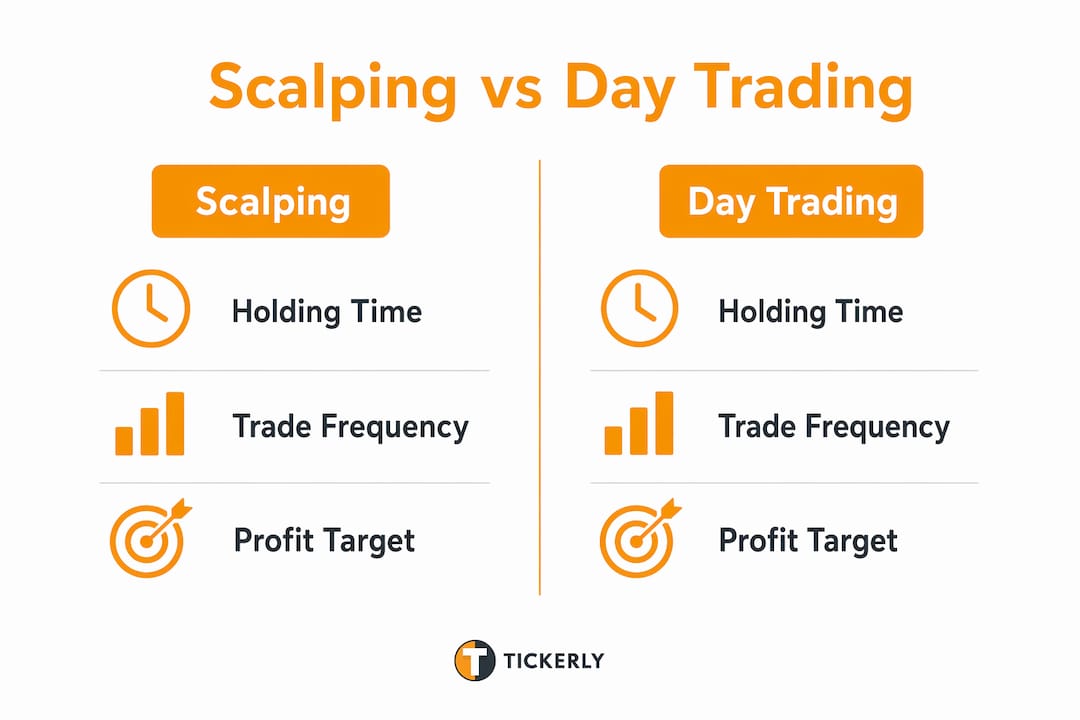
Scalping and day trading are often used interchangeably, but they describe meaningfully different approaches. Both close all positions before the end of the session, but the similarities largely stop there.
| Factor | Scalping | Day Trading |
|---|---|---|
| Holding time | Seconds to 15 minutes | Minutes to several hours |
| Trades per day | Dozens to hundreds | Typically 2 to 10 |
| Profit target per trade | 0.05% to 0.5% | 0.5% to 3% or more |
| Risk per trade | Very tight stop-loss | Wider stop-loss tolerance |
| Skill requirement | Extreme speed and focus | Market analysis and patience |
| Automation reliance | High | Moderate |
Scalping differs from day trading primarily in trade frequency, holding time, and profit targets, with scalping operating on much shorter timeframes. A day trader might spend 20 minutes analyzing a setup before entering. A scalper cannot afford that luxury. The decision window is measured in seconds.
Swing trading sits even further from scalping on the spectrum. Swing traders hold positions for days or weeks, absorbing larger price swings in exchange for fewer, larger gains. The comparison between day trading and swing trading clarifies that each style demands a different temperament. Scalping specifically rewards traders who thrive under pressure, process information fast, and can detach emotionally from rapid losses and wins alike.
What are the most common scalping strategies?
Scalping is not a single technique. It is a category of approaches, each exploiting a different aspect of market microstructure or price behavior. The common scalping techniques include market making, breakout, momentum, mean reversion, and Level II order-flow scalping.
Here is how each one works in practice:
-
Market making. The trader simultaneously posts a bid and an ask, profiting from the spread. This is primarily the domain of institutional desks and algorithmic systems, not retail traders.
-
Breakout scalping. You identify a consolidation zone on a 1-minute chart and enter the moment price breaks above resistance or below support. The target is a quick move of 5 to 10 pips or ticks before price retraces.
-
Momentum scalping. This technique follows a strong directional move, entering after a brief pullback and riding the continuation. It works best during high-volume periods like market open or major news releases.
-
Mean reversion scalping. When price moves sharply away from a short-term moving average, you fade the move, expecting a snap back. This requires tight stops because momentum can extend further than expected.
-
Level II and order-flow scalping. Advanced traders read the order book directly, spotting large limit orders that act as support or resistance. Scalping profits depend on execution quality and order-flow cues more than on directional prediction.
Breakout and momentum scalping are the most accessible for beginners. Mean reversion and order-flow approaches require deeper market knowledge and faster infrastructure. For traders new to forex scalping strategies, starting with breakout setups on major currency pairs like EUR/USD or GBP/USD gives you the liquidity and data history needed to refine your edge.
Pro Tip: Avoid trading more than two instruments simultaneously when you start scalping. Cognitive load multiplies fast, and splitting attention across multiple charts degrades execution quality on all of them.
How to implement scalping strategies effectively
Knowing the theory is only half the equation. Execution is where scalping is won or lost. Here is a structured approach to putting scalping into practice:
-
Choose the right market and session. Forex pairs like EUR/USD during the London or New York session, or crypto assets like Bitcoin during peak volume hours, offer the liquidity scalping requires. Thin markets punish scalpers with wide spreads and erratic fills.
-
Define your rules before the session starts. Scalping demands speed, precision, and discipline, and missed exits quickly undo small gains. Write down your entry trigger, stop-loss level, and profit target before the market opens. Improvising mid-trade is how small losses become large ones.
-
Set hard stop-losses on every trade. A scalper’s stop-loss is typically 3 to 10 pips or ticks, depending on the instrument. Never widen a stop because price is “almost there.” That thinking is incompatible with scalping.
-
Control transaction costs aggressively. Commission structures, spreads, and slippage are your primary cost centers. Use a broker with raw spreads and low per-trade commissions. Calculate your break-even cost per trade and factor it into your profit target.
-
Use automation to maintain consistency. High cognitive load in scalping often necessitates rule-based automation. Manual execution across 50 or 100 trades per session introduces fatigue-driven errors. Automated alerts and bot execution remove that variable. Tools that connect TradingView strategies directly to exchange APIs, like Tickerly, let you automate trade exits with precision and speed that manual clicking cannot match.
-
Review every session. Log your trades, note your average slippage, and track which setups performed. Scalping edges erode over time as market conditions shift. Continuous review is how you detect that erosion before it damages your account.
Pro Tip: Set a hard daily loss limit equal to your average winning session. If you hit it, stop trading. Scalpers who chase losses after a bad run typically turn a manageable drawdown into an account-threatening one.
Key takeaways
Scalping is a high-frequency trading strategy that succeeds or fails on execution quality, cost management, and disciplined rule-following rather than on market prediction.
| Point | Details |
|---|---|
| Core definition | Scalping captures small, repeated price moves across many trades per session. |
| Liquidity is non-negotiable | Tight spreads and deep liquidity are required to keep transaction costs below profit targets. |
| Scalping vs day trading | Scalping holds positions seconds to 15 minutes; day trading holds minutes to hours with fewer, larger targets. |
| Strategy selection | Breakout and momentum techniques suit beginners; order-flow scalping requires advanced infrastructure. |
| Automation is a force multiplier | Rule-based bots reduce cognitive fatigue and execution errors across high-frequency sessions. |
Why I think most traders underestimate what scalping actually demands
Scalping should be a shortcut to fast profits, I can tell you the reality is almost the opposite. Scalping is one of the most demanding disciplines in trading, not because the concepts are complex, but because the execution window is brutally unforgiving.
The cognitive load is real. Executing many decisions per hour requires a level of mental stamina that most traders do not anticipate until they are three hours into a session and making sloppy entries. The traders I have seen succeed at scalping long-term are not necessarily the smartest analysts. They are the most disciplined rule-followers.
Automation has genuinely changed the calculus here. When you remove the manual click from the equation and let a bot execute your TradingView Pine Script signal in milliseconds, you eliminate a category of error that compounds across hundreds of trades. That is not a minor improvement. It is a structural advantage. The trading rules foundation matters more in scalping than in any other style because there is no time to deliberate.
My honest advice: treat scalping as a craft that requires months of deliberate practice, not a technique you deploy after reading one article. Start with a single setup, one instrument, and a demo account. Build your edge before you risk real capital.
— Jay
Take your scalping further with Tickerly
Scalping rewards speed above almost everything else. Manual execution across dozens of trades per session introduces latency and human error that compound directly into your P&L. Tickerly converts your TradingView strategies into fully automated trading bots that execute on connected exchanges with near-zero delay, no hesitation, and no emotional interference.
Whether you are running a breakout strategy on crypto or a momentum setup on forex, Tickerly handles execution while you focus on strategy refinement. It supports multiple strategies simultaneously across different markets, so your scalping edge is not limited by how fast you can click. Explore automated trading bots and see how automation transforms scalping from a high-stress manual process into a disciplined, repeatable system. You can also review the full list of supported exchanges to confirm your preferred market is covered.
FAQ
What is scalping in trading, in simple terms?
Scalping is a trading strategy where you open and close positions within seconds to minutes, targeting very small price gains that add up across many trades in a single session. It relies on high trade frequency rather than large individual profits.
Is scalping profitable for retail traders?
Scalping can be profitable, but success depends on tight cost management, fast execution, and strict discipline. Transaction costs like spreads, commissions, and slippage can quickly erase gains if not controlled, making broker selection and execution speed critical factors.
What are the best markets for scalping?
Forex pairs like EUR/USD and GBP/USD, major crypto assets like Bitcoin, and highly liquid equities are the best markets for scalping. These instruments offer the tight spreads and deep liquidity that scalping requires to keep costs below profit targets.
How is scalping different from day trading?
Scalping holds positions for seconds to 15 minutes and executes dozens to hundreds of trades per day, while day trading holds positions for minutes to hours with far fewer trades and larger profit targets per position.
Do I need automation to scalp effectively?
Automation is not strictly required, but it provides a significant edge. High cognitive load across many rapid decisions leads to execution errors and fatigue. Rule-based bots connected to platforms like TradingView execute signals faster and more consistently than manual trading allows.