

TL;DR:
- Trading fees include both explicit costs like commissions and regulatory charges, and implicit costs such as spreads and slippage. Managing both is essential to accurately assessing your total trading expenses and optimizing your strategy.
Trading fees are the charges imposed by brokers and trading venues every time you buy or sell a security, and they include both explicit costs you see on your statement and implicit costs buried in your execution price. Most traders focus on commissions, but the full picture of trading costs spans regulatory charges, spreads, slippage, and margin interest. Brokers like Alpaca, Fidelity and Charles Schwab have eliminated stock commissions, yet fees persist in other forms. Understanding what are trading fees in their entirety is the difference between a strategy that looks profitable on paper and one that actually is.
What are the main types of trading fees?
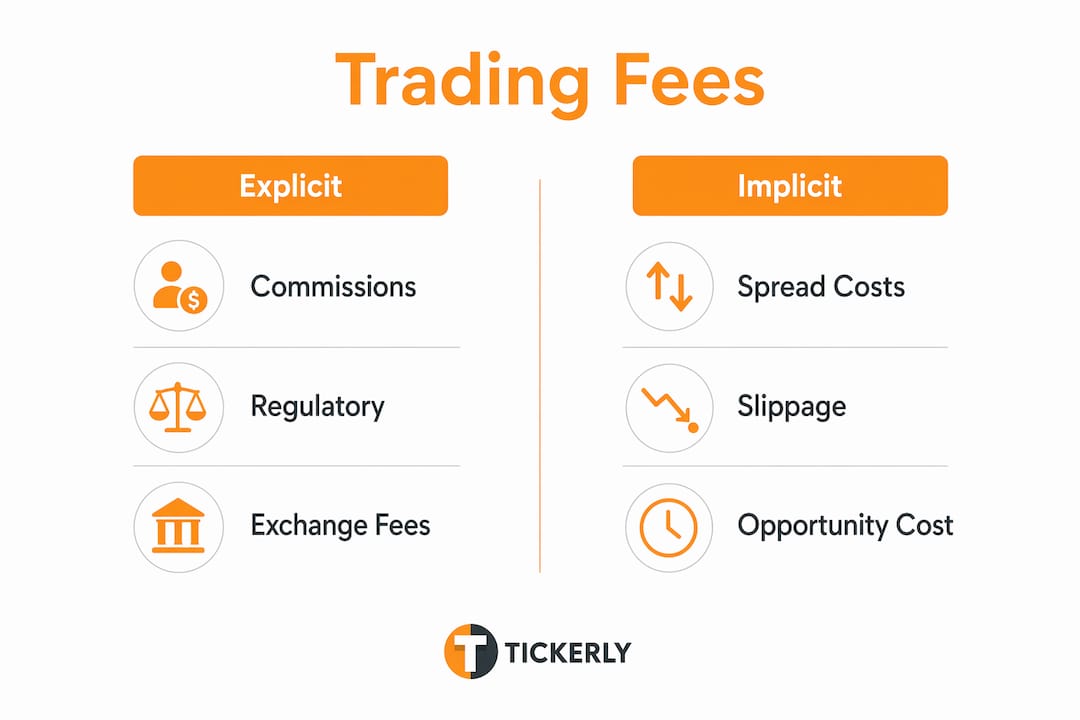
Trading fees consist of two broad categories: explicit fees that appear on invoices and fee schedules, and implicit fees you infer by comparing expected versus actual execution prices. Both categories reduce your net returns, and ignoring either one distorts your true trading costs.

Explicit fees
Explicit fees are the charges you can read directly from a broker’s fee schedule or your trade confirmation. They include:
-
Commissions: The per-trade charge your broker collects. Stock and ETF commissions at major U.S. brokers have moved to $0, but options still carry per-contract fees.
-
Exchange and clearing fees: Charges from the venue where your order executes and the clearinghouse that settles it.
-
Regulatory fees: The SEC Section 31 fee and the FINRA Trading Activity Fee (TAF). These apply on the sell side and are often passed through to you by your broker.
-
Per-contract options fees: Options fees range from $0 to $1.00 per contract, depending on the broker. Robinhood and Webull charge $0 per contract; most full-service brokers average $0.65 per contract.
-
Maker/taker fees (crypto): Crypto exchanges like Binance charge 0.075% for both makers and takers. Coinbase’s Simple platform charges 0.6% for makers and 1.2% for takers. Maker orders pay lower fees because they add liquidity; taker orders pay more because they consume it.
-
Margin interest: If you trade on borrowed capital, margin interest is an ongoing explicit cost. Margin rates range from 5.83% to around 12% annually. On a $50,000 margin balance, the difference between the lowest and highest rate can exceed $3,000 per year.
Implicit fees
Implicit fees do not appear on any invoice. You estimate them by analyzing execution quality.
-
Spread costs: The difference between the bid and ask price. Every market order you place crosses this spread, and you absorb it immediately.
-
Slippage: The gap between the price you expected and the price you received. Slippage is common in fast markets or with large orders in thin assets.
-
Market impact: Large orders move the price against you as they fill. This is most relevant for institutional-sized trades but affects active retail traders in low-liquidity instruments.
Pro Tip: Check your trade confirmations against the quoted price at the time of your order. The gap between those two numbers is your realized slippage, and it compounds quickly across dozens of trades per week.
| Fee Type | Category | Typical Range |
|---|---|---|
| Stock commission | Explicit | $0 at most major brokers |
| Options per-contract fee | Explicit | $0–$1.00 per contract |
| Crypto maker fee (Binance) | Explicit | 0.075% |
| Crypto taker fee (Coinbase Simple) | Explicit | 1.2% |
| Margin interest | Explicit (recurring) | 5.83%–12% annually |
| Bid-ask spread | Implicit | Varies by asset and liquidity |
| Slippage | Implicit | Varies by order size and market |
How do trading fees differ by broker type and asset class?
Fee structures vary significantly depending on whether you use a discount broker, a full-service firm, or a crypto exchange. The asset class you trade also determines which fee types apply.
Stocks and ETFs at discount brokers like Fidelity, Schwab, and TD Ameritrade now carry $0 commissions per trade. That shift has been real and meaningful for long-term investors. Active traders, however, still face spread costs, regulatory fees, and potentially payment for order flow effects on execution quality.
Options remain the one major asset class where per-contract fees persist across nearly every broker. At $0.65 per contract, a 10-contract trade costs $6.50 in explicit fees before you account for the spread. High-frequency options traders can accumulate hundreds of dollars in contract fees weekly.
Mutual funds and ETFs carry expense ratios as ongoing costs distinct from trading commissions. Equity mutual funds average 0.40% annually, while index equity ETFs average just 0.14%. These fees are deducted from fund assets daily, so they reduce your returns even if you never place a trade.
Crypto exchanges use maker/taker models that reward liquidity providers. If you place limit orders that sit in the order book, you pay maker rates. If you place market orders that execute immediately, you pay taker rates. Taker rates are consistently higher, which means aggressive market orders cost more on every crypto platform.
Pro Tip: If you trade options frequently, the per-contract fee matters more than the commission headline. A broker advertising $0 commissions but charging $1.00 per contract costs more than a broker charging $0.65 per contract on a 20-lot trade.
| Asset Class | Common Fee Type | Typical Cost |
|---|---|---|
| Stocks/ETFs | Commission | $0 at major discount brokers |
| Options | Per-contract fee | $0–$1.00 per contract |
| Mutual funds | Expense ratio | ~0.40% annually |
| Index ETFs | Expense ratio | ~0.14% annually |
| Crypto (taker) | Maker/taker fee | 0.075%–1.2% per trade |
| Margin trading | Interest rate | 5.83%–12% annually |
What are the most overlooked trading fees?
The fees traders miss most often are the ones that do not appear as line items on a trade confirmation. These indirect costs can quietly erode profitability over time.
Regulatory fees are charged on the sell side and change annually. Starting April 4, 2026, the SEC Section 31 fee increased to $20.60 per million dollars of transactions. That rate applies on your trade date, not your settlement date. Most traders never check the current rate and use outdated assumptions when calculating costs.
Payment for order flow (PFOF) is how many zero-commission brokers actually earn revenue. Your broker routes your order to a market maker who pays for that flow. The market maker profits from the spread, which means you may receive slightly worse execution than you would on a lit exchange. The cost is invisible but real.
“Total trading friction should be considered holistically; the cheapest broker depends on your trading style and how spreads, commissions, and other fees combine cumulatively.” — Broker Fees Analysis 2026
Other commonly missed fees include:
-
Inactivity fees: Some brokers charge monthly or quarterly fees if you do not meet a minimum trade count or account balance.
-
Overnight swap fees (forex and CFDs): Holding a leveraged position past the daily rollover incurs a swap charge. These compound daily and can exceed the trade’s profit on multi-day holds.
-
Currency conversion fees: Trading assets denominated in a foreign currency triggers a conversion charge, often 0.5%–1.5% per transaction.
-
Hidden commissions in “zero spread” accounts: Only 26% of brokers offer truly commission and spread-free trading. Brokers advertising zero spreads often charge per-trade commissions instead. The total cost is similar or higher.
The practical fix is to calculate your total round-turn cost: spread plus commission plus any overnight fees for the full open-and-close cycle. That number tells you what a trade actually costs, not just what the headline fee says. You can use a forex margin calculator to model how margin costs compound across different rate scenarios before you commit capital.
How to calculate and manage your trading fees
Accurately estimating your total trading costs requires separating three distinct cost buckets. Building a fee model that separates explicit and implicit costs avoids double counting and clarifies where your real friction sits.
-
Tally explicit per-trade fees. Pull your broker’s published fee schedule. For each trade, add the commission, any per-contract fee, and the applicable regulatory charges. Your trade confirmation should itemize these. If it does not, contact your broker for a fee breakdown.
-
Add recurring explicit fees. If you use margin, calculate your daily interest charge by dividing your annual margin rate by 365 and multiplying by your borrowed balance. Do this for every day you hold a leveraged position. Track this separately from per-trade fees because it scales with time, not trade count.
-
Estimate implicit execution costs. Compare the mid-price of the asset at the moment you placed your order against your actual fill price. The difference is your combined spread cost and slippage. Average this across 20–30 trades to get a reliable per-trade implicit cost estimate. For a deeper look at analyzing real trading costs, including slippage patterns, reviewing your execution data by order type is the most direct method.
-
Evaluate broker fit against your trading style. A high-volume day trader placing 50 trades per day needs near-zero spreads and fast execution. A swing trader holding positions for days cares more about overnight swap rates and margin interest. The broker with the lowest advertised fee is rarely the cheapest for every trading style.
-
Optimize order types to reduce implicit costs. Limit orders control your entry price and eliminate slippage on the entry side. Using limit orders instead of market orders on liquid assets is one of the most direct ways to cut implicit costs without changing brokers.
Pro Tip: Run a 30-day fee audit. Export your trade history, calculate total explicit fees paid, and estimate implicit costs using mid-price comparisons. Most active traders are surprised by how much implicit costs exceed their commissions.
Key takeaways
Trading fees combine explicit charges you can schedule and implicit execution costs you must estimate, and managing both is the only way to accurately measure your true cost per trade.
| Point | Details |
|---|---|
| Two cost categories | Every trade carries explicit fees (commissions, regulatory charges) and implicit fees (spread, slippage). |
| Zero commissions ≠ zero cost | Stock commissions are $0 at major brokers, but options, spreads, and margin interest still apply. |
| Regulatory fees change | The SEC Section 31 fee rose to $20.60 per million in April 2026; always check the current rate. |
| Implicit costs compound | Spread and slippage often exceed commissions for active traders; estimate them from execution data. |
| Broker fit matters | The cheapest broker depends on your asset class, trade frequency, and use of margin. |
The fee reality most traders ignore
Traders obsess over commissions and ignore everything else. The move to $0 stock commissions was genuinely good news. But it also gave many traders a false sense that trading became free. It did not.
What actually happened is that broker revenue shifted. Margin interest, payment for order flow, and spread widening picked up the slack. The shift to zero commissions changed where the cost sits, not whether it exists. I have seen traders rack up more in margin interest over a single month than they paid in commissions over an entire year of active trading.
The other thing I would push back on is the assumption that a lower headline fee always means lower total cost. A broker charging $0 commissions with wide spreads and aggressive PFOF routing can cost you more per trade than a broker charging $0.65 per contract with tighter execution. You cannot know which is cheaper without running the numbers on your actual order flow.
My honest recommendation: treat your trading fees as a business expense line. Audit them quarterly. Separate explicit from implicit costs. And stay current on regulatory changes like the 2026 Section 31 adjustment, because those numbers shift without much fanfare and affect every sell-side transaction you make.
— Jay
How automated trading can help you manage execution costs
Execution timing is one of the biggest drivers of implicit trading costs. Manual traders often enter at suboptimal prices simply because they react too slowly to market conditions. Tickerly’s automated trading bots execute your TradingView strategies the moment conditions are met, reducing the latency between signal and fill.
Faster execution means less slippage on entries and exits. Tickerly connects directly to supported exchanges via API, bypassing the manual steps that introduce delay. For active traders in crypto, forex, and stocks, that speed advantage compounds across every trade in your strategy. If you are already working to understand and reduce your trading fees, automating your execution is the logical next step toward tighter cost control.
FAQ
What are trading fees in simple terms?
Trading fees are the costs you pay to buy or sell a financial asset. They include explicit charges like commissions and regulatory fees, plus implicit costs like the bid-ask spread and slippage.
Are trading fees worth it for small accounts?
For small accounts, fees have a proportionally larger impact on returns. Choosing brokers with $0 stock commissions and low expense ratio ETFs minimizes cost drag when capital is limited.
How do crypto trading fees differ from stock trading fees?
Crypto exchanges use a maker/taker model where takers pay higher fees than makers. Binance charges 0.075% for both; Coinbase Simple charges up to 1.2% for takers, compared to $0 commissions for stocks at most U.S. brokers.
What is the SEC section 31 fee and who pays it?
The SEC Section 31 fee is a regulatory charge applied on the sell side of securities transactions. Starting April 4, 2026, the rate is $20.60 per million dollars of transactions, and brokers typically pass this cost to the seller.
How do i reduce my total trading fees?
Use limit orders to control entry prices and reduce slippage, select a broker whose fee structure matches your trading style and volume, and audit margin interest separately from per-trade commissions to see your true total cost.