

TL;DR:
- A trading journal records every trade, including reasoning, emotions, and rule adherence, improving performance. Consistent journaling reveals behavioral patterns, enhances discipline, and helps identify strengths and weaknesses over time. Using simple tools and immediate logging fosters habits that maximize long-term trading success.
A trading journal is a systematic record of every trade you take, capturing not just profit and loss but the reasoning, emotional state, and rule adherence behind each decision. Traders who use structured journals consistently outperform those who rely on memory alone. Tools like Edgewonk, TraderSync, and Journali have made this practice more accessible than ever. This trading journal guide walks you through exactly what to record, which tools to use, how to build a review habit, and the mistakes that kill most journaling attempts before they start.
What should you record in a trading journal?
A trading journal is more than a P&L ledger. It is a behavioral and psychological record that reveals the recurring patterns driving your results, both good and bad.
The seven critical fields to capture per trade are:
-
Date and time of entry and exit
-
Instrument traded (e.g., BTC/USD, EUR/USD, AAPL)
-
Direction (long or short)
-
Entry and exit price with position size
-
P&L in both dollar and percentage terms
-
Pre-trade thesis: why you took the trade and which setup triggered it
-
Process score: a rating of how well you followed your rules, tracked separately from the outcome
Beyond these core fields, two qualitative notes matter enormously. First, log your emotional state before and during the trade. Were you confident, anxious, or revenge trading after a loss? Second, write a post-trade reflection covering what went right, what went wrong, and whether you followed your plan.
Focusing on quality data beats chasing quantity. Starting with just 5 core fields prevents the data overload that causes most beginners to quit within weeks. Once the habit is solid, you can expand your template.
Pro Tip: Rate your process score on a 1–5 scale immediately after closing a trade. This single metric, tracked over 50+ trades, will show you whether your losses come from bad setups or poor execution of good setups.
Manual vs. software: how to choose the right tool
The right journaling tool depends on your trading frequency, technical comfort, and how much time you want to spend on data entry.

| Method | Best For | Key Advantage | Key Drawback |
|---|---|---|---|
| Notebook | Low-frequency traders | Zero cost, tactile reflection | No data analysis possible |
| Google Sheets / Excel | Beginners to intermediate | Fully customizable templates | Manual entry, formula errors |
| Edgewonk | Intermediate to advanced | Deep behavioral analytics | Learning curve, paid subscription |
| TraderSync | Active stock and options traders | Broker sync, performance reports | Monthly fee |
| Journali | Crypto and multi-asset traders | Auto-tagging, math automation | Newer platform, smaller community |
Manual spreadsheets work well when you take fewer than 10 trades per week. Google Sheets and Excel give you full control over your trading journal templates, and the setup cost is zero. The tradeoff is time. Every field requires manual input, and errors compound quickly.
Dedicated software changes the equation significantly. Automated journaling platforms like Journali handle math and tagging automatically, freeing up trader time and reducing entry errors. The best tools in 2026 sync automatically with brokers, cutting manual entry time by up to 90%. Pricing for pro tiers runs $14–$30 per month, which is a small cost relative to the edge you gain.
The expert consensus is clear: the best journal is the one you use consistently. A simple spreadsheet you fill out every day beats a sophisticated platform you abandon after two weeks. Start with the tool that creates the least friction for your current workflow, then upgrade as your data needs grow.
For traders already using TradingView, exploring journal automation options that connect directly to your alert and strategy data can eliminate most manual work entirely.
How to build a journaling habit that actually sticks
Consistency is the only variable that determines whether your journal produces results. A journal you check once a month is a diary. A journal you review weekly is a performance system.
Maintaining a professional trading journal takes roughly 3 hours per week. That breaks down into 3–5 minutes for the initial trade entry, 2–3 minutes for post-trade reflection, and 30–60 minutes for a structured weekly review. That time investment is modest relative to the edge it builds.
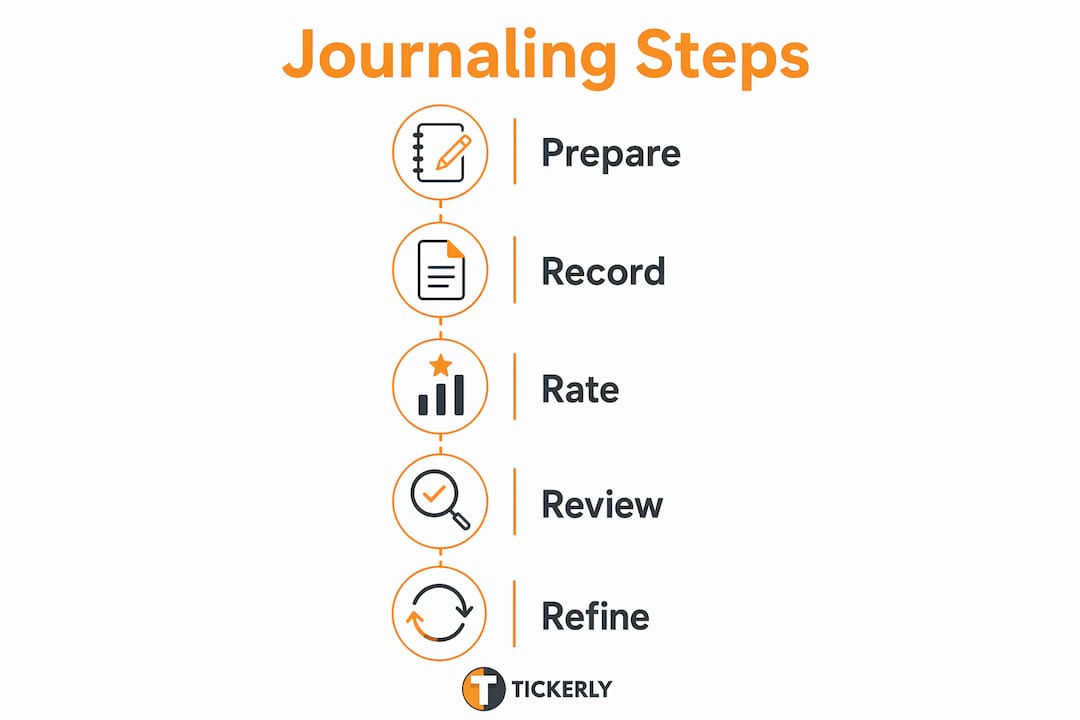
Here is a step-by-step journaling routine that works:
-
Log immediately after closing. Logging trades right after closure preserves the emotional context and rationale that memory erodes within hours. Set a 5-minute timer as a hard rule.
-
Schedule your weekly review. Block 30–60 minutes every Sunday or Monday morning. Treat it like a non-negotiable appointment, not an optional task.
-
Run a monthly deep analysis. A tiered review process that includes a focused monthly look at your 3 best and 3 worst trades produces the clearest performance insights.
-
Focus reviews on mistake patterns. Patterns in mistakes are more predictive of future improvement than cataloging wins. Ask: “What did my losing trades have in common?”
-
Use calendar reminders. Automation removes the decision fatigue of remembering to journal. Set recurring reminders for both daily logging and weekly reviews.
Pro Tip: Create a “minimum viable entry” for high-activity days. If you took 8 trades and are mentally drained, log just the instrument, direction, P&L, and one sentence on process adherence. A partial entry beats no entry.
The habit compounds over time. After 3 months of consistent entries, you will have enough data to identify your highest-probability setups, your worst behavioral patterns, and the market conditions where your edge disappears. That knowledge is worth more than any indicator.
What are the most common trading journal mistakes?
Most traders start journaling with good intentions and quit within 30 days. The failure points are predictable, and each one has a direct fix.
-
Tracking too many fields too early. Beginners who try to log 15+ data points per trade burn out fast. Data overload causes most beginners to quit before the habit forms. Fix: start with 5 fields and add complexity only after 30 consistent days.
-
Logging trades hours or days later. Delayed logging destroys accuracy. The timing of logging immediately after trade closure is critical because recall bias distorts both the emotional record and the rationale. Fix: log within 5 minutes of closing every position.
-
Judging trades by outcome instead of process. A trade that followed your rules perfectly but lost money is a good trade. A trade that violated your rules but made money is a bad trade. A good trade is defined by process adherence, not by the P&L. Fix: track your process score separately and review it independently of returns.
-
Skipping journaling during losing streaks. This is the most damaging mistake. Losing streaks are exactly when your journal is most valuable. They contain the behavioral data that explains why you are losing. Fix: make journaling non-negotiable regardless of performance.
-
Overtrading without noticing the pattern. Traders making 15 or more trades daily often see performance drop after the 3rd or 4th trade. Your journal will surface this pattern if you track time-of-day and trade sequence. Fix: review your P&L by trade number within each session.
“The journal does not judge you. It just shows you the truth about your trading. The traders who improve fastest are the ones willing to look at that truth honestly.” — Trading Journal: The Complete System
Understanding overtrading patterns is one of the most direct benefits a structured journal delivers, especially for active day traders in crypto and forex.
Key takeaways
A trading journal works because it separates process adherence from outcomes, revealing the behavioral patterns that determine long-term profitability.
| Point | Details |
|---|---|
| Start with 5 core fields | Track date, instrument, direction, P&L, and thesis to build the habit without burnout. |
| Log immediately after closing | Capturing emotional context within 5 minutes prevents recall bias and incomplete records. |
| Separate process from outcome | Rate rule adherence independently of P&L to build real discipline over time. |
| Use tiered reviews | Run weekly pattern checks and monthly deep dives on your 3 best and 3 worst trades. |
| Choose consistency over complexity | A simple spreadsheet used daily outperforms sophisticated software used occasionally. |
Why i think most traders journal the wrong way
The psychological benefit is underrated in most trading journal guides. Accountability to your own written record changes how you take trades. You start asking, “Would I be comfortable writing this down?” before entering. That question alone eliminates a surprising number of impulsive trades.
My current setup uses automation to pull trade data directly from my TradingView alerts, which means I spend zero time on data entry and all my review time on analysis. If you are serious about evaluating your trading results with real depth, that shift from manual entry to automated capture is the single biggest efficiency gain available to active traders today.
Start simple. Be honest. Review consistently. The edge you are looking for is already in your trade history.
— Jay
Take your journal further with Tickerly
Journaling manually works, but it has a ceiling. Every minute you spend on data entry is a minute you are not spending on analysis.
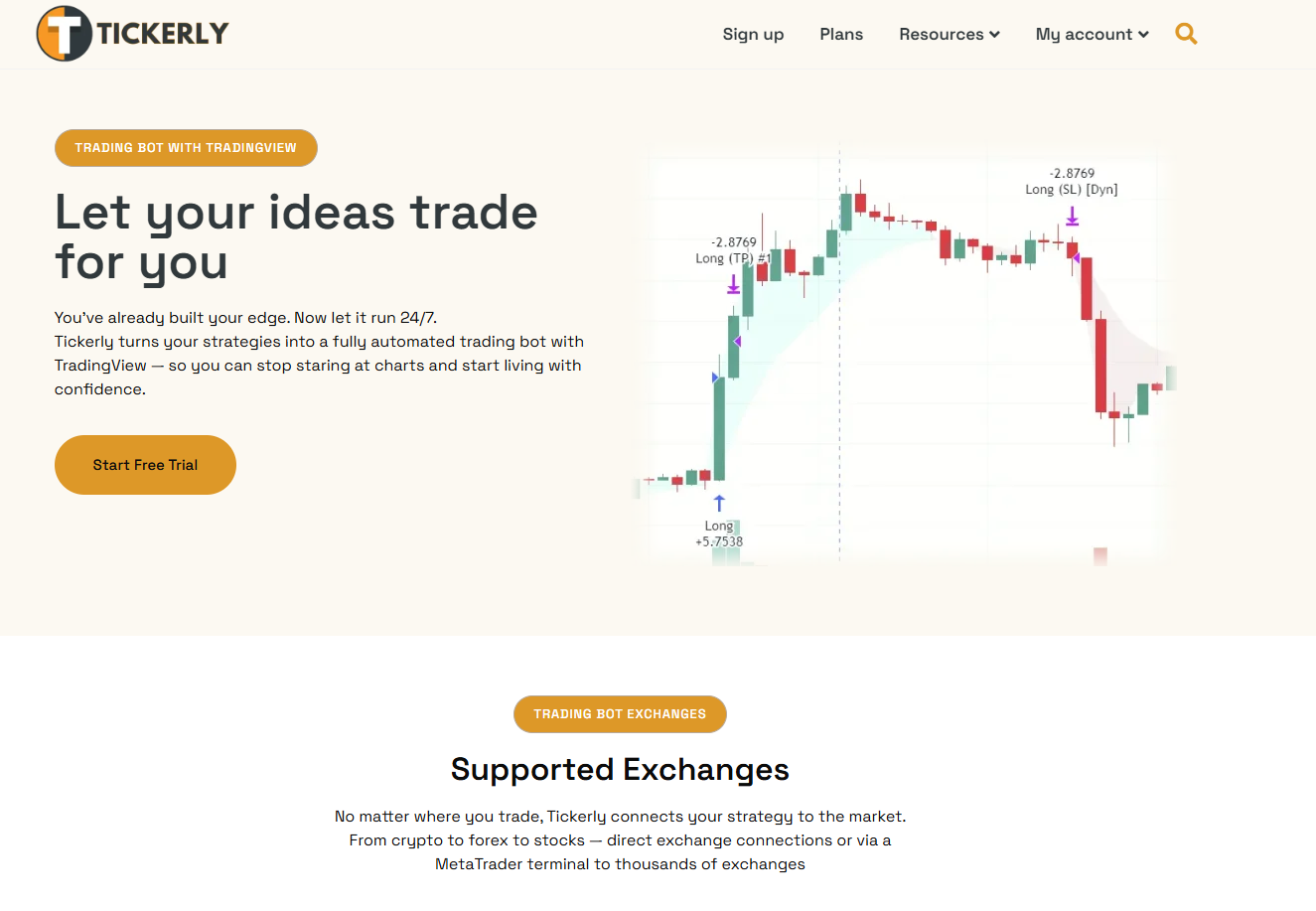
Tickerly connects your TradingView strategies directly to live trading bots, and its alert log captures every signal and execution automatically. That means your journal data is always complete, timestamped, and accurate without any manual input. For active traders running multiple strategies across crypto, forex, or stocks, this removes the single biggest friction point in consistent journaling. Explore how Tickerly’s automation can turn your TradingView edge into a fully documented, continuously running trading operation.
FAQ
What is a trading journal?
A trading journal is a structured record of every trade you take, capturing entry and exit data, trade rationale, emotional state, and process adherence. It functions as both a performance database and a behavioral accountability tool.
How many fields should a beginner track?
Beginners should start with 5 core fields: date, instrument, direction, P&L, and pre-trade thesis. Adding more fields too early causes data overload and kills the habit before it forms.
How often should you review your trading journal?
Run a 30–60 minute review weekly to spot short-term patterns, and a deeper monthly analysis focused on your 3 best and 3 worst trades to identify behavioral trends.
What is the best trading journal software in 2026?
Edgewonk, TraderSync, and Journali are the leading options in 2026. The best choice depends on your asset class and whether you need broker sync. Pricing ranges from free basic tiers to $14–$30 per month for pro features.
Should you journal trades that break your rules?
Yes, especially those trades. Rule-breaking entries reveal the behavioral triggers behind your worst losses and are the most valuable data in your entire journal.