

Scalping is the art of making dozens of small, precise trades every session, capturing gains of just $0.05 to $0.25 per share while holding positions for seconds to minutes. The appeal is obvious. The execution, however, is where most traders fall apart. You can understand a scalping strategy step by step on paper and still blow up your account because you entered late, ignored the spread, or let one bad trade turn into three. This guide covers every phase of the process: preparation, execution, risk controls, and the advanced tools that separate consistent scalpers from frustrated ones.
Table of Contents
Key takeaways
| Point | Details |
|---|---|
| Preparation comes first | Confirm session timing, spread conditions, and risk limits before placing a single trade. |
| Execution precision wins | Tape reading and Level 2 data matter more than indicator signals for timing your entries. |
| Risk per trade stays tiny | Cap each trade at 0.1% to 0.25% of capital with a hard stop loss, no exceptions. |
| Routine prevents overtrading | Set a daily max of 3 to 5 setups and stop trading after hitting your loss limit. |
| Automation adds consistency | Algorithmic tools execute rules precisely and remove emotional decision-making from the equation. |
Setting up your scalping strategy step by step
Before you place a single order, your environment needs to be right. Scalping demands infrastructure that most traders underestimate until they watch a profitable setup evaporate because their order filled 0.3 seconds too late.
Platform and tools you actually need
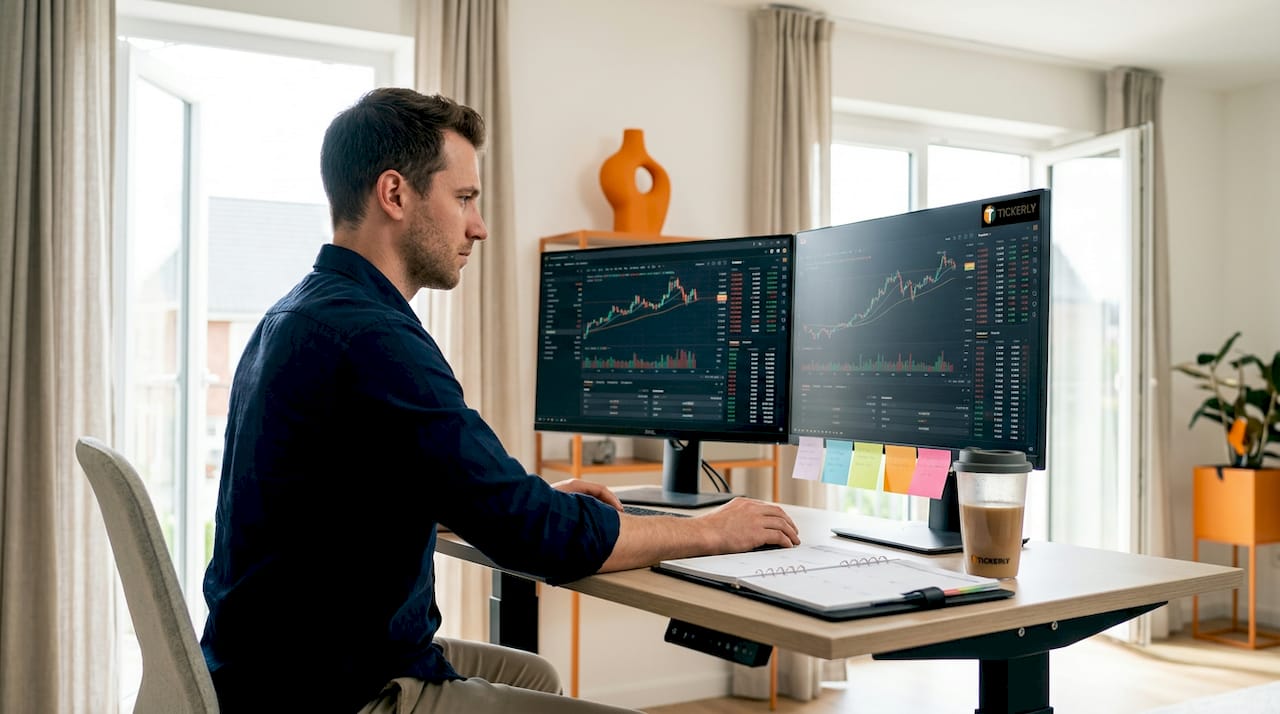
Retail scalpers rely on Level 2 order book data, hotkeys, tape reading, and fast executions as non-negotiable features. A standard retail brokerage interface built for long-term investors will not cut it. You need direct market access, a platform that shows time-and-sales data in real time, and the ability to execute orders with a single keystroke.
Here is your pre-trade readiness checklist before every session:
-
Session timing: Trade during peak liquidity windows. For forex, that means the London and New York overlap (8 AM to 12 PM EST). For equities, focus on the first and last 30 minutes of the regular session.
-
Spread filter: If the bid-ask spread is wider than your target profit on that instrument, skip it entirely. A wide spread is a guaranteed loss before the trade even moves.
-
Risk limits confirmed: Know your max loss for the session before you open the platform, not after your third bad trade.
-
Momentum context: Check the daily chart to understand whether the asset is trending or ranging. Scalping works best when there is a directional bias.
-
Max trade cap: A pre-trade checklist should include a hard cap of 3 to 5 setups per session to prevent overtrading.
-
Hardware check: Confirm your internet connection, data feed, and hotkey bindings are working before the open.
Pro Tip: Set your stop loss and position size in advance using a calculator or spreadsheet. Doing math in the middle of a fast-moving market leads to sizing errors that wipe out your session’s edge.
How to execute a scalping trade
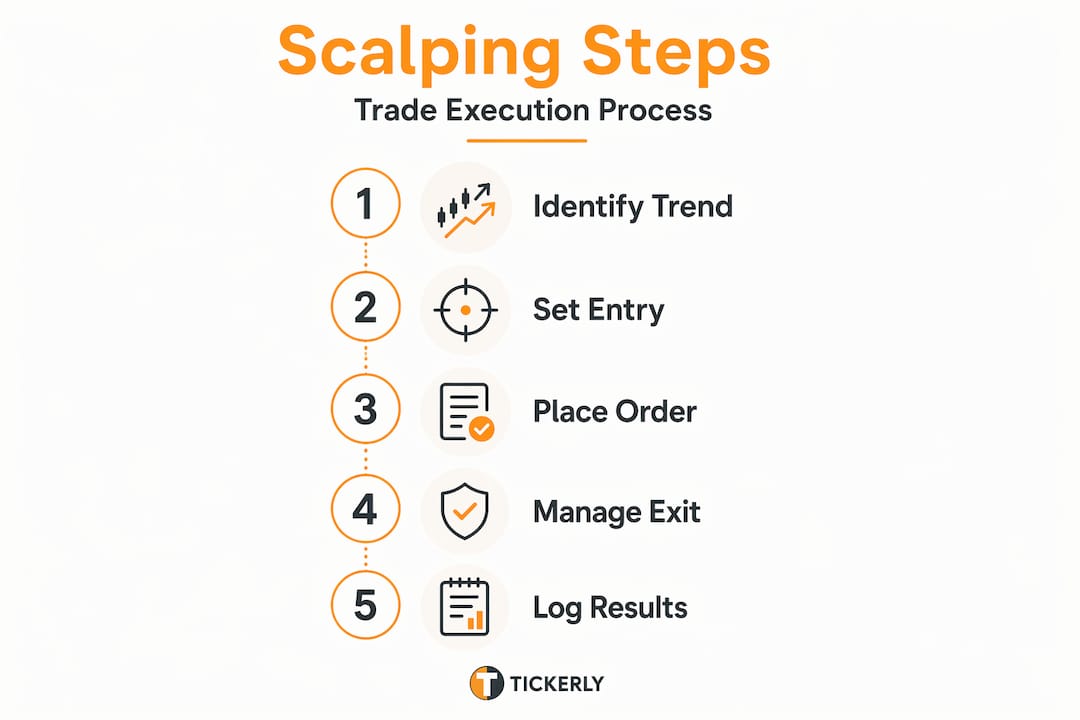
This is the core process. Every step matters and skipping one typically means a losing trade. Scalping targets holding times of 10 seconds to 5 minutes, which means there is no room for hesitation once a setup triggers.
-
Identify the short-term trend. Open your 1-minute and 5-minute charts. Look for price consistently above or below a 20-period and 50-period EMA. A 15-minute scalping setup uses price above EMA 20 and EMA 50 as a prerequisite for long trades. Apply the same logic to your shorter timeframe confirmation.
-
Wait for a pullback to a value zone. Do not chase price. Wait for a retracement to the EMA 20 or a recognized support/resistance level. This keeps your stop loss tight and your reward-to-risk ratio favorable.
-
Confirm momentum with RSI or Stochastic. Before entering, check that RSI is above 50 for longs (or below 50 for shorts) and that Stochastic is not in an extreme overbought zone. These indicators do not predict direction. They confirm that momentum supports your trade thesis.
-
Wait for a trigger candle. You need a specific entry signal, not just a feeling. Look for a bullish engulfing candle, a pin bar rejection at your value zone, or a breakout candle closing above a resistance level with volume expansion.
-
Enter with a hotkey. Speed is critical. Volume acceleration and tape reading tell you when supply or demand is shifting. When you see prints speeding up in your direction, execute immediately. One second of hesitation can be the difference between a clean entry and a chasing trade.
-
Set your stop loss and take profit instantly. Place your stop loss below the swing low (for longs) or above the swing high (for shorts). Use a minimum 1:1.5 reward-to-risk ratio. On a $0.10 stop, your target is at least $0.15.
-
Exit at your target or stop, no negotiation. Moving your stop loss because you “feel” the trade will come back is how small losses become large ones. If price hits your stop, the trade is closed.
| Step | Action | Key Tool |
|---|---|---|
| Trend identification | EMA 20 and EMA 50 on 1-minute chart | Charting platform |
| Entry confirmation | RSI above 50, Stochastic not overbought | Momentum indicators |
| Trigger | Engulfing candle or breakout with volume | Candlestick + tape |
| Execution | Hotkey order entry | Direct market access |
| Exit | Predefined stop loss and take profit | Order management |
Pro Tip: If you miss the ideal entry by more than a few ticks, skip the trade entirely. Forcing a late entry shifts your risk-reward against you before the position opens.
Risk management and building a routine
Execution skill means nothing without a risk framework that keeps you in the game long enough to profit from it.
The math is straightforward: risk per trade should stay between 0.1% and 0.25% of your total capital, with hard stop losses on every position. If you are trading a $10,000 account, that is $10 to $25 per trade. It sounds small because it should be small. The edge in scalping comes from frequency and precision, not from one big winner.
Here are the core risk management practices to build into your daily routine:
-
Hard daily loss limit: Decide before the session what dollar amount causes you to stop trading. Most professional scalpers use 1% to 2% of account equity. Hit that number and close the platform.
-
Session trade cap: A structured checklist approach with a max trades cap prevents the overtrading that damages scalping profitability more than bad entries do.
-
Trade journaling: Log every trade with entry price, exit price, setup type, spread at entry, and emotional state. Review weekly. Patterns in your losses will tell you exactly where to fix your process.
-
Fee awareness: Exchanges offer scalper fee waivers on closing fees when trades open and close within tight time windows, for example 30 minutes for BTC/ETH futures. Structure your holding times to benefit from these waivers. Fees compound quickly across dozens of daily trades.
-
Automating your exits: Tools that automate trade exits in TradingView remove the hesitation that turns a $15 loss into a $60 one.
“Discipline via a checklist prevents overtrading and spread damage. These are the two biggest threats to scalping profitability, and both are entirely within your control.”
Paper trading and journaling improve scalping skills before you commit real capital. Start on a demo, then move to minimum position sizes on live markets. Consistency of execution matters far more than perfection on any individual trade.
Common pitfalls to avoid
Most scalping problems fall into a small number of repeatable categories. Recognizing them before you experience them saves significant money.
-
Late entries: Entering after the trigger candle has already extended kills your risk-reward ratio. If the candle is 70% of your target away from your stop, the trade is already compromised.
-
Ignoring the spread: Entering a trade when the spread consumes 40% of your planned profit means you need an above-average move just to break even.
-
Overleveraging: Position sizes that are too large make stop losses emotionally painful, which leads to moving them.
-
Trading choppy markets: Scalping indicators generate false signals at high rates during low-trend, sideways conditions. Using an ADX filter to suppress signals during low-trend periods prevents a large portion of losing trades.
-
Revenge trading: Taking a trade immediately after a loss to “win it back” is the single most reliable way to turn a small drawdown into a session-ending one.
Pro Tip: Add an ADX reading below 20 as a hard filter. If ADX is below that threshold, your scalping setup has not met trend conditions and the trade should be skipped regardless of how good the candle looks.
Handling drawdowns psychologically requires a pre-defined response, not improvisation. When you hit your daily loss limit, stop. When you take three consecutive losses, take a 15-minute break before considering the next trade. These are not suggestions. They are rules that protect your account when your judgment is compromised.
Advanced scalping tools and automation
Once you have the fundamentals solid, there are higher-level approaches worth understanding.
Gamma scalping is an options-based technique worth knowing even if you trade equities or forex. Gamma scalping profits come from volatility through repeated delta-hedging adjustments rather than directional bets. It is a delta-neutral strategy that captures movement regardless of direction. The concept reinforces a core scalping truth: your edge does not have to come from predicting where price goes.
| Feature | Manual Scalping | Automated Scalping |
|---|---|---|
| Execution speed | Limited by human reaction time | Millisecond order entry |
| Emotional discipline | Requires constant self-control | Rules execute without deviation |
| Strategy consistency | Varies with fatigue and focus | Identical execution every trade |
| Setup complexity | Low setup overhead | Requires initial coding or configuration |
| Backtesting capability | Limited to manual review | Full historical simulation available |
Algorithmic bots and automation can significantly reduce emotional errors and execute scalping rules with precision that manual trading cannot match at scale. The key features to look for in a scalping bot include sub-second order routing, built-in risk caps per trade and per session, support for liquid instruments, and the ability to build strategies on TradingView and deploy them automatically.
Automation is not a replacement for understanding the strategy. You still need to design the rules, set the parameters, and monitor performance. But once your manual process is proven, automating it removes the friction that degrades execution over a long session.
My honest take on scalping success
I’ve watched a lot of traders approach scalping as if speed were the primary skill. It is not. In my experience, the traders who last are the ones who treat every component of the process as a rule rather than a guideline.
The uncomfortable truth about overtrading is that it feels productive. You are placing trades, you are active, you are engaged. But each marginal trade beyond your best setups carries lower expected value and higher emotional cost. Fewer, better trades is almost always the right answer.
What beginners consistently overlook is how much their environment affects execution. A slow platform, an unplanned entry, a position size that feels uncomfortable: each one of these erodes your edge before price even moves. Fix the infrastructure first.
Integrating tools like automated bots did not replace my trading skill. It extended it. I use automation to enforce the rules I already know I should be following, especially late in a session when discipline naturally fades.
Scalping is a process. Approach it that way and the results will follow.
— Jay
Take your scalping further with Tickerly
If you are ready to stop letting manual execution slow down a proven scalping system, Tickerly is built for exactly that moment.
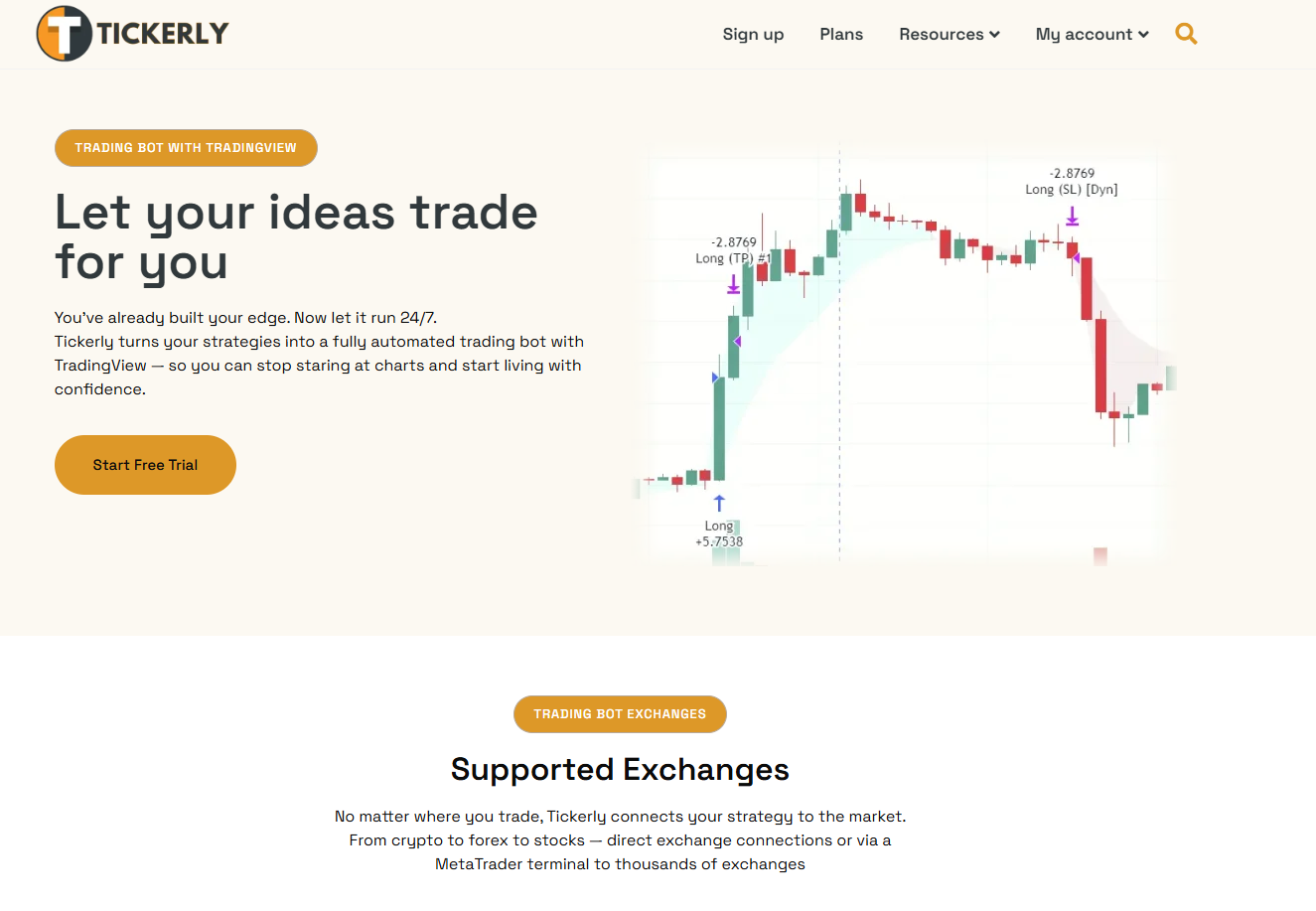
Tickerly turns your TradingView strategies into a fully automated trading bot that executes your scalping rules with precision, at the speed the market demands. No hesitation. No emotional override. Just your strategy running the way you designed it. You can explore top TradingView strategies built for automated execution, browse the automated trading FAQ to understand exactly how the system works, and connect to supported exchanges that meet the liquidity and fee requirements scalpers need. Start with a demo to see how automation complements your manual skills before you commit fully.
FAQ
What is scalping trading?
Scalping is a short-term trading approach where traders open and close positions within seconds to minutes, targeting small price increments across many trades per session. It relies on execution speed, tight risk controls, and high trade frequency rather than large individual gains.
What indicators work best for scalping?
The most effective scalping indicators include EMAs (20 and 50 period) for trend direction, RSI for momentum confirmation, and Stochastic for overbought or oversold context. Tape reading and Level 2 order book data are equally critical for precise entry timing.
How much should I risk per scalping trade?
Risk per trade should be between 0.1% and 0.25% of your total trading capital, with a hard stop loss on every position. On a $10,000 account, that means risking $10 to $25 per trade.
How do I avoid overtrading when scalping?
Set a hard cap of 3 to 5 setups per session before you begin trading and stop immediately after hitting your daily loss limit. A pre-session checklist with these rules written down makes it far easier to enforce them in real time.
Can I automate a scalping strategy?
Yes. Automated bots can execute scalping rules with millisecond precision, removing emotional decision-making and ensuring consistent application of your strategy. The key is building and validating your rules manually first, then using tools like Tickerly to deploy them systematically.