

TL;DR:
- Swing trading involves holding assets for two to thirty days to capitalize on short- to medium-term price movements. It relies on technical analysis, disciplined risk management, and a clear set of rules to identify high-probability setups. Proper execution and patience are key to success, with automation tools helping maintain consistency.
Swing trading is defined as a trading style where you hold assets for 2 to 30 days to profit from short- to medium-term price moves in financial markets. Unlike day trading, which demands constant screen time, swing trading lets you analyze markets outside market hours and even keep a full-time job. Unlike long-term investing, it actively targets specific price swings rather than waiting years for returns. The style relies on technical analysis, disciplined risk management, and a clear set of rules to identify high-probability setups before you risk a single dollar.
What is swing trading and how does it work?
Swing trading works by identifying a price move in progress or about to begin, entering at a defined level, and exiting when the move reaches your target. The core mechanics are straightforward: you use technical analysis to read price charts, find a setup, and place a trade with a preset stop-loss and profit target. The holding period is typically 2–30 days, which gives price enough time to move in your favor without requiring you to watch every tick.

Common swing trading strategies
Three strategies form the foundation of most swing trading approaches:
-
Pullback buying. A stock or crypto asset trends upward, pulls back to a support level or moving average, and you buy the dip expecting the trend to resume. This is the most beginner-friendly setup because the trend context is clear.
-
Trend following. You enter in the direction of the dominant trend after a breakout above resistance or a confirmed continuation pattern. Momentum indicators like the Relative Strength Index (RSI) or Moving Average Convergence Divergence (MACD) help confirm the move.
-
Mean reversion. An asset moves far from its average price and you bet on a return to the mean. This works best in range-bound markets and requires tighter risk controls because you are trading against short-term momentum.
Each strategy depends on confluence: the agreement of multiple signals before you enter. A candlestick reversal pattern at a key support level, confirmed by RSI divergence, carries far more weight than any single signal alone. Professional swing traders use a minimum risk-to-reward ratio of 1:2, meaning they target at least $2 in profit for every $1 they risk. Advanced setups target 3:1 or even 5:1.
Pro Tip: Never enter a trade without first identifying your stop-loss level. If you cannot define where you are wrong, the trade does not qualify.
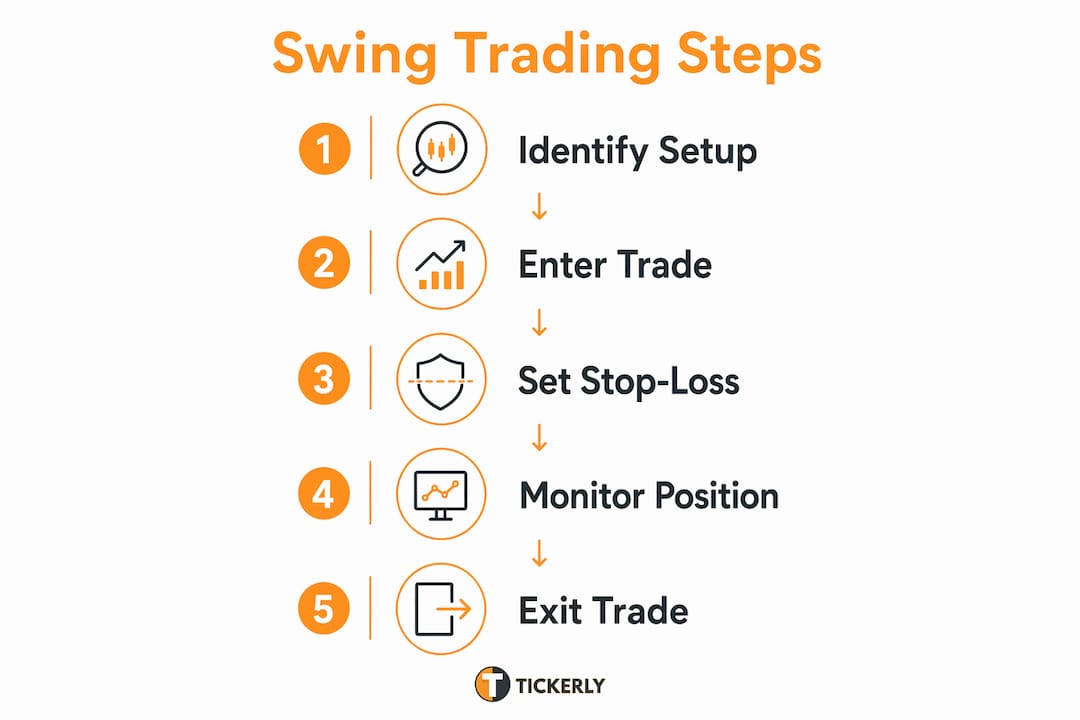
What is the swing trading process from start to finish?
The swing trading process follows a repeatable sequence. Skipping any step is where most beginners lose money.
-
Scan for setups. Review your watchlist of stocks, forex pairs, or crypto assets during off-market hours. Look for charts that match your strategy criteria: trend direction, key levels, and pattern formation.
-
Define your trade parameters. Before placing any order, write down your entry price, stop-loss level, and profit target. Calculate your position size using a position size calculator to confirm you are risking no more than 1–2% of capital per trade.
-
Manage the open trade. Once the trade gains 1R (the amount you initially risked), move your stop to breakeven. This removes downside risk and lets you hold for larger gains without fear of giving back profit.
-
Exit at your target or stop. Do not move your profit target higher out of greed or your stop lower out of hope. Stick to the plan you made before emotions were involved.
-
Review every trade. Log the setup, entry, exit, and outcome. After 30–50 completed trades, you have enough data to judge whether a strategy has a real statistical edge.
Pro Tip: Use a trading journal app or spreadsheet to track every trade. Patterns in your losses reveal more than patterns in your wins.
The time commitment is manageable. Swing trading requires roughly 1–3 hours per day, mostly during pre-market or after-hours scanning. That is a fraction of what day trading demands, which makes it realistic for traders who are not yet trading full time. A starting capital of around $5,000 is a practical minimum for meaningful position sizing without over-concentrating risk.
What are the risks and common mistakes in swing trading?
Swing trading carries real risks that beginners consistently underestimate. Knowing them in advance is the difference between surviving your first year and blowing up your account.
The most common mistakes include:
-
Over-trading. Taking too many setups dilutes your edge and multiplies transaction costs. Quality beats quantity every time.
-
Poor stop placement. Placing stops too tight gets you shaken out of valid trades. Placing them too wide means your losses are larger than your risk plan allows.
-
Ignoring overnight risk. Holding positions overnight exposes you to gap openings caused by earnings reports, economic data releases, or geopolitical events. Size positions accordingly.
The first 48 hours after entry are the most volatile period for most swing trades. Price often tests your stop before moving in your direction. This is called a “shakeout,” and hard stop discipline post-entry is what separates traders who survive it from those who exit prematurely.
“Beginners often mistakenly aim to perfectly predict market tops or bottoms. Successful swing traders accept capturing portions of moves with rule-based systems.” — Swing Trading, Wikipedia
Testing your strategy in a simulator before risking real capital is not optional. Running at least 50 simulated trades before going live builds pattern recognition and emotional control simultaneously. Common beginner investing mistakes like overtrading and emotional decision-making show up clearly in simulation, where the cost is zero.
How does swing trading differ across stocks, forex, and crypto?
Swing trading applies across multiple markets, but each market has distinct characteristics that affect your approach.
| Market | Typical volatility | Best timeframes | Key consideration |
|---|---|---|---|
| Stocks | Moderate | Daily, 4-hour | Earnings gaps, sector trends |
| Forex | Low to moderate | 4-hour, daily | 24-hour market, macro drivers |
| Crypto | High | 4-hour, daily, weekly | 24/7 trading, extreme overnight gaps |
Stocks offer the most regulated environment and the clearest fundamental catalysts. Forex runs 24 hours on weekdays, which suits traders in different time zones. Crypto operates around the clock, seven days a week, which means overnight risk is constant and position sizing must reflect that higher volatility.
The tools available to swing traders have expanded significantly. Charting platforms with built-in technical indicators, alert systems, and backtesting capabilities are now standard. Automation via trading bots adds another layer: bots execute trades based on predefined rules, removing the emotional variable entirely. For swing traders who have a validated strategy, automation means your plan runs consistently whether you are at your desk or not.
Key tools worth knowing:
-
Charting software with support for candlestick patterns, RSI, MACD, and volume analysis
-
Position size calculators to enforce your 1–2% risk rule on every trade
-
Swing trading alerts to notify you when a setup meets your criteria without requiring constant chart monitoring
-
Backtesting tools to test your strategy on historical data before committing real capital
For traders interested in automated forex trading or crypto, connecting a validated TradingView strategy to a bot removes execution delays and ensures your rules are followed precisely, even during fast-moving markets.
Key Takeaways
Swing trading succeeds when you combine a rules-based strategy, strict position sizing of 1–2% risk per trade, and the discipline to follow your plan through the inevitable losing trades.
| Point | Details |
|---|---|
| Holding period | Swing trades last 2–30 days, targeting short- to medium-term price moves. |
| Risk management | Risk no more than 1–2% of capital per trade and target a minimum 1:2 risk-to-reward ratio. |
| Process discipline | Define entry, stop, and target before placing any order, then stick to the plan. |
| Breakeven stop rule | Move your stop to breakeven once the trade gains 1R to protect profit and reduce stress. |
| Validate before going live | Complete 30–50 simulated trades to confirm your strategy has a real statistical edge. |
How Tickerly helps swing traders execute with consistency
Swing trading strategies only work if you execute them consistently. Emotional decisions, missed alerts, and delayed entries erode even the best-designed plan over time.
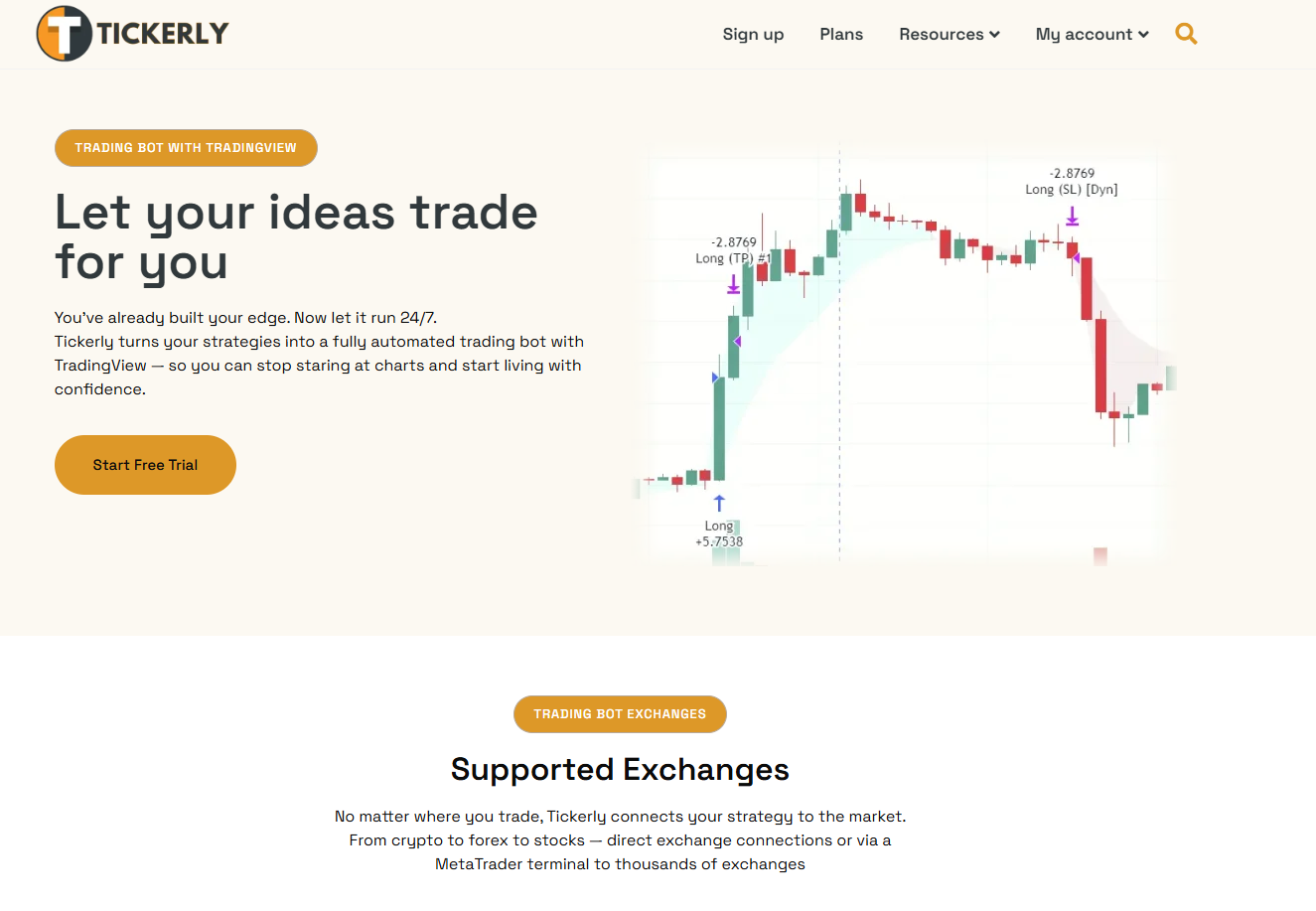
Tickerly automates your TradingView strategies into fully functional trading bots, so your rules run exactly as designed, every time. Whether you are trading stocks, forex, or crypto, Tickerly’s real-time alert system notifies you the moment a setup triggers and executes the trade without hesitation. You can run multiple automated strategies simultaneously, which means your swing trading plan keeps working even when you are away from your screen. For traders ready to remove emotion from execution, Tickerly’s platform connects directly to your exchange and handles the rest.
FAQ
What is swing trading in simple terms?
Swing trading is a style where you hold an asset for 2 to 30 days to profit from a short-term price move. It sits between day trading and long-term investing in terms of time commitment and risk.
How much money do you need to start swing trading?
A practical starting point is around $5,000, which allows meaningful position sizing while keeping individual trade risk at 1–2% of capital. Smaller accounts make proper risk management difficult.
How is swing trading different from day trading?
Day traders open and close all positions within a single trading session. Swing traders hold positions for days to weeks, which requires less screen time and allows analysis during off-market hours.
What is the best risk-to-reward ratio for swing trading?
Professional swing traders use a minimum risk-to-reward ratio of 1:2. Advanced setups target 3:1 or 5:1, meaning the potential gain is three to five times the amount risked.
Can swing trading be automated?
Yes. Traders with a validated strategy can connect it to a trading bot that executes entries, manages stops, and exits positions automatically. Automation enforces your rules without emotional interference, which is one of its primary advantages for swing traders.