

Cross-exchange execution means placing coordinated orders on two or more trading venues at once, usually to capture a price gap or mirror liquidity between them. It works, but the payoff shrinks fast once you count spreads, transfer fees, slippage, and the leg risk of one order filling before the other. Reliable profitability depends on tooling, monitoring, and cost modeling, not just spotting a price gap.
TL;DR:
Cross-exchange execution success depends heavily on reducing transfer fees, slippage, and latency, as spreads and market depth can quickly erode profits.
Effective strategies involve simultaneous order placement, conditional execution, and split-sizing to mitigate leg risk and improve fill certainty.
Machinery, such as API speed and pre-funding, is crucial for minimizing delays and preventing unhedged exposure during partial fills.
Costs from fees, spreads, and transfer charges often outweigh apparent price gaps, making thorough cost modeling vital before executing.
Automation tools that instantly fire correlated orders upon alerts outperform manual timing, especially in volatile or high-frequency trading environments.
Table of Contents
What Is Cross Exchange Execution, Exactly?
Cross-exchange execution covers any trading approach that requires simultaneous or near-simultaneous action on multiple venues. Three patterns dominate:
-
Arbitrage: buying on one exchange and selling on another to capture a price gap, closed the moment the gap disappears.
-
Cross-exchange market making (XEMM): quoting on one venue while hedging exposure on another, profiting from the spread rather than a directional bet.
-
Liquidity mirroring: replicating order book depth from a primary exchange onto a thinner one, useful for market makers who need presence everywhere without splitting capital evenly.
-
Unified cross-exchange accounts: shared-margin setups that let a trader hold one balance and route orders across venues without manually moving funds between them.
Venue choice matters more than most traders assume. A 1997 study by Hendrik Bessembinder00032-9) comparing NYSE, NASD dealer markets, and regional exchanges found realized execution costs varied meaningfully by venue, and that some market makers “cream skim” easy, uninformed order flow while leaving harder trades for other venues. The lesson holds decades later in crypto and forex: the exchange with the tightest posted spread isn’t always the one with the best realized cost.
Core Execution Techniques for Multi-Exchange Trading
Every cross exchange execution strategy comes down to how you sequence and size orders across venues. The mechanics separate traders who survive volatile fills from those who get picked apart by latency.
-
Simultaneous order placement. Send both legs within a tight timing window, typically measured in milliseconds for crypto arb and slightly wider for forex. The tighter the tolerance, the smaller your exposure if one leg fails.
-
Atomic or conditional execution. Some platforms let you chain orders so the second leg only fires once the first confirms. True atomicity across independent exchanges is rare. Practitioner notes on cross-exchange arbitrage point out that auto-rollback logic can attempt to unwind a stranded leg, but it can’t guarantee reversal once a partial fill has already happened.
-
Hedging and rebalancing. Market makers running XEMM need to keep inventory balanced across venues. Automated rebalancing, triggered at defined thresholds rather than fixed intervals, cuts unnecessary transfer costs while keeping exposure neutral.
-
Split-sizing. Breaking a large order into smaller child orders across both legs reduces the odds that one side fills completely while the other stalls, a direct defense against leg risk.
Pro Tip: Size your first leg slightly smaller than your true target position. If the second leg only partially fills, you’re managing a smaller imbalance instead of a full one.
Execution Costs and Fees You Can’t Ignore
The spread quoted on an exchange’s order book and the spread you actually pay are rarely the same number. Bessembinder’s research on realized versus posted spreads still applies: the effective cost of a fill depends on order size, venue depth, and how informed the counterparty flow is, not just the top-of-book quote.
Four cost components decide whether a cross exchange execution opportunity is real or a mirage:
-
Effective spread: the actual cost of crossing the book, which widens as your order size approaches available depth.
-
Slippage: price movement between decision and fill, worse on thinner venues or during volatility spikes.
-
Maker/taker fees: taker fees on both legs can quietly erase a gap that looked profitable on paper.
-
Transfer and withdrawal fees: moving capital between exchanges to rebalance inventory carries network fees and, on some chains, confirmation delays that add execution risk.
The math traders skip: A small price gap may appear attractive until you subtract two taker fees and a withdrawal fee to rebalance. Many arbitrage setups that appear profitable at the quote level break even or lose money once fully costed.
Perpetual futures traders add one more line item: funding-rate drift. Holding a hedge leg on a perpetual contract across a funding interval can eat into or exceed the captured spread if the rate moves against your position.
Operational Risks That Break Cross-Exchange Strategies
Leg risk is the single biggest threat to any cross exchange execution setup. It happens when one order fills and the other doesn’t, leaving you with unhedged directional exposure you never intended to hold. A price spike during that gap can turn a market-neutral trade into a real loss in seconds.
Latency and connectivity failures compound the problem. Rate limits on exchange APIs can delay or reject orders during high-traffic periods, exactly when spreads are widest and most tempting. A few mitigations meaningfully reduce the damage:
-
Pre-fund both venues so rebalancing never depends on a same-moment transfer.
-
Use unified cross-exchange accounts where available to cut transfer latency between legs.
-
Set hard throttles and circuit breakers that pause trading after a defined number of failed or partial fills.
-
Run continuous latency and fill-rate monitoring with alerting, not periodic manual checks.
Pro Tip: After any partial fill, don’t chase the missing leg at market. Pause, reassess the new exposure, and re-enter with a limit order sized to the actual imbalance, not the original target.
Tooling and Integration Options for Multi-Exchange Trading
Choosing how to connect to multiple venues shapes your latency, custody model, and how much engineering overhead you sign up for.
-
Client-side libraries like CCXT normalize order placement and market data across more than 100 exchanges through one API. They’re excellent for prototyping and testing but add an abstraction layer that can cost precious milliseconds for latency-sensitive strategies.
-
Direct exchange APIs cut out that abstraction layer and typically offer the fastest path to execution, at the cost of maintaining separate integration code per venue.
-
Unified cross-exchange accounts, exemplified by Gate’s CrossEx API, share margin across supported exchanges and can materially cut transfer latency and capital friction. The tradeoff: symbol mapping constraints and, in some cases, USDT-only bridges that limit which assets you can hold across venues.
-
WebSocket feeds beat REST polling for order book and fill data when timing matters, since REST introduces polling delay that WebSocket streaming avoids.
Worth flagging: general-purpose cross-platform execution tools built for running commands across operating systems solve a completely different problem than exchange integration and aren’t a substitute for finance-grade API connections. Before going live, test against a sandbox environment with deterministic market-data replay so you can measure realized slippage and fill behavior under repeatable conditions rather than guessing from live results.
Implementation Checklist Before You Go Live
-
Confirm API rate limits and quotas on every venue you’ll trade, and build throttles under those ceilings.
-
Run sandbox simulations with replayed market data to validate fill logic before risking capital.
-
Pre-fund both venues to the minimum balance your rebalancing model requires.
-
Set position size limits and circuit breakers that halt trading after repeated partial fills.
-
Track fill rate, median order latency, and realized spread against expected spread as your core KPIs.
-
Reconcile balances across venues on a fixed cadence, not just when something looks wrong.
How Tickerly Fits Into a Multi-Exchange Execution Workflow
Cross-exchange execution lives or dies on speed and reliability, which is exactly where automation earns its keep. Tickerly converts TradingView strategy alerts into live orders, connecting to multiple exchange platforms so a single strategy can act across venues without manual intervention.
For traders running cross exchange execution logic, tools may offer features such as rapid execution hooks that fire when an alert triggers, multi-exchange connectivity to reduce integration work, support for running multiple strategies simultaneously, and centralized monitoring of fills, failures, and partial executions.
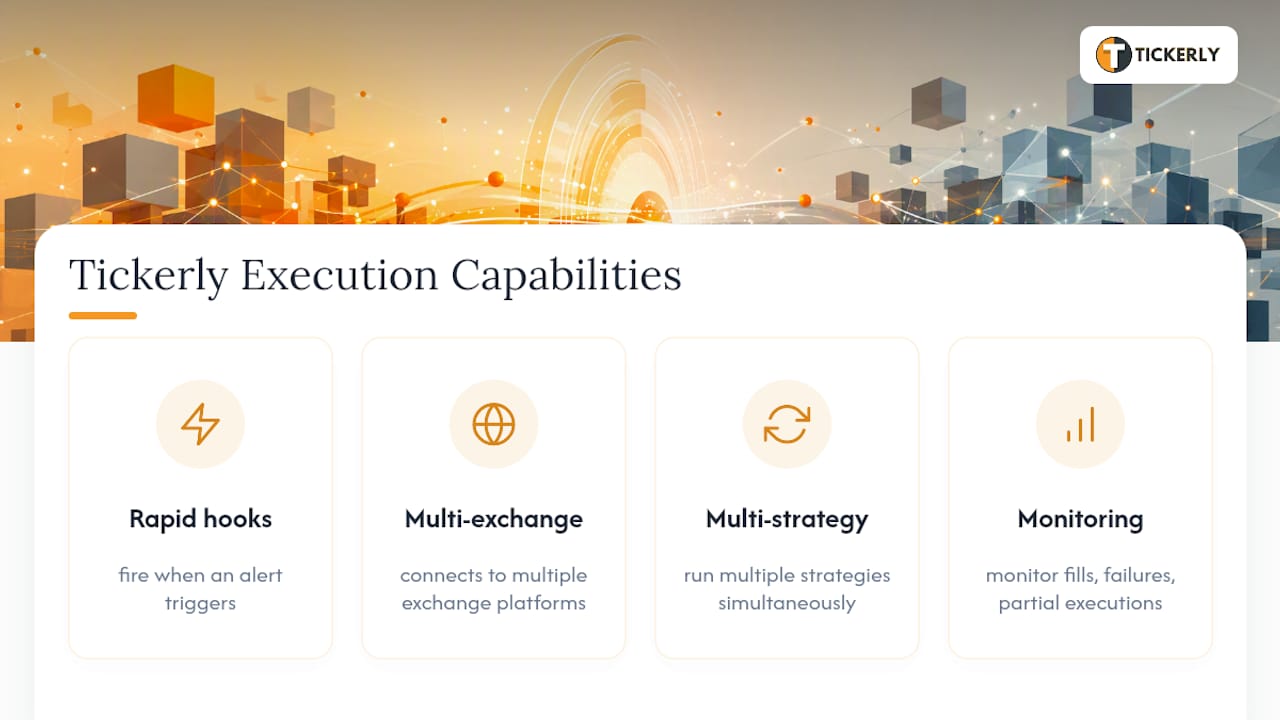
The practical effect: fewer of the checklist items above require custom engineering, and the failure modes tied to latency and manual coordination shrink accordingly.
The Real Bottleneck Isn’t the Opportunity, It’s the Plumbing
Most traders overweight the hunt for price gaps and underweight the engineering that makes acting on them profitable. Bessembinder’s research made this point about equities almost three decades ago: venue differences in realized cost are structural, not noise you can average away. That still holds in crypto and forex today. The gap you spot on a screen is rarely the gap you actually capture.
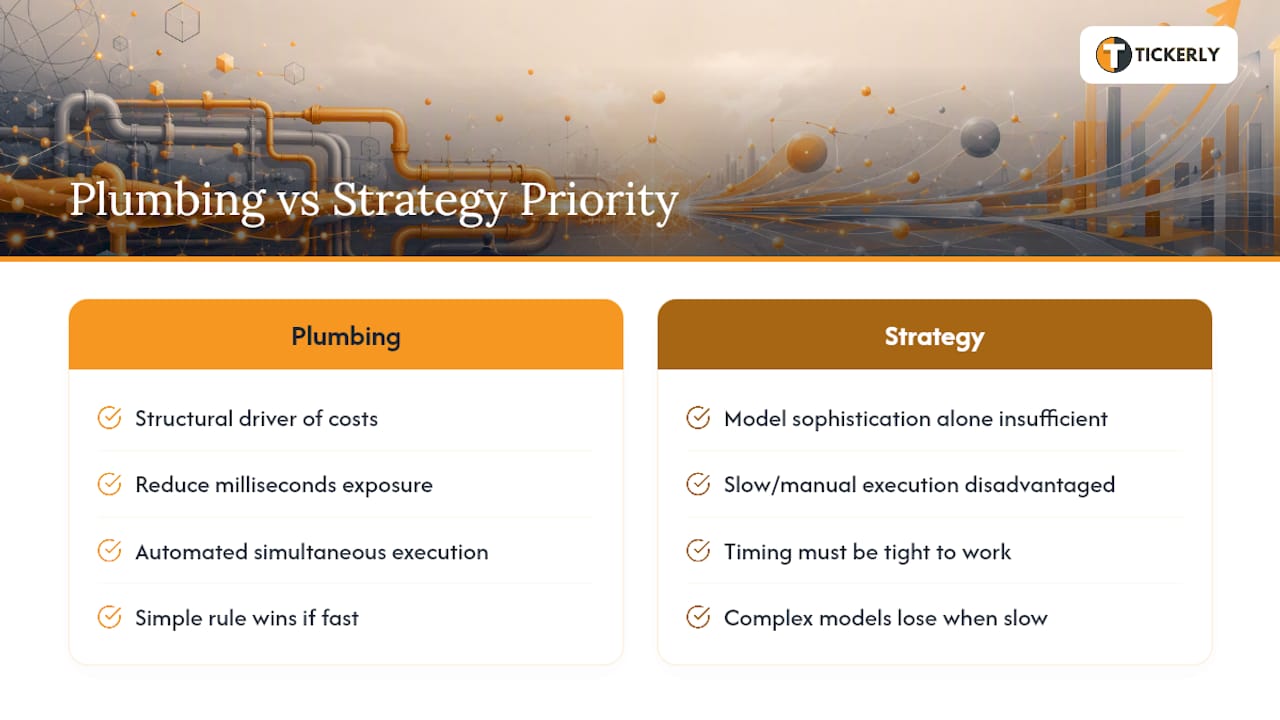
Conventional advice tends to stop at “watch your fees.” That’s necessary but incomplete. The bigger lever is reducing the time between your two legs, because every millisecond of exposure is a millisecond where the market can move against an unhedged position. Manual traders checking two exchange tabs are structurally disadvantaged against anyone running automated, simultaneous execution.
If you’re serious about cross-exchange strategies, prioritize infrastructure before strategy complexity. A simple arbitrage rule executed with tight timing and solid monitoring will outperform a sophisticated model running on slow, manual execution every time. Get the plumbing right first, then optimize the edge.— Jay
Automate the Legs, Not Just the Idea
Tickerly gives traders running cross-exchange strategies something manual execution can’t: orders fired the instant a TradingView alert triggers, across every connected venue, without you tabbing between exchange windows hoping both legs land close enough together.
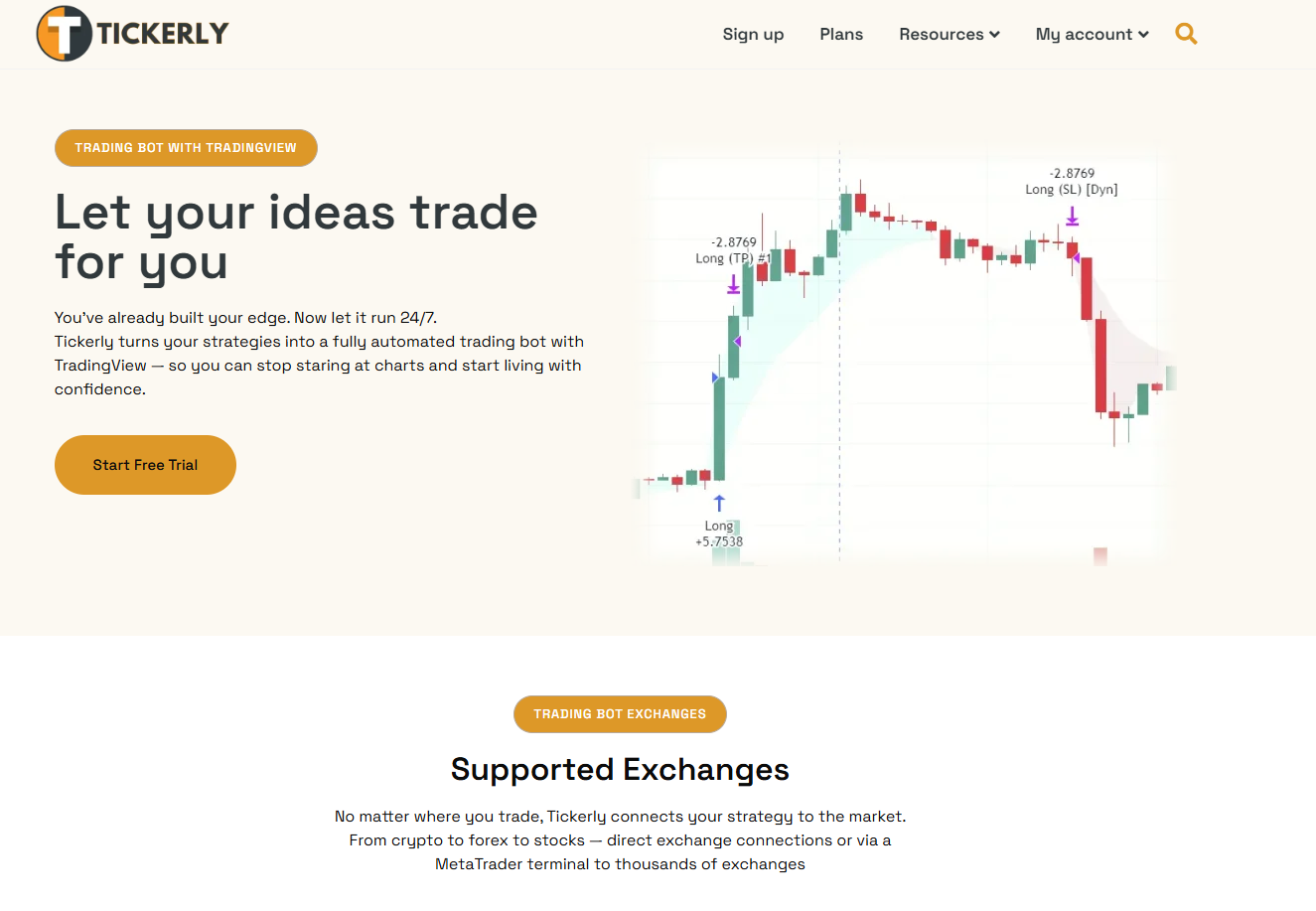
If you’ve built a strategy in Pine Script and you’re tired of watching two screens trying to time simultaneous fills by hand, Tickerly turns that alert into a live order automatically, with support for running multiple strategies across multiple exchanges at once. That’s the difference between an arbitrage idea that looks good on a backtest and one that survives contact with real leg risk. Start your free trial and connect your TradingView strategy to live execution to see how it handles your setup.
This article is general information, not a substitute for advice from a qualified financial advisor. Consult a qualified financial professional about your own circumstances before acting on anything here.
Sources
-
CCXT – Cryptocurrency Exchange Trading Library | One API for 100+ Exchanges
-
Effective cross-exchange arbitrage strategies (practitioner notes)
FAQ
What Is Best Execution in Trading?
Best execution means filling an order at the most favorable realized price available, factoring in spread, slippage, and fees, not just the venue with the tightest posted quote. Bessembinder’s research showed realized costs can vary by venue even when posted spreads look similar.
Can You Give an Example of a Cross Trade?
A cross trade happens when a broker or trader matches a buy order and a sell order for the same asset internally, without routing to the open market, sometimes across affiliated venues. This differs from cross-exchange arbitrage, which involves independent, unaffiliated exchanges.
Is Cross Trading Illegal?
Cross trading is heavily regulated and often restricted or banned outright when it’s used to avoid market prices or benefit one client over another; rules vary by jurisdiction and asset class, so check the specific regulator governing your market before assuming a practice is permitted. Cross-exchange arbitrage between independent public exchanges is a separate, generally legal practice, distinct from internal cross trading.
What Is the 3-5-7 Rule for Day Trading?
The 3-5-7 rule is a risk management guideline suggesting no single trade should risk more than 3% of capital, total exposure across open trades should stay under 5%, and winning trades should target a return relative to risk taken that is large enough to justify the trade. It’s a general position-sizing heuristic, not a rule specific to cross-exchange execution.
Does Automation Reduce Leg Risk in Cross-Exchange Trades?
Automation shortens the time gap between placing both legs of a trade, which directly reduces the window where one leg fills and the other doesn’t. Platforms like Tickerly that execute orders the instant an alert triggers cut this exposure compared to manual, sequential order entry.
Recommended
This article was produced with Al assistance and reviewed for accuracy. It is provided for general information only and is not professional or financial advice.