

TL;DR:
- Trade execution involves fulfilling a buy or sell order across brokers and exchanges where poor execution can harm profits. Different order types and broker routing choices affect speed, price certainty, and overall trading costs. After execution, trades go through clearing and settlement, with US equities now settling on T+1, impacting risk management.
Trade execution is defined as the process of fulfilling a buy or sell order in the financial markets, converting a trading decision into an actual transaction. Every time you place an order, a chain of events fires across brokers, electronic systems, and exchanges before your trade is confirmed. The trade execution process involves order validation, routing, matching, and confirmation, all governed by standards set by bodies like the SEC and clearinghouses like the DTCC. Getting this process right matters as much as picking the right trade. Poor execution erodes profits just as surely as a bad entry signal.

What is trade execution, step by step?
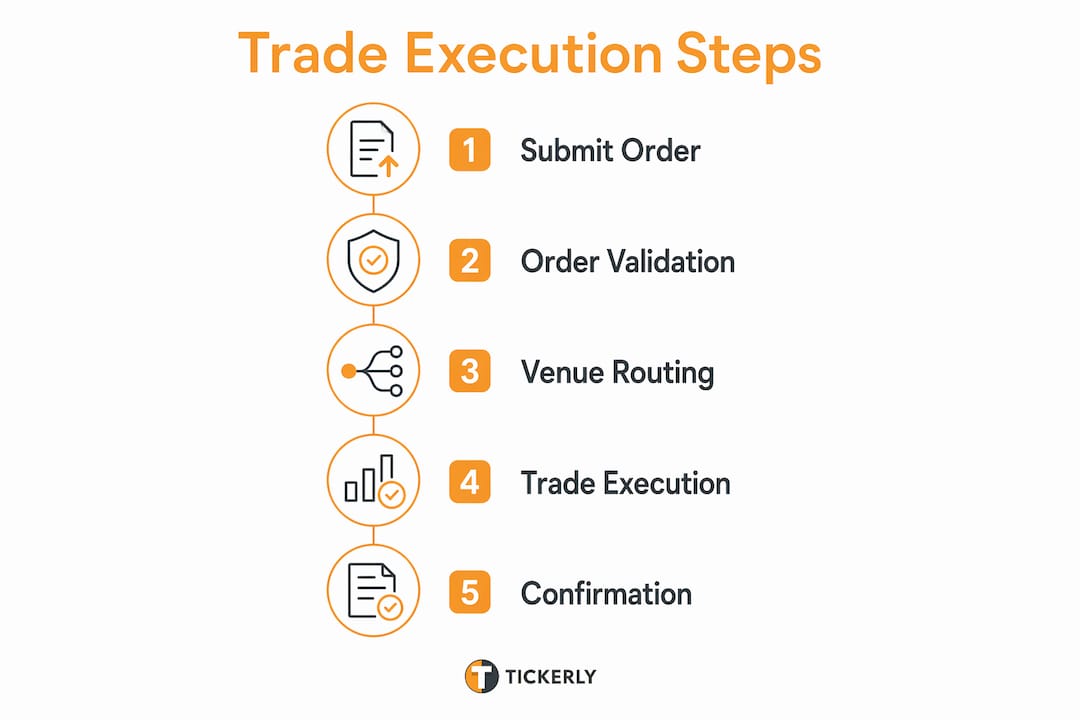
The trade execution process begins the moment you submit an order. Your broker’s order management system receives the order and runs a mandatory validation check, confirming available funds, account restrictions, and order validity before anything else happens. Only after passing this check does your order move forward.
Once validated, the broker routes the order to an execution venue. That venue could be a public exchange like NYSE or Nasdaq, an Electronic Communication Network (ECN), or an alternative trading system. The routing decision depends on the broker’s algorithms, your order type, and current market conditions.
At the venue, a matching engine pairs your order with a counterparty. This step happens fast. Matching engines work in microseconds for liquid stocks during market hours, while broker validation adds milliseconds. The full round trip from your click to trade confirmation typically completes in under one second for actively traded securities.
After the match, the broker sends you a trade confirmation. This message states the filled price, quantity, and timestamp. The confirmation is not the same as legal ownership transfer. That happens later, through clearing and settlement.
-
Order submission. You place a market or limit order through your broker’s platform or API.
-
Validation. The broker checks funds, restrictions, and order parameters.
-
Routing. The order travels to an exchange, ECN, or internal matching pool.
-
Matching. The engine pairs your order with a counterparty at the best available price.
-
Confirmation. Your broker sends a fill report with price, size, and time.
Pro Tip: Record your fill price and the time of confirmation for every trade. Comparing your fills against the National Best Bid Offer (NBBO) at the moment of submission tells you exactly how much price improvement or slippage you received.
What types of trade execution orders exist?
Order type is the single biggest variable you control in the execution process. Each type produces a different tradeoff between speed, price certainty, and fill probability.
Market orders execute immediately at the best available price. Speed is guaranteed, but price is not. In a fast market, the price you see on screen can differ from the price you receive. Retail traders often assume the displayed price guarantees their fill, but prices can shift between submission and execution, especially in volatile conditions.
Limit orders execute only at your specified price or better. You control the price, but you accept the risk that the order may not fill at all if the market never reaches your level. Limit orders are the preferred tool when you need price discipline over speed.
Stop orders sit dormant until a trigger price is reached, then convert to market orders. Stop-limit orders convert to limit orders instead, giving you price control after the trigger fires. Both types carry the risk of partial fills or no fills during fast price moves.
| Order type | Execution speed | Price certainty | Fill certainty |
|---|---|---|---|
| Market | Immediate | Low | High |
| Limit | Conditional | High | Moderate |
| Stop (market) | Fast after trigger | Low | High after trigger |
| Stop-limit | Conditional after trigger | High | Low in fast markets |
The right order type depends on your strategy. Scalpers and high-frequency traders favor market orders because speed matters more than a few ticks of slippage. Swing traders and position traders favor limit orders because entry price directly affects their risk-to-reward ratio.
Pro Tip: Use limit orders during pre-market and after-hours sessions. Spreads widen significantly outside regular hours, and a market order can fill far from the last traded price.
How do execution venues and broker routing affect quality?
Broker routing decisions fundamentally change how an order is handled and what price you receive. This is one of the least understood variables in trading, yet it directly affects your bottom line.
Execution venues fall into two broad categories. Public exchanges like NYSE and Nasdaq display orders in a central order book and match them transparently. Alternative venues, including dark pools and ECNs, operate with less pre-trade transparency but can offer price improvement for large orders by avoiding the public order book entirely.
Brokers choose between several routing approaches:
-
Direct Market Access (DMA). Your order goes straight to the exchange order book. You get full transparency and control over routing, but you pay exchange fees directly.
-
Internalization. The broker matches your order against its own inventory or other client orders. This can be faster and cheaper, but it may not always achieve the best price.
-
Smart Order Routing (SOR). Algorithms scan multiple venues simultaneously and route your order, or slices of it, to wherever the best price and liquidity exist at that moment.
Institutional traders rely heavily on Smart Order Routing to fragment large orders across venues, reducing market impact and preventing other participants from detecting the full order size. A single large market order on a public exchange signals your intention to the market, which can move prices against you before the order fills completely.
Regulatory best execution obligations require brokers to seek the most favorable terms reasonably available. In practice, this means brokers must document their routing policies and demonstrate that their choices benefit clients. You can request your broker’s order routing reports to see where your orders actually go.
The choice of execution venue affects latency, price improvement, and total transaction cost. Evaluating your broker’s routing quality is as important as evaluating their commission schedule.
What happens after trade execution? Clearing and settlement explained
Execution is not the end of the trade lifecycle. After your fill confirmation arrives, two more processes must complete before you legally own the securities: clearing and settlement.
Clearing is the verification and reconciliation step. After execution, clearinghouses act as central counterparties to both sides of the trade, guaranteeing that obligations will be met. The clearinghouse steps between buyer and seller, eliminating direct counterparty risk. In the US, the National Securities Clearing Corporation (NSCC), a subsidiary of the DTCC, handles clearing for equities.
Settlement is the actual transfer of securities and cash. Since may 2024, the standard settlement cycle for US equities is T+1, meaning final ownership transfers one business day after execution. This is a reduction from the previous T+2 cycle and lowers the window during which either party carries settlement risk.
Key post-execution concepts every trader should know:
-
Delivery-versus-Payment (DvP). Securities and cash transfer simultaneously, eliminating the risk that one side delivers without receiving the other.
-
Failed settlements. If a seller cannot deliver securities by the settlement date, the trade fails. This triggers penalties and can force a buy-in.
-
International variation. Settlement cycles differ by market. Many international equity markets still operate on T+2, and some bond markets use T+0 or same-day settlement.
The distinction between execution and settlement matters for risk management. Your position shows as filled immediately after execution, but you carry settlement risk until T+1 closes. Understanding this separation helps you manage post-trade risk exposure accurately.
What are the best trade execution strategies for traders?
Execution quality is as critical as the trade decision itself. For high-frequency traders, execution differences translate directly into millions of dollars in transaction costs. For retail traders, the impact is smaller but still meaningful across hundreds of trades per year.
The most effective trade execution strategies combine order type discipline, timing awareness, and broker selection:
-
Match order type to market conditions. Use limit orders in low-liquidity environments and during volatile sessions. Use market orders only when speed is genuinely more valuable than price precision.
-
Split large orders. Breaking a large position into smaller tranches reduces market impact. Each tranche moves less price and reveals less information about your total order size.
-
Time your entries. Liquidity is highest in the first and last hour of the regular trading session for US equities. Executing during peak liquidity hours reduces spreads and slippage.
-
Evaluate broker execution quality. Request your broker’s Rule 605 and Rule 606 reports. These SEC-mandated disclosures show execution quality statistics and order routing destinations.
-
Use algorithmic execution for large trades. Algorithms like VWAP (Volume Weighted Average Price) and TWAP (Time Weighted Average Price) spread orders over time to minimize market impact.
Pro Tip: Backtesting a strategy on historical data is only half the picture. Always factor in realistic slippage estimates based on your broker’s average execution quality. A strategy that looks profitable in backtesting can underperform in live trading if execution costs are ignored.
Key Takeaways
Trade execution quality determines your actual trading results, not just your strategy’s theoretical edge.
| Point | Details |
|---|---|
| Execution speed | Liquid stock orders typically confirm in under one second, from click to fill. |
| Order type choice | Market orders prioritize speed; limit orders prioritize price. Match the type to your strategy. |
| Venue and routing | Broker routing decisions affect price improvement, slippage, and total transaction cost. |
| Settlement cycle | US equities settle T+1 since may 2024, one business day after execution. |
| Post-trade risk | Legal ownership transfers at settlement, not at execution confirmation. |
Why execution deserves as much attention as your strategy
Most traders spend the majority of their time refining entry signals and exit rules. Very few spend equivalent time auditing their execution quality. That is a costly oversight.
I have watched traders run profitable backtests only to see live results fall short, not because the strategy was wrong, but because execution costs ate the edge. A strategy with a 0.3% average gain per trade can turn negative once you account for consistent slippage of 0.15% per side. The math is unforgiving.
The shift to T+1 settlement in the US is a concrete example of how the market infrastructure around execution keeps evolving. Traders who understood the change adjusted their cash management and margin calculations accordingly. Those who did not faced unexpected margin calls during the transition period.
Automation changes the execution equation significantly. Manual traders react in seconds. Automated systems react in milliseconds. That gap matters most in fast markets, where the best prices disappear before a human can click. The growing role of API-driven execution and algorithmic order routing means that understanding the mechanics of execution is no longer optional for serious traders. It is the foundation of a repeatable, measurable trading process.
My advice: treat execution as a separate discipline from strategy development. Track your fills, compare them to the NBBO, and review your broker’s routing reports quarterly. The traders who do this consistently find real, measurable improvements in their net returns.— Jay
Tickerly and the execution advantage
Execution speed separates profitable trades from missed opportunities, and manual trading simply cannot keep pace with modern markets.
Tickerly automates your TradingView strategies into fully functional trading bots that execute orders the moment your signal fires, with no delay and no second-guessing. The platform connects directly to exchange APIs, removing the latency that costs manual traders their edge. Whether you trade crypto, forex, or stocks, Tickerly handles automated order execution across multiple strategies simultaneously. You can run several bots in parallel, each following its own rules, while you focus on strategy development rather than order entry. Explore how bot-driven trading can put your execution on autopilot.
FAQ
What is trade execution in simple terms?
Trade execution is the process of completing a buy or sell order in the financial markets. It covers everything from order submission through broker validation, routing, matching, and fill confirmation.
How long does trade execution take?
For liquid stocks during regular market hours, the full process from order submission to trade confirmation typically completes in under one second, with matching engines operating at the microsecond level.
What is the difference between execution and settlement?
Execution is the moment your order is filled and confirmed by the broker. Settlement is the legal transfer of securities and cash, which occurs one business day after execution for US equities under the T+1 standard.
How does order type affect trade execution?
Market orders execute immediately at the best available price, prioritizing speed over price certainty. Limit orders execute only at your specified price or better, giving you price control at the cost of fill certainty.
What is Smart Order Routing?
Smart Order Routing (SOR) is an algorithmic system that scans multiple execution venues simultaneously and routes orders, or order slices, to the venue offering the best price and liquidity, reducing market impact and slippage.