

TL;DR:
- Live trading involves real-time buying and selling of financial assets using actual capital, exposing traders to genuine market conditions and psychological pressures. Success depends on disciplined strategies, low-latency execution infrastructure, and managing emotional responses like fear and greed; skipping proper preparation often leads to quick account losses. Automation tools like Tickerly help traders execute signals promptly, reducing execution risks and improving consistency in live trading environments.
Live trading is the real-time buying and selling of financial instruments using actual capital, where every executed order directly affects your account balance. Unlike simulated environments, live trading exposes you to genuine market conditions: real spreads, real slippage, and real psychological pressure. Whether you trade stocks on the NYSE, currency pairs on the forex market, or crypto assets on BitMart, the mechanics and stakes are identical. Your decisions carry immediate financial consequences, and the market does not wait for you to reconsider. Understanding what live trading is, how it works, and what separates consistent traders from impulsive ones is the foundation of any serious trading education.
What is live trading and how does it work?
Live trading, also called real-time trading, is defined as the execution of buy and sell orders against live market data using real money in a brokerage or exchange account. High-performance platforms achieve sub-1 second fill speeds with 99.6% reliability, which means the infrastructure you trade on directly determines whether your order fills at the price you intended. That gap between intention and execution is where most beginners lose money before they even understand why.

The process works in a straightforward sequence. You analyze a market, identify an entry signal based on your strategy, place an order through your platform, and the exchange matches your order with a counterparty. In liquid markets like EUR/USD or Bitcoin, this happens in milliseconds. In thinner markets, the fill can take longer and arrive at a worse price than expected.
Live trading spans multiple asset classes. Equity traders use platforms like TD Ameritrade or Interactive Brokers. Forex traders access the interbank market through MetaTrader 4 or MetaTrader 5. Crypto traders operate on exchanges like Kraken or Bybit. Each market has its own session hours, liquidity profile, and volatility characteristics, but the core definition of live trading remains constant: real money, real prices, real outcomes.
How does live trading differ from demo or paper trading?
The distinction between live and paper trading goes far beyond the presence of real money. Psychological differences between demo and live trading significantly affect performance, because fear and greed disrupt logical execution in ways that a simulated account never replicates.
Here is a direct comparison of the two environments:
| Factor | Paper trading | Live trading |
|---|---|---|
| Capital at risk | None | Real money |
| Emotional pressure | Minimal | High |
| Slippage | Rarely simulated | Always present |
| Spreads | Often fixed or ignored | Variable, market-driven |
| Order fill quality | Instant, idealized | Dependent on liquidity |
| Psychological impact | Low | High, often disruptive |
Beyond the table, several live-market realities simply do not exist in demo accounts:
-
Slippage: Your order fills at a different price than the one you clicked, because the market moved between your click and the exchange’s confirmation.
-
Variable spreads: During news events or low-liquidity periods, the bid-ask spread widens sharply, increasing your entry cost.
-
Partial fills: In illiquid markets, your full order size may not fill at one price, leaving you with a fragmented position.
-
Latency: Your internet connection and platform speed affect whether you enter at the price you see on screen.
Industry guidance recommends consistent demo trading for 1 to 3 months before transitioning to live markets. The purpose is not just to learn strategy mechanics. It is to build enough confidence in your system that you can execute it without hesitation when real money is on the line. Skipping this step is the single most common reason new traders blow their first account within weeks.
What are the main risks and execution challenges in live trading?
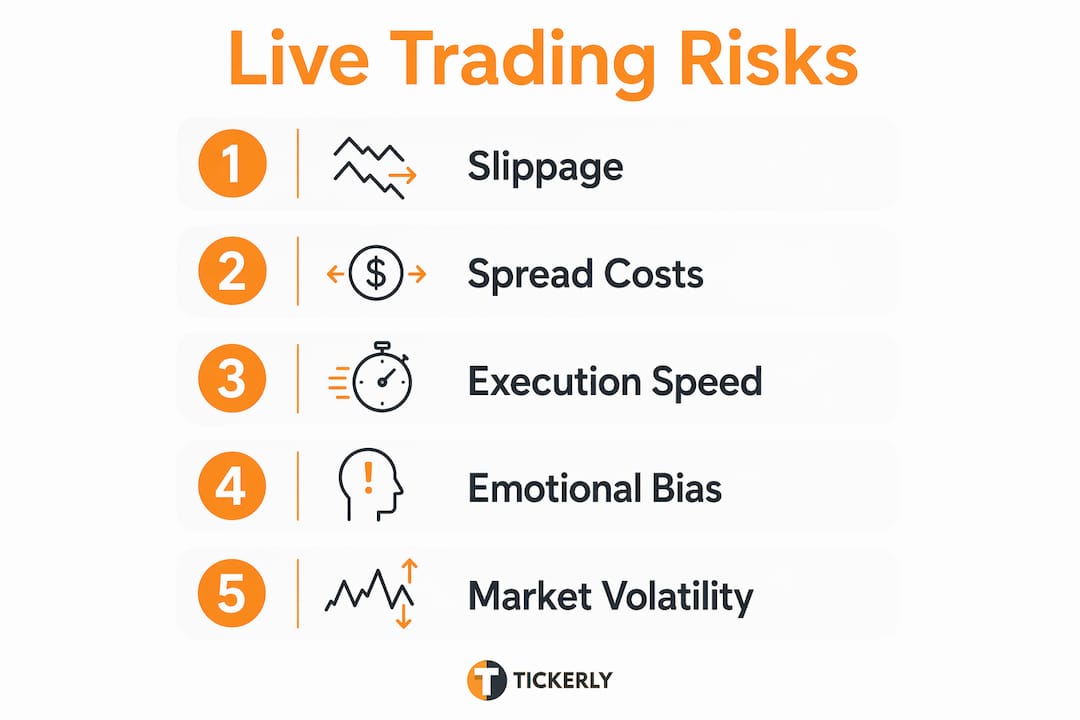
Traders must monitor stop-loss orders and leverage to prevent disproportionate losses in live trading, because the compounding effect of small execution failures adds up faster than most beginners anticipate. The risks fall into two categories: market-structure risks and infrastructure risks.
Market-structure risks include:
-
Slippage: Caused by fast-moving prices or low liquidity, slippage means your order executes at a worse price than intended. Accounting for execution slippage is vital for realistic live trading results, and professional traders build a slippage buffer into every strategy backtest.
-
Variable spreads: Brokers widen spreads during volatility, turning a theoretically profitable trade into a losing one before it even moves in your direction.
-
Liquidity gaps: In crypto markets especially, thin order books can cause price to jump several levels, leaving you with a fill far from your target.
Infrastructure risks include:
-
Latency: Slow execution software or a poor internet connection introduces delays that cost you price accuracy. Unreliable connectivity in high volatility can cause order delays or failures, turning potential gains into losses.
-
Platform downtime: Exchanges and brokers occasionally go offline during peak volatility, exactly when you need to act.
-
Ghost orders: Orders that appear submitted but have not reached the exchange, leaving you exposed without knowing it.
Pro Tip: Before going live, test your platform’s execution speed during a high-volatility event like a Federal Reserve announcement or a major crypto news release. If your fills are consistently 2 to 3 price levels away from your target, your infrastructure needs an upgrade before your strategy does.
For a deeper look at controlling these variables, Tickerly’s guide on managing risk in trading bots covers slippage, spread management, and liquidity controls in practical detail.
What psychological factors influence live trading performance?
Live trading is the ultimate test of a trader’s skill because emotional pressures absent in demo trading make psychological control as important as strategy. When real money is at stake, the brain processes losses and gains differently than it does in a simulated environment. This is not a mindset problem you can simply think your way out of. It is a neurological response to financial risk.
The four most destructive psychological patterns in live trading follow a predictable sequence:
-
Fear of loss: You exit a winning trade too early because you are afraid the profit will disappear, cutting your reward-to-risk ratio below your planned target.
-
Greed: You hold a winning position past your take-profit level hoping for more, only to watch it reverse and close at breakeven or a loss.
-
Impatience: You enter trades that do not fully meet your setup criteria because you feel like you are missing out on market movement.
-
Revenge trading: After a loss, you immediately re-enter the market with a larger position to recover the money, which compounds the original loss.
Beginners often underestimate the psychological shift when moving from paper to live trading, causing impulsive behaviors. Starting with smaller position sizes reduces emotional shocks and gives you time to build tolerance for the discomfort of real financial risk. Think of it as a calibration process, not a sign of weakness.
Pro Tip: Keep a trading journal from your first live trade. Record not just the entry and exit prices, but your emotional state before and after each trade. After 30 trades, patterns in your impulsive decisions become visible and correctable.
Tickerly’s resource on essential trading tips addresses both technical analysis discipline and psychological regulation across experience levels.
How do traders develop effective live trading strategies?
Consistent live trading success depends on a rigid, adaptable plan that adjusts to market volatility and enforces risk controls. A strategy is not just an entry signal. It is a complete decision framework covering position sizing, risk per trade, entry criteria, exit rules, and conditions under which you do not trade at all.
The core components of a live trading strategy:
-
Written trading plan: Document every rule in your strategy before you place a single live trade. Strategy adherence and dynamic risk management distinguish successful live traders from those who improvise under pressure.
-
Position sizing tied to volatility: Use the Average True Range (ATR) indicator to scale your position size based on current market volatility. A wider ATR means a smaller position to keep your dollar risk constant.
-
Stop-loss rules: Every trade must have a predefined stop-loss placed before entry, not after. Moving a stop-loss further away from price to avoid being stopped out is one of the most expensive habits in trading.
-
Take-profit targets: Define your reward-to-risk ratio before entry. A minimum of 1.5:1 is the standard starting point for most short-term strategies.
-
Trade logging and review: Track every live trade in a spreadsheet or dedicated journal tool like Edgewonk or TraderVue. Review your results weekly to identify which setups are performing and which are not.
The progression from demo to live trading works best when structured in stages. Start with the smallest position size your broker allows, typically one micro lot in forex or a fractional share in equities. Hold that size for at least 20 to 30 trades before scaling up. This approach gives your strategy time to prove itself under real market conditions without exposing you to account-threatening losses during the learning curve.
For step-by-step guidance on the transition from paper to live execution, Tickerly’s practical trade execution guide walks through the process in detail. You can also use Tickerly’s framework for evaluating live trading results to build a disciplined review process from the start.
Pro Tip: Apply real market trading tactics from experienced traders to stress-test your plan against conditions your backtest may not have captured, such as flash crashes or liquidity voids.
Key takeaways
Live trading success requires combining technical strategy, psychological discipline, and reliable execution infrastructure before risking meaningful capital.
| Point | Details |
|---|---|
| Live trading definition | Real-time buying and selling of financial assets using actual capital against live market data. |
| Demo before live | Practice consistently for 1 to 3 months on a demo account before transitioning to real money. |
| Execution risks matter | Slippage, variable spreads, and latency erode profitability and must be built into every strategy. |
| Psychology drives outcomes | Fear, greed, and revenge trading cause more losses than poor strategy selection in early live trading. |
| Plan before you trade | A written, rule-based trading plan with defined position sizing and stop-loss rules is non-negotiable. |
Why most traders underestimate what live trading actually demands
A trader spends weeks building a solid strategy on a demo account, hits a 70% win rate over 50 trades, and then goes live expecting similar results. Within two weeks, the win rate drops to 45% and the average loss is twice the average win. The strategy did not break. The trader did.
What changes in live trading is not the market. It is you. The moment real money is at stake, every decision carries emotional weight that a demo account simply cannot simulate. I have seen traders with genuinely profitable systems destroy their accounts in the first month because they could not execute their own rules under pressure.
The piece most traders overlook is infrastructure. Slow execution software is not just an inconvenience. It is a direct tax on every trade you place. Professional live traders prioritize low-latency execution and reliable connectivity because they understand that a 200-millisecond delay in a fast-moving crypto or forex market can be the difference between a clean fill and a 10-pip slippage. That adds up to real money over hundreds of trades.
My honest advice: start smaller than you think you need to. Trade sizes so small that a loss does not bother you emotionally. Build your live track record over 50 to 100 trades before scaling. The market will still be there when you are ready. Rushing the process costs far more than patience does.
— Jay
Take your live trading further with Tickerly
Manual execution in live markets means you are always one slow reaction away from a missed trade or a bad fill. Tickerly converts your TradingView strategies into fully automated trading bots that execute orders the moment your signal fires, with no hesitation and no emotional override.
Tickerly connects directly to crypto, forex, and stock exchanges via API, delivering execution speeds that manual trading cannot match. Whether you are running a momentum strategy on Bitcoin or a mean-reversion system on EUR/USD, Tickerly handles order placement, position sizing, and trade management continuously. Explore the full case for automated trading bots and see how automation removes the execution friction that costs live traders the most. You can also review the automated trading FAQ to understand exactly how bot-driven execution works in live markets.
FAQ
What is the live trading definition in simple terms?
Live trading is the real-time execution of buy and sell orders in financial markets using actual money, where results directly affect your account balance. It contrasts with paper trading, which uses simulated funds with no real financial consequences.
How does live trading work for beginners?
Beginners open a funded account on a broker or exchange, select a financial instrument, and place orders based on a predefined strategy. Starting with smaller position sizes reduces emotional pressure while you build experience in real market conditions.
Is live trading profitable?
Live trading is profitable for traders who follow a documented strategy, manage risk with stop-loss orders, and account for execution costs like slippage and spreads. Most beginners lose money initially because they underestimate psychological pressure and market friction.
What is the difference between live vs paper trading?
Paper trading uses virtual funds with idealized fills, while live trading involves real capital, variable spreads, slippage, and genuine emotional stakes. The performance gap between the two environments is primarily psychological, not technical.
What are the best live trading platforms?
Popular live trading platforms include MetaTrader 4 and MetaTrader 5 for forex, Interactive Brokers for equities, and Kraken or Bybit for crypto. Platform selection depends on asset class, execution speed requirements, and API access for automated strategies. You can also review risk management rules to evaluate which platform features matter most for your trading style.