

TL;DR:
- Demo trading allows traders to practice executing trades without risking real money in a real-market environment. Practicing for 30 to 90 days helps develop disciplined habits, improves technical skills, and prepares traders psychologically for live markets. Transitioning with micro-lot trading minimizes emotional impact and ensures better profitability in real trading.
Demo trading is the practice of executing trades with virtual capital in a real-market environment, building skills without risking actual money. Every serious trader, from forex newcomers to crypto day traders, faces the same challenge: how do you learn execution, risk management, and strategy without paying for every mistake with real funds? The answer is paper trading, the industry term for what most brokers call a demo account. Traders who used demo accounts for at least 3 months before going live were 40% more likely to remain profitable after their first year. That single statistic makes the case for why use demo trading better than any theory.
Why use demo trading to build real trading skills?
Demo trading gives you hands-on experience with the exact tools you will use in live markets. You practice placing market orders, setting stop losses, sizing positions, and reading charts, all without the cost of real mistakes. This hands-on repetition converts abstract rules into muscle memory, so your execution speed and accuracy improve before any real capital is at stake.

A demo account replicates live market prices, spreads, and charts, differing only in order execution specifics and real-money psychology. That means the technical environment you practice in is nearly identical to what you will face live. You learn the platform’s order entry screens, chart analysis tools, and alert systems under realistic conditions.
The demo environment also lets you test broker platforms before committing funds. You can evaluate execution speed, charting quality, and interface design without any financial exposure. Learning how to analyze investment platforms before funding an account is one of the most underrated advantages of demo practice.
Key skills you build during demo practice:
-
Order types: Market orders, limit orders, and stop orders each behave differently under volatility.
-
Position sizing: Calculating lot sizes relative to account balance and risk tolerance.
-
Stop loss placement: Setting stops based on technical levels, not arbitrary dollar amounts.
-
Chart reading: Identifying support, resistance, and trend structure in real time.
-
Platform navigation: Moving between charts, order windows, and account summaries quickly.
Pro Tip: Treat every demo trade as if real money is on the line. Traders who approach demo accounts casually develop sloppy habits that cost them in live markets.
What psychological differences exist between demo and live trading?
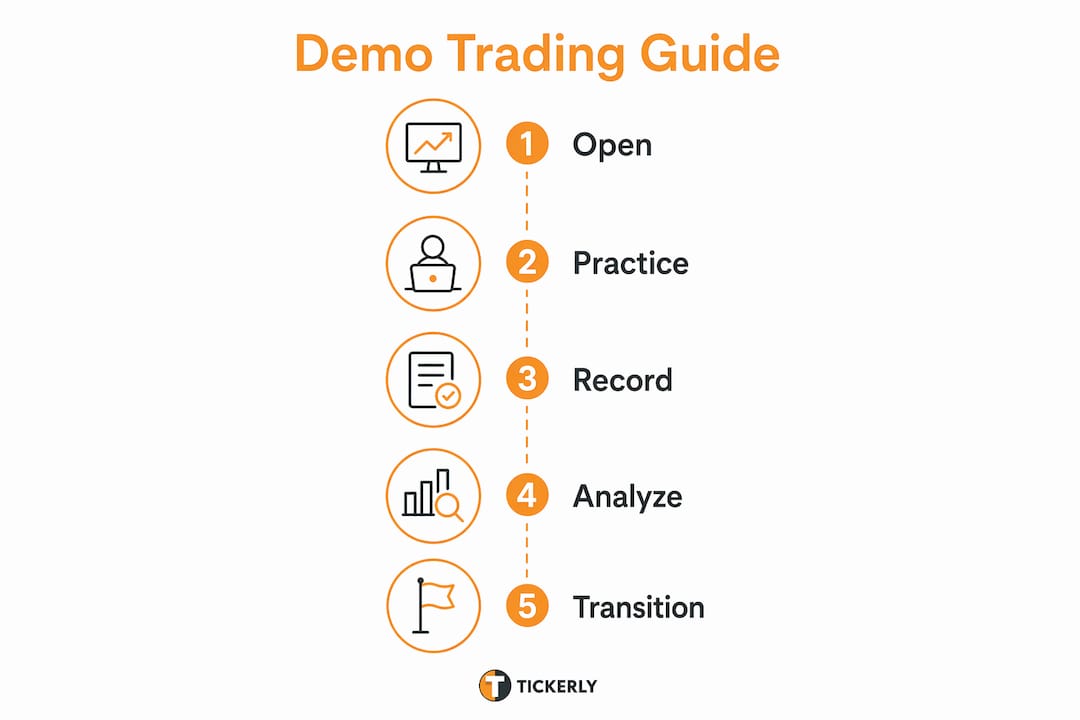
The biggest gap between demo and live trading is not technical. It is emotional. When real money is at risk, loss aversion, fear, and greed alter your decision-making in ways that simply do not appear during demo practice. Demo results tend to outperform live results precisely because the absence of financial risk removes the psychological friction that causes most trading errors.
This gap is not a reason to skip demo practice. It is a reason to use demo practice more deliberately. The goal is to build disciplined habits so that when emotions do appear in live trading, your execution remains consistent.
“Demo accounts do not replicate psychological stress. Traders must treat demo money as real capital to build the proper habits that transfer to live markets. Without that discipline, demo practice produces false confidence rather than genuine skill.”
The risk of treating demo trading as a game is real. Gamification of demo accounts leads traders to take oversized positions they would never risk with real funds. This creates a false sense of confidence. When they move to live trading, those habits collapse under the weight of actual financial consequences.
Common psychological pitfalls in demo trading:
-
Oversizing positions: Taking 10x normal risk because losses feel abstract.
-
Ignoring stop losses: Letting losing trades run because there is no real pain.
-
Overtrading: Placing trades out of boredom rather than signal confirmation.
-
Skipping the journal: Not recording trades because the stakes feel low.
Pro Tip: Set a rule before each demo session: “I will not take any trade I would not take with real money.” This single constraint forces you to trade with the same discipline you need live.
The transition from demo to live trading requires a deliberate step. Starting with micro-lot live trades after demo practice exposes you to real psychological dynamics while keeping financial risk minimal. That exposure is irreplaceable.
How long should you use a demo account before going live?
The recommended demo practice window is 30 to 90 days of active, disciplined trading. That range gives you enough time to build repeatable habits without developing the bad habits that come from extended demo use. Staying on demo beyond 90 days can cause traders to lose touch with real-market frictions like slippage, partial fills, and the psychological weight of capital at risk.
Traders who practiced for at least 3 months before going live were 40% more likely to remain profitable in their first year. That is not a minor edge. It is the difference between building a foundation and guessing your way through early live trades.
Before you transition to a live account, evaluate your performance against these four readiness indicators:
-
Consistent profitability: You have achieved positive returns across at least 20–30 trades, not just a lucky streak.
-
Risk rule adherence: You have followed your position sizing and stop loss rules on every single trade, without exception.
-
Losing streak management: You have experienced a drawdown period and stayed disciplined rather than revenge trading.
-
Strategy clarity: You can describe your entry, exit, and risk rules in writing without ambiguity.
If you cannot check all four boxes, extend your demo practice. If you can, the next step is live trading with the smallest available position size. Micro-lot trading eases the demo-to-live shift by giving you real psychological exposure at minimal financial cost. Most brokers offer micro-lot accounts specifically for this transition phase.
The role of simulation in trading does not end at the demo stage. Many experienced traders continue to use demo environments to test new strategies before deploying them with live capital.
What are the best practices to maximize demo trading benefits?
Demo trading works best when you treat it as a controlled experiment, not a casual exercise. The structure you apply during demo practice directly determines the quality of habits you carry into live trading.
Typical demo accounts provide virtual balances from $10,000 to $100,000. Most traders make the mistake of selecting the maximum balance available. Instead, match your demo balance to the actual capital you plan to deposit live. If you plan to start with $2,000, practice with $2,000. This forces you to calculate position sizes correctly from day one.
Best practices that separate effective demo traders from those who waste the opportunity:
-
Keep a trading journal. Log every entry, exit, trade rationale, and outcome. Review it weekly to identify patterns in your decision-making.
-
Test one strategy at a time. Switching strategies frequently prevents you from gathering enough data to evaluate any single approach. Commit to one method for at least 30 trades before drawing conclusions.
-
Trade during your planned live hours. If you plan to trade the New York session, practice during the New York session. Market behavior varies significantly by session.
-
Use demo to test broker execution. Evaluate how quickly orders fill, whether spreads widen during news events, and how the platform handles volatility.
-
Set a defined end date. Treat your demo period like a training camp with a fixed schedule, not an open-ended practice with no accountability.
Essential trading habits developed during demo practice transfer directly to live trading when built with this level of discipline. The traders who treat demo as a laboratory produce better live results than those who treat it as entertainment.
Key Takeaways
Disciplined demo trading for 30 to 90 days, with realistic position sizing and a trading journal, is the most reliable way to build the skills and habits needed for profitable live trading.
| Point | Details |
|---|---|
| Practice period matters | Traders who demo for at least 3 months are 40% more likely to stay profitable in year one. |
| Match your demo balance | Set your virtual balance equal to your planned live capital to practice correct position sizing. |
| Bridge the psychology gap | Treat every demo trade seriously to build the discipline that holds under live market pressure. |
| Know when to go live | Confirm consistent profitability, risk rule adherence, and losing streak management before funding an account. |
| Demo is a lab, not a game | Oversizing positions and ignoring stops in demo creates false confidence that fails in live markets. |
The uncomfortable truth about demo trading most guides skip
I have watched a lot of new traders cycle through demo accounts for months and still blow up their first live account within weeks. The pattern is almost always the same. They used demo trading as a confidence builder rather than a skill builder. There is a real difference.
Demo practice works when you use it to stress-test a specific strategy under specific conditions. It fails when you use it to feel ready. Feeling ready and being ready are not the same thing. The traders I have seen transition successfully treated their demo period like a job. Fixed hours, a written plan, and a journal reviewed every Friday.
The other thing most guides will not tell you: live trading psychology hits differently than anything you can simulate. No amount of demo practice fully prepares you for the moment you watch a real position move against you. What demo practice does is give you a set of rules so ingrained that you follow them even when your instincts are screaming otherwise. That is the actual value. Not confidence. Habit.
Start demo practice with the same seriousness you would bring to a funded account. End it on schedule. Then move to micro-lots live and let the real education begin.
— Jay
Tickerly: where demo strategy meets live automation
Once you have validated a strategy through demo practice, the next challenge is executing it consistently in live markets without emotional interference.
Tickerly automates your TradingView strategies into fully functional trading bots, removing the manual execution errors that undermine even well-tested approaches. You can connect Tickerly to your exchange, deploy the strategy you refined in demo, and let it run with the same logic every time. For traders ready to scale beyond manual execution, Tickerly’s automated trading tools handle crypto, forex, and stocks simultaneously across multiple strategies. If you have questions about how automation fits your trading plan, the automated trading FAQ covers the most common transition questions in plain language.
FAQ
What is demo trading?
Demo trading is practicing with virtual funds in a real-market environment, using live prices and charts without risking actual capital. Brokers typically provide virtual balances between $10,000 and $100,000 for this purpose.
How long should I use a demo account?
The recommended practice window is 30 to 90 days of active, disciplined trading. Traders who practice for at least 3 months before going live are 40% more likely to remain profitable in their first year.
Does demo trading accurately reflect live trading?
Demo accounts replicate live prices, spreads, and charts, but they do not replicate the psychological stress of real capital at risk. Live results typically differ from demo results because real money changes decision-making.
What are the biggest mistakes traders make with demo accounts?
The most common mistakes are oversizing positions, ignoring stop losses, and failing to keep a trading journal. These habits create false confidence that collapses when real money is involved.
When should I switch from demo to live trading?
Switch when you have achieved consistent profitability across at least 20–30 trades, followed your risk rules without exception, and managed at least one losing streak without revenge trading. Start live trading with micro-lot sizes to ease the psychological transition.