

TL;DR:
- Strategy automation uses technology to execute and modify trading strategies in real time, minimizing manual input. It eliminates delays, ensures rule consistency, and enables continuous multi-strategy management across markets, boosting performance and efficiency. Successful implementation relies on process mapping, performance measurement, and a tiered human oversight system to sustain long-term profitability.
Strategy automation is the use of technology to continuously execute and adjust trading strategies with minimal manual intervention, replacing periodic human decisions with real-time, data-driven action. For traders and investors in crypto, forex, and stocks, this shift from manual to automated execution is the difference between capitalizing on a fleeting price move and watching it disappear. Platforms like Tickerly convert TradingView Pine Script strategies into live trading bots that fire orders in milliseconds, while AI-driven monitoring tools flag anomalies the moment they appear. This guide explains why choosing strategy automation is one of the highest-leverage decisions you can make as an active trader in 2026.
Why choose strategy automation to eliminate execution bottlenecks
Manual trading creates execution bottlenecks at every step. You spot a signal, confirm it, calculate position size, enter the order, and by the time your finger hits the button, the spread has widened or the candle has closed. Automated systems remove every one of those delays. They monitor price feeds, evaluate conditions against your strategy logic, and submit orders in a single continuous loop with no human latency in between.

The performance gap between manual and automated competitors is not theoretical. Automated systems detect issues in real time and adjust immediately, while manual traders operating on periodic review cycles can lag by weeks or months. In fast markets like crypto, a lag of even a few seconds is enough to miss an entire arbitrage window or get filled at a significantly worse price.
Real-time KPI monitoring is one of the clearest advantages of automation. Instead of reviewing your P&L at the end of the day or week, automated systems track drawdown, win rate, and average trade duration on every closed position. Early anomaly detection, such as a sudden spike in slippage or a drop in fill rate, triggers alerts before a small problem compounds into a significant loss.
Consider a day trader running a momentum strategy on BTC/USDT. Manually, they might catch three or four setups per session before fatigue sets in. An automated bot running the same logic executes every qualifying setup around the clock, including during Asian session hours when the trader is asleep. The compounding effect of capturing more valid setups, consistently and without emotional interference, is where automation builds its edge.
-
Continuous execution: Bots run 24/7 across crypto, forex, and stock markets without fatigue or distraction.
-
Latency reduction: Order submission happens in milliseconds, not seconds, which matters in volatile markets.
-
Consistent rule application: Every trade follows the exact same entry and exit criteria, eliminating discretionary drift.
-
Multi-strategy management: You can run separate strategies on different assets simultaneously, something impossible to do manually at scale.
Pro Tip: Map your current manual workflow before you automate it. If your entry logic has ambiguous conditions, the bot will execute those ambiguities at full speed. Automation without process mapping accelerates errors, not profits.
Key benefits of a strategic approach to trading automation
Installing a bot is not the same as implementing a strategy. The distinction matters because 63% of organizations deploying automation tools report low adoption rates when they skip process mapping before tool selection. The same principle applies to traders: automating a poorly defined strategy produces consistent losses faster than a human would generate them.
A strategic approach to automation means you define success before you deploy. That requires tracking three distinct layers of performance:
-
Activity metrics: Number of trades executed, signals fired, and orders filled. These confirm the bot is running but say nothing about quality.
-
Outcome integrity metrics: Error rates, slippage versus backtest assumptions, and exception resolution time. Only 5% of scaling enterprises measure beyond activity metrics, which is why so many automation projects stall after initial deployment.
-
Business impact metrics: Net P&L change, Sharpe ratio improvement, and cycle time reduction. These are the numbers that justify continued investment in automation infrastructure.
Governance and human oversight are not optional extras. In regulated financial markets, your automated system needs to produce audit-ready records of every decision it makes. This means logging entry conditions, order timestamps, fill prices, and exit triggers in a format you can review and explain. Platforms that build governance into their architecture from day one save you significant compliance work later.
Risk management is another area where a strategic approach pays dividends. Position sizing rules, maximum drawdown limits, and circuit breakers that pause trading during extreme volatility conditions should all be defined in your strategy before automation. An automated system enforces these rules without exception, which is something a tired or overconfident human trader cannot guarantee.
Pro Tip: Start with one targeted workflow, such as automating exits on an existing manual strategy, before building a fully automated entry-to-exit system. Proving value on a small scope first gives you the data and confidence to scale responsibly.
Technical architecture considerations for reliable automated trading
The architecture of your automation stack determines whether your live results match your backtests. The single most important principle is separating strategy logic from execution plumbing. Your strategy logic defines when to buy and sell. Your execution layer handles order routing, API calls, and error handling. Mixing the two creates subtle bugs, including the notorious “time-travel” error where a backtest accidentally uses future price data to generate historical signals.
Realistic execution modeling is equally critical. A backtest that ignores trading fees, bid-ask spread, and slippage will always look better than live performance. Walk-forward validation, where you test your strategy on out-of-sample data in rolling windows, guards against overfitting and gives you a realistic expectation of live drawdown before you commit real capital.
| Architecture element | Manual approach | Automated approach |
|---|---|---|
| Strategy logic | Discretionary, varies by session | Codified rules, applied consistently |
| Execution speed | Seconds to minutes | Milliseconds |
| Backtesting accuracy | Informal, often cherry-picked | Walk-forward validated with fees and slippage |
| Error detection | Post-trade review | Real-time anomaly alerts |
| Scalability | Limited by human attention | Runs multiple strategies simultaneously |
AI and no-code platforms have made sophisticated automation accessible to traders who are not software engineers. BCG reports that AI enables resource reallocation within days rather than the quarterly cycles that previously locked organizations into slow decisions. For traders, this translates to dynamic strategy adjustments based on changing market regimes without rebuilding your entire system from scratch.
Agentic AI represents the next step in this progression. Broadridge’s production rollout of agentic AI in capital markets workflows achieved day-one cost reductions of up to 30% within regulated environments. The key requirement was domain-specific knowledge combined with supervised execution, not fully autonomous operation. That balance between automation and human oversight is the architecture pattern worth studying.
How manual vs. automated strategy execution compares in practice
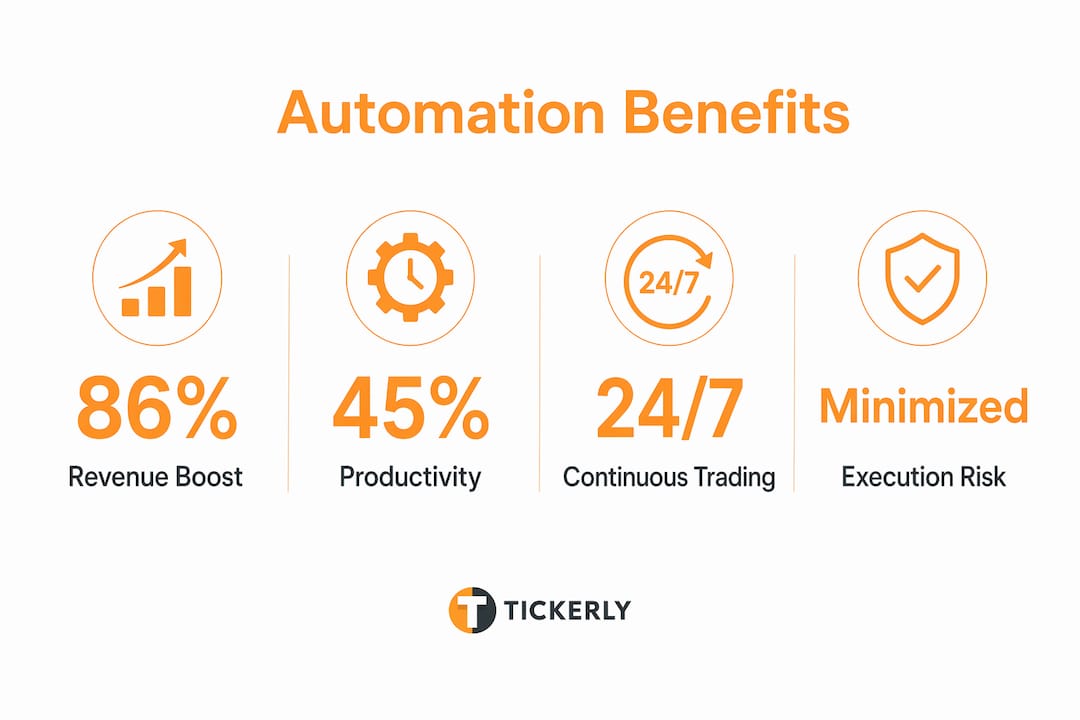
The performance data on automation adoption is direct. Early adopters report 86% revenue increases and 45% productivity improvements compared to organizations still running manual processes. For traders, productivity improvement means more valid setups captured per day, more markets covered simultaneously, and faster recovery from drawdown periods because the system detects deteriorating performance before it becomes catastrophic.
Consider the difference in how each approach handles a sudden volatility spike. A manual trader monitoring three charts might miss the signal on the fourth. An automated system running across all four assets simultaneously fires the alert and executes the response in the same instant. That asymmetry compounds over hundreds of trading sessions.
Cost efficiency is a concrete, measurable benefit. Automated systems reduce the time you spend on repetitive execution tasks, freeing you to focus on strategy development, market research, and risk review. The 30% cost reduction achieved in regulated financial workflows through agentic AI reflects the same dynamic at an institutional scale.
-
Emotion-free execution: Automated bots do not revenge trade, overtrade after a win streak, or freeze during high-volatility events.
-
Faster issue detection: Real-time monitoring identifies strategy degradation weeks before a manual review would catch it.
-
Scalable diversification: Running five uncorrelated strategies simultaneously is operationally straightforward with automation and practically impossible without it.
For traders exploring automated portfolio rebalancing, the compounding benefit of consistent rebalancing without manual intervention is one of the clearest demonstrations of automation’s long-term value.
Key takeaways
Strategy automation delivers its greatest value when you combine disciplined process mapping with the right execution architecture and continuous performance measurement across all three metric layers.
| Point | Details |
|---|---|
| Process mapping comes first | Define your strategy logic completely before selecting or deploying any automation tool. |
| Measure three metric layers | Track activity, outcome integrity, and business impact to avoid stalled automation projects. |
| Separate logic from execution | Keep strategy rules and order routing in distinct modules to prevent backtesting errors in live deployment. |
| Governance is non-negotiable | Audit-ready logs and tiered human oversight protect you in regulated financial markets. |
| Start small, then scale | Prove value on one workflow before expanding to multi-strategy, multi-asset automation. |
The measurement gap most traders never close
I have watched traders deploy technically sound automation setups and still underperform their backtests by a wide margin. The reason is almost always the same: they measure activity and ignore outcome integrity. They know how many trades fired. They do not know whether slippage is eating 40% of their theoretical edge, or whether their exit logic is triggering two candles later than the backtest assumed.
The traders who build lasting edges with automation are the ones who treat it as a continuous improvement process, not a one-time setup. They review performance weekly, update their walk-forward validation windows monthly, and treat every deviation from backtest expectations as a diagnostic signal rather than noise. Patience during the calibration phase is what separates profitable automation from expensive frustration.
If you are new to this process, the automation strategies for beginners resource from Tickerly is a practical starting point for building that discipline from day one.
— Jay
Put your TradingView strategy to work with Tickerly
Tickerly converts your TradingView Pine Script strategies into fully operational trading bots without requiring you to write a single line of execution code. It connects directly to crypto, forex, and stock exchanges via API, firing orders in milliseconds from TradingView alerts. The platform handles multiple strategies simultaneously, giving you the diversification and continuous coverage that manual trading cannot match.
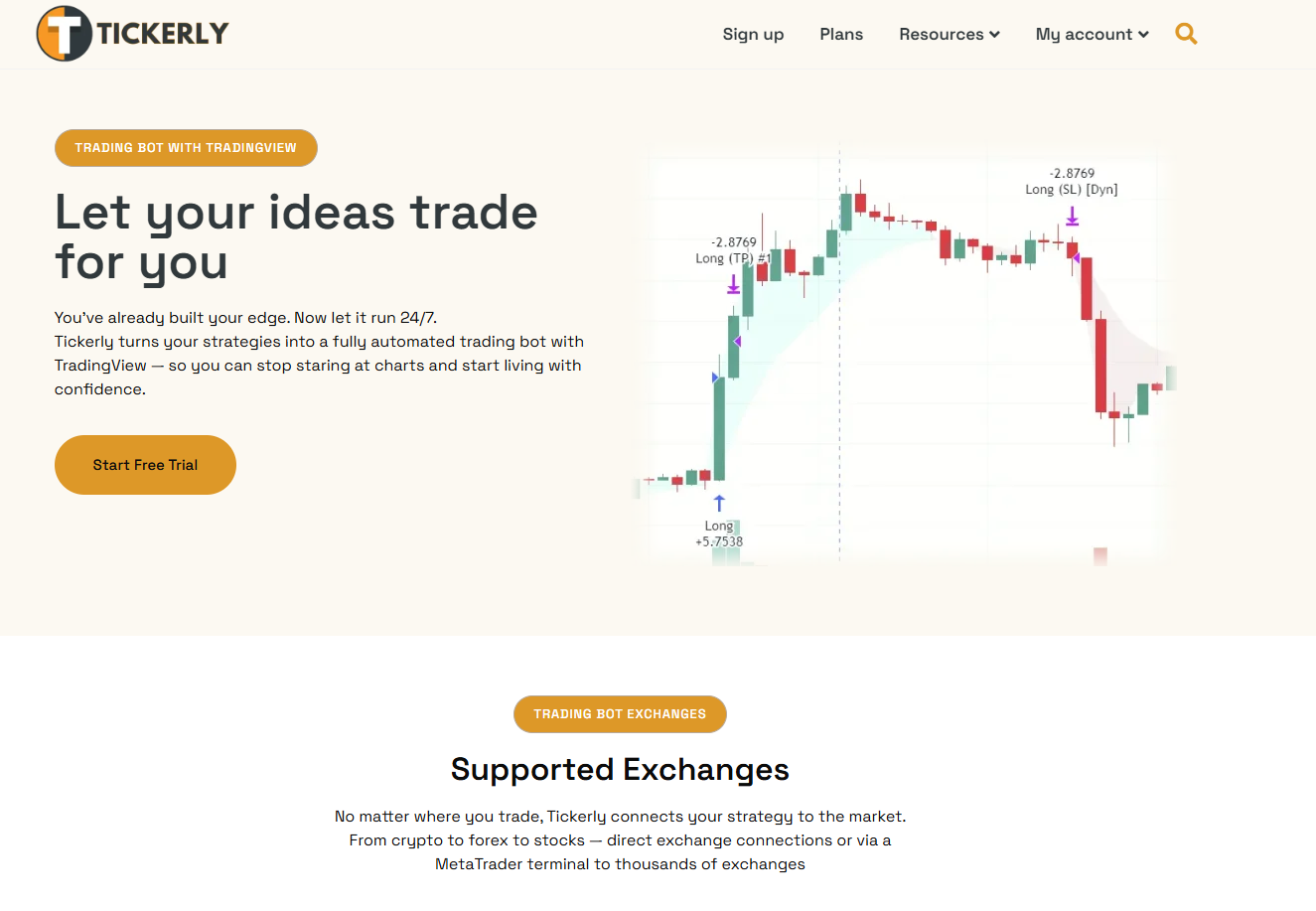
If you want to understand the full scope of what automated bots deliver in terms of efficiency and profitability, the automated bots benefits page on Tickerly walks through the specific advantages in detail. For traders ready to move from TradingView backtests to live execution, the step-by-step integration guide covers the complete setup process. Tickerly’s architecture keeps your strategy logic separate from execution, which directly addresses the backtesting accuracy and live deployment gap discussed throughout this article.
FAQ
What is strategy automation in trading?
Strategy automation is the use of software to continuously execute and adjust trading strategies based on predefined rules, replacing manual order entry with real-time, algorithm-driven execution across financial markets.
Why choose strategy automation over manual trading?
Automated systems execute trades in milliseconds, operate 24/7 without fatigue, and apply strategy rules consistently. Early adopters report 86% revenue increases and 45% productivity improvements compared to manual approaches.
What are the biggest risks of trading automation?
The primary risks are automating a poorly defined strategy and skipping realistic execution modeling. Walk-forward validation combined with accurate slippage and fee modeling is the standard method for closing the gap between backtest and live performance.
How do I measure whether my automation strategy is working?
Track three layers: activity metrics (trades executed), outcome integrity metrics (error rates, slippage), and business impact metrics (P&L change, Sharpe ratio). Most traders only track activity, which is why only 5% of scaling projects realize their full projected value.
Does strategy automation require coding skills?
Not with modern no-code platforms. Tickerly, for example, connects TradingView Pine Script strategies to live exchanges through a webhook-based API without requiring custom execution code from the trader.