

TL;DR:
- Grid trading is an automated strategy that places buy and sell orders at fixed intervals, profiting from market oscillation within a range. It works best in volatile, range-bound markets like crypto and forex, but requires careful parameter tuning and active risk management to prevent losses during trending markets. Proper setup, backtesting, and disciplined lot sizing are essential for consistent profitability.
Grid trading is an automated strategy where buy and sell orders are placed at fixed price intervals above and below a set price, capturing profit from market oscillation without predicting direction. Unlike trend-following systems, grid trading profits from volatility itself. That makes it a natural fit for crypto and forex markets, where prices frequently swing within defined ranges. This guide covers how the grid trading strategy works mechanically, what risks you must manage, how to configure your parameters, and how automated grid trading compares to other algorithmic methods.
What is grid trading and how does it work?
Grid trading is defined as a systematic method of placing layered buy and sell orders at predetermined price intervals, forming a “grid” across a price range. Grid trading profits from price oscillation within defined horizontal levels, buying as price moves down the grid and selling as price moves up, capturing the spread between each level. The strategy requires no directional forecast. You simply define a range, set your intervals, and let the bot execute.

The mechanics of a grid setup
Setting up a grid involves three core parameters: the price range (upper and lower bounds), the number of grid levels, and the order size per level. A trader running EUR/USD on a 1.0800 to 1.1000 range with 10 levels would place buy orders every 20 pips below the midpoint and sell orders every 20 pips above it. Each time price crosses a grid line, one order fills and the next order in the opposite direction is queued.
Here is how a standard grid cycle runs:
- Define the range. Set upper and lower price boundaries based on recent consolidation zones or support and resistance levels.
- Set grid intervals. Divide the range into equal spacing. More levels mean smaller profits per trade but more frequent fills.
- Place layered orders. Buy limit orders sit below the current price; sell limit orders sit above it.
- Capture the spread. Each completed buy-then-sell cycle at adjacent grid lines generates a small, repeatable profit.
- Reinvest or lock profits. After a net profit threshold is reached, re-base the grid to the new price center.
Automation handles all of this in real time. Grid trading bots on platforms like Binance, Bybit, and TradingView execute orders the moment price touches a level, with no manual input required. Automation tools reduce emotional bias and enable continuous market participation, though they require ongoing parameter adjustments to remain effective.
Pro Tip: Set a minimum of 8–10 grid levels within your range. Fewer levels mean wider spacing, which reduces fill frequency and lowers the compounding effect of repeated cycles.
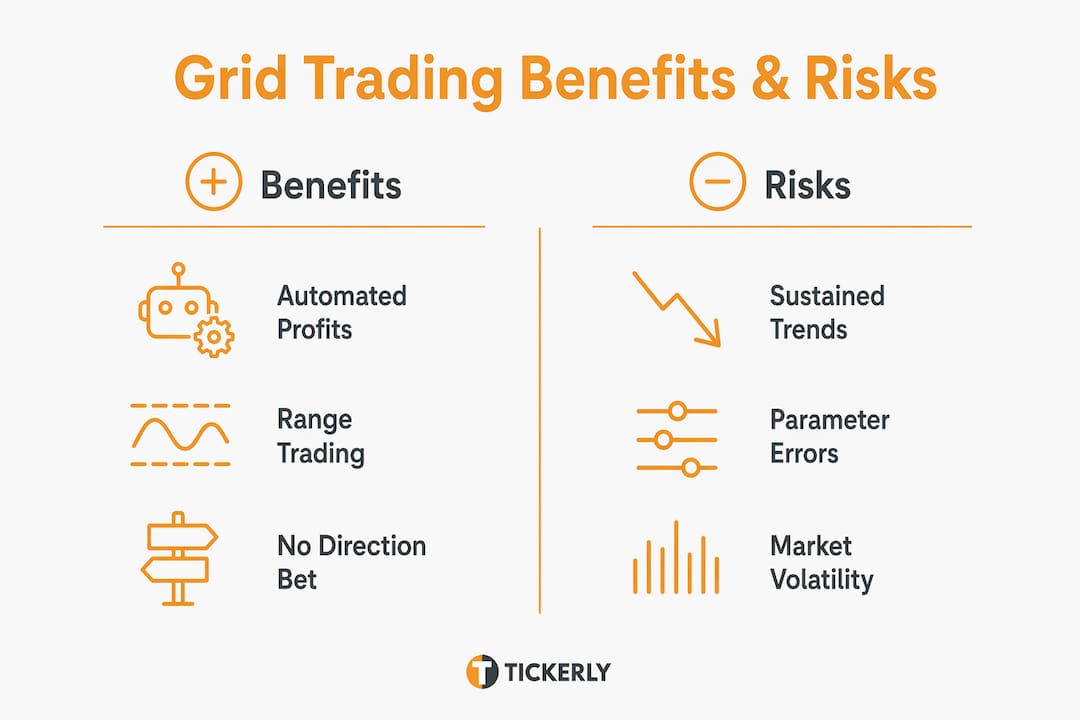
What are the key benefits and risks of grid trading?
Grid trading’s core strength is that it removes the need for directional forecasting, excelling in consolidation ranges but faltering in breakouts that cause capital-weighted losses. That is a significant edge. Most retail traders lose money trying to predict market direction. Grid trading sidesteps that problem entirely.
Benefits worth knowing
- No directional bias required. The strategy profits whether price moves up or down within the grid, as long as it keeps oscillating.
- Continuous execution. Bots run 24/7 across crypto and forex markets, capturing cycles while you are offline.
- Emotion-free trading. Automated order placement removes the hesitation and overtrading that plague manual traders.
- Scalable across assets. You can run simultaneous grids on BTC/USDT, ETH/USDT, and EUR/USD with independent parameters for each.
- Consistent small profits. In volatile but sideways markets, grid trading generates multiple profitable cycles that compound over time.
Risks you cannot ignore
Grid trading is most effective in range-bound markets. Strong directional trends expose one side of the grid to cascading losses, and equity stop-out limits are often set at 10% of capital to prevent catastrophic drawdowns.
The biggest risk is a sustained trend. If EUR/USD breaks above your upper grid boundary and keeps climbing, all your sell orders fill at a loss while your buy orders never trigger. Margin requirements grow as open positions accumulate on the wrong side. Proper lot sizing per order typically targets 1–2% of account equity per full grid cycle to contain this exposure. Without that discipline, a single trending week can wipe out weeks of grid profits.
How to configure and optimize a grid trading strategy
Grid trading requires rigorous parameter tuning. Its complexity lies more in range and grid spacing determination than in trade execution itself. Getting these numbers right separates consistently profitable grids from ones that bleed slowly.
Choosing your range and spacing
The price range should reflect recent consolidation behavior. Look at the asset’s 30-day price history and identify the high and low of the dominant sideways zone. Avoid setting boundaries too tight. A range that is too narrow gets broken frequently, forcing you to reset the grid and incur costs.
Grid spacing is where most beginners make costly errors. Setting spacing too tight, narrower than twice the trading fees, results in non-profitable or losing cycles. The recommended spacing is approximately 1–1.5 times the asset’s Average True Range (ATR). ATR measures average daily price movement, so spacing at that level gives each grid level enough room to fill and reverse before the next level triggers.
Pro Tip: Pull the 14-period ATR on your asset’s daily chart before setting grid spacing. If BTC/USDT has a 14-day ATR of $1,200, set grid intervals at $1,200 to $1,800 per level for optimal cycle frequency.
Parameter comparison: tight vs. optimal grid spacing
| Parameter | Tight spacing (below 2x fees) | Optimal spacing (1–1.5x ATR) |
|---|---|---|
| Fill frequency | Very high | Moderate |
| Profit per cycle | Near zero or negative | Positive after fees |
| Drawdown risk | High (whipsaw losses) | Controlled |
| Recommended use | Never | Volatile, range-bound assets |
| Stop-loss placement | Difficult to set | Outside range boundary |
Expert advisors recommend setting grid parameters dynamically using indicators like ATR for spacing and stop-loss orders to limit exposure and avoid cascading losses. A stop-loss placed just outside the grid boundary caps your maximum loss on a breakout. Without it, you are fully exposed to a trending move.
Grid trading is not a set-and-forget system. Active monitoring for market condition changes and re-basing the grid after locking net profits prevents unintended capital exposure as market structure shifts.
How does grid trading compare to other automated strategies?
Grid trading differs from trend-following and scalping strategies by relying on price range oscillation rather than directional bias or execution speed. Each method has a specific market environment where it performs best.
| Strategy | Market condition | Directional bias | Execution speed | Parameter complexity |
|---|---|---|---|---|
| Grid trading | Range-bound, volatile | None | Low to moderate | High (range, spacing, sizing) |
| Trend-following | Trending markets | Required | Moderate | Moderate |
| Scalping | Any, high liquidity | Minimal | Very high | Low to moderate |
| Mean reversion | Range-bound | Minimal | Moderate | Moderate |
Trend-following algorithms like moving average crossover systems need a clear directional move to generate returns. In a choppy, sideways market, they produce false signals and losses. Grid trading thrives in exactly that environment. Scalping algorithms depend on ultra-low latency and tight bid-ask spreads, making them hardware-intensive and broker-dependent. Grid bots, by contrast, work on standard API connections with no special latency requirements.
The tradeoff is parameter complexity. Scalping bots have relatively simple entry and exit logic. Grid bots require you to define range, spacing, order count, lot size, and stop-loss levels before deployment. Backtesting each configuration on historical data is non-negotiable before going live. Platforms like TradingView support algo trading on TradingView with Pine Script, letting you backtest grid logic across years of price data before committing capital.
Key Takeaways
Grid trading profits from price oscillation within a defined range, requiring no directional forecast, but demands disciplined parameter tuning and active risk management to avoid drawdown in trending markets.
| Point | Details |
|---|---|
| Core mechanism | Buy and sell orders placed at fixed intervals capture profit from price oscillation. |
| Best market condition | Range-bound, volatile markets like crypto and forex produce the most consistent grid cycles. |
| Critical risk | Sustained directional trends expose one side of the grid, requiring stop-losses and 1–2% equity sizing per cycle. |
| Spacing rule | Set grid intervals at 1–1.5x ATR to cover fees and generate positive cycles. |
| Not set-and-forget | Re-base the grid after locking profits and monitor for market condition changes actively. |
My take on grid trading after watching traders deploy it
Grid trading looks deceptively simple on paper. Place orders at intervals, collect the spread, repeat. The traders I have seen struggle with it almost always make the same mistake: they set the grid and walk away. They treat automation as a substitute for judgment. It is not.
The parameter tuning phase is where grid trading actually lives or dies. I have watched traders run profitable grids for three weeks, then lose two months of gains in four days because a news event broke the range and they had no stop-loss in place. The automation handled execution perfectly. The human failed at risk architecture.
The other underrated factor is asset selection. Grid trading on a low-volatility asset with tight spreads generates almost nothing. The strategy needs movement. BTC/USDT and ETH/USDT in 2025 and 2026 have provided exactly the kind of high-amplitude, range-bound volatility that grid bots exploit well. EUR/USD during low-news periods is another solid candidate.
My honest recommendation: run your grid configuration through at least 90 days of backtesting before live deployment. Check the algo trading pitfalls that trip up even experienced traders. Then start with a small allocation, confirm the live behavior matches your backtest, and scale from there. Grid trading rewards patience and precision. It punishes overconfidence.
— Jay
Run your grid trading strategy with Tickerly
If you are ready to move from theory to live execution, Tickerly connects your TradingView grid strategies directly to your exchange account via API, with no manual order management required.
Tickerly’s execution speed means your grid orders hit the market the moment a price level triggers, with no lag that could cost you a fill. You can run multiple grid configurations simultaneously across crypto, forex, and stock markets, each with independent parameters. The platform handles order routing, position tracking, and real-time alerts so you stay informed without being chained to a screen. Explore automated trading bots to see how Tickerly turns your TradingView strategy into a fully operational grid bot today.
FAQ
What is grid trading in simple terms?
Grid trading is an automated strategy that places buy and sell orders at fixed price intervals, profiting from price oscillation within a defined range without requiring any directional market forecast.
Is grid trading profitable?
Grid trading is profitable in range-bound, volatile markets where price oscillates between levels repeatedly. In strong trending markets, it accumulates losses on the exposed side of the grid, making stop-loss placement and proper lot sizing critical.
What markets work best for grid trading?
Crypto pairs like BTC/USDT and ETH/USDT and forex pairs like EUR/USD during consolidation periods are the most effective markets for grid trading, due to their high volatility within defined price ranges.
How do I set grid spacing correctly?
Set grid spacing at 1–1.5 times the asset’s 14-period Average True Range (ATR). Spacing narrower than twice your trading fees produces non-profitable cycles after costs.
Can beginners use automated grid trading?
Yes, but beginners should backtest every configuration for at least 90 days before going live, start with small position sizes targeting 1–2% equity risk per full grid cycle, and use a stop-loss outside the grid boundary to cap downside on breakouts.