

TL;DR:
- Automated trend detection uses AI and real-time data pipelines to identify market shifts without manual input. It offers speed, accuracy, and scalability, enabling traders to respond quickly to emerging trends across multiple assets. Human review remains essential to filter noise and confirm signals, ensuring more reliable trading decisions.
Trend detection automation is defined as the use of AI-driven algorithms and real-time data pipelines to continuously identify, classify, and alert traders to emerging market shifts without manual intervention. The industry term for this practice is automated trend analysis, and it sits at the intersection of machine learning, predictive analytics, and execution speed. Platforms like WGSN and Genz.ai have pushed the technology forward, with enterprise-grade systems now processing data from over 2,800 sources and delivering alerts within minutes of trend emergence. For traders in crypto, forex, and equities, this capability is the difference between entering a move early and chasing it after the fact.
How does trend detection automation work in financial markets?
Automated trend analysis starts with data ingestion. A modern system pulls simultaneously from price feeds, order book data, social platforms, news APIs, and on-chain metrics. The breadth matters because no single source captures the full picture of a developing market move.

Once data is collected, algorithms evaluate three core signals: velocity (how fast a trend is growing), acceleration (whether growth is speeding up or slowing down), and sentiment (whether the conversation around an asset is positive, negative, or shifting). Analyzing velocity and acceleration together is what separates genuine breakout detection from false positives. High velocity alone can indicate a peak rather than the start of a move, which is a critical distinction for position sizing.
Sophisticated systems then map signals against lifecycle stages: baseline, emerging, growing, peaking, declining, and viral. Each stage calls for a different trading response. A signal in the “emerging” stage warrants a small exploratory position; a “peaking” signal may call for profit-taking or a short setup. This lifecycle framework gives traders a structured way to interpret what the algorithm is telling them rather than reacting to raw numbers.
The final layer is the analyst-in-the-loop framework. Algorithmic outputs require human review to filter noise and confirm signal quality before action is taken. This is not a weakness of the technology. It is a deliberate design choice that keeps the system honest and prevents automated systems from acting on corrupted or anomalous data.
-
Data ingestion layer: Aggregates price, sentiment, social, and on-chain data in real time
-
Signal processing layer: Calculates velocity, acceleration, and sentiment scores per asset
-
Lifecycle classification layer: Tags each signal with a trend stage for context
-
Alert delivery layer: Pushes structured alerts to dashboards, bots, or execution platforms
Pro Tip: Set your system to flag both velocity and acceleration simultaneously. A trend with high velocity but declining acceleration is approaching its peak, not its beginning.
What are the main benefits of automated trend detection for traders?
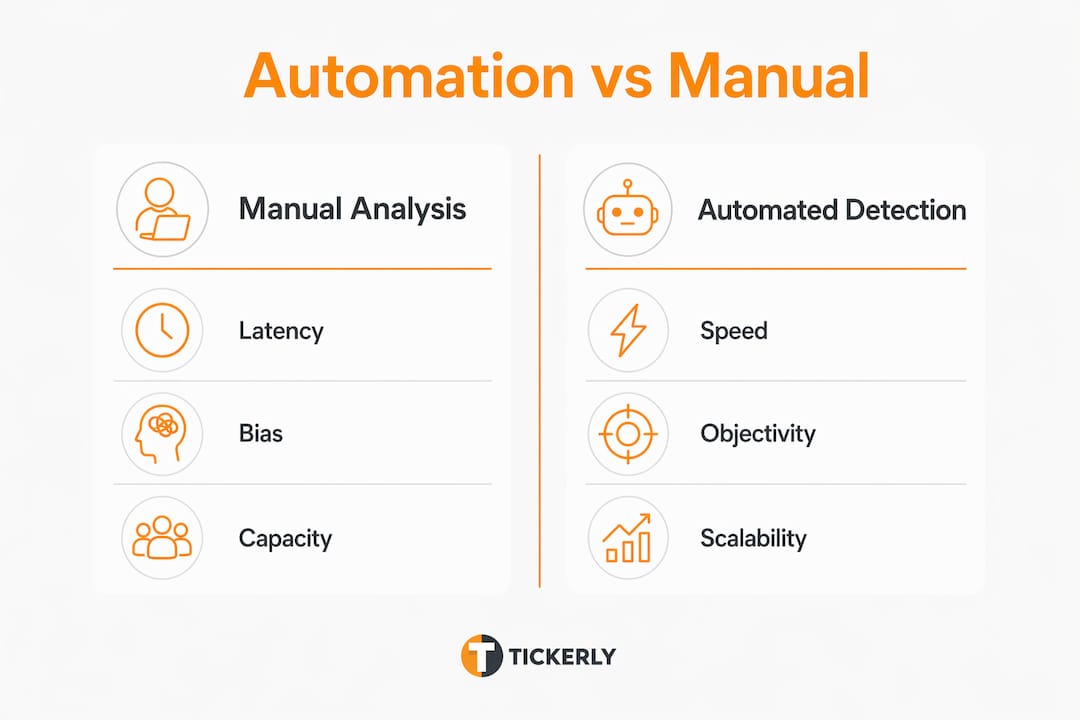
The most direct benefit is speed. Real-time trend detection systems operate with 99.9% uptime and deliver alerts within minutes of trend emergence. In liquid markets, minutes translate directly into entry price quality and risk-adjusted returns.
Accuracy is the second major advantage. Leading AI platforms report viral content prediction accuracy exceeding 85%, with enterprise systems processing over 100,000 social posts per month. That scale of data processing is physically impossible for a human analyst working in real time, which means automation captures signals that manual monitoring misses entirely.
The financial impact is measurable. Professional trend intelligence solutions have generated over $500,000 incremental revenue for retail users through predictive trend identification. While that figure comes from retail assortment analytics, the underlying mechanism, acting on trend signals before the broader market, applies directly to trading.
-
Reduced latency: Alerts fire within minutes, not hours, giving you a structural edge over manual monitoring
-
Higher signal accuracy: AI models filter noise and weight sentiment alongside volume for cleaner signals
-
Scalability: One system monitors hundreds of assets simultaneously across crypto, forex, and equities
-
Noise reduction: Automated filtering removes low-quality signals before they reach your dashboard
-
Decision support: The system surfaces the “what” and “when” so you can focus on the “why”
“AI does not replace human judgment but acts as a foundation for evidence-based decision making, providing ‘what’ and ‘when’ while humans provide the ‘why’ and context.” — Enstyle AI
This framing matters for traders who worry that automation removes their edge. The opposite is true. Automation removes the cognitive load of monitoring, freeing you to apply judgment where it actually creates alpha.
How does automated trend detection compare to manual analysis?
Manual trend analysis has three structural limits: latency, cognitive bias, and capacity. A human analyst monitoring five assets across three timeframes is already near their processing ceiling. Add news flow, social sentiment, and order book dynamics, and the signal-to-noise ratio collapses fast.
Automation removes all three constraints. A well-configured system monitors unlimited assets, processes multi-source data continuously, and applies consistent logic without fatigue or confirmation bias. Tracking conversation volume alone can be misleading; automated systems that incorporate sentiment and influencer impact produce materially better signals than volume-only approaches. This is where many manual traders go wrong: they see a spike in mentions and interpret it as bullish momentum without checking whether the sentiment is actually positive.
| Factor | Manual analysis | Automated trend detection |
|---|---|---|
| Monitoring speed | Hours to days | Minutes to seconds |
| Data sources | 3 to 10 typically | 2,800+ simultaneously |
| Bias risk | High (confirmation, recency) | Low (algorithm-consistent) |
| Scalability | Limited by analyst capacity | Unlimited assets and markets |
| Sentiment analysis | Qualitative, inconsistent | Quantified, continuous |
| Operating hours | Business hours only | 24/7 with 99.9% uptime |
| Cost at scale | Increases linearly with assets | Fixed infrastructure cost |
The table makes the efficiency case clearly. But the more important point is qualitative: manual analysis and automated trend monitoring are not competing approaches. They are complementary layers. Automation handles the surveillance and classification work; human judgment handles the interpretation and execution decisions.
How to integrate automated trend detection into your trading strategy
The starting point is workflow compatibility. Automation achieves highest value when it integrates into existing dashboards and execution platforms, allowing immediate action on alerts without switching contexts. If your system requires you to leave your trading platform to check a separate trend dashboard, you will use it inconsistently.
For traders using TradingView, the integration path is well-established. Pine Script strategies can be configured to fire alerts based on trend signals, which then route directly to execution bots via webhook. Tickerly’s TradingView automation setup covers this workflow in detail, including how to structure alert messages for clean bot execution. Pairing this with trend following strategies built specifically for TradingView gives you a complete pipeline from signal detection to trade execution.
-
Choose tools that fit your existing stack: Prioritize platforms with native API connections to your broker or exchange
-
Set tiered alerts: Use separate alert thresholds for “emerging” signals (small position) versus “growing” signals (full position)
-
Backtest your alert logic: Confirm that your trend detection parameters produce positive expectancy before going live
-
Combine sentiment with price action: Never act on a trend alert that contradicts your price-based technical setup
-
Review weekly: Audit which alerts led to profitable trades and which were noise, then adjust parameters accordingly
Pro Tip: Avoid configuring alerts based purely on volume spikes. A spike without positive sentiment confirmation is more likely a news-driven anomaly than a sustainable trend. Always require both signals to align before executing.
The most common integration mistake is over-automation. Traders who remove all human review from the alert-to-execution pipeline often find that edge cases, data anomalies, and flash events trigger positions that a human would immediately recognize as invalid. Keep at least one human checkpoint in the workflow, particularly for larger position sizes.
What future developments are shaping trend detection automation?
The next generation of trend detection systems is being built on event-driven microservices architecture, which improves both the speed and reliability of real-time data processing. This architectural shift means systems can handle larger data volumes with lower latency, which is particularly relevant for high-frequency crypto and forex strategies where milliseconds matter.
AI model improvements are moving in two directions simultaneously. Sentiment analysis is becoming more granular, with models now capable of distinguishing between organic community sentiment and coordinated influencer campaigns. This distinction is critical for crypto markets, where influencer-driven pumps can mimic genuine trend signals at the surface level.
Predictive market simulations represent the most forward-looking development. Rather than simply detecting trends that have already begun, next-generation systems will model probable trend trajectories based on historical lifecycle patterns and current market conditions. For traders, this means receiving a probability-weighted forecast alongside the trend signal, not just a binary alert.
Personalization is also advancing rapidly. Systems are moving toward user-specific alert calibration, where the algorithm learns your trading style, risk tolerance, and preferred asset classes and adjusts signal thresholds accordingly. Combined with AI trend analysis applied to financial markets, this creates a feedback loop that improves signal quality over time based on your actual trading outcomes.
Key takeaways
Trend detection automation delivers its highest value when AI-generated signals are combined with human judgment, structured lifecycle analysis, and workflow-integrated alert systems.
| Point | Details |
|---|---|
| Speed advantage | Automated systems deliver alerts within minutes, versus hours for manual monitoring. |
| Accuracy at scale | AI platforms process 2,800+ sources with 85%+ prediction accuracy, far beyond manual capacity. |
| Lifecycle classification | Tagging signals as emerging, growing, or peaking determines the correct trading response. |
| Sentiment over volume | Volume spikes without sentiment confirmation produce misleading signals; require both to align. |
| Human-AI integration | Automation handles surveillance; human judgment handles interpretation and final execution decisions. |
Put your trend signals to work with Tickerly
Detecting a trend is only half the equation. Acting on it before the window closes is where the real edge lives.
Tickerly converts your TradingView strategies and trend-based alerts into fully automated trading bots that execute across crypto, forex, and stock exchanges with zero latency from signal to order. You set the alert logic in TradingView, Tickerly handles the execution. The result is a complete pipeline from trend detection to live trade, running continuously without manual intervention. If you are ready to stop watching signals and start acting on them, automated bot trading is the logical next step. You can also explore the best trading bots for 2026 to find the right setup for your strategy.
FAQ
What is trend detection automation in trading?
Trend detection automation is the use of AI algorithms and real-time data pipelines to continuously identify and classify emerging market trends without manual monitoring. Systems analyze price, sentiment, and social data simultaneously to deliver structured alerts to traders.
How accurate are automated trend detection systems?
Leading AI platforms report prediction accuracy exceeding 85%, with enterprise systems processing data from over 2,800 sources. Accuracy improves further when sentiment analysis is combined with volume and velocity signals rather than relying on any single metric.
Can automated trend detection replace a human trader?
Automated trend detection does not replace human judgment. It provides the “what” and “when” of a trend signal while the trader supplies the “why” and the final execution decision, which is the analyst-in-the-loop model used by professional-grade systems.
How do I connect trend detection alerts to automated trade execution?
The most direct path for TradingView users is to configure Pine Script alerts that fire via webhook to an execution bot. Tickerly’s automated trading setup connects TradingView alerts directly to exchange order execution with minimal configuration.
What is the biggest mistake traders make with trend automation?
Acting on volume spikes without sentiment confirmation is the most common error. A spike in mentions or trading volume without corresponding positive sentiment is more likely a news anomaly than a sustainable trend, and automated systems must be configured to require both signals before firing an alert.