

Building reliable trading strategy automation that connects seamlessly to both exchanges and platforms like TradingView usually means stitching together multiple tools or settling for closed bot libraries you cannot modify. Many options either lock core automation features behind expensive plans, require steep scripting expertise, or pause new signups for months at a time. This comparison details pricing, scripting flexibility, group management, and signup availability for five trading automation platforms so you can choose a Traderspost.io alternative that fits your speed, control, and workflow needs right now.
Table of Contents
Tickerly
At a Glance
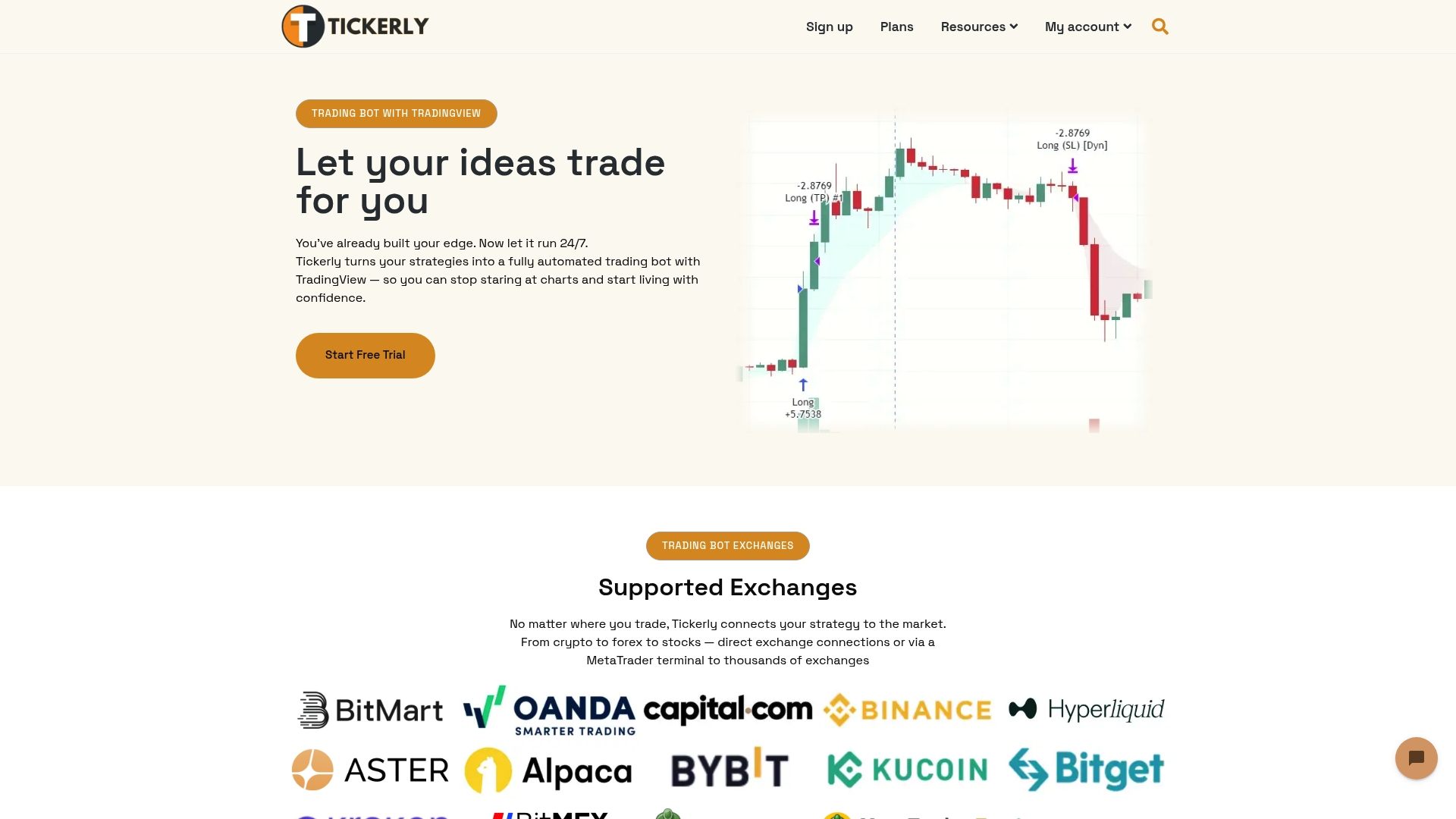
The vendor advertises industry-leading execution speed by running dedicated servers close to major exchanges, a setup meant to cut latency and slippage for live orders. That execution claim is the clearest technical advantage called out in the product data.
Tickerly links your TradingView alerts directly to exchange execution while adding scripting hooks for risk rules and position sizing. The platform targets traders who want fast, repeatable automation across many asset classes.
Core Features
Connects TradingView strategies to exchanges so alerts become live orders with minimal wiring. Traders can map multiple strategies to a single ticker or coin pair.
Fast trade execution runs via near-exchange servers to reduce roundtrip time. Built-in scripting supports position sizing and stop-loss enforcement inside automation logic.
Multi-asset support spans crypto, forex, stocks, indices, commodities, metals, bonds and decentralized exchanges. The onboarding flow and tiered account levels let traders scale active strategies and alert volumes.
Key Differentiator
The platform’s main advantage is its ability to automate any TradingView strategy script into a trading bot, regardless of complexity or trading logic, without requiring any special setup.
Who It’s For
Active traders and strategy developers who already work in TradingView and want reliable automation without building their own execution stack. It fits traders who value low latency and multi-asset reach and who can write or maintain the scripts that encode risk rules.
Less fit for beginners who expect a hands-off managed strategy service.
Unique Value Proposition
Directly turning TradingView strategy signals into live orders across exchanges is the most concrete promise here. That direct link shortens the integration path from idea to execution and preserves the scripting logic traders author in TradingView.
For traders who iterate strategies daily, that workflow reduces friction and the time between updating a script and seeing it run in the market.
Real World Use Case
A forex trader wires a Pine Script strategy to Tickerly, configures stop-loss and position sizing rules inside the platform, and routes orders to Oanda. The trader removes manual trade entry, enforces consistent risk per signal, and focuses on improving the strategy rather than clicking fills.
Pricing
Pricing starts at Level 2 for $19 per month, rises to Level 3 at $29 per month and Level 4 at $39 per month. Each tier includes a 30-day free trial and increases the number of active strategies and alert allowances.
Website: https://tickerly.net
Traiders
At a Glance
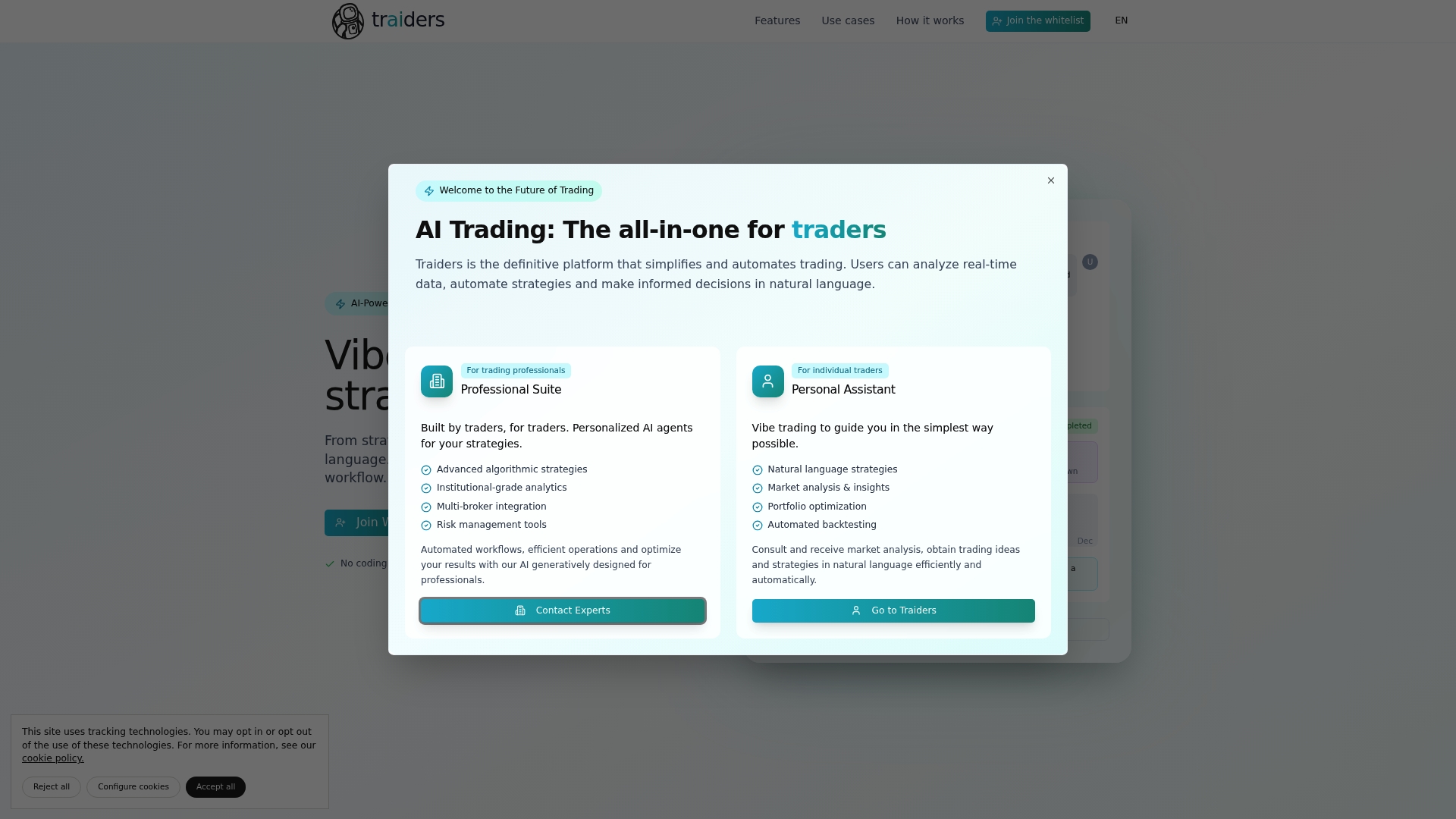
You can build, test, and deploy algorithmic strategies using plain English instructions rather than code. The platform pairs that natural language workflow with APIs for large-scale backtesting and deployment, making it useful for both individual traders and institutional teams.
Core Features
Traiders supports natural language strategy creation and optimization, letting you describe entry, exit, and position sizing in conversational terms. It includes backtesting on historical data and real-time market data for live execution. The platform also offers broker connections and compliance audit trails for institutional needs.
Key Differentiator
The standout is the natural language interface that converts strategy descriptions into executable logic. That approach removes most coding barriers and speeds iteration, so strategy refinement happens in plain commands instead of editing scripts or templates.
Pros
-
User-friendly AI assistant simplifies creating strategies, which reduces the time from idea to test compared with code-first tools.
-
Backtesting and advanced optimization tools let you iterate parameter sets using conversational adjustments rather than manual tuning.
-
Broker connectivity to platforms like MetaTrader and Binance supports multi-exchange deployment for crypto and FX traders.
-
API access is available for batch backtests and automation, which suits quant teams running large experiment sets.
Cons
-
Publicly available user reviews are sparse, so real-world satisfaction and edge cases are hard to verify from outside sources.
-
Traders unfamiliar with algorithmic concepts may still face a learning curve despite the no-code interface.
-
The product description offers limited detail about security and data privacy practices, leaving unanswered operational questions for compliance teams.
When It May Not Fit
If you require audited, third-party user reviews before procurement, Traiders may feel risky; the review footprint is thin. If your team relies on in-house, hand-coded execution logic and full control over low-level order mechanics, a code-first engine may serve you better.
Notable Integrations
-
MetaTrader
-
Binance
Who It’s For
Traders and trading desks that want to move from idea to live execution without building code. Also relevant for institutional teams that need audit trails and API-driven batch backtesting for model validation.
Real World Use Case
A quantitative trader drafts a momentum rule in plain language, backtests it across three years of crypto data, then uses the API to run a grid of parameter optimizations. After finding a robust parameter set, the trader deploys the strategy to multiple exchanges for live execution.
Pricing
Pricing is not published in the product data and appears to require contacting the vendor for plan details. Expect enterprise licensing or usage-based pricing for institutional API access and custom compliance features.
Website: https://traiders.io
Lexx Trade Platform
At a Glance
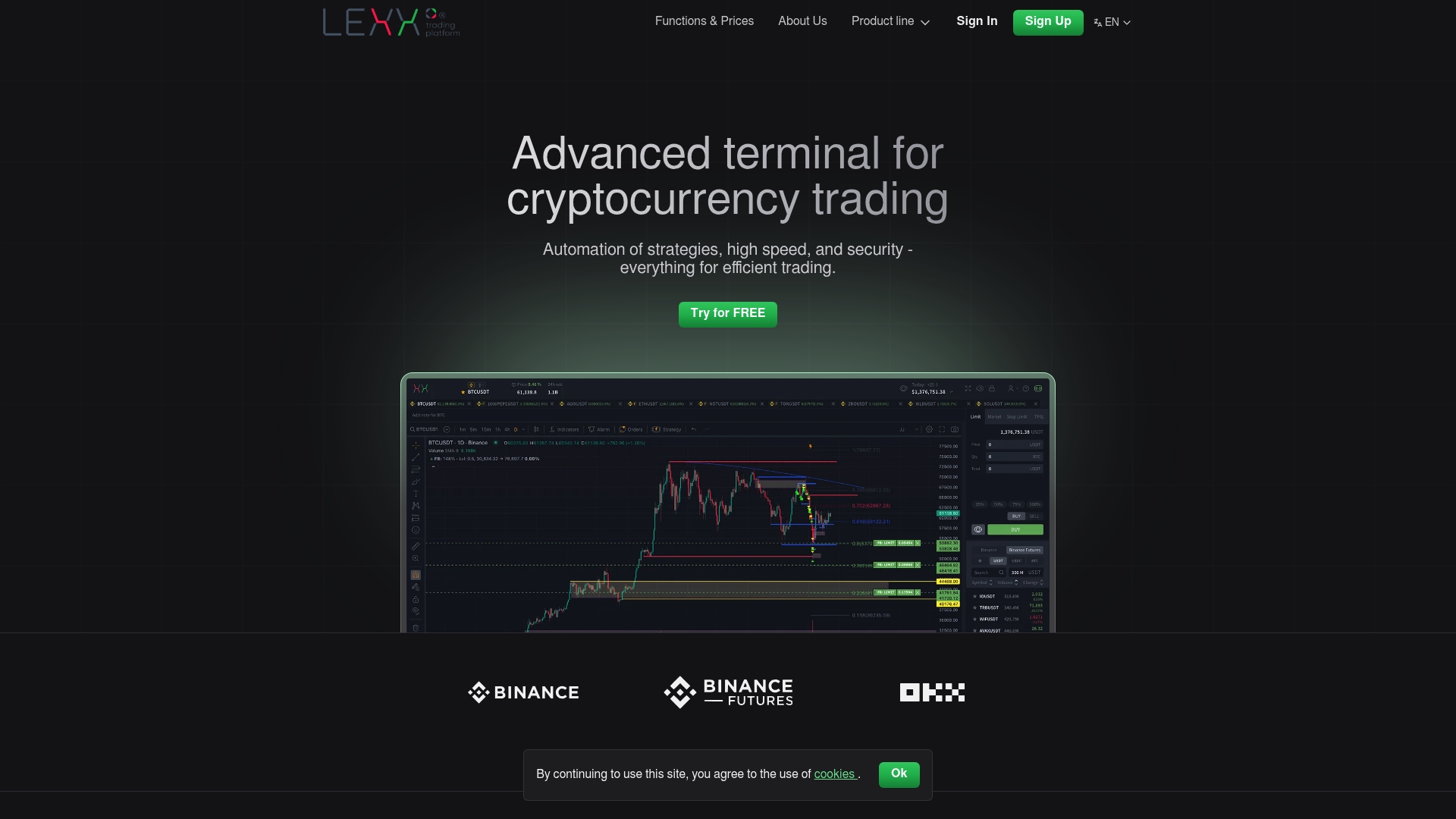
The vendor advertises a fastest exchange connection of 0.01 seconds, a headline figure aimed at execution-sensitive traders. Lexx acts strictly as a trading terminal: it does not custody funds or open exchange accounts for users.
Core Features
Lexx offers strategy automation for continuous 24/7 execution and a fast, user-friendly interface that keeps charts and order controls in the same view. The platform supports multiple strategies and assets concurrently and includes market monitoring with real-time notifications.
Trade management is chart-native. You can place orders, set breakeven, and display liquidation levels directly on visual charts powered by TradingView. That visual control reduces context switching during high-frequency windows.
Key Differentiator
What separates Lexx is the combination of its speed claim and deep interface customization. For active traders the platform’s layout options and per-strategy controls let you keep many strategies live without losing situational awareness. That 0.01s claim is the promise that underpins the product’s positioning toward low-latency traders.
Pros
-
High execution focus improves order responsiveness. The product data highlights a fastest connection window that appeals to traders running rapid entries and exits.
-
Runs multiple strategies and assets simultaneously, which reduces the need to juggle separate terminals when you manage a portfolio of bots or manual rules.
-
Cross-device interface customization lets you tune layouts for a desktop command center or a compact laptop trading station.
-
Telegram notifications and market alerts keep you informed when a strategy triggers or an order fills without staying glued to a screen.
-
Dedicated technical support and training resources shorten the learning curve for advanced features and automation workflows.
Cons
-
Public feedback is limited. The product has mixed and low-volume Trustpilot entries, so user sentiment is uncertain from external sources.
-
It is not an all-in-one broker. The platform’s refusal to manage funds or open accounts means extra setup with exchanges for many users.
-
Pricing detail beyond a basic free plan and monthly subscriptions is sparse in available materials, which complicates total-cost planning for high-volume traders.
When It May Not Fit
If you want a single vendor to custody funds, handle KYC, and run accounts for you, Lexx is the wrong approach. Also, if you prefer widely reviewed, community-vetted tools, the limited public review volume and mixed signals could be a deal breaker.
Notable Integrations
- TradingView — charting and visual trade management are powered by TradingView integrations, letting you use familiar indicators and chart templates within the terminal.
Who It’s For
Experienced cryptocurrency traders and active investors who prioritize low-latency execution and need automation-ready tooling. Best for traders who already maintain exchange accounts and want a high-control terminal rather than a broker-managed service.
Real World Use Case
A professional trader runs three automated strategies across major crypto exchanges, monitors fills and health of each bot from a single desktop workspace, and receives Telegram alerts for exceptions. Using Lexx, the trader reduces manual intervention during volatile sessions and keeps hands on strategy tuning.
Website: https://lexx-trade.com
AutomatedTrading.io
At a Glance
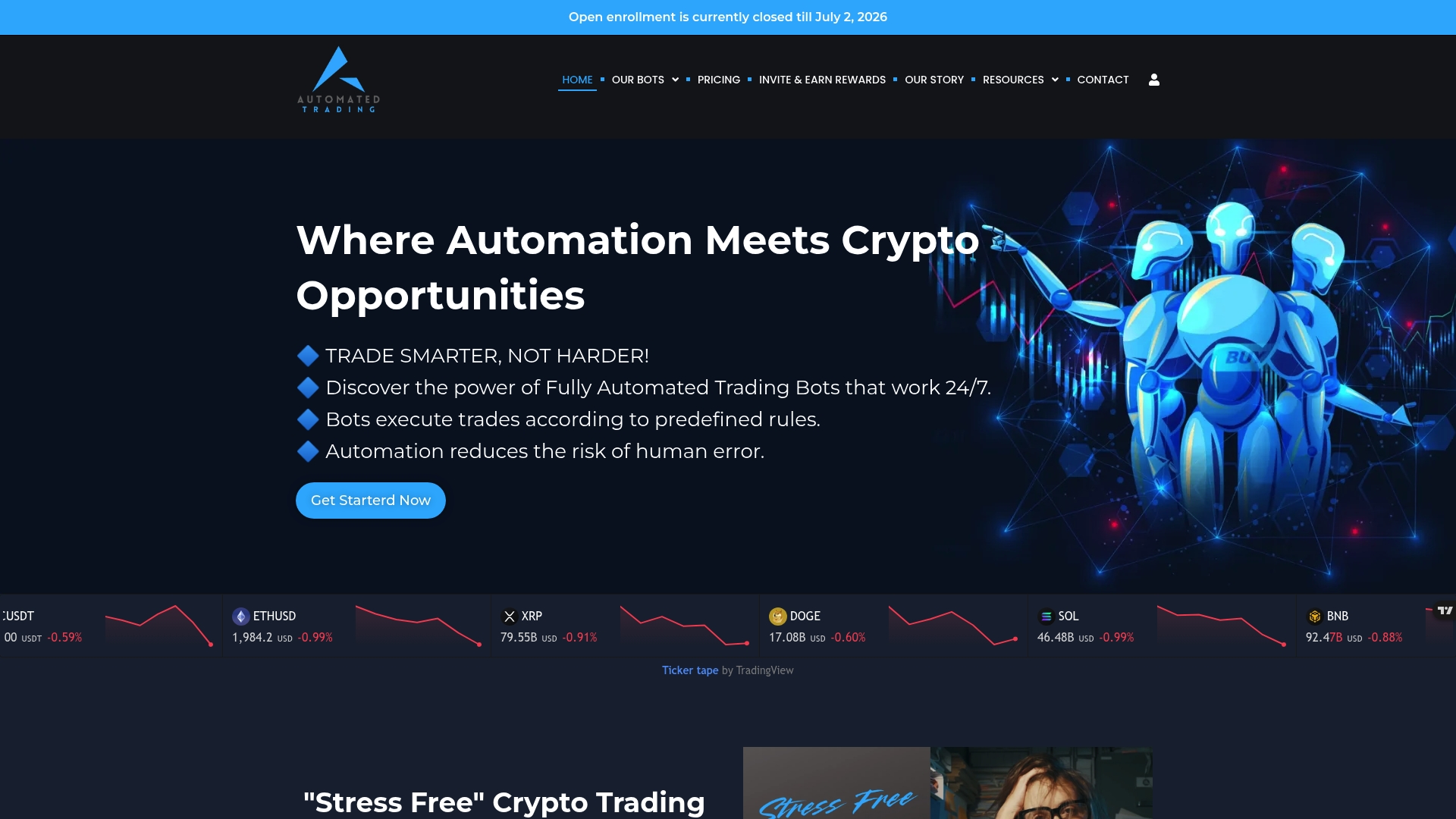
Enrollment is currently closed until July 2026, so you cannot sign up right now. The vendor positions the service around a library of pre coded, back tested crypto bots and a community that shares strategies and referral rewards.
Core Features
Fully automated bots for scalping, mid term holding, futures, and spot trading that run 24/7 and execute orders across exchanges. The platform includes back testing and strategy optimization tools so you can iterate without risking live capital.
Risk controls are built into each bot with stop loss, take profit, and position sizing options. The product also offers educational material and a community area for sharing success stories and tactics.
Key Differentiator
AutomatedTrading.io emphasizes a ready made bot library plus community engagement rather than forcing you to script strategies from scratch. The free trial option aims to let traders validate bots before committing to a subscription.
Pros
-
The bots run around the clock, which reduces manual oversight for active traders and frees time for other responsibilities.
-
The vendor advertises a 14‑day free trial, giving you a short window to test a bot on paper or small live size without long term lock in.
-
Supports major exchanges, so you can route strategies to liquidity pools and order books you already use.
-
Built in risk tools let you set stop loss and take profit rules directly inside each strategy rather than wiring them up externally.
-
Educational content and a community make it easier for new users to understand bot settings and trade intent.
Cons
-
Enrollment closure until July 2026 blocks immediate access; interested traders must wait to onboard.
-
There are no independent third party reviews tied to the platform, so performance claims rest on vendor supplied testimonials.
-
Automated trading carries market risk; volatility can produce outsized drawdowns even with risk parameters set.
When It May Not Fit
If you need immediate access, this is the wrong moment because sign ups are paused. If your workflow requires audited, third party performance records for reporting or compliance, the lack of independent validation will be a problem.
If you prefer to code your own strategies rather than use pre coded bots, this product will feel restrictive compared with platforms that expose full scripting environments.
Notable Integrations
Connects to leading exchanges: Binance, Binance US, Coinbase, Kraken. Integration is exchange level via API keys so you retain custody and execution control on your exchange accounts.
Who It’s For
Individual crypto traders who want turn key automation and prefer picking from tested strategies instead of coding. Good for traders who value community feedback and educational guides alongside bot access.
Real World Use Case
A full time professional deploys scalp bots on Bitcoin and Ethereum to capture small intraday moves while at their day job. The trader uses the free trial to validate settings, then runs bots with conservative position sizing to keep risk manageable.
Pricing
Subscriptions run monthly, quarterly, or annual with automatic discounts for new subscribers and occasional promotions. Pricing is subscription based rather than per trade or per API call.
Website: https://automatedtrading.io
Alertatron
At a Glance
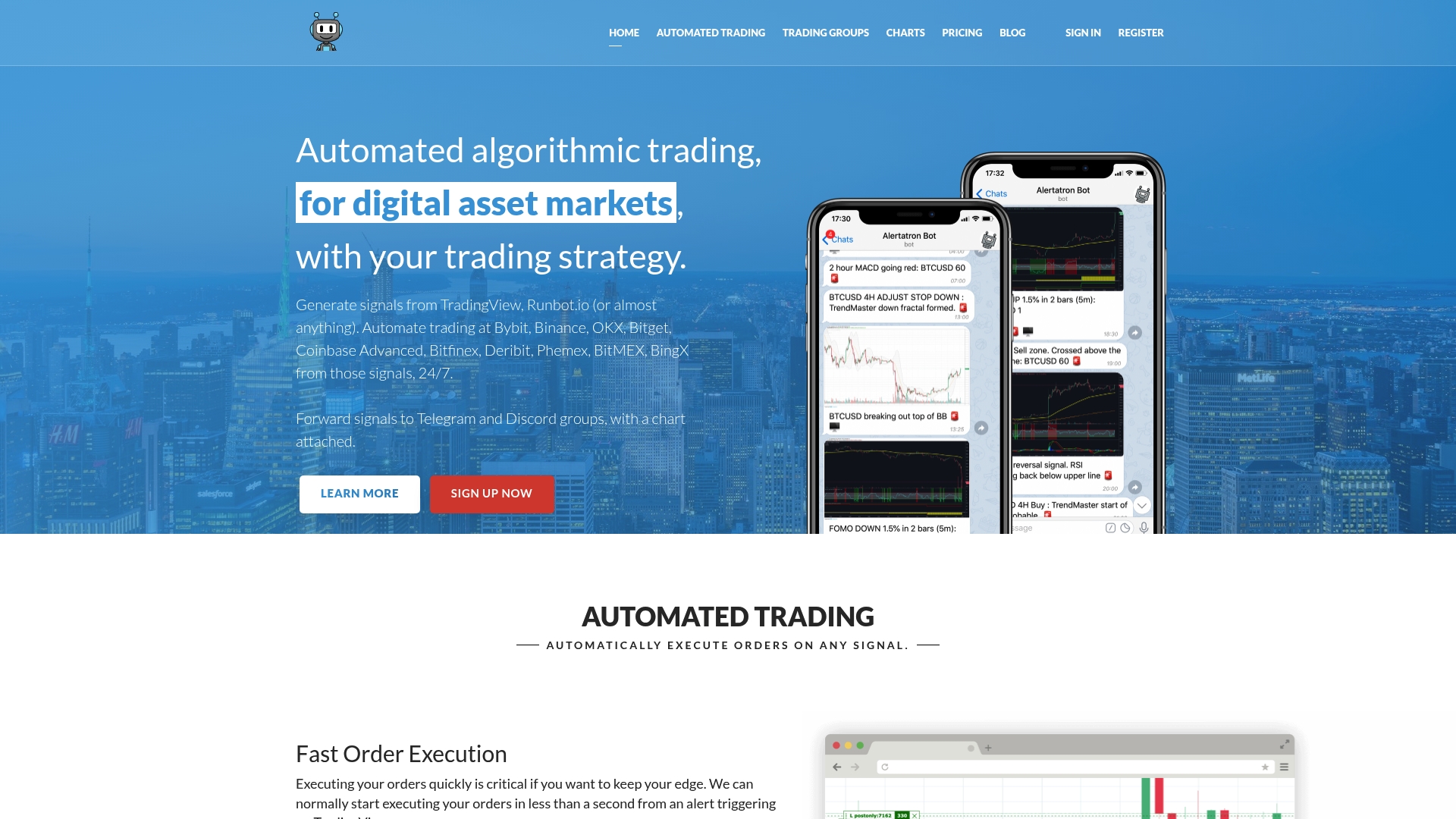
Alertatron’s marketing materials state support for trading groups of up to 200 clients, a feature pitched at signal providers and small investment clubs. The product pairs TradingView alerts with a dedicated execution engine that the vendor says handles complex order sequences across major crypto exchanges.
Core Features
-
Automates signals from TradingView and other sources so alerts become live orders without browser extensions.
-
Executes orders 24/7 on exchanges such as Binance, Bybit, and OKX with support for stop loss, take profit, trailing, and scaled entries.
-
Offers a dedicated bot engine and group management via the Pro plan with isolated client accounts and per-client PnL tracking.
-
Captures high resolution chart snapshots and routes notifications to Telegram, Discord, Slack, email, or webhooks.
Key Differentiator
The clearest angle is the isolated trading engine built for group managers and service providers. Where Tickerly focuses on turning individual TradingView strategies into a personal bot, Alertatron targets multi-client workflows and execution isolation so one account’s actions do not affect another.
Pros
-
Low friction setup. No installation or browser extension is required, so you can start sending alerts in minutes after initial configuration.
-
Multi exchange coverage lets you route a single signal to different venues depending on liquidity or fee preferences.
-
Supports advanced order flows and scaled entries so manual trade choreography can become an automated sequence.
-
High resolution chart captures paired with message routing simplify record keeping for clients and compliance notes.
-
Documentation and signal customization options are extensive, which helps when you need nonstandard alert formats.
Cons
-
Users report a history of bugs and technical issues, including delayed execution and bot instability during stressful market conditions.
-
Customer support is often described as limited or slow and may not resolve complex execution problems quickly.
-
There are reports of order handling problems and occasional position update delays that created financial risk during tests.
When It May Not Fit
If you require guaranteed subsecond execution or enterprise grade SLA support, Alertatron is likely the wrong choice. The vendor and community reports of instability and delayed fills make it a poor match for latency sensitive arbitrage or for firms that cannot tolerate execution variance.
Notable Integrations
-
Telegram for alert routing and client notifications
-
Discord for group channels and audit trails
-
Slack for team notifications
-
Email for receipts and alerts
-
Webhooks for custom backend integrations
Who It’s For
Crypto traders, signal providers, and trading group managers who need automated order sequencing and per-client PnL in a single platform. It fits teams that trade multiple exchanges and who can tolerate some operational friction for group features.
Real World Use Case
A trading group uses Alertatron to convert TradingView alerts into executed trades, sends chart snapshots to Telegram channels, and tracks each client’s results under isolated accounts. That workflow replaces manual order copying and centralizes audit trails for client reporting.
Pricing
Plans start at $59/month for the Starter tier and scale up to $199/month for the Ultra Trader tier, with discounts available for annual billing. The company lists group features on higher tiers.
Website: https://alertatron.com
Evaluating Tickerly and its Alternatives
Selecting the appropriate trading strategy automation platform can heavily influence a trader’s workflow efficiency and strategy execution. Below, we analyze and compare Tickerly.net against its competitors to highlight their distinct features, benefits, and limitations.
Key Differentiators in Strategy Execution
Tickerly.net stands out for its flexibility and ability to automate any TradingView strategy script logic with the same simple setup; no complicated configuration needed. This feature is vital for high-frequency traders who depend on rapid order execution adjacent to major exchanges, reducing slippage and enhancing execution reliability. In contrast, Lexx Trade Platform also emphasizes execution speed but integrates advanced user interface customization for traders prioritizing layout control alongside latency requirements. Traiders, meanwhile, innovates in strategy creation through natural language processing, enabling traders to design and modify strategies without programming expertise. This capability lowers the skill barrier for strategy automation but requires external verification of operational reliability.
Support for Novices versus High-Volume Professionals
While Tickerly.net supports a tiered pricing model to accommodate hobbyists and professional traders, its interface assumes familiarity with scripting and strategy design. Alternative platforms like Traiders, with its no-code interface, provide an accessible entry point for those newer to algorithmic trading. For group-based trading scenarios, Alertatron targets service providers with multi-client support and group management tools, albeit with documented reliability challenges under market stress.
Best Fit Recommendations
-
Tickerly.net: Best for experienced traders prioritizing low-latency execution and a strategy-script-first approach who just need trade automation.
-
Lexx Trade Platform: Recommended for traders seeking rapid trading interfaces with chart-native order controls and heavy customization options.
-
Traiders: Ideal for individuals or teams desiring a program-free environment for strategy development and testing, supported by APIs for integration.
-
Alertatron: Suitable for trading signal providers managing group accounts with varied execution requirements under a single interface.
Our Pick: Tickerly.net
For traders needing direct, low-latency connection from TradingView signals to live orders, tickerly.net provides a compelling solution. Its dedicated infrastructure ensures rapid execution rhythms critical for scalping or breakout strategies. However, for those preferring more details control in the execution layer or managing client-structured trading workflows, exploring Traiders or Alertatron could prove more advantageous.
Trading Strategy Automation Tools: Comparison
Explore the following trading automation platforms based on their capabilities, pricing, and suitability to help you select the most impactful solution for your strategies.
| Product | Core Feature | Best For | Pricing | Notable Limitation |
|---|---|---|---|---|
| Tickerly | Converts TradingView alerts to live orders | Active traders with low-latency needs | From $19/month | Requires strategy development and scripting expertise |
| Traiders | Natural language strategy creation | Traders looking for no-code customization | Not disclosed | Limited public feedback and security details |
| Lexx Trade Platform | High-speed trade terminal with customization | Experienced traders prioritizing execution speed | Not disclosed | Not a comprehensive broker platform |
| AutomatedTrading.io | Pre-coded automated bots | Crypto traders seeking turnkey automation | Subscription based | Enrollment closed until July 2026 |
| Alertatron | Advanced multi-client trading execution | Trading groups needing isolated accounts | From $59/month | Reports of technical issues and delayed executions |
Explore Reliable Alternatives to Traderspost.io with Tickerly
If you are looking for a Traderspost.io alternative that transforms TradingView strategies into a fully automated trading bot with industry-leading execution speed, Tickerly offers a powerful solution. Many traders face the challenge of connecting alerts to live orders while managing risk through scripting and position sizing. Tickerly directly addresses this by running servers close to exchanges for fast order fills and letting you automate multiple strategies across various asset classes.
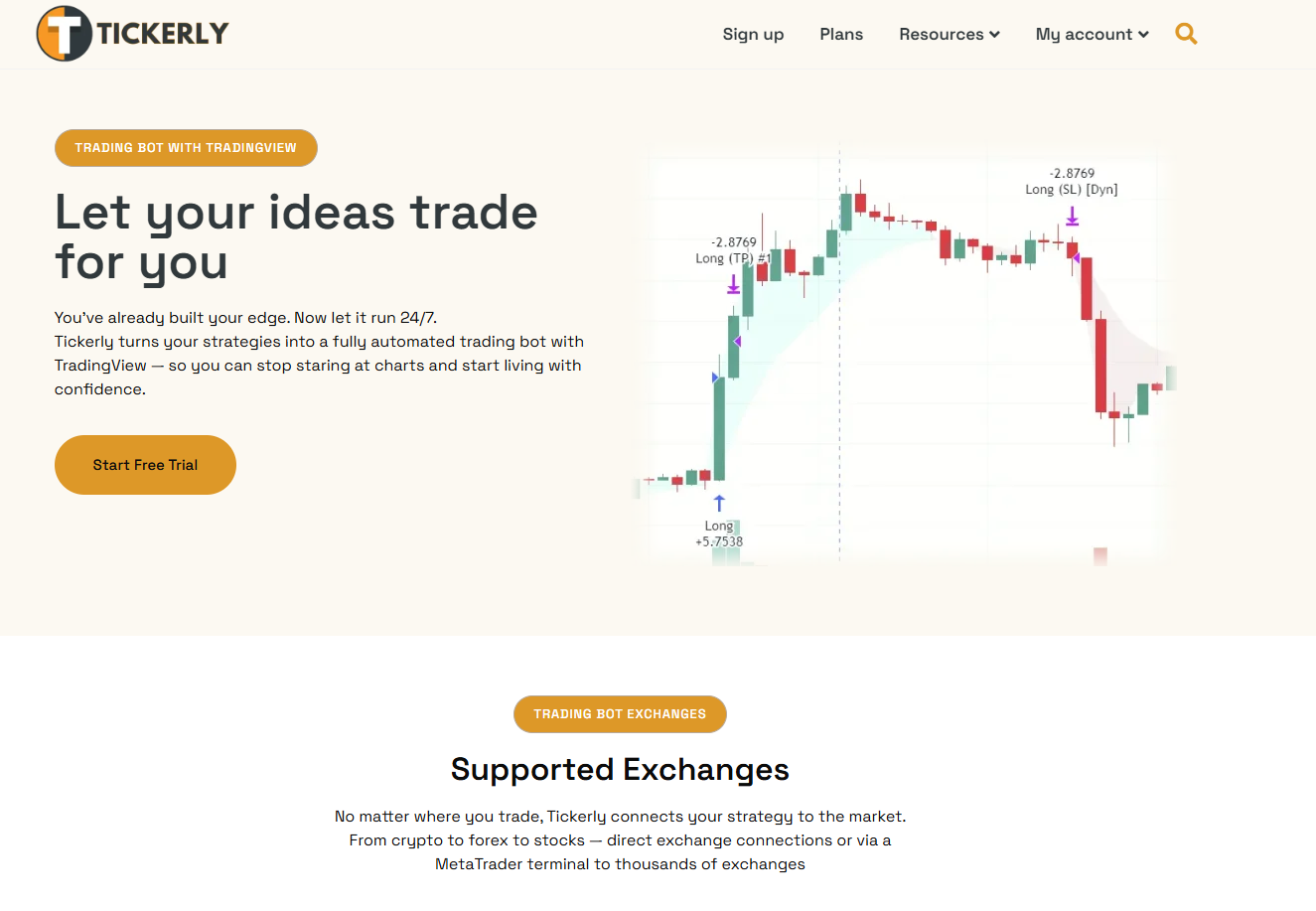
Discover how Tickerly can help you reduce manual errors and improve execution speed by visiting our Guides Archives – Tickerly. Act today and convert your TradingView alerts into live trades in minutes. Visit Tickerly to build your automated workflow and take control of your strategy execution with confidence.
Frequently Asked Questions
How does Tickerly improve trade execution speed compared to competitors?
Tickerly offers high execution speed by utilizing colocated execution nodes near major exchanges to minimize latency. This setup significantly reduces slippage and confirms orders faster than general-purpose webhooks. Traders seeking high-frequency or tight-entry strategies should consider Tickerly for its rapid order execution capabilities.
What is the difference between Tickerly and Traiders in terms of user accessibility?
Traiders provides a natural language strategy creation interface that allows users to describe trading strategies without coding, making it accessible for non-programmers. In contrast, Tickerly requires traders to build disciplined rules and is tailored for those who can write or maintain scripts. Beginners might find Traiders easier to navigate, but they may miss Tickerly’s execution speed advantages.
Can I automate multiple trading strategies using Tickerly?
Yes, Tickerly allows you to map multiple strategies to a single ticker or coin pair, enhancing your trading flexibility. This feature enables users to implement both trend and mean-reversion strategies simultaneously. Consider Tickerly if you wish to automate varied strategies without additional complexity.
How does Tickerly support different asset classes compared to its competitors?
Tickerly supports a broad range of asset classes, including crypto, forex, stocks, indices, commodities, metals, and decentralized exchanges. This versatility allows traders to apply their TradingView strategies across different markets without switching tools. If you’re managing diverse assets, Tickerly is designed to meet those needs effectively.
What are the pricing tiers for Tickerly, and how do they accommodate different trader levels?
Tickerly’s pricing starts at $14 per month for Level 1, $19 for Level 2, and $29 for Level 3, with each tier offering a 30-day free trial and increasing active strategy and alert allowances. These structured pricing tiers enable both hobby traders and more active traders to find a suitable plan based on their trading volume. Choose Tickerly to scale your trading strategies in alignment with your needs.