

Picking a trend following strategy for your TradingView bot sounds straightforward until you realize there are dozens of systems competing for your attention. Moving averages, breakout channels, Turtle rules, ensemble models — each claims to be the answer. Trend following itself has a proven track record stretching across decades and market cycles, but implementation discipline separates profitable traders from those who quit after the first drawdown. This article breaks down the top strategies, gives you a direct comparison framework, and walks you through the practical steps to connect your chosen system to an automated bot on TradingView.
Table of Contents
- What makes a trend following strategy effective?
- Classic trend following strategies: The top 3 approaches
- Advanced enhancements: Diversification, volatility targeting, and ensemble methods
- Comparing the top strategies for TradingView automation
- Practical steps: Automating trend following strategies on TradingView
- Our take: Why simplicity and discipline outperform complex systems
- Automate your trend strategy with Tickerly
- Frequently asked questions
Key Takeaways
| Point | Details |
|---|---|
| Discipline matters most | Automated trend following excels when traders stick to simple, proven rules without constant tweaks. |
| Diversify for resilience | Spreading strategies across assets and timeframes reduces drawdowns and improves returns. |
| Automation enhances results | TradingView and bot integrations enable hands-off execution, supporting psychological discipline. |
| Performance is proven | Academic evidence backs the long-term profitability of trend following across markets. |
What makes a trend following strategy effective?
Not every strategy that follows a trend is built to last. The difference between a solid trend following system and a fragile one comes down to a few critical parameters. Before you pick an approach or write a single line of Pine Script, you need to understand what you’re actually measuring.
Effective trend following strategies share these foundational traits:
- Clear signal generation: Entries and exits must be rule-based, whether through moving average crossovers, breakout levels, or momentum filters. Ambiguity kills consistency.
- Asymmetric risk/reward: You accept many small losses in exchange for the occasional large winner. This is not a bug; it’s the design.
- Drawdown tolerance: Extended losing streaks are normal. Any system that can’t survive a 20-30% drawdown in backtesting shouldn’t be trusted in live markets.
- Automation compatibility: Signals must be discrete and programmable. Subjective judgment calls are impossible for a bot to replicate reliably.
Here’s the part most traders find uncomfortable. Win rates of 30-50% are typical, with profitability driven entirely by large winners offsetting frequent small losses. You will lose more often than you win. What makes the math work is that your winners are much larger than your losers.
“The core challenge of trend following is not finding winners — it is staying in the system long enough for winners to pay for all the losses that preceded them.”
This is precisely why automation matters so much. Human traders second-guess rules mid-trade, cut winners early, and let losers run. A bot doesn’t. Focusing on optimizing for long-term profit through strict rule adherence is where automated systems have a measurable edge over manual execution. Research into trend following crisis alpha confirms this pattern holds across asset classes and decades.
Classic trend following strategies: The top 3 approaches
With the right criteria in mind, let’s review the most time-tested strategies you can automate. Each of these has survived real-world markets and generates clear, programmable signals.
- Moving Average Crossover (50/200 SMA): The most widely recognized trend following method. A buy signal fires when the 50-period SMA crosses above the 200-period SMA, and a sell when the reverse occurs. It’s simple to code, easy to backtest, and captures major trends. The downside is significant lag and frequent whipsaws in sideways markets. For bots, the clean binary signal is ideal, but you should pair it with a volatility filter to avoid dead markets.
- Donchian Channel Breakout: Developed by Richard Donchian, this system enters long when price breaks above the highest high of the past N periods and exits when it falls below the lowest low. It’s inherently adaptive to current market ranges and works well on liquid assets. The entry logic is objective and extremely bot-friendly, making it a popular choice among algorithmic traders.
- Turtle Trading Rules: The legendary system taught by Richard Dennis in the 1980s, based on channel breakouts with strict position sizing and pyramiding rules. Turtle rules are highly systematic and fully adaptable via Pine Script for modern TradingView automation. You can customize entry channels, ATR-based stops, and position scaling to fit current market conditions.
Pro Tip: When coding Turtle rules in Pine Script, use ATR (Average True Range) as your stop distance multiplier rather than fixed pip values. This keeps your risk exposure consistent across different volatility regimes and assets.
Research covering two centuries of data shows trend following delivers a Sharpe ratio of 0.72 with a t-statistic of 10.5 across aggregated markets, and stocks specifically returned 19.3% annually from 1983 to 2004 with a Sharpe of 1.24.
These numbers are why professionals keep returning to these strategies. For strategy optimization tips that apply directly to TradingView bots, consistent parameter rules matter more than chasing the highest backtest return. You can explore the full TradingView automation guide for platform-specific implementation details.

Advanced enhancements: Diversification, volatility targeting, and ensemble methods
After understanding core strategies, it’s important to know how professionals stack the odds even further in their favor. The strategies above are strong individually, but combining and enhancing them is where institutional-grade performance comes from.
Trend following provides crisis alpha across assets but requires diversification across assets and timeframes to reduce whipsaw losses. A system running on a single instrument in one timeframe will experience far deeper drawdowns than a diversified ensemble.
Key benefits of ensemble and diversification approaches:
- Reduced correlation risk: Different assets respond to trends at different speeds. Running your system on equities, commodities, and crypto simultaneously smooths your equity curve.
- Timeframe layering: Combining signals from the daily and 4-hour charts filters out noise without sacrificing entry speed.
- Volatility targeting: Adjusting position size based on realized volatility keeps dollar risk constant regardless of market conditions. This is one of the most underused enhancements in retail trading.
- Mean reversion complement: Trend following struggles in range-bound markets. Adding a lightweight mean reversion filter to identify sideways conditions and pause trend signals significantly reduces false entries.
Key stat: Diversified trend following models running across 50+ markets with volatility targeting have historically achieved Sharpe ratios above 1.0, compared to 0.72 for undiversified single-market approaches.
Pro Tip: When automating strategies in TradingView, build correlation and volatility checks directly into your Pine Script alerts. Use the “ta.correlation()` function and ATR-relative thresholds to gate entries and prevent over-exposure during high-correlation or low-volatility regimes. The adaptable Turtle rules framework is a useful reference for how systematic position scaling integrates with these filters.
Comparing the top strategies for TradingView automation
Equipped with a strong foundation, let’s directly compare these approaches for TradingView automation. Use this table to match each strategy to your risk tolerance, automation skill level, and target assets.
| Criterion | Moving Avg Crossover | Donchian Channel | Turtle Rules |
|---|---|---|---|
| Automation simplicity | High | High | Medium |
| Signal clarity | Medium | High | High |
| Drawdown risk | Medium | Medium | Medium/High |
| Backtest ease | High | High | Medium |
| Adaptability | Low | Medium | High |
| Best asset class | Equities, crypto | Futures, commodities | Multi-asset |
The two centuries of evidence behind trend following confirms that no single method dominates every condition. Each strategy has a context where it excels.
Where each strategy fits best:
- Moving Average Crossover: Best for traders new to automation who want a clean, verifiable signal on liquid markets like BTC/USD or major equity indices.
- Donchian Channel Breakout: Ideal for futures and commodity markets where breakout behavior is historically reliable. Works well in trending regimes with higher ATR.
- Turtle Rules: Built for serious multi-market automation where position sizing precision and pyramiding matter. Requires more Pine Script knowledge but delivers the most institutional-grade output.
If you want a step-by-step TradingView bot setup for any of these systems, the key is matching signal complexity to your execution infrastructure. A complex signal with slow execution is worse than a simple signal with fast, reliable execution.
Practical steps: Automating trend following strategies on TradingView
Once you’ve picked your strategy, here’s how to get it running on TradingView and connected to your trading bot. The process is more structured than most traders expect.
- Select and define your strategy rules: Write out every entry, exit, stop loss, and position sizing rule in plain language before touching Pine Script. Vague rules become broken code.
- Code in Pine Script with clean alert conditions: Use
alertcondition()for every signal. Each alert should fire exactly one action: enter long, exit long, enter short, or exit short. Keep logic modular. - Backtest across multiple market conditions: Run your strategy across at least three distinct market regimes (trending up, trending down, and sideways). If it fails badly in one regime, adjust before going live.
- Connect to your trading bot via webhook: Platforms like Tickerly use TradingView webhooks to receive alert payloads and execute orders with minimal latency. Configure your JSON alert message format carefully to match your platforms expectations.
- Paper trade before live deployment: Run your connected system in paper trading mode for at least two to four weeks. Monitor execution logs and compare bot fills to expected signal prices.
- Monitor and version your scripts: Every meaningful change to your strategy deserves a version tag. This makes it easy to roll back if live performance diverges from backtest results.
Pro Tip: Volatility targeting and ATR-based stops are not optional for live trading. Without them, a volatility spike will blow through your stops and invalidate your entire position sizing model in a single trade.
Common integration errors include mismatched alert message formats, missing exchange API permissions, and running strategies on illiquid instruments where fill prices deviate sharply from signal prices. Check your TradingView automation setup against known working configurations, and consult the autotrading setup documentation to avoid the most frequent issues traders encounter.
Our take: Why simplicity and discipline outperform complex systems
After working with automated trend strategies across various market conditions, a clear pattern emerges that most traders learn only after painful experience: complexity is the enemy of execution.
It’s tempting to layer indicator after indicator, add regime filters, tweak lookback periods weekly, and rebuild your Pine Script every time a drawdown appears. But this path almost always leads to overfitting. A strategy that looks perfect in backtesting but has 14 parameters is a strategy optimized for the past, not the future.
The traders who generate consistent returns from trend following automation are rarely the ones with the most sophisticated systems. They run a straightforward crossover or channel breakout with strict, unchanging rules. They don’t touch their bot during drawdowns. They trust the math and let the large winners arrive on their own schedule. Long-term optimization is about improving process, not endlessly adjusting parameters.
Simplicity is not a compromise. It’s a competitive advantage.
Automate your trend strategy with Tickerly
Ready to turn your favorite trend strategy into a hands-off system? Tickerly connects directly to TradingView and converts your Pine Script alerts into fully automated trades, with no coding required beyond what you’ve already built.
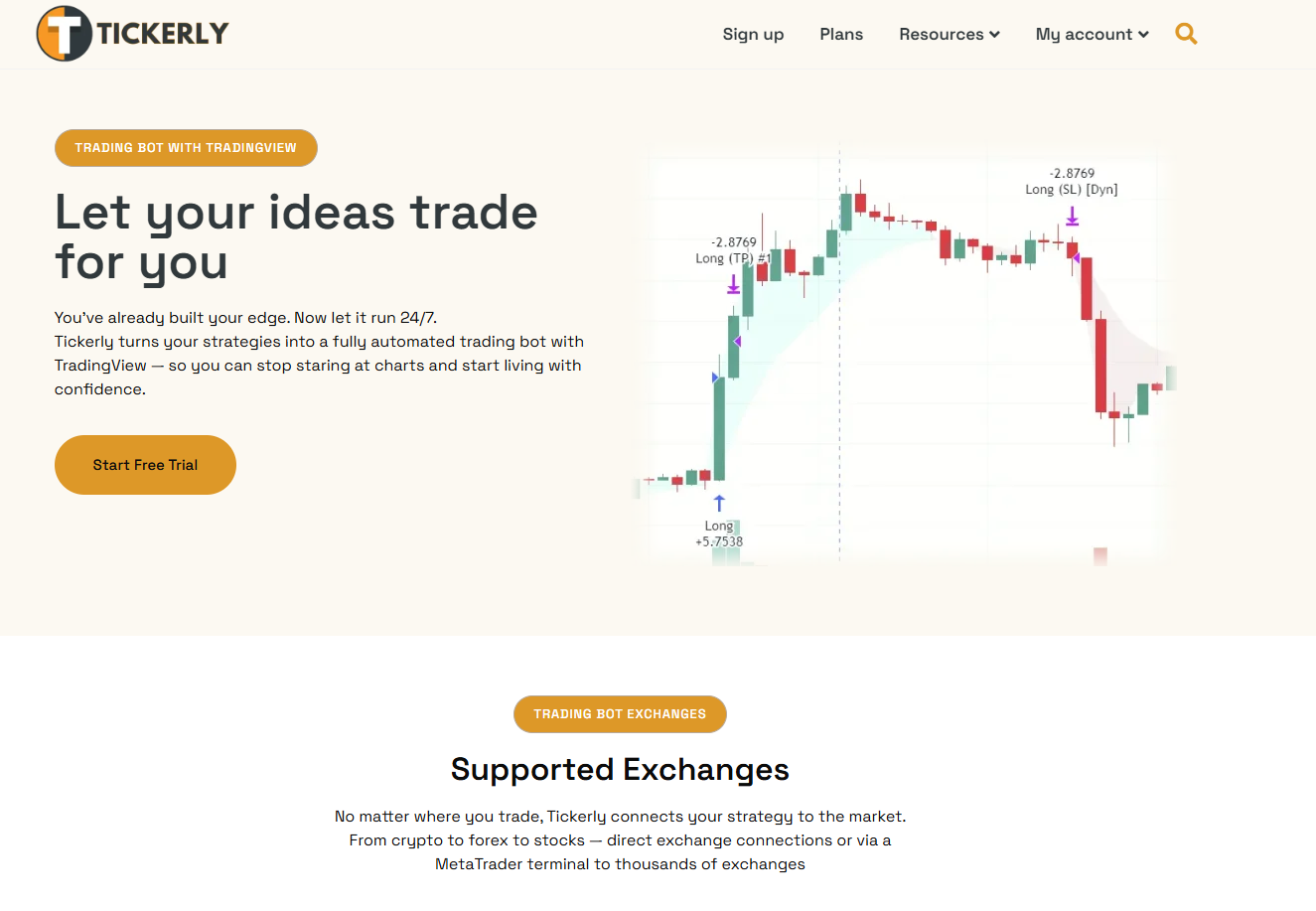
Whether you’re running a Moving Average Crossover on crypto or a full Turtle system across futures markets, Tickerly handles the execution layer so you can focus on strategy refinement. Browse the strategy library to find pre-built trend templates, or dive into the algotrading on TradingView guide to see exactly how the integration works. If you have specific questions about your setup, the automated trading FAQ covers the most common configurations and troubleshooting steps. Start automating your trend strategy today.
Frequently asked questions
Why do trend following strategies have low win rates but can still be profitable?
Trend following wins 30-50% of trades but remains profitable because winning trades are significantly larger than losing ones, creating a positive expected value over time when rules are followed consistently.
Are trend following systems still effective in modern markets?
Yes. Two centuries of data confirm positive trend following returns with a Sharpe ratio of 0.72 and a t-statistic of 10.5, demonstrating persistent effectiveness across different market eras and asset classes.
How can I avoid large losses in automated trend following?
Diversify across multiple assets and timeframes, and apply volatility-based position sizing to keep risk exposure constant, which prevents any single trade from causing disproportionate drawdown.
What’s the biggest mistake traders make with trend following bots?
Overcomplicating the signal logic and adjusting parameters during drawdowns destroys the consistency that makes trend following work, leading to an overfitted system that performs worse than a simpler, unchanged alternative.