

Most traders assume that simply enabling automation is enough to optimize their portfolio performance. The reality is more nuanced. The timing and method of rebalancing matter just as much as the act itself, and getting this wrong costs real returns. Whether you rebalance too often or not often enough, the consequences show up in your Sharpe ratio, your transaction costs, and your exposure to unintended risk. This guide breaks down everything TradingView traders need to know: the performance evidence behind different rebalancing strategies, how to implement automation using Pine Script and webhooks, and how to minimize cost and risk along the way.
Table of Contents
- Why rebalancing matters: The performance impact
- Automating rebalancing with TradingView: Tools and scripts
- Choosing the best rebalancing strategy: Threshold, calendar, and hybrid
- Reducing cost and risk: Practical automation tips
- Our take: Automation is a tool, not a shortcut
- Next steps: Power your portfolio with advanced TradingView automation
- Frequently asked questions
Key Takeaways
| Point | Details |
|---|---|
| Automation boosts efficiency | Using TradingView scripts lets you rebalance portfolios quickly and consistently with less manual effort. |
| Threshold wins in volatile markets | Threshold-based rebalancing delivers higher risk-adjusted returns during high volatility than calendar methods. |
| Strategy choice affects cost | Choosing a hybrid or dynamic approach with alerts prevents both drift and excessive trading costs. |
| Real-world testing prevents errors | Always backtest and monitor automated strategies to avoid magnifying mistakes and unexpected losses. |
Why rebalancing matters: The performance impact
Portfolio rebalancing is the process of realigning your asset weights back to a predetermined target allocation. Over time, as individual assets appreciate or depreciate at different rates, your portfolio drifts away from its intended structure. This drift is called allocation drift, and it is one of the most underestimated sources of unintended risk in active portfolio management.
Consider a simple example: you start with a 60% equity and 40% bond allocation. After a strong equity bull run, equities now represent 75% of your portfolio. You haven’t made a single trade, yet your risk profile has fundamentally shifted. You are now holding a portfolio that behaves more aggressively than you originally intended, and if a correction hits, the drawdown will be deeper than your plan accounted for.

The stakes get higher when you look at the data. Research on rebalancing frequency reveals a critical trade-off: frequent rebalancing can actually fight momentum, causing underperformance relative to a simple buy-and-hold strategy, while infrequent rebalancing allows risk drift to compound over time. The sweet spot, according to this evidence, is a threshold-based approach, which consistently delivers the best net Sharpe ratio in high-volatility market regimes.
Here is a direct performance comparison between the three primary rebalancing methods:
| Rebalancing method | Sharpe ratio (calm market) | Sharpe ratio (volatile market) | Transaction cost impact |
|---|---|---|---|
| Calendar-based (annual) | 0.34 | 0.34 | Low |
| Frequent (weekly/monthly) | 0.28 | 0.27 | High |
| Threshold-based | 0.38 | 0.46 | Moderate |
The numbers tell a clear story. Threshold rebalancing consistently outperforms in volatile regimes. Annual calendar rebalancing is stable but leaves performance on the table. Frequent rebalancing, despite its appeal for active traders, often destroys value through transaction costs and momentum interference.
Beyond performance, there are concrete risks to ignoring rebalancing altogether:
- Overexposure to single assets: A single winning position can grow to dominate your portfolio, concentrating risk dangerously.
- Missing your investment mandate: Funds and serious traders set allocation targets for a reason. Drift means you are no longer following your own rules.
- Compounded drawdowns: Unbalanced portfolios tend to suffer more severe drawdowns during corrections because risk has quietly accumulated.
- Psychological pressure: Watching an overweighted position swing wildly is stressful and often triggers poor emotional decisions.
You can explore TradingView automation tools to understand how the platform supports systematic portfolio management at the execution level. The foundation is solid. The strategy on top of it needs to be equally rigorous.
“Advanced AI and DRL models can add alpha via behavioral models, but for most traders, threshold-based rebalancing remains the most reliable and cost-effective approach.” — Quant Decoded
Automating rebalancing with TradingView: Tools and scripts
TradingView is widely recognized as the gold standard for charting and strategy development among retail and professional traders alike. Its scripting language, Pine Script, gives you the ability to build custom portfolio simulation and backtesting tools directly inside the platform. According to multi-asset rebalancing research, you can construct a rebalancing portfolio ticker in Pine Script that supports weekly, monthly, or annual rebalancing on up to 10 tickers with fully custom weights. This is a practical, powerful starting point for automating your allocation management.
Here is a step-by-step framework for setting up automated rebalancing in TradingView:
- Define your target allocation: List each asset and its target percentage weight. For example: BTC 40%, ETH 30%, SOL 15%, USDC 15%.
- Write or import a Pine Script: Use a script that tracks current portfolio weights in real time and calculates drift from your targets.
- Set threshold or calendar triggers: Configure the script to fire an alert when drift exceeds your threshold (e.g., 5%) or when a calendar period ends.
- Connect alerts to your broker via webhook: TradingView’s alert system allows you to send webhook payloads to third-party automation tools or directly to broker APIs in rare cases.
- Test the setup in paper trading mode: Before going live, verify that alerts fire correctly and that order execution logic is functioning as intended.
- Deploy and monitor: Go live with position sizing parameters locked in and monitoring enabled.
The comparison between calendar and threshold alert automation matters at the implementation level too:
| Alert type | Setup complexity | Execution frequency | Best for |
|---|---|---|---|
| Calendar-based | Low | Predictable | Low-volatility portfolios |
| Threshold-based | Medium | Event-driven | High-volatility crypto portfolios |
| Hybrid | High | Optimized | Experienced traders |
You can reference this TradingView scripts guide for deeper technical detail on building and deploying Pine Script strategies.
Pro Tip: Webhooks are the bridge between TradingView’s alert system and live broker execution. When your Pine Script fires an alert, it can send a JSON payload containing order parameters to platforms like Tickerly, which then executes the trade automatically. This removes human latency from the equation entirely, ensuring your rebalancing orders are placed at the exact moment your conditions are met. Learn more about autotrading on TradingView to see how this pipeline works end to end.
One important limitation to note: TradingView’s native Pine Script environment supports up to 10 securities in a single script. For portfolios exceeding that count, you will need to build multiple scripts or use a middleware solution that aggregates signals across scripts and executes them through a single API connection.
Choosing the best rebalancing strategy: Threshold, calendar, and hybrid
Understanding which rebalancing strategy fits your situation is critical. The wrong choice does not just cost performance; it can actively increase risk exposure in the markets where you need protection most.
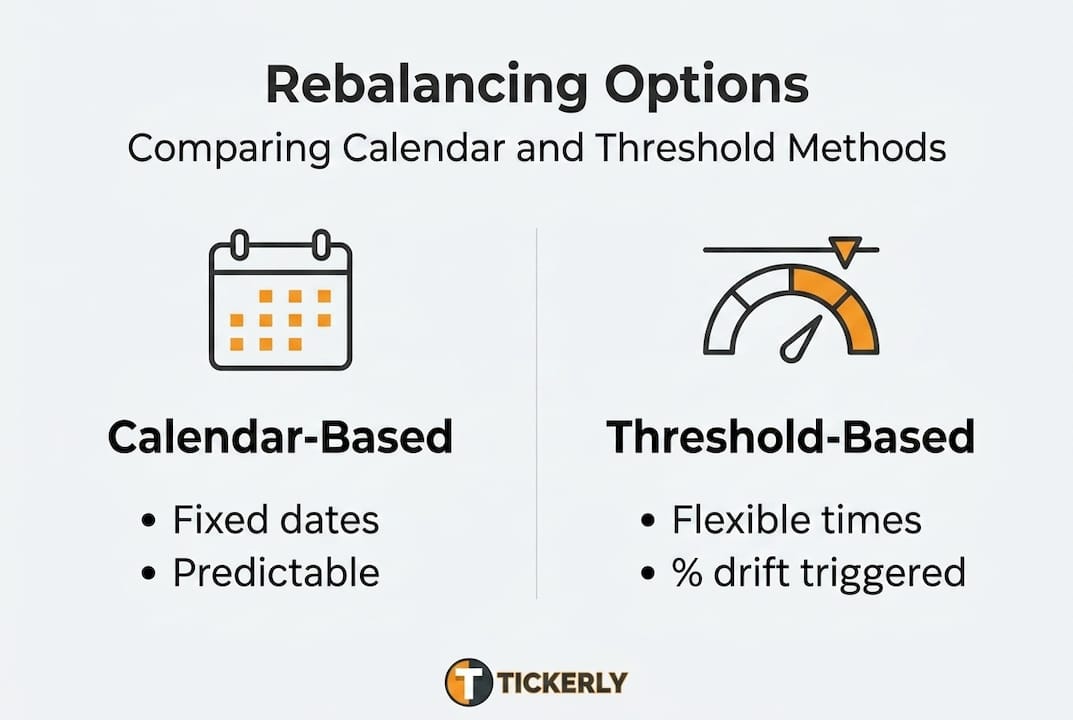
Calendar-based rebalancing triggers at fixed intervals: weekly, monthly, quarterly, or annually. It is simple, predictable, and easy to backtest. The main advantage is low cognitive overhead. You set it and review it on a schedule. The disadvantage is that markets do not care about your calendar. A massive drawdown in the middle of a quarter will not trigger a rebalance until your next scheduled date, leaving you overexposed for an extended period.
Advantages of calendar-based rebalancing:
- Minimal transaction costs due to low frequency
- Easy to plan for tax-loss harvesting events
- Predictable execution that suits regulated environments
Disadvantages of calendar-based rebalancing:
- Cannot respond to sudden market moves
- May miss optimal rebalancing windows in trending markets
- Fixed timing can coincide with low-liquidity periods
Threshold-based rebalancing triggers when any asset drifts beyond a set percentage from its target. In volatile markets, threshold strategies achieve a Sharpe ratio of 0.46 versus 0.34 for annual calendar rebalancing, a meaningful performance advantage when market swings are frequent and large. This method is inherently adaptive. It trades when conditions demand it, not when the clock says so.
Advantages of threshold-based rebalancing:
- Responds dynamically to actual market conditions
- Minimizes unnecessary trading in stable markets
- Outperforms in high-volatility regimes
Disadvantages of threshold-based rebalancing:
- Can trigger frequent trading in choppy, high-frequency markets
- Requires careful threshold calibration to avoid over-trading
- More complex to implement and backtest in Pine Script
Hybrid strategies combine both approaches. A common structure is to rebalance on a calendar schedule and trigger an immediate rebalance if any asset drifts beyond a set threshold between scheduled dates. This preserves the discipline of calendar-based planning while adding the responsiveness of threshold triggers.
Pro Tip: If you are trading crypto portfolios with high volatility assets like BTC or ETH, start with a 5% to 10% drift threshold combined with a monthly calendar check. This hybrid setup reduces transaction frequency while catching significant drift events before they compound your risk exposure. You can learn to automate trading on TradingView with this exact kind of conditional logic using Pine Script alerts.
The right strategy depends on three factors: your portfolio’s volatility profile, your transaction cost structure, and your risk tolerance. High-volatility crypto portfolios benefit most from threshold or hybrid approaches. Low-volatility, diversified multi-asset portfolios can function effectively with annual calendar rebalancing. For most active TradingView traders, the hybrid model offers the best overall risk-adjusted outcome. Explore the TradingView automation solution ecosystem to see what fits your execution requirements.
Reducing cost and risk: Practical automation tips
Even the best rebalancing strategy generates friction costs if not executed carefully. Slippage, transaction fees, and over-trading are the three most common ways automation erodes the performance gains that rebalancing is supposed to deliver.
Here is a structured process for minimizing cost and risk in your automated rebalancing workflow:
- Run preview simulations before going live. Pine Script allows you to simulate historical rebalancing events without executing orders. Use this to verify that your script’s logic triggers correctly and that the trade frequency falls within acceptable cost thresholds.
- Set minimum trade size filters. If an asset has drifted by only 0.3% from its target, the cost of rebalancing likely exceeds the benefit. Build logic into your script that ignores drift below a minimum dollar or percentage threshold.
- Use limit orders where possible. Automated rebalancing with market orders in low-liquidity conditions will generate significant slippage. Configure your webhook payloads to send limit orders with a defined tolerance band around the current price.
- Batch rebalancing orders. Instead of firing individual orders for each asset, structure your automation to calculate all required trades simultaneously and execute them as a batch. This reduces the number of round trips and associated fees.
- Schedule rebalancing outside high-volatility windows. Avoid executing rebalancing orders during major economic releases, market opens, or known high-volatility events where spreads widen and slippage increases.
“In volatile and choppy markets, dynamic thresholds using ATR-based calculations combined with preview simulations are the most effective way to prevent over-trading and minimize slippage in automated rebalancing systems.” — Quant Decoded
The ATR, or Average True Range, is a volatility indicator that measures how much an asset moves on average over a given period. Using ATR as your threshold baseline means your rebalancing triggers tighten when the market is calm and widen when volatility spikes. This dynamic adjustment prevents the system from firing unnecessary trades during choppy sideways markets, which is one of the most expensive failure modes in automated rebalancing.
Pro Tip: Set up a dedicated monitoring alert that tracks cumulative drift across all portfolio positions in real time. Many traders focus only on individual asset drift and miss the aggregate picture. When total portfolio drift exceeds a combined threshold, it is a stronger signal than any single asset crossing a line. You can configure this at the setting up alerts level inside TradingView.
Periodic reviews are non-negotiable. Even well-calibrated systems need quarterly checks to verify that the strategy logic still aligns with current market conditions. Use swing trading alerts as a complementary layer to catch short-term momentum signals that might indicate a temporary drift rather than a structural portfolio shift.
Our take: Automation is a tool, not a shortcut
Here is the uncomfortable truth that most automation guides skip: automation amplifies whatever is already in your strategy. A well-designed rebalancing system with solid backtesting and rigorous threshold calibration will perform consistently over time. A poorly designed one will execute bad trades faster and at greater scale than any human trader could manage manually.
We have seen traders deploy automated rebalancing scripts that were backtested over a single bull market period, then watched those same scripts generate excessive transaction costs when conditions shifted. The backtesting window matters enormously. A strategy that looks excellent across 12 months of trending data may perform poorly in a choppy, range-bound environment. Always test across multiple market regimes before trusting a script with real capital.
The most important safeguard is a scheduled review routine. Set a calendar reminder every quarter to audit your rebalancing script’s performance. Ask three questions: Is the drift threshold still appropriate for current volatility? Are transaction costs within budget? Are the portfolio’s target weights still aligned with your investment thesis? These reviews protect you from the slow drift of strategy decay. For more on building resilient systems, see our strategy optimization tips.
Automation earns its place in your toolkit when it is paired with discipline and periodic review. Without that, it is just fast, expensive, unchecked execution.
Next steps: Power your portfolio with advanced TradingView automation
Rebalancing is one of the highest-leverage activities you can automate as a TradingView trader. The strategies covered in this guide give you the framework. Now you need the execution infrastructure to make them work reliably.
Tickerly turns your TradingView Pine Script strategies into fully automated trading bots, connecting your alerts to live broker execution through fast, reliable webhooks. Whether you are implementing threshold-based rebalancing, a hybrid calendar approach, or a custom multi-asset strategy, Tickerly handles the execution layer so you can focus on strategy refinement. Explore algotrading tools designed specifically for TradingView traders, and follow the step-by-step TradingView automation guide to get your rebalancing bot live quickly and confidently.
Frequently asked questions
What is automated portfolio rebalancing?
Automated portfolio rebalancing uses scripts or software to adjust asset allocations based on predefined rules, removing manual intervention. Using Pine Script automation, TradingView traders can build custom multi-asset rebalancing tickers that trigger alerts and execute orders through webhook-connected brokers.
Is frequent rebalancing better than infrequent?
No. Frequent rebalancing fights momentum and increases transaction costs, while infrequent rebalancing allows risk to drift unchecked. Threshold-based strategies deliver the best net Sharpe ratio by trading only when drift warrants action.
Can TradingView automate rebalancing for multiple assets?
Yes. TradingView’s Pine Script supports rebalancing on up to 10 tickers with fully custom target weights and alert configurations, making it a practical tool for multi-asset portfolio management.
How can I minimize trading costs in automated rebalancing?
Dynamic thresholds using ATR combined with preview simulations are the most effective methods for reducing unnecessary trades and controlling slippage in automated rebalancing systems.