

TL;DR:
- Effective price action trading relies on mastering key candlestick patterns like pin bars, engulfing candles, and inside bars within the correct market context for consistent high-probability entries. Traders must focus on trading at significant support and resistance zones, assess market mode on higher timeframes, and implement disciplined risk management to build profitability. Incorporating institutional signals and routine review enhances skill development, while automation tools like Tickerly streamline precise execution.
Top price action strategies are defined as trading methods that read raw price movement, candlestick patterns, and key structural levels to generate high-probability entries without relying on lagging indicators. Price action trading, the recognized industry term for this approach, produces 12% higher Sharpe ratios than indicator-based systems. That edge comes with a cost: it demands discretion, screen time, and pattern mastery that most retail traders underestimate. This guide covers the best price action techniques used by professional traders, from foundational candlestick setups to advanced institutional signals, so you can build a method that holds up across crypto, forex, and stocks.
1. Top price action strategies start with these three candlestick patterns
The three core candlestick formations in any price action strategy guide are pin bars, engulfing candles, and inside bars. Each signals a different market dynamic, and each requires a specific entry logic. Foundational patterns like these produce win rates between 55% and 68%, rising to 68 to 71% when confirmed by volume. That improvement is not marginal. It is the difference between a strategy with positive expectancy and one that slowly bleeds capital.
-
Pin bars form when price rejects a level sharply, leaving a long wick and a small body. They signal that buyers or sellers stepped in decisively at that level. Enter on the close of the pin bar or on a 50% retracement of the wick, with your stop placed just beyond the wick’s tip.
-
Engulfing candles occur when a candle’s body fully covers the prior candle’s body, signaling a momentum shift. Bullish engulfing at support and bearish engulfing at resistance are the highest-probability versions. Volume confirmation on the engulfing candle is non-negotiable.
-
Inside bars represent volatility contraction, where price coils inside the prior candle’s range. They signal a breakout is building. Trade the break of the mother bar’s high or low, with your stop on the opposite side of the inside bar.
Pro Tip: Limit your active patterns to 3 to 5 and master them before expanding your playbook. Spreading attention across a dozen setups dilutes your edge and slows pattern recognition.
2. How to determine market context before placing any trade

Al Brooks, one of the most cited practitioners in price action trading, states that confirming trend or range on a higher timeframe before applying any strategy is the single most important filter. This is not optional advice. Applying a trend-following setup during a ranging market is the most common reason traders with solid pattern recognition still lose money.
Market mode identification works as follows. A trending market shows a clear sequence of higher highs and higher lows (uptrend) or lower highs and lower lows (downtrend). A ranging market oscillates between defined support and resistance without breaking structure. Trend identification by swing highs and lows correctly predicts market conditions 78% of the time, making it the most reliable classification method available without indicators.
| Market mode | Best price action setups | What to avoid |
|---|---|---|
| Trending | Pin bars in pullbacks, engulfing candles at moving averages | Fading the trend at mid-range levels |
| Ranging | Inside bar breakouts at range extremes, engulfing at boundaries | Breakout trades in the middle of the range |
| Breakout transition | Volume-confirmed engulfing, retest entries after breakout | Chasing initial breakout candles without confirmation |
Higher timeframe analysis is your primary filter. If the daily chart shows a downtrend, you do not take bullish pin bar setups on the 15-minute chart. The stagnating or sideways market conditions that confuse many traders become readable once you classify them correctly using swing structure rather than gut feel.
3. Why location matters more than pattern perfection
A pin bar in the wrong place is noise. Location at significant support, resistance, or institutional interest areas is more important than pattern perfection. This is the insight that separates traders who study price action from traders who profit from it.
Key levels are not single lines. They are zones, areas where price has previously reversed, consolidated, or accelerated. Marking these zones on the daily or 4-hour chart before a session gives you a map of where patterns carry weight. A pin bar forming at a zone that has held four times over six months carries far more significance than a textbook-perfect pin bar forming in open space between levels.
Institutional traders think in zones, not lines. Breakouts on low volume are often false, and the zones where retail stops cluster are precisely where institutions push price before reversing. Recognizing this dynamic turns apparent “failed breakouts” into high-probability fade setups.
4. How to integrate risk management into every trade
Professional price action traders target a 40 to 60% win rate and build profitability through positive expectancy, not through being right most of the time. This reframes the entire goal. You do not need to win 70% of your trades. You need your winners to outpace your losers by a ratio of at least 1:1, and ideally 1:2.
Execution discipline requires three non-negotiable rules:
-
Position sizing: Risk 1 to 2% of total capital per trade. This rule alone prevents the account blowups that end most retail trading careers. A 10-trade losing streak at 2% risk costs you roughly 18% of capital. The same streak at 10% risk destroys 65%.
-
Stop-loss placement: Place stops beyond the pattern’s extreme, not at a round number or arbitrary distance. A pin bar stop goes just past the wick tip. An inside bar stop goes just past the mother bar’s opposite extreme.
-
Trade frequency: Experienced traders mark 5 to 7 key levels pre-market and take 2 to 5 confirmed trades per week. More trades do not mean more profit. They mean more exposure to suboptimal setups.
Pro Tip: Review your risk-reward expectations before every session. If a setup does not offer at least 1:1.5 reward to risk based on the nearest key level, skip it. Patience here compounds over months.
5. Advanced price action methods using institutional signals
Institutions do not trade the same way retail traders do. Volume spikes of 3x average indicate institutional participation, and breakouts on low volume are traps designed to trigger retail stop orders before price reverses. Understanding this changes how you read every breakout.
Smart Money Concepts (SMC) extend traditional price action into institutional territory. The key elements are:
-
Order blocks: The last opposing candle before a strong institutional move. These zones act as magnets when price returns to them, offering high-probability reversal entries.
-
Liquidity sweeps: Price moves beyond a visible high or low, triggering retail stops, then reverses sharply. Fading these sweeps at liquidity-concentrated levels produces higher win probability than trading the initial breakout.
-
Multi-pattern confluence: A pin bar at a weekly support zone, inside a daily order block, on above-average volume is a far stronger signal than any single element alone. Zone-based support and resistance combined with volume confirmation is the standard for institutional-grade trade validation.
“Price action signals reflect institutional intent. Patterns like pin bars are tools used to trap retail stops, so fading false breaks around liquidity pools is one of the most effective edges available to discretionary traders.” — TradeAlgo
The shift from single-line support and resistance to zone-based thinking is the single biggest upgrade most intermediate traders can make. It immediately reduces false signals and improves entry timing.
6. How to build a disciplined price action trading routine
Consistency in price action trading comes from daily deliberate practice and chart study, not from finding a new strategy every month. The traders who develop genuine discretionary skill follow a structured daily routine. Here is the framework that works:
-
Spend 30 or more minutes each morning reviewing charts. Scroll through your watchlist on the daily and 4-hour timeframes. Identify which pairs or instruments are trending, ranging, or approaching key levels. This builds the pattern recognition that no course can shortcut.
-
Mark 5 to 7 key levels before each session. These are your decision zones. Price action setups that form at these levels get your attention. Everything else gets ignored.
-
Maintain a chart reading journal. After each session, note which patterns appeared, whether you took the trade, and what the outcome was. Review this journal weekly. Pattern fluency develops through repetition and honest self-assessment.
-
Limit yourself to 2 to 3 trusted setups. Pin bars, engulfing candles, and inside bars cover the majority of high-probability opportunities. Chasing exotic patterns dilutes focus and increases errors.
-
Wait for confirmation before entering. A pattern forming is not a signal. A pattern closing with volume confirmation at a key level is a signal. The discipline to wait for that close separates profitable traders from impatient ones.
Psychology is the final variable. Accepting that price action is a discretionary skill with no shortcuts removes the frustration of early losses and replaces it with a learning orientation. Traders who embrace the learning curve and track their progress systematically develop genuine edge within 6 to 12 months of consistent practice.
Key takeaways
The most effective price action strategies combine pattern recognition at key structural levels with strict risk management and market context awareness to generate consistent positive expectancy.
| Point | Details |
|---|---|
| Pattern win rates improve with context | Pin bars and engulfing candles reach 68 to 71% win rates when confirmed by volume at key levels. |
| Market mode determines strategy selection | Identify trending vs. ranging conditions on the daily chart before applying any setup. |
| Risk management defines profitability | Target 1:1.5 to 1:2 risk-reward and risk no more than 2% per trade to protect capital. |
| Institutional signals add edge | Volume spikes of 3x average and liquidity sweeps at order blocks signal high-probability reversals. |
| Routine builds discretionary skill | Daily chart review, journaling, and limiting trades to 2 to 5 per week compounds skill over time. |
Why I think most traders overcomplicate price action
Looking at how traders actually perform versus how they think they perform, the pattern is consistent: traders who master three to five setups and trade them with conviction outperform traders who know twenty patterns but apply them inconsistently. The research backs this up, but so does every conversation I have had with traders who finally turned the corner.
The mistake I see most often is treating price action as a pattern-matching exercise divorced from context. A pin bar is not a buy signal. A pin bar at a weekly demand zone, on a daily chart, in a confirmed uptrend, with a volume spike, is a buy signal. That distinction is everything. Traders who skip the context step wonder why their win rates do not match the textbook statistics.
My honest recommendation is to spend the first three months doing nothing but classifying market conditions and marking key levels. Do not trade. Just observe. When you can look at any chart and immediately identify the trend structure, the key zones, and the dominant candlestick behavior, you are ready to apply the automation strategies for beginners and more advanced execution methods with real confidence.
One more thing: volume is underused by most price action traders. The risk-on to risk-off shifts that drive institutional flows show up in volume before they show up in price. Watching volume alongside your patterns gives you a half-step advantage that compounds significantly over hundreds of trades.
— Jay
How Tickerly helps you execute price action strategies faster
Price action trading demands precise, timely execution. When a pin bar closes at a key level with volume confirmation, the window to enter at the optimal price is often seconds wide.
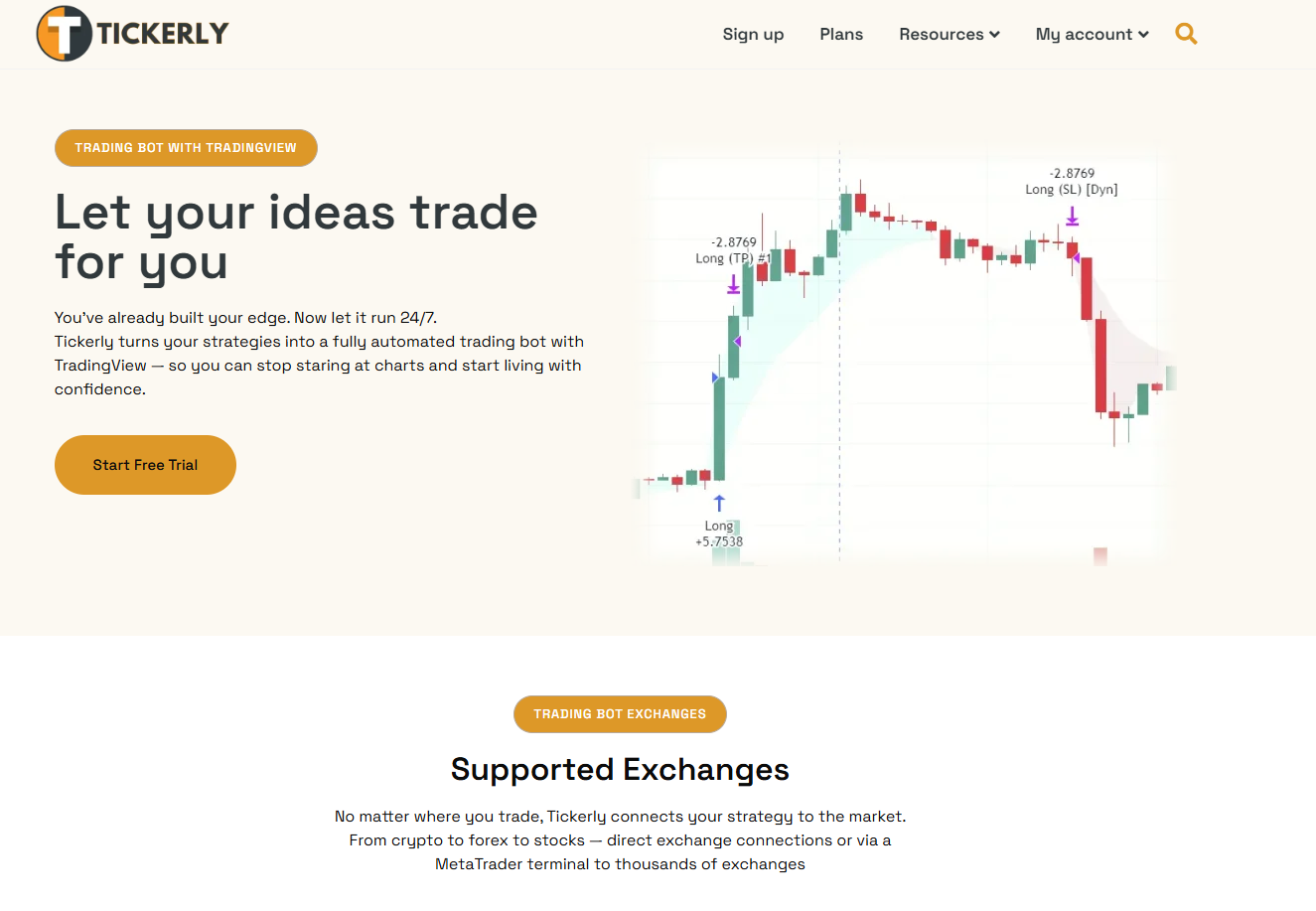
Tickerly automates your TradingView strategies into fully functional trading bots that act on your price action signals in real time, without hesitation or emotional override. You define the rules: pattern confirmation, position size, stop placement, and target. Tickerly executes them with the speed and consistency that manual trading cannot match. For traders who have built a proven price action edge, automated trading bots remove the execution gap between signal and fill. Explore Tickerly’s full bot guide to see which trading bot fits your strategy best.
FAQ
What is the best candlestick pattern for price action trading?
Pin bars at key support and resistance levels produce win rates of 61 to 63%, making them the most reliable single pattern. Confirmation from volume and higher timeframe trend context pushes that rate higher.
How many trades should a price action trader take per week?
Disciplined traders take 2 to 5 confirmed trades per week, focusing only on setups that form at pre-marked key levels. Higher frequency typically means lower quality setups and reduced profitability.
Do price action strategies work in crypto markets?
Yes. Pin bars, engulfing candles, and inside bars appear consistently across crypto, forex, and equities because they reflect universal buyer and seller dynamics. Volume confirmation is especially important in crypto, where institutional liquidity sweeps are frequent.
What win rate should I realistically expect from price action trading?
A realistic win rate is 40 to 60%, with profitability driven by positive expectancy through risk-reward ratios of 1:1 to 1:2 or better. Chasing a higher win rate often leads to tighter stops that get hit before trades move in your favor.
How long does it take to become proficient at price action trading?
Price action is a discretionary skill that requires sustained daily chart study. Most traders develop reliable pattern recognition within 6 to 12 months of consistent practice, journaling, and focused review of historical setups.