

If you’re outgrowing Mudrex, the strongest replacements fall into a handful of camps: Tickerly for TradingView-native strategy automation, Coinrule for no-code rule building, 3Commas and Bitsgap for multi-exchange terminals, and HaasOnline or Trality if you script your own logic. Tickerly stands out for traders who already build strategies in Pine Script and want alerts converted into live orders with minimal latency. Test any candidate on a demo before funding it.
TL;DR:
Tickerly converts existing TradingView alerts into live orders across multiple exchanges with minimal latency, ideal for Pine Script traders seeking automation.
Demo testing should confirm platform compatibility with your strategies, API permissions, and exchange support, especially before committing funds.
The best platform depends on your strategy-building approach, with scripting environments suited for full control and no-code tools better for condition-based traders.
Security measures like limited API permissions, encryption, and two-factor authentication are essential, especially on multi-exchange aggregators.
Prioritize platforms that support backtesting, offer clear fee structures, and have active community support to ensure reliability and troubleshoot issues.
Table of Contents
Top Mudrex Alternatives, Ranked by What They Actually Do Well
Every platform on this list solves a slightly different problem, and picking based on “best overall” instead of “best for my workflow” is how traders end up paying for features they never touch.
1. Tickerly converts TradingView alerts into live orders across multiple exchanges, with execution speed built around minimizing the gap between signal and fill. It supports multiple strategies and alerts, enabling traders to manage various setups without needing separate subscriptions for each. It’s the strongest fit for anyone who already writes Pine Script and wants that logic executing without babysitting a chart.
2. Coinrule uses a no-code rule builder with reusable templates, aimed at traders who think in “if this, then that” logic rather than code. It includes a demo mode for testing rules before committing capital, which makes it a low-risk entry point for beginners.
3. Trality pairs a Python coding environment with a bot marketplace, so quants can script custom logic and also rent strategies built by other users.
4. 3Commas runs a multi-exchange terminal with its SmartTrade order workflows, built for traders juggling several venues from one dashboard.
5. Bitsgap offers a unified terminal with AI-assisted bot configuration, useful for anyone who wants manual smart orders and automated bots living in the same interface.
6. Cryptohopper leans on a strategy marketplace and copy-trading features, letting less experienced users mirror strategies built by others.
7. HaasOnline is built for developers, using HaasScript to support complex, custom-coded strategies that go well beyond template logic.
8. TradeSanta keeps things template-first, favoring fast deployment over deep customization.
9. WunderTrading, 10. EazyBot, 11. ProfitTrailer, 12. Tuned, 13. CoinWealth, and 14. KoinBasket round out the broader field of Mudrex competitors that directories consistently list alongside the names above. Each tends to combine cloud-hosted bots with tiered subscription pricing, and the practical differences show up mostly in exchange coverage and how much strategy customization each plan tier unlocks.
Pricing across this group generally follows a freemium-to-tiered pattern: a limited free or trial tier, then paid plans scaled by number of bots, trading volume, or connected exchanges. Multiple SaaS directories confirm this shared roster of alternatives, which tells you the market has largely converged on the same set of serious contenders.
How to Choose Among Mudrex Alternative Trading Platforms
The right platform depends on four things: how you build strategies, where you trade, how much you’re willing to pay, and whether you trust an automated fill enough to walk away from the screen.
-
Backtesting and paper trading: Confirm the platform lets you run a strategy against historical data and simulate live conditions before real money is at risk. Coin Bureau’s own testing approach treats these platforms as execution tools, not prediction engines, and backtesting is the feature that separates a disciplined setup from a guess.
-
Exchange coverage: Some platforms, like Pionex, run bots natively inside one exchange. Others aggregate across many venues by API, which adds flexibility but also adds a subscription cost layer, according to Koinly’s platform comparison.
-
Pricing model: Free or built-in bots remove hosting complexity but lock you to one exchange. Aggregator platforms charge monthly or annual fees but let you route orders wherever liquidity is best.
-
Strategy builder: No-code rule builders (Coinrule) suit traders who think in conditions. Scripting environments (HaasOnline, Trality) suit traders who want full control over entry, exit, and risk logic.
-
Hosting and execution: Cloud-hosted bots run continuously without your machine staying on. Self-hosted setups give more control but require more technical upkeep.
Before you commit a subscription fee, run this checklist during any free trial:
-
Backtest one real TradingView strategy against at least three months of price data.
-
Execute several paper trades to confirm the platform’s fill logic matches what you expect.
-
Verify the exchange’s supported API order types (limit, market, stop) actually match your strategy’s needs.
-
Test routing across at least two exchanges if multi-venue execution matters to you.
Watch for red flags: no demo or paper-trading mode, unclear or hidden fee tiers, thin API documentation, or exchange support that excludes the venue where you actually trade.
Pro Tip: Run the exact same TradingView strategy through two platforms’ demo modes side by side. The execution timing difference, not the feature list, usually reveals which one is worth paying for.
Where Tickerly Fits Among These Automation Options
Tickerly was built specifically around the workflow most of the platforms above only partially support: taking a TradingView alert and turning it into a live order without a manual step in between. That distinction matters for traders whose entire strategy already lives in Pine Script rather than a platform-specific rule builder.
Common use cases include:
-
Day traders who fire multiple TradingView alerts per session and need each one executed without lag.
-
Traders running several strategies simultaneously across crypto, forex, and stocks, where manual execution would mean missing at least one signal.
-
Active investors who need cross-exchange execution so a signal gets filled at the best available venue rather than whichever exchange happens to be open in another tab.
Where Coinrule and TradeSanta focus on template-based automation and 3Commas and Bitsgap focus on multi-exchange terminals, Tickerly’s angle is direct TradingView-to-order execution. If your strategy already exists as a Pine Script alert, that’s a narrower gap to close than rebuilding logic inside a different platform’s rule engine.
Customer Support and Community Resources Worth Checking
Support quality varies more across this category than most traders expect going in. Platforms built around code and scripting, like HaasOnline and Trality, tend to lean on active user forums and documentation because their audience is technical enough to self-serve. Template-first platforms like TradeSanta and Coinrule generally invest more in onboarding guides and live chat, since their audience skews toward less experienced automation users.
Marketplace-style platforms such as Cryptohopper build community into the product itself: strategy creators answer questions from copy-trading followers directly, which functions as a support channel even without a formal ticket system. That’s worth factoring in if you plan to run someone else’s strategy rather than your own.
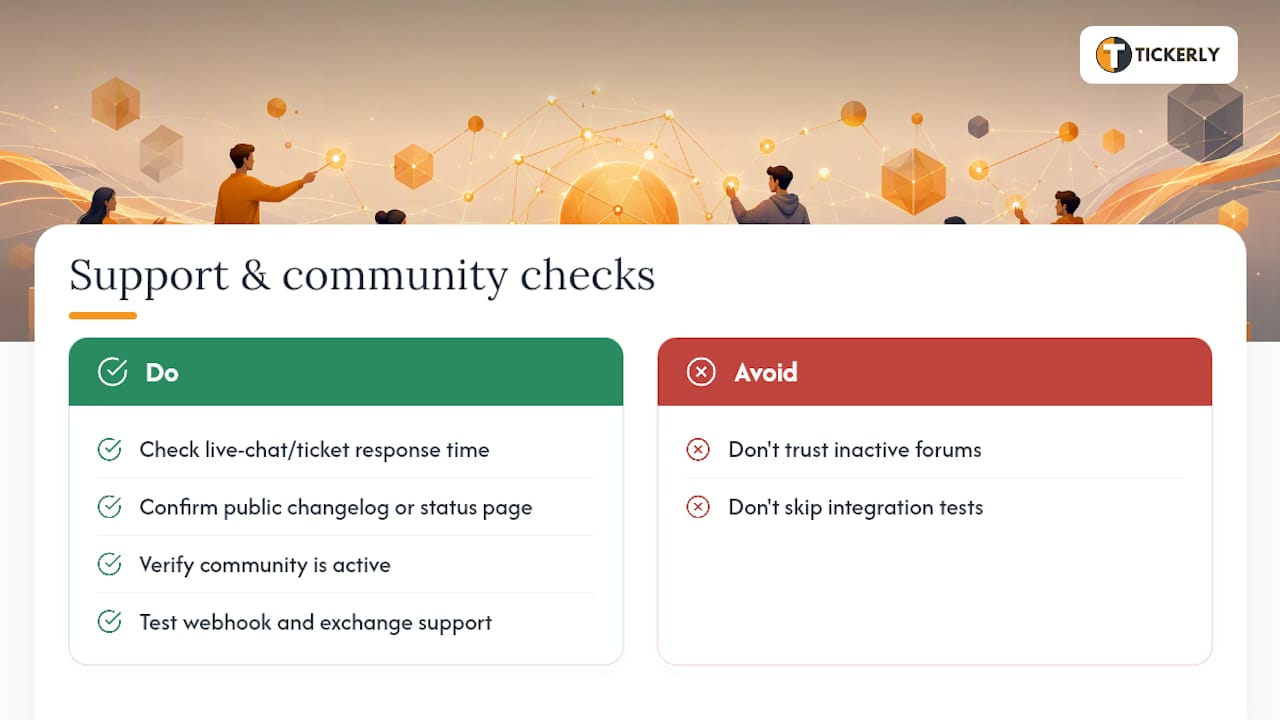
Before subscribing anywhere, check three things: response time on a live chat or ticket during business hours, whether a public changelog or status page exists for outages, and whether the community (Discord, Telegram, or forum) is actually active or just nominally present. A platform with thousands of users but a dead support forum is a worse bet than a smaller platform with an engaged one.
Tickerly’s support model focuses on assistance with exchange connections and TradingView webhook setup, as these integration steps are common points of failure rather than the strategy logic itself.
Security and Compliance Across These Platforms
API key permissions are the first thing to check on any platform in this category. A properly configured integration should only request trade execution permissions, never withdrawal access. If a platform’s setup flow asks for withdrawal permissions to run a bot, that’s a structural red flag regardless of how good its strategy tools look.
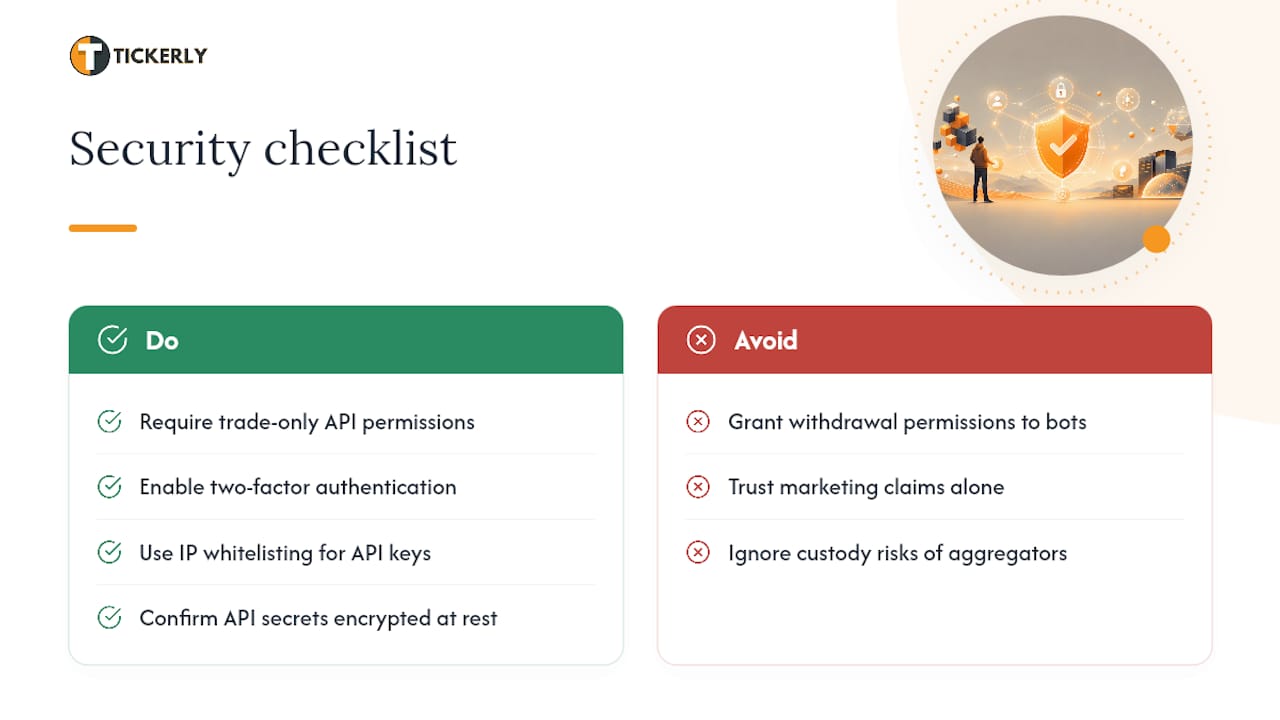
Beyond API scoping, look for two-factor authentication as a baseline, IP whitelisting for API keys where the exchange supports it, and encrypted storage of any credentials the platform holds on your behalf. Multi-exchange aggregators like 3Commas and Bitsgap carry more custody-adjacent responsibility than single-venue tools like Pionex, simply because they’re holding connections to more accounts at once.
Compliance posture differs by jurisdiction and by how each platform is structured, so this isn’t a place to take a marketing page at its word. Read the platform’s own security documentation rather than a third-party summary, and confirm whether it stores API secrets encrypted at rest or relies entirely on the exchange’s own permission model.
Tickerly’s execution architecture uses scoped API permissions to connect to exchanges, maintaining fund custody on the exchange rather than transferring it to a third-party wallet. That structural choice, rather than a badge or certification claim, is the detail worth verifying on any platform you’re about to trust with real capital.
Why the “Best Overall” Question Is the Wrong One to Ask
Most comparison articles rank these platforms as if one wins outright, and that framing has always bothered me. The real question isn’t which platform is best. It’s which workflow you already have and which platform stops fighting it.
A trader who lives in TradingView and writes Pine Script doesn’t need a rule builder like Coinrule. They need their existing signals executed faster and more reliably, which is a narrower and more solvable problem than “give me a whole new strategy system.” That’s the gap Tickerly is built to close, and it’s a different job than what Trality or HaasOnline solve for developers writing bots from scratch.
The conventional advice, “pick the platform with the most features,” ignores that most traders use a fraction of what they pay for. Prioritize the one feature that actually blocks your current strategy from running unattended, test it in demo mode first, and ignore the rest of the feature list until that’s proven out.— Jay
Try Tickerly: From TradingView Alert to Live Order
If your trading strategy already lives in TradingView, the platforms above ask you to rebuild it somewhere else. Tickerly skips that step entirely. It reads the alert your Pine Script already generates and executes it directly on your connected exchange, with no rule builder to relearn and no manual copy-paste between chart and order book.
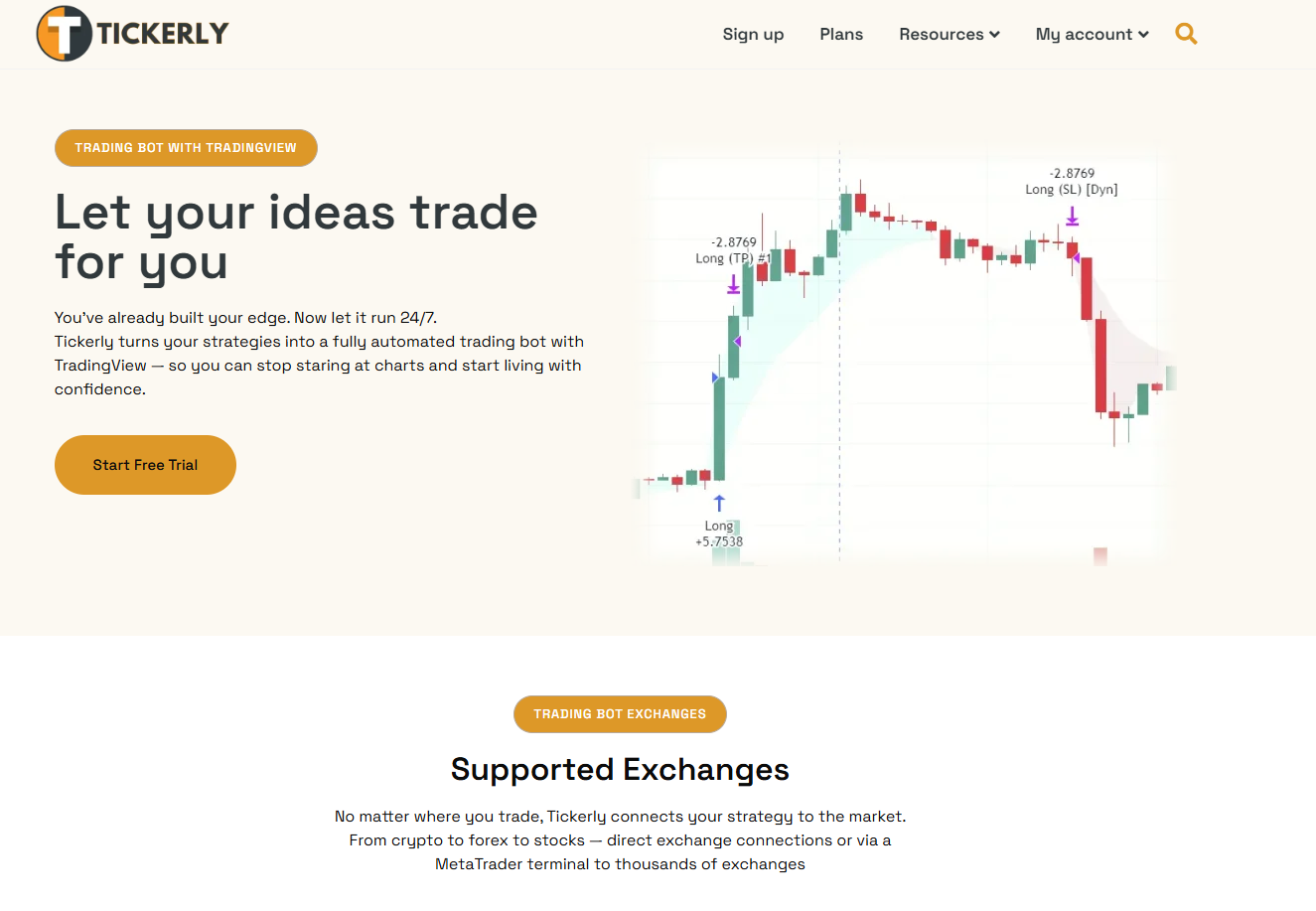
Getting started takes three moves: connect an exchange in demo mode first, convert one existing TradingView alert into a live order to see the execution speed for yourself, and run a handful of paper trades before you commit real capital. If you want the technical walkthrough, Tickerly’s TradingView strategy automation guide covers the setup from alert to live fill, including how to configure multiple strategies without them colliding on the same account.
Sources
-
10 Best Crypto Trading Bots June 2026 | Expert Review | Koinly
-
10 Best Mudrex Alternatives & Competitors (2026) – SoftwareSuggest
FAQ
What Are Some Other Apps Similar to Mudrex?
Coinrule, 3Commas, Bitsgap, Cryptohopper, Trality, HaasOnline, and TradeSanta all serve as direct Mudrex substitutes, and Tickerly fills the gap specifically for traders automating TradingView-based strategies.
Which Is Better, CoinSwitch or Mudrex?
Both are exchange-focused platforms rather than dedicated automation tools, so the better choice depends on whether you need built-in bot automation (Mudrex) or a simpler exchange interface (CoinSwitch); neither replaces a TradingView-native automation platform like Tickerly.
How Reliable Is Mudrex?
Reliability on any automated trading platform comes down to execution speed, exchange uptime, and how thoroughly you’ve backtested your strategy, not the platform’s marketing claims alone. Coin Bureau’s guidance on these platforms treats them as execution tools rather than guaranteed profit systems.
Which Crypto to Stay Away From?
No trading automation platform can screen out bad assets for you. The safer approach is applying your own risk criteria, low liquidity, unclear tokenomics, unverified teams, before automating a strategy around any coin, regardless of which platform executes it.
Does Tickerly Support Backtesting Before Going Live?
Tickerly is built around executing strategies you’ve already tested in TradingView, so the backtesting happens in TradingView’s own environment before the alert is ever converted into a live order.
Recommended
This article was produced with Al assistance and reviewed for accuracy. It is provided for general information only and is not professional or financial advice.