

Most traders assume one approach is simply better than the other. The reality is more complicated. Systematic traders outperformed discretionary traders by 23% annually in a 2024 retail forex study, yet win rates across both camps remained strikingly similar, ranging from 42% to 58% after slippage and strategy decay. That gap between win rate and actual profitability tells you everything: execution consistency, emotional control, and system design matter more than the raw method you choose. This guide breaks down both approaches with real evidence so you can make a smarter, more informed decision for your trading setup.
Table of Contents
- What is the difference between manual and automated trading?
- How do outcomes differ? Evidence from trading results
- Pros and cons: when is manual or automated trading better?
- Making the shift: how to decide or combine both approaches
- Why most traders misunderstand the automation debate
- Explore automated trading on TradingView with Tickerly
- Frequently asked questions
Key Takeaways
| Point | Details |
|---|---|
| No universal winner | Manual and automated trading perform differently depending on context and trader discipline. |
| Automation boosts consistency | Systematic trading often outperforms manual by staying consistent and removing emotion. |
| Blended approaches work | Many top traders on TradingView mix both styles for flexibility and resilience. |
| Both need oversight | Neither method is hands-free—continuous monitoring and improvement are essential. |
What is the difference between manual and automated trading?
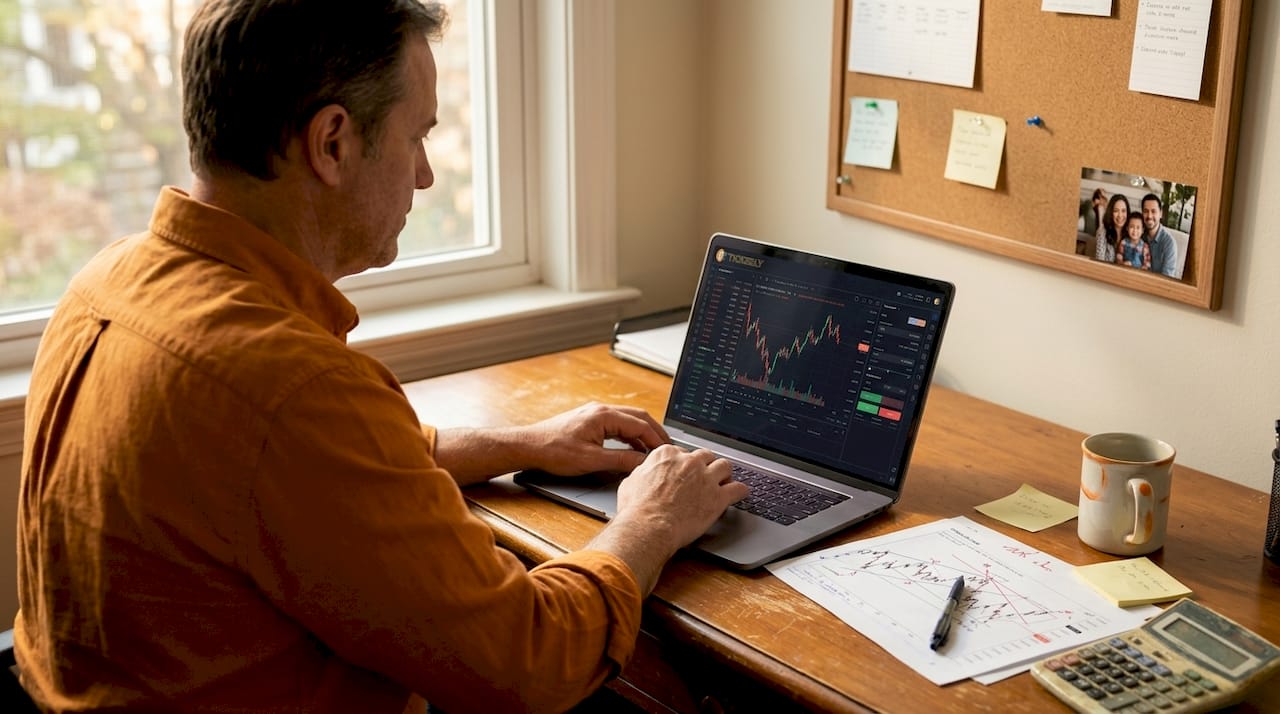
Manual trading means you make every decision yourself. You analyze the chart, identify an entry signal, size your position, and click the buy or sell button with your own hands. Every exit, every stop loss adjustment, every decision to hold or fold comes directly from you in real time.
Automated trading means a pre-programmed set of rules executes trades on your behalf. You define the logic once, whether in Pine Script on TradingView or through an API-connected bot, and the system handles execution without requiring your active presence. The bot does not hesitate, second-guess, or feel fear.
These two definitions sound straightforward, but the practical difference runs much deeper. Manual traders rely on intuition, pattern recognition, and real-time judgment. Automated traders rely on backtesting, rule precision, and system reliability. Neither approach is passive. Both require skill, just different kinds of skill.
Here is a direct comparison of the key dimensions:
| Dimension | Manual trading | Automated trading |
|---|---|---|
| Execution speed | Seconds to minutes | Milliseconds |
| Emotional influence | High | Near zero |
| Flexibility | Very high | Limited to coded rules |
| Required skills | Chart reading, discipline | Coding, backtesting, system design |
| Scalability | Low (time-intensive) | High (runs 24/7) |
| Setup time | Minimal | Significant upfront investment |
| Ongoing oversight | Active | Moderate (monitoring required) |
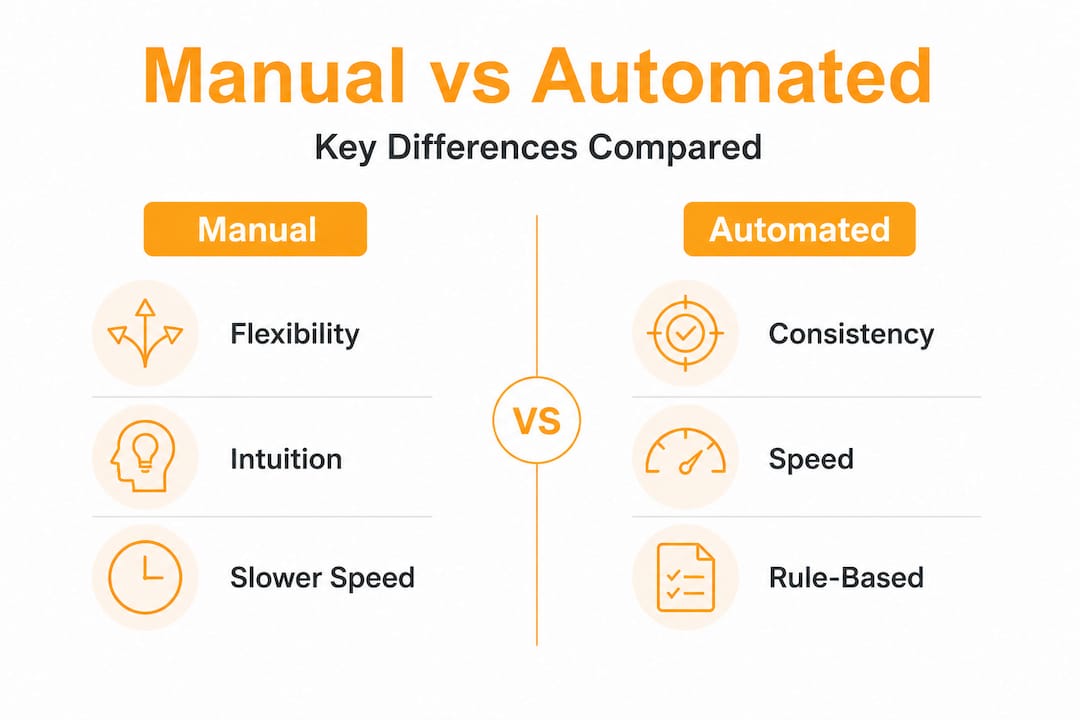
The core trade-off is clear: manual trading gives you flexibility and the ability to respond to news or unusual conditions, while automated trading gives you speed and consistency. As the automated trading FAQ explains, neither style eliminates risk. They simply shift where the risk originates.
Understanding how AI trading bots process and execute orders can also help you appreciate why execution-level differences matter so much in fast markets. A bot operating with sub-millisecond latency is not just faster; it is structurally different from a human clicking a button.
Key distinctions traders often overlook include:
- Slippage exposure: Manual traders frequently experience worse fills during volatile periods because reaction time lags behind price movement.
- Overnight and weekend risk: Automated systems can monitor positions 24/7, while manual traders must either close positions or accept exposure when they are away.
- Strategy complexity: Automated systems can execute multi-leg strategies, conditional orders, and position scaling rules that would be nearly impossible to manage manually in real time.
Pro Tip: Most experienced traders do not stick purely to one method forever. They often start manual, identify patterns in their behavior or strategy, then automate the parts where emotion or speed creates the biggest drag on performance.
How do outcomes differ? Evidence from trading results
With definitions in place, let us examine how the approaches actually stack up in practice.
The numbers from recent research are eye-opening. Systematic strategies outperformed discretionary approaches by 23% annually in a controlled retail forex environment. That is not a marginal difference. Compounded over three to five years, a 23% annual edge creates enormous divergence in account equity.
But context matters. Win rates between manual and automated approaches were nearly identical, sitting between 42% and 58% for both groups. So if win rate is similar, where does the performance gap come from?
The answer comes down to three factors:
- Execution consistency: Automated systems fill orders at the exact trigger price with no hesitation. Manual traders frequently miss entries, exit too early, or move stop losses under pressure.
- Emotional interference: Fear and greed are the two most destructive forces in trading. A bot does not experience either. It executes the rules exactly as coded, every single time.
- Compounding small advantages: A system that captures an extra 0.2% per trade through tighter fills and consistent sizing compounds dramatically over hundreds of trades.
“The edge in automated trading is not about being right more often. It is about capturing more of the edge you already have by removing the human execution layer.” This insight reflects what the data consistently shows across asset classes and timeframes.
Hedge fund data reinforces this picture. Funds with high levels of automation yielded 50 basis points per month more than their human-reliant counterparts on a risk-adjusted basis. That is roughly 6% extra per year just from the structural advantages of automation, not from having better signals.
For TradingView users considering automated forex trading, these numbers are directly relevant. Your Pine Script strategy might already have a positive expectancy. The question is whether manual execution is capturing that expectancy fully, or leaking it through imprecise timing and emotional decision-making.
| Metric | Manual traders | Automated strategies |
|---|---|---|
| Annual outperformance | Baseline | +23% in systematic studies |
| Monthly edge (hedge funds) | Baseline | +50 bps/month |
| Win rate range | 42% to 58% | 42% to 58% |
| Primary performance driver | Judgment, experience | Execution consistency, rule fidelity |
The data does not say manual trading is dead. It says that if your strategy has a genuine edge, automation makes it more likely that edge translates into actual profit.
Pros and cons: when is manual or automated trading better?
Now that you see the data, let us look at the practical strengths and limitations. These are the real reasons traders choose one approach over another.
Manual trading strengths:
- Real-time adaptability: You can respond to breaking news, sudden geopolitical events, or unexpected volatility that no coded rule anticipated.
- No technical setup required: You need a brokerage account, a charting platform, and your own discipline. No API keys, webhooks, or coding required.
- Intuition-based edge: Some experienced traders develop pattern recognition skills that are genuinely difficult to codify. Their edge is tacit, and automating it would actually degrade it.
- Learning acceleration: Trading manually forces you to deeply understand market mechanics because every decision is yours. Many top algorithmic traders started manual for exactly this reason.
Manual trading weaknesses:
- Emotional biases (fear, greed, revenge trading) consistently erode performance.
- Physical limitations mean you cannot monitor every opportunity around the clock.
- Execution speed makes certain strategies like scalping or arbitrage practically impossible.
- Inconsistent position sizing and stop loss management reduce risk-adjusted returns.
Automated trading strengths:
- Speed and latency advantages: Bots execute in milliseconds. In fast-moving crypto markets, this difference is the strategy working or failing entirely.
- Discipline and rule fidelity: The system follows your rules 100% of the time. No deviation based on how you are feeling that morning.
- Scalability: One bot can monitor dozens of pairs simultaneously. One human cannot.
- Backtesting integration: Platforms like TradingView let you test your Pine Script strategy across years of historical data before risking live capital.
Automated trading weaknesses:
- Technical failures, including exchange downtime, API errors, and connectivity issues, can cause missed trades or unwanted positions.
- Curve-fitting risk: a strategy that backtests perfectly may fail in live conditions because it was over-optimized to historical data.
- Unusual market events (flash crashes, black swan events) can trigger outsized losses if emergency logic is not built in.
Hedge funds with automation advantages generate 50 bps monthly more than those relying on human execution, but even they maintain oversight teams. You can review the range of supported exchanges to see which markets support full automation, and understand how automated trading works mechanically before committing.
Pro Tip: Automated does not mean “set and forget.” Even a well-designed system needs regular review, parameter updates as market conditions evolve, and manual intervention during extreme volatility. Think of it as managing a disciplined employee, not installing a vending machine.
Making the shift: how to decide or combine both approaches
Understanding the benefits and trade-offs makes it easier to construct a tailored approach, whether that means fully manual, fully automated, or a smart hybrid.
Start with honest self-assessment. Three questions define your path:
- What are your actual strengths? If you have strong intuition and love active analysis, pure automation may frustrate you and reduce your engagement. If you consistently sabotage your own entries with hesitation or emotional exits, automation is likely a direct performance upgrade.
- What does your account size support? Smaller accounts benefit from automation because you can run lean, disciplined strategies without paying the emotional cost of watching every tick. Larger accounts with complex risk management may still benefit from human oversight alongside automated execution.
- What is your risk tolerance for technical failure? Automated systems introduce a new category of risk: system failure. If you are not comfortable monitoring API connections, exchange connectivity, and bot logs regularly, a hybrid approach gives you a safety net.
A practical three-step framework for making the shift:
- Assess your goals and trading behavior. Run a manual trading journal for at least 30 trades. Identify where your biggest losses came from. If most came from emotional decisions rather than bad signals, automation addresses the root cause. If most came from flawed analysis, automation will just execute bad trades faster.
- Test both in parallel. Use TradingView’s paper trading feature to run your strategy in automated mode while you continue trading manually. Compare the outcomes over 60 to 90 days. This parallel testing reveals exactly how much execution drag your manual approach carries.
- Scale what works. Once you identify whether your edge is sharper through automation, manual discretion, or a hybrid blend, allocate capital accordingly. Do not scale a method purely because it feels comfortable. Scale what the data tells you actually works.
Live win rates are strikingly similar between manual and automated traders, which means blending both approaches strategically can preserve your intuitive edge while removing execution friction. You can automate your trade exits to eliminate emotional stop-loss management while keeping manual entry decisions, for example. Many traders find this hybrid produces better results than either extreme.
Review strategies for long-term profitability to understand how to continuously refine your automated approach over time rather than treating it as a finished product. And it is worth understanding the real limitations of AI bots before deploying capital, so your expectations are grounded in how these systems actually behave in live markets.
Pro Tip: Review your trading performance every month with the same question: “Is this approach still working, or am I sticking with it out of habit?” Markets evolve, and your method should evolve with them.
Why most traders misunderstand the automation debate
Having explored the facts, it is time to address a major misconception that too many guides leave out entirely.
Most of the automation vs. manual debate gets framed as a technology question. Faster bots win. Smarter algorithms win. More data wins. But the traders we see succeed consistently on TradingView are not winning because they found the perfect indicator or the fastest execution layer. They are winning because they understand their own edge and build systems around it.
Automation is not a performance upgrade by default. It is a performance amplifier. If your strategy has a positive expectancy and you have validated it through rigorous backtesting, automation captures more of that expectancy by removing execution friction. But if your strategy does not have an edge, automation just loses money faster and more consistently.
The reverse is also true. Manual trading is not obsolete. In illiquid markets, during major news events, or when trading instruments that require contextual judgment, a skilled discretionary trader can outperform any rigid coded system. The best traders know when to let the bot run and when to step in.
What the data actually shows is that the edge comes from iteration and adaptation, not from picking a side. The most successful TradingView users we observe are the ones who treat their trading approach like a living system. They backtest, deploy, review results, identify failure points, and adjust. Whether that adjustment means adding automation to an emotional weak spot or pulling back automation when a strategy stops working in current market conditions, the mindset is adaptive.
The automation FAQ addresses many of the specific technical questions traders have when first considering this shift. But the deeper question is not “should I automate?” It is “do I understand my strategy well enough to define its rules precisely?” If you cannot answer yes, more time in manual mode is actually the right next step.
Explore automated trading on TradingView with Tickerly
You now have a clear, evidence-based picture of how manual and automated trading compare. The next step is putting that knowledge to work with the right tools.
Tickerly turns your TradingView Pine Script strategies into fully automated trading bots without requiring you to build complex infrastructure from scratch. Whether you want to automate your exits, run a full systematic strategy, or test a hybrid setup where automation handles execution while you retain discretion on entries, Tickerly gives you the flexibility to build exactly that. Explore the automated trading FAQ for practical answers, read the full guide to automated trading on TradingView to understand the setup process, or start exploring TradingView trading bots to see how Tickerly fits your specific trading style and goals.
Frequently asked questions
What are the biggest risks of manual trading?
Manual trading exposes you to emotional mistakes like revenge trading, inconsistent position sizing, and delayed execution, all of which can erode the edge of an otherwise sound strategy.
Is automated trading always more profitable than manual?
No. Automated strategies outperformed discretionary by 23% in some studies, but win rates remain similar, and results depend heavily on strategy quality, market conditions, and how well the system is maintained.
Can you combine manual and automated trading techniques?
Yes, and many traders achieve stronger results this way. Blending both approaches lets you automate execution and risk management while preserving discretionary judgment for entry signals or unusual market conditions.
Does automated trading eliminate all manual work?
No. Successful automated systems still require regular monitoring, parameter updates, and manual intervention during extreme volatility or technical failures. Automation reduces workload, but it does not eliminate responsibility.