

Automated trading bots execute faster than any human can react, which is exactly what makes them powerful and exactly what makes them dangerous. Understanding how to manage risk in trading bots is not optional if you want to protect your capital over the long run. A bot running without proper safeguards can amplify losses at the same speed it generates profits, and in volatile markets, that speed becomes a liability. This guide walks you through the prerequisites, practical strategies, portfolio-level controls, and technical pitfalls that separate traders who survive drawdowns from those who don’t.
Table of Contents
Key takeaways
| Point | Details |
|---|---|
| Layer your risk controls | No single stop-loss protects you; combine position sizing, circuit breakers, and kill-switches for full coverage. |
| Use dynamic thresholds | Static risk limits fail in shifting market regimes; adapt thresholds to real-time volatility for better protection. |
| Monitor at the portfolio level | Track correlation and aggregate exposure, not just individual trade risk, to avoid compounding losses. |
| Address technical failure modes | Floating-point errors and naive circuit breakers can silently undermine your risk controls; test for them explicitly. |
| Scale risk gradually after drawdowns | Ramp exposure back up only after confirmed positive performance to avoid compounding losses in a regime shift. |
Risk management foundations for trading bots
Before you configure a single parameter, you need a clear picture of what you are actually trying to control. Risk in trading bots breaks down into three levels: trade-level risk, strategy-level risk, and portfolio-level risk. Most traders only think about the first one.
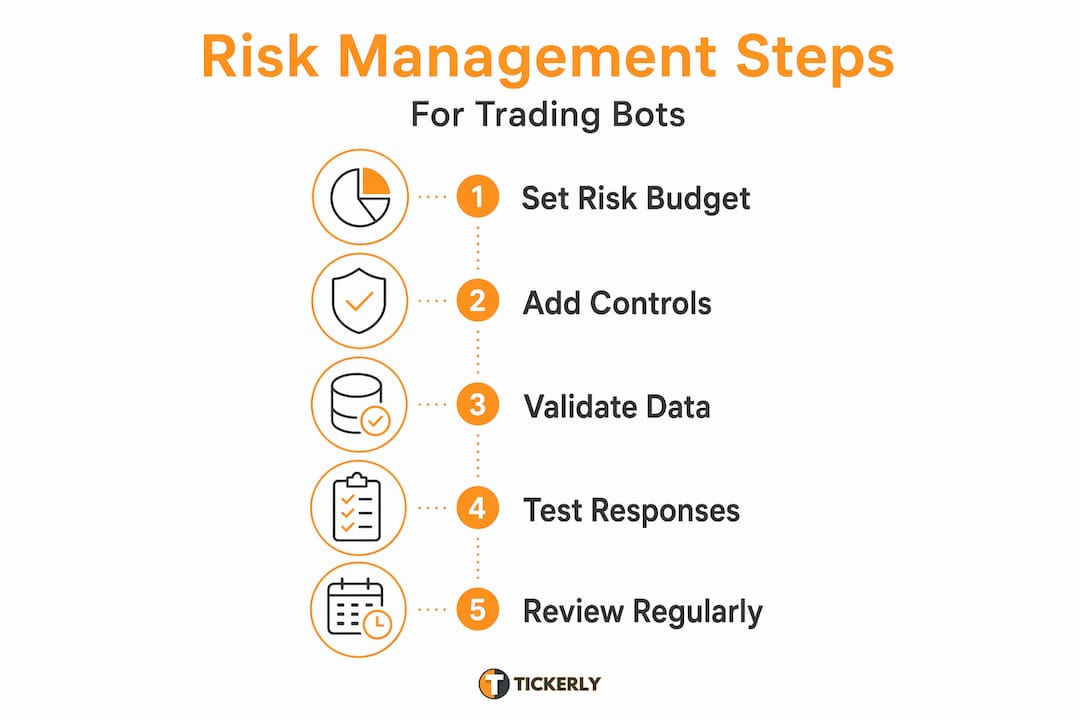
At the trade level, setting stop-loss levels and maximum trade amounts keeps your bot operating within safe boundaries, which is especially critical in high-frequency and leveraged environments where market swings hit fast. At the strategy level, you need a defined maximum drawdown before the bot pauses. At the portfolio level, you need aggregate exposure limits that account for correlation between positions.
Here are the core tools every bot trader should have configured before going live:
-
Position size limits: Maximum capital allocated per trade, expressed as a percentage of total account equity
-
Stop-loss orders: Automatic exits at defined loss thresholds to cap downside on individual trades
-
Drawdown circuit breakers: Strategy-level shutdowns when cumulative losses exceed a predefined limit
-
Kill-switches: Hard system-level stops triggered by PnL breaches, order rate anomalies, or connectivity failures
-
Volatility filters: Conditions that pause trading when market volatility exceeds a safe operating range
You also need reliable data feeds and exchange connectivity. A bot making decisions on stale or incorrect price data is not managing risk. It is creating it. Before deployment, confirm your exchange connection handles reconnects gracefully, and test order execution under simulated load.
Pro Tip: Establish your risk budget before backtesting your strategy. If you define that your bot can lose a maximum of 10% of account equity before halting, your strategy parameters should be built around that constraint, not the other way around.
Step-by-step strategies to reduce trading bot risks
With your foundations in place, here is how to configure risk controls that actually work in production.
-
Set position sizing based on account equity. Fixed percentage sizing at 0.5% to 2% of total account equity is an anti-martingale approach that scales your exposure with your actual performance. When your account grows, position sizes grow proportionally. When you lose, they shrink automatically. For more mathematically precise sizing, the Kelly Criterion calculates optimal bet size based on win rate and risk/reward ratio. In practice, use fractional Kelly at 25% to 50% of the full Kelly output to reduce variance.
-
Configure stop-loss and trailing stop orders with slippage in mind. Stop-market orders guarantee execution but not price. Stop-limit orders guarantee price but not execution, meaning you can get gapped through your level entirely in fast markets. The right choice depends on your asset’s liquidity. For crypto or thinly traded forex pairs, stop-market orders are generally safer because getting out at a slightly worse price beats not getting out at all. Build an additional 0.2% to 0.5% slippage buffer into your risk calculations to account for real-world execution.
-
Implement circuit breakers with a maximum drawdown limit. Decide on a daily loss threshold, typically 2% to 5% of account equity, at which your bot stops trading entirely for the session. Code this as a hard rule, not a soft warning.
-
Deploy multi-layered kill-switches targeting different failure modes. A single PnL-based kill-switch is not enough. Production-grade bots need separate triggers for: cumulative loss limits, unusual order rates (which signal a software loop) and price deviation beyond expected ranges. Each kill-switch addresses a distinct failure mode that the others will not catch.
-
Apply dynamic risk thresholds that adjust to market volatility. Static thresholds are blind to changing conditions; a stop-loss sized for normal volatility becomes dangerously tight during a low-volatility regime and dangerously wide during a spike. Use the Average True Range (ATR) or a similar volatility measure to scale your stop distance dynamically. When volatility doubles, your position size should roughly halve to keep dollar risk constant.
Pro Tip: After configuring your kill-switches, run a deliberate test in a paper trading environment where you force the trigger conditions. If your bot does not halt exactly as designed, fix the logic before going live. This is not optional testing. It is the only way to know your safety net works.
Portfolio-level risk controls
Managing individual trade risk is necessary. Managing risk across your entire portfolio of strategies is what separates consistently profitable bot traders from those who blow up after a correlated market event.

The core problem is correlation. When you run multiple strategies simultaneously, their positions may be correlated without you realizing it. Two momentum bots on different assets can both go long at the same time during a broad market rally, and both lose simultaneously when the rally reverses. Correlation-adjusted position sizing accounts for this by reducing individual strategy allocations when their positions overlap significantly.
Here is what a portfolio-level risk framework looks like in practice:
-
Volatility targeting: Dynamically adjust total portfolio exposure so that expected portfolio volatility stays constant regardless of market conditions. Increase exposure in calm periods and reduce it during turbulent ones.
-
Drawdown scaling: When portfolio drawdown exceeds 5%, reduce all strategy allocations by 25%. At 10% drawdown, reduce by 50%. This prevents a bad streak from becoming a catastrophic loss.
-
Strategy correlation monitoring: Calculate rolling 30-day correlations between your active strategies. If two strategies show correlation above 0.7, treat them as one position for sizing purposes.
-
Live risk dashboard: A real-time display of exposure, volatility, and drawdown across all active strategies gives you the early warning signals you need for human intervention before losses compound.
The comparison below shows how static versus dynamic portfolio risk management performs across key metrics:
| Metric | Static allocation | Dynamic (volatility-targeted) |
|---|---|---|
| Drawdown depth | Higher; uncapped in volatile regimes | Reduced; exposure scales down automatically |
| Performance in calm markets | Moderate; allocation unchanged | Higher; exposure increases in low-volatility periods |
| Reaction to correlation spikes | None; positions accumulate | Reduced sizing when correlation is detected |
| Operational complexity | Low | Moderate; requires real-time data processing |
My honest take on what actually works
I’ve watched traders configure technically perfect risk parameters and still get hurt. The reason is usually overconfidence in backtesting results. In my experience, the biggest gap in most bot risk frameworks is not the stop-loss logic. It’s the assumption that past volatility predicts future volatility well enough for static thresholds to hold.
What I’ve found actually works is accepting that your risk controls will be wrong sometimes, and designing for that reality. A layered approach where a trade-level stop-loss, a strategy-level circuit breaker, and a portfolio-level kill-switch all operate independently gives you three chances to contain damage instead of one. When one layer fails, the next one fires.
I’ve also learned that human oversight is not a sign that your automation failed. Regulatory bodies require firms to maintain control over any automated tools they deploy, and that governance requirement exists for good reason. No bot should be running for days without a human reviewing its behavior. Weekly reviews of position sizing, drawdown history, and correlation data are the minimum responsible practice.
The part most traders underestimate is the recovery protocol after a drawdown. Ramping risk exposure gradually after confirmed positive performance, rather than jumping back to full size the moment the circuit breaker resets, is what separates sustainable bot trading from repeated boom-and-bust cycles. Patience here is not timidity. It’s capital preservation in practice.
— Jay
How Tickerly helps you trade with built-in risk awareness
Managing bot risk at the level this article describes requires both a solid strategy and a reliable automation layer underneath it.
Tickerly turns your TradingView Pine Script strategies into fully automated trading bots, giving you direct control over execution parameters, position sizing, and order management across supported exchanges. If you are looking to put what you’ve read here into practice, exploring automated bot benefits is a strong starting point for understanding how automation and risk control work together. You can also browse the strategy library to find risk-aware approaches built for TradingView automation. Tickerly gives you the infrastructure. Your risk framework gives it direction.
FAQ
What is the most important risk control for a trading bot?
No single control is sufficient, but position sizing combined with a drawdown circuit breaker forms the minimum viable foundation. Together they cap both individual trade losses and cumulative strategy losses before they become unrecoverable.
How do stop-losses fail in automated trading?
Stop-loss orders can execute at prices significantly worse than the target level due to slippage and market gaps, particularly in fast-moving or low-liquidity markets. Using stop-market orders with a built-in slippage buffer reduces but does not eliminate this risk.
What are the main trading bot risk factors to monitor?
The primary trading bot risk factors include position concentration, correlated strategy exposure, order execution failures, data feed errors, and software bugs that cause unintended trading behavior.
How often should I review my bot’s risk settings?
Review position sizing, drawdown limits, and strategy correlation at least weekly. After any significant market event or circuit breaker trigger, conduct an immediate post-event analysis before restarting the bot.
Can a trading bot manage risk automatically without human oversight?
A bot can execute predefined risk rules automatically, but human oversight remains mandatory. Regulatory requirements aside, no automated system can anticipate every market condition, and reviewing bot behavior regularly is the only way to catch logic errors before they cause serious losses.