

Automation removes emotions from trading, but it doesn’t remove the need for clear thinking. Many traders pour hours into building Pine Script strategies on TradingView, only to watch them perform brilliantly in backtests and fall apart in live markets. The culprit, more often than not, is poor documentation. As research confirms, over-optimization from poor documentation causes live failure despite strong backtests. If you’re running automated strategies, documentation isn’t optional overhead. It’s the foundation that separates repeatable, scalable trading from costly guesswork.
Table of Contents
- The core benefits of documenting trading strategies
- What should your trading strategy documentation include?
- How documentation improves testing, iteration, and live performance
- Common pitfalls and best practices (what most traders miss)
- Our perspective: Why real documentation wins (beyond checklists and code)
- Get more from your strategies with Tickerly
- Frequently asked questions
Key Takeaways
| Point | Details |
|---|---|
| Documentation boosts results | Written strategies yield more consistent, scalable performance in both backtests and live trading. |
| Essential elements to include | Cover logic, risk parameters, regime filters, and process workflows to maximize clarity and repeatability. |
| Backtesting depends on clarity | Documented rules create reproducible tests and strategies that perform as expected. |
| Avoid common documentation mistakes | Go beyond code comments by capturing decisions, diagrams, and deployment details for better real-world outcomes. |
The core benefits of documenting trading strategies
With automation’s pitfalls exposed, let’s explore how proper documentation directly protects and empowers your trading process. The immediate payoff is clarity. When your strategy logic is written down in plain language, you can reason about it without re-reading hundreds of lines of Pine Script. That clarity is genuinely valuable when markets move fast and you need to decide quickly whether your bot’s behavior is expected or broken.
According to expert guidance, documentation enables comprehensive READMEs including strategy overview, core logic, backtesting guides, parameters, and known issues for better understanding and maintenance of automated trading strategies. This matters whether you’re running a solo system or collaborating with other developers. Without a structured README, every collaborator has to reverse-engineer decisions that should already be recorded.
Beyond maintainability, documentation is also the foundation of debugging. When your strategy starts producing unexpected signals, you need a reference point. If your written documentation says “only enter longs when the 50-period EMA is above the 200-period EMA,” you can immediately check whether that condition is correctly coded. Without that reference, you’re hunting blindly. Proper documentation facilitates debugging and reproducibility, enabling iteration and systematic improvement that is crucial for complex Pine Script strategies on TradingView.
There are several core benefits you’ll gain immediately by building a documentation habit:
- Maintainability: You can return to a strategy after weeks or months and still understand what it does and why.
- Collaboration: New team members or contractors can onboard without spending hours decoding logic.
- Debugging: When signals misfire, your documentation gives you a clear checklist to trace the problem.
- Iteration: Past decisions and parameter changes are visible, so you know what you’ve already tested and why you moved on.
- Risk control: Documenting known limitations prevents you from deploying a strategy in market conditions it was never designed for. You can also audit trading bots more effectively when the underlying logic is clearly recorded.
Solid documentation also strengthens your backtesting validation process by giving you a clear set of rules to test against, rather than testing a vague idea. And if you’re new to automation, the automated trading FAQ is a useful primer before building your first documented strategy.
“A strategy you can’t explain in plain language is a strategy you don’t fully understand.” This principle should guide every documentation session you sit down to do.
Pro Tip: Go beyond code comments. Add a simple flowchart showing signal generation, entry triggers, and exit conditions. A one-page visual diagram often communicates more than 200 lines of inline comments.
What should your trading strategy documentation include?
Understanding the value is step one, but knowing exactly what to write down makes all the difference. Here’s what matters most. Experienced traders and prop firm evaluators agree that documentation of setups, risk parameters, filters, and trade management rules ensures repeatability, edge refinement, and performance under pressure.
Use the table below as your baseline documentation template:
| Documentation element | What to record | Why it matters |
|---|---|---|
| Strategy overview | Purpose, target market, timeframe | Frames all future decisions |
| Core logic | Entry and exit conditions in plain language | Enables debugging and review |
| Market regime filters | Trend vs. chop conditions, volatility rules | Prevents losses in wrong conditions |
| Risk parameters | Max drawdown, position sizing, stop-loss rules | Protects capital in live trading |
| Trade management rules | Scaling in/out, trailing stops, re-entry rules | Ensures consistent execution |
| Backtest parameters | Date range, commission, slippage settings | Makes results reproducible |
| Known limitations | Conditions where the strategy underperforms | Sets realistic expectations |
| Change log | Date, change made, reason, test result | Tracks evolution and learning |
For crypto bot risk management, the risk parameters section deserves special attention. Record not just what your stop-loss is, but why you chose that specific level and what testing supported that choice.
The strategy essentials that belong in any solid trading bot also belong in your documentation. Treat your docs as the human-readable version of what your bot does automatically. If you’re building trading bots on TradingView, this documentation habit should start before you write your first line of Pine Script.
Here’s a practical workflow to keep documentation current without it becoming a burden:
- Draft the overview first. Before writing any code, write one paragraph explaining what the strategy does and why you believe it has an edge.
- Record parameters as you set them. Don’t wait until the strategy is complete. Document each parameter choice with the reasoning behind it.
- Update after every backtest. Log the date, the parameter settings used, and the key metrics: net profit, max drawdown, Sharpe ratio, and win rate.
- Review after every live trade session. Note any execution surprises, slippage issues, or signal behavior that differed from backtest expectations.
- Revise regime filters quarterly. Market conditions change. Review whether your regime filters still apply and update accordingly.
- Archive versions, don’t delete them. When you change a strategy significantly, save the previous version with a note explaining why you moved on.
This workflow takes 15 to 30 minutes per session and pays enormous dividends when you’re troubleshooting a live system at 2 a.m.
How documentation improves testing, iteration, and live performance
You now know what to record. Here’s how this process changes your results in practice, from backtest to live execution.
The biggest risk in backtesting is overfitting, where a strategy is tuned so precisely to historical data that it fails to generalize. Documented rules prevent overfitting, ensure reproducibility, and support validation across different market regimes. Without written rules, you can unconsciously bend your testing parameters to produce better-looking results. With documented rules, you’re accountable to a fixed set of conditions before the test begins.
Structured trading journals track execution, psychology, and regime performance, identifying strategy weaknesses for refinement and helping you avoid emotional deviations. This is especially relevant when automation is involved. Even with a bot running, you may manually override signals or pause the system. Documenting these decisions creates a clear record of whether those interventions helped or hurt performance.

Here’s a direct comparison of what documented versus undocumented strategy management looks like across key phases:
| Phase | Documented strategy | Undocumented strategy |
|---|---|---|
| Backtesting | Reproducible, rule-bound, consistent parameters | Prone to parameter drift and cherry-picking |
| Live deployment | Clear reference for expected behavior | Frequent confusion about why signals trigger |
| Debugging | Traceable cause-and-effect | Lengthy, frustrating guesswork |
| Iteration | Builds on recorded tests and outcomes | Repeats already-failed experiments unknowingly |
| Team collaboration | Fast onboarding, shared understanding | Knowledge siloed in one person’s head |
| Performance review | Objective, metric-driven analysis | Subjective, memory-based recollection |
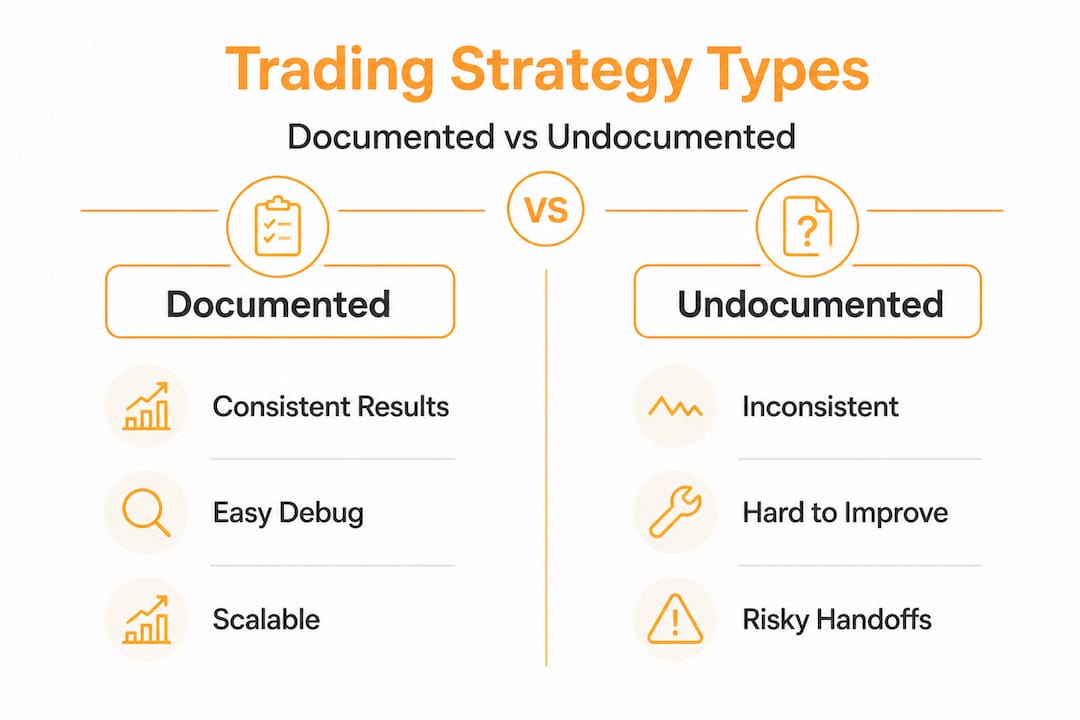
Keeping backtest reliability high requires that your testing environment matches your documented assumptions. If your docs say “tested on 4H BTC/USDT from January 2020 to December 2024 with 0.1% commission,” your next backtest uses those exact settings. This is how you know whether a strategy has genuinely improved or just got lucky. For strategy longevity, iterative documentation is what keeps edge alive as markets evolve.
A critical metric to track in your documentation: R-multiple (risk-to-reward per trade). Documented R-multiples across 50+ trades reveal whether your edge is real or statistical noise. Also track regime performance, meaning how the strategy performs in trending versus range-bound conditions. Many traders using AI trading bots discover their system works in trending markets but bleeds capital in choppy ones. Documentation makes this pattern visible and actionable.
Pro Tip: After every 25 live trades, compare actual execution metrics against your backtest projections. If slippage is consistently 0.15% higher than expected, document that finding and adjust your backtesting commission assumptions to match reality.
Common pitfalls and best practices (what most traders miss)
Even with the right intentions, some common traps derail strategy refinement. Here’s what seasoned developers do differently.
The most frequent mistake is treating code comments as a substitute for real documentation. Comments explain what a line of code does. They rarely explain why a parameter is set to a specific value or when a filter should be active. Expert guidance confirms that code comments are insufficient; you need diagrams for data flows, architectural decision records (ADRs) for decisions, and deployment procedures for live automated strategies. An ADR is a short document that records a significant decision: what you decided, what alternatives you considered, and why you chose this path.
Another critical oversight is ignoring market regime filters in documentation. Strategies must document regime filters such as trend versus chop conditions because backtests fail without them. TradingView’s strategy tester reveals this clearly through equity curves that spike during trends and deteriorate in sideways markets. If you don’t document which regime your strategy is designed for, you’ll deploy it in the wrong conditions repeatedly.
Here’s a quick summary of what most traders miss and what to do instead:
- Mistake: Only updating docs when something breaks. Fix: Update after every significant parameter change, not just failures.
- Mistake: Storing documentation only in code files. Fix: Maintain a separate document or wiki that non-coders can read.
- Mistake: Deleting old strategy versions. Fix: Archive them with notes on why they were abandoned.
- Mistake: Skipping deployment documentation. Fix: Record every API connection, webhook setup, and broker configuration. Most live failures are process failures, not logic failures.
- Mistake: Documenting only wins. Fix: Write detailed post-mortems for losing streaks. These are your most valuable learning documents.
The algorithmic trading tips on continuous improvement always point back to this: the teams that build durable, profitable systems are the ones who treat documentation as a professional discipline, not an afterthought. If you’re still deciding which automation approach to use, the trading bot guide covers the landscape clearly.
For those working with AI bot setups, documentation is even more critical because AI-generated signals can be opaque. Your docs become the layer of accountability that keeps you from blindly trusting outputs you can’t trace back to a clear decision.
Our perspective: Why real documentation wins (beyond checklists and code)
To round out this guide, here’s what most traders, even experienced ones, overlook in their approach to documentation.
The standard advice is to document your entry criteria, your exits, and your risk parameters. That’s all correct. But the gap between a well-documented strategy and a truly operational strategy is process documentation. Most live failures don’t happen because the Pine Script logic was wrong. They happen because the deployment procedure was unclear, the webhook fired to the wrong broker account, or the position sizing rule wasn’t applied correctly during a volatile open.
We’ve seen this pattern consistently: traders who spend 10 hours perfecting their Pine Script but 10 minutes on deployment notes are the same traders who blame their strategy when the real problem is their process. Code comments alone are insufficient; you need diagrams for data flows, deployment procedures, and decision records for any automated strategy running real capital.
Here’s the contrarian view worth sitting with: most trading edge is lost in handoffs, not in design. The handoff from backtest logic to live bot, from strategy idea to parameter choices, from your understanding to a collaborator’s understanding. Good documentation is the only reliable cure for handoff failures.
Our practical advice: rewrite your documentation after live trades, not just after backtests. The act of writing forces you to reconcile what you expected versus what actually happened. It’s one of the most powerful forms of long-term automation discipline available to any trader. Your automation is only as strong as your weakest process link, and writing makes those weak links visible before they cost you real money.
Get more from your strategies with Tickerly
You’ve built the knowledge framework, now it’s time to put it into practice. Tickerly is built for traders who take their TradingView strategies seriously, turning documented, well-tested strategies into fully automated trading bots without losing any of the precision you’ve worked to create.
Tickerly bridges the gap between your TradingView backtesting environment and live market execution. Whether you’re refining an existing strategy or building a new one from scratch, the platform supports the kind of meticulous, documented approach this article advocates. You’ll find the FAQ on automation helpful for answering common questions about execution, API setup, and bot management. Explore TradingView automation with Tickerly to see how documented strategies connect directly to live bots, and dive into the algotrading workflows guide to optimize your full pipeline from signal to execution.
Frequently asked questions
What is the main reason to document automated trading strategies?
Documentation makes your strategies understandable, repeatable, and easier to refine for consistent results. As expert sources confirm, comprehensive READMEs covering strategy overview, core logic, parameters, and known issues are essential for proper maintenance of automated trading strategies.
Will documenting my strategy help avoid live trading disasters?
Yes, clear documentation prevents critical errors, aids debugging, and minimizes overfitting when moving strategies from backtest to live trading. Documented rules ensure reproducibility and validate performance across different market regimes, dramatically reducing the chance of live failure.
Do I need more than code comments in my documentation?
Yes, you should include diagrams, workflow guides, and process notes because code alone is not enough for robust automation. Expert guidance confirms that code comments are insufficient and that diagrams, architectural decision records, and deployment procedures are all necessary components.
How often should I update my trading strategy documentation?
Update your documentation after every significant strategy change or new testing phase to keep it accurate and actionable. A quick update after each backtest session or live trade review is enough to maintain an accurate and useful record.
What are the risks of skipping strategy documentation?
Undocumented strategies often lead to unreliable backtests, confusion, and avoidable live trading mistakes. Research confirms that undocumented strategies produce unreliable results by allowing overfitting and making it impossible to reproduce or validate performance across different market conditions.
Recommended
- Optimizing Automated Trading Strategies for Long-Term Profitability
- Effective Backtesting: How to Validate Your Trading Strategies
- How to Diversify Trading Strategies for Better Performance
- Demystifying TradingView scripts: boost your automated trading
- Why use trading rules: improve risk and gain funding in 2026 – DayProp Funding
- How to Optimize Trading Decisions for Quantitative Edge – My Framer Site