

TL;DR:
- A comprehensive bot setup checklist ensures proper configuration, testing, and monitoring to prevent costly deployment errors. Following a sequential process, traders define goals, prepare data, configure, test, and monitor their bots to achieve reliable live trading. Proper ownership and disciplined post-launch reviews enhance long-term performance and reduce risks.
A checklist for bot setup is a structured sequence of critical steps that ensures your trading bot is properly configured, tested, and ready to execute trades in live markets. Most bot rollout failures trace back to one root cause: traders skip steps or select tools before defining goals. The industry term for this process is “bot deployment,” and it covers everything from system requirements and knowledge preparation to testing, compliance, and post-launch monitoring. This guide walks you through each phase so your bot goes live with confidence, not guesswork.
1. What does a solid checklist for bot setup actually cover?
A bot deployment checklist is a sequential list of tasks that prevents costly errors at every stage of setup. Unordered deployments are the leading cause of bot rollout failures, particularly when traders select platforms before defining their trading objectives or success metrics. The checklist approach forces you to work in the right order: define the job, prepare inputs, configure the bot, test it, and then go live.
The core phases are system readiness, knowledge preparation, channel integration, configuration, testing, and post-launch tuning. Each phase builds on the last. Skipping phase two to rush into phase four is the equivalent of backtesting a strategy with bad data. You get results, but they mean nothing.

2. How to prepare knowledge sources and trading rules
Your bot performs exactly as well as the rules and data you feed it. Clean, current, and well-structured trading data is not optional. Uploading unstructured documents such as raw PDFs without proper formatting does not train a bot effectively. It creates retrieval errors and unpredictable behavior in live conditions.
Follow this sequence when preparing your knowledge base and strategy rules:
-
Define the bot’s job. Decide whether it handles trade execution, alerts, risk management, or a combination. A bot without a defined job scope tries to do everything and does nothing well.
-
Gather your trading rules. Document entry and exit criteria, position sizing logic, and stop-loss parameters in plain, structured text.
-
Build your risk parameter library. Include maximum drawdown limits, exposure caps per asset, and correlation rules for multi-strategy bots. Tickerly’s guide on managing bot risk covers this in detail.
-
Organize pricing and market data. Use current, clean data feeds. Outdated price data produces backtesting results that do not reflect real market conditions.
-
Write trade qualification flows. Define exactly which conditions must be true before the bot enters a trade. Ambiguous rules create ambiguous behavior.
-
Schedule data updates. Markets change. Build a process to refresh your knowledge base and strategy rules on a regular cadence, not just at launch.
The goal is a bot that knows its job, follows clear rules, and has access to accurate data at all times.
3. Which channels and integration points should your bot connect to?
Start with one channel. The most common mistake in bot deployment is trying to connect every API and platform simultaneously before the bot is stable. Choose the channel where you currently do the most trading volume and begin there.
-
Primary exchange API: Connect your bot to your main trading exchange first. Verify API key permissions carefully. Read-only keys will not execute trades.
-
Alert systems: Platforms like TradingView send webhook alerts that trigger bot actions. Confirm your alert message format matches what your bot expects. Tickerly’s alert message structure documentation covers the exact format required.
-
Risk management feeds: Connect any external risk or compliance data sources your strategy depends on. For traders in digital assets, AML compliance requirements apply to data handling and should be reviewed before connecting live accounts.
-
Analytics and logging: Set up a logging endpoint from day one. You cannot tune what you cannot measure.
-
Secondary channels: Plan for multi-channel expansion only after your primary channel runs cleanly for at least one week.
Phased rollout is the professional standard. It limits blast radius when something goes wrong and gives you a clean baseline for performance comparison.
4. Critical steps for configuring and testing your bot before going live
Configuration and testing are where most traders underinvest their time. A bot that looks correct in theory can fail in production due to edge cases, API timeouts, or malformed alert messages. The pre-launch testing standard requires validating functional flows, retrieval accuracy, safety compliance, and a review of at least 10 failed scenarios per intent or trade type.
-
Configure entry and exit scripts. Set your exact trade triggers, order types, and exit conditions. Test each one in isolation before combining them.
-
Set handoff and escalation rules. Define what happens when the bot cannot execute. Does it alert you? Does it cancel the order? Ambiguity here causes real financial loss.
-
Run staged tests with 30 or more test prompts or trade scenarios. Cover normal conditions, edge cases, and failure states.
-
Validate retrieval accuracy. Confirm the bot pulls the correct rule or data point for each scenario. A bot that retrieves the wrong stop-loss parameter is worse than no bot at all.
-
Test fallback behavior. Dependable bots handle API failures and uncertain conditions gracefully rather than crashing or executing bad trades.
-
Review failed scenarios. Analyze every test case that produced an unexpected result. Adjust configuration and retest before moving forward.
-
Execute smoke tests on critical paths. A smoke test set of 10–15 critical conversation or trade paths, run before every deployment, catches regressions before they reach live markets.
Pro Tip: Maintain a separate operational readiness checklist beyond basic QA. Include items like API key expiration dates, rate limit thresholds, and fallback notification contacts. These details are easy to overlook and expensive to discover in production.
For traders building on TradingView, Tickerly’s step-by-step bot building guide covers the configuration workflow in detail, including Pine Script alert setup and exchange connection.
5. Post-launch tuning, monitoring, and operational ownership
Going live is not the finish line. The first 72 hours after launch are the most critical window for catching issues. A 72-hour post-launch review identifies and resolves the majority of early operational problems before they compound.
-
Review execution logs within 72 hours. Look for failed orders, unexpected exits, and latency spikes.
-
Track KPIs from day one. Monitor trade execution rate, error rate, escalation rate, and conversation or order drop-offs.
-
Schedule weekly analysis sessions. Markets shift. A bot tuned for last month’s volatility may underperform in current conditions.
-
Define escalation triggers with named owners. Explicit escalation paths with defined response times, such as within 30 minutes for critical failures, reduce unresolved issues significantly.
-
Update your knowledge base and strategy rules regularly. New market conditions, regulatory changes, and strategy refinements all require bot updates.
-
Set fallback procedures. Define exactly what happens when no one is available to respond to an escalation. Automated alerts, position freezes, or safe-mode execution are all valid options depending on your risk tolerance.
“Assigning a named individual as bot owner, not just a team, creates the accountability that separates bots that improve over time from bots that quietly degrade. Ownership without a name attached is no ownership at all.”
Operational discipline after launch determines long-term bot performance. The traders who treat post-launch monitoring as a core part of their workflow consistently outperform those who set and forget.
Key takeaways
A complete bot deployment checklist covers system readiness, structured knowledge preparation, phased channel integration, rigorous testing, and disciplined post-launch monitoring, in that exact order.
| Point | Details |
|---|---|
| Follow sequential order | Define goals and system requirements before selecting tools or connecting APIs. |
| Prepare clean trading rules | Structure entry, exit, and risk parameters in plain text before grounding your bot. |
| Start with one channel | Launch on your highest-volume exchange first, then expand after one stable week. |
| Test 30+ scenarios pre-launch | Cover normal conditions, edge cases, and failure states before going live. |
| Review within 72 hours | Post-launch analysis in the first three days catches the majority of early issues. |
Why most traders underestimate the checklist
I have watched traders with genuinely good strategies lose money not because their logic was wrong, but because their bot was never properly set up. The configuration was rushed, the testing was shallow, and the post-launch monitoring was nonexistent. The strategy looked great in backtesting and fell apart in production.
The checklist is not bureaucracy. It is the difference between a bot that executes your strategy and one that approximates it badly under pressure. Every step you skip becomes a variable you cannot control in live markets. The traders who treat bot deployment like a formal engineering process, with documented rules, staged testing, and named ownership, are the ones who actually benefit from automation.
My honest advice: slow down at the testing phase. Most traders spend 80% of their setup time on configuration and 20% on testing. Flip that ratio. A bot that survives 30 adversarial test scenarios will handle live markets far better than one that passed five easy ones.— Jay
How Tickerly supports your bot setup from day one
Tickerly is built for traders who want their TradingView strategies running as live bots without writing custom code or managing complex infrastructure. The platform connects directly to major exchanges, handles automated trade execution with low latency, and supports multiple strategies running simultaneously.
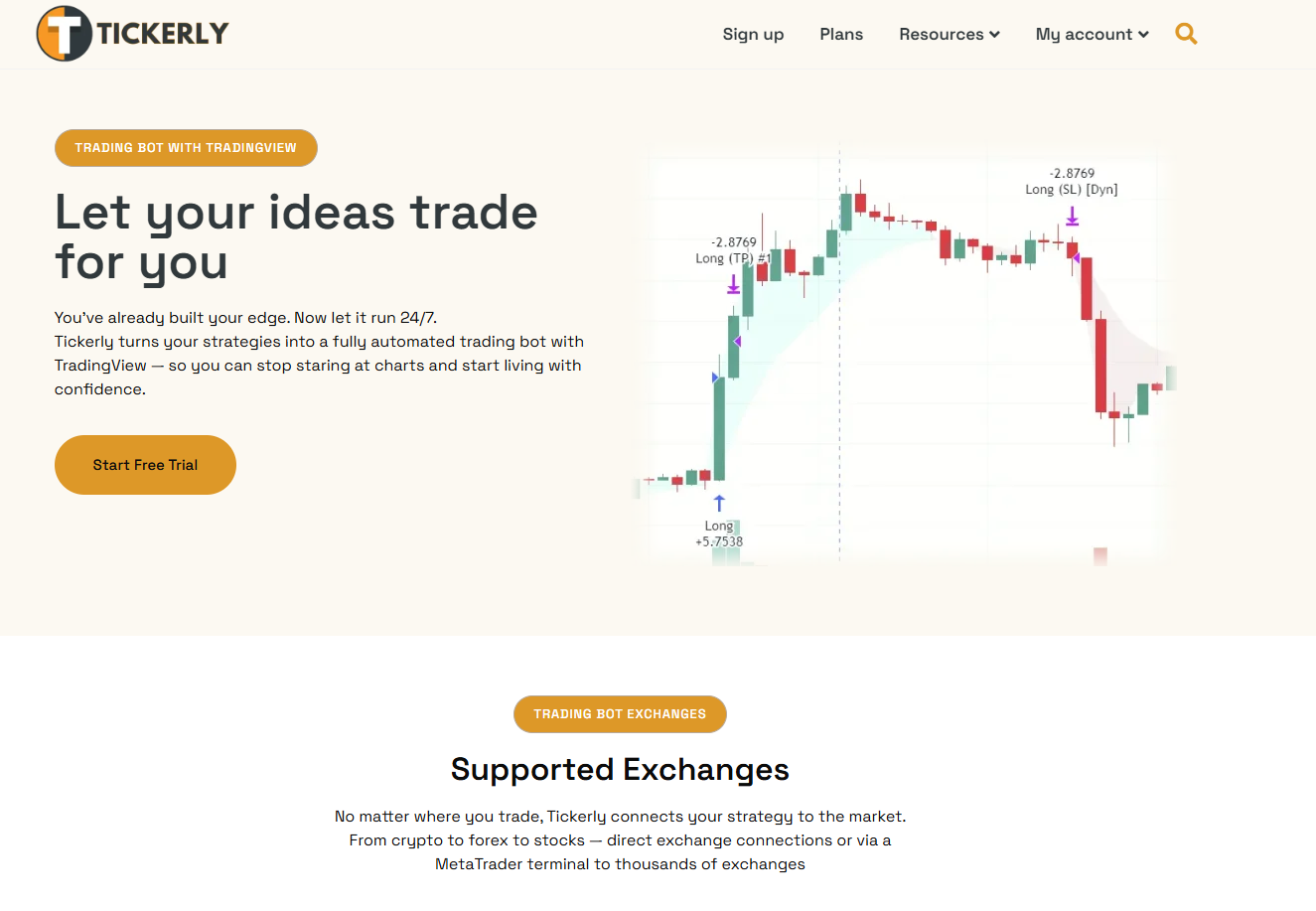
Tickerly’s documentation covers alert message formats, exchange connections, and strategy configuration in detail, giving you the reference material you need at each stage of your bot deployment checklist. Whether you trade crypto, forex, or stocks, the platform’s real-time alert system means your bot acts on signals the moment they fire. Explore Tickerly’s full trading bot guide to see how the platform fits your specific setup requirements.
FAQ
What is a checklist for bot setup?
A bot setup checklist is a sequential list of tasks covering system requirements, knowledge preparation, channel integration, configuration, testing, and post-launch monitoring. Following it in order prevents the unordered deployments that cause most bot rollout failures.
What are the minimum technical requirements for a trading bot?
Minimum requirements include Node.js version 22 or higher and at least 1 GB of RAM, with 4 GB recommended for stable multi-strategy operation. Background service configuration is also required to prevent unexpected downtime.
How many test scenarios should I run before going live?
Run at least 30 test scenarios covering normal conditions, edge cases, and failure states. Also maintain a smoke test set of 10–15 critical trade paths and execute it before every deployment.
When should I review my bot after launch?
Conduct your first review within 72 hours of going live. Early post-launch analysis resolves the majority of initial operational issues before they affect trading performance.
How do I handle bot failures during live trading?
Define explicit escalation triggers with named responsible individuals and set maximum response times before launch. Configure fallback procedures such as automated alerts or position freezes so the bot degrades safely when issues occur.