

The algorithmic trading market sits at $21 billion in 2024 and is projected to reach $25 billion by 2026, a trajectory that tells you everything about where professional forex trading is heading. Yet most retail traders either overestimate what bots can do or completely underestimate the discipline required to run them effectively. Bots are not a passive income machine you set and forget. They are precision instruments that reward careful strategy design and punish complacency. This article breaks down exactly how forex bots work, why traders adopt them, what risks you must manage, and how AI is reshaping the entire landscape for TradingView users in 2026.
Table of Contents
- How bots automate forex trading
- Why traders choose forex bots: Key advantages and empirical results
- Risks and limitations: Curve-fitting, adaptability, martingale traps
- How AI and advanced bots are changing forex automation
- The uncomfortable truth: Automation doesn’t guarantee success
- Next steps: Automate your trading with Tickerly
- Frequently asked questions
Key Takeaways
| Point | Details |
|---|---|
| Bots enable 24/7 trading | Automated execution allows traders to capture trades at any hour without constant oversight. |
| Empirical results show limits | Despite promising backtests, live bot win rates are often reduced by slippage and market volatility. |
| Risk management is crucial | Over-reliance and risky strategies like martingale can quickly cause major losses if not properly controlled. |
| Simple strategies outperform | Robust, straightforward bot frameworks usually yield better real-world results than complex or over-fitted algorithms. |
| AI bots are evolving | New AI-driven bots add adaptability and news analysis but still require careful design and monitoring. |
How bots automate forex trading
At their core, forex trading bots are software programs that monitor market conditions and execute trades automatically based on a predefined set of rules. No hesitation. No second-guessing. No emotional interference. The bot reads the market, evaluates the conditions against your strategy logic, and fires an order in milliseconds.

For traders using TradingView, the workflow is built around Pine Script, TradingView’s proprietary scripting language. You write or import a strategy in Pine Script, define your entry and exit conditions, and set up alert triggers. When the market meets your conditions, TradingView fires an alert. That alert carries a payload, typically a JSON message, that gets sent via webhook to an external service or broker integration. Understanding TradingView scripts overview is the first practical step toward building a reliable automation pipeline.
The webhook is the critical link in the chain. As Pine Script strategies generate alerts with webhooks that connect to external services or brokers, including MT4 and MT5 via copiers, for automated execution, enabling 24/7 trading without constant monitoring. This means your strategy can fire trades while you sleep, during news events, or across multiple currency pairs simultaneously without you lifting a finger.
Here is what the full automation workflow looks like in practice:
- Strategy design: You define your logic in Pine Script, specifying indicators, entry signals, stop loss levels, and take profit targets.
- Alert configuration: TradingView alerts are set to trigger on strategy conditions, with the webhook URL pointing to your execution server.
- Signal transmission: When conditions are met, TradingView sends a real-time HTTP POST request to your webhook endpoint.
- Order execution: The receiving server or middleware interprets the signal and places the corresponding order on your broker account via API.
- Trade management: The bot monitors open positions and closes them based on your predefined rules, without any manual input.
The practical benefits of this architecture are significant. You get 24/7 execution across all forex sessions, from Tokyo open to New York close. You eliminate latency caused by human reaction time, which in fast markets can be the difference between a filled order at your target price and costly slippage. You also remove the emotional variables that cause most discretionary traders to deviate from their plans at the worst possible moments.
Pro Tip: Before connecting your Pine Script strategy to a live broker, run it through TradingView’s built-in strategy tester for at least 200 historical trades. This gives you a statistically meaningful baseline before you risk real capital.
The broker connectivity layer deserves special attention. Different brokers support different integration methods. Some connect directly via REST API. Others require a copier tool that bridges TradingView alerts to MT4 or MT5. Understanding your broker’s supported protocols before you build your automation stack saves significant troubleshooting time later.
Why traders choose forex bots: Key advantages and empirical results
The case for automation is not just theoretical. The numbers tell a compelling story about why institutional and retail traders alike are moving toward bot-driven systems.
$21 billion. That is the current size of the algorithmic trading market, with 88% of traders having used algorithms before the AI era even began. AI-enhanced deployments are now boosting trading volumes by 15% in some implementations.
The advantages of automated forex trading cluster into several clear categories:
- Emotion-free execution: Bots do not panic during drawdowns. They do not chase trades after a losing streak. They execute your rules exactly as written, every single time.
- Consistency: A bot applies your strategy identically across 1,000 trades. A human trader cannot maintain that level of mechanical consistency.
- Speed: Execution speed measured in milliseconds matters in forex. Bots react to market conditions far faster than any human can.
- Scalability: One bot can monitor dozens of currency pairs simultaneously. Scaling a manual trading operation to that level is practically impossible.
- Backtesting capability: You can test your strategy against years of historical data before risking a single dollar, giving you a realistic performance baseline.
Here is how bot performance metrics compare across key dimensions:
| Metric | Manual trading | Automated bot trading |
|---|---|---|
| Execution speed | 1 to 5 seconds | Under 100 milliseconds |
| Emotional bias | High | None |
| Hours of operation | Limited by trader | 24/7 across all sessions |
| Strategy consistency | Variable | Mechanical and precise |
| Backtested win rate | Not applicable | Typically 55 to 70% |
| Live win rate (adjusted) | Varies widely | Often 30 to 50% lower than backtest |
That last row in the table is the one most traders overlook. Backtests often show 55 to 70% win rates but degrade 30 to 50% in live trading due to slippage, spread widening, and market regime changes. This gap is not a reason to avoid bots. It is a reason to calibrate your expectations carefully and build strategies with enough margin to remain profitable even after live degradation.
The practical implication is straightforward: if your backtest shows a 60% win rate with a 1.5 risk-to-reward ratio, you need to stress-test that strategy assuming a 35 to 40% reduction in win rate before you trust it with real capital. Strategies that only look good in backtests but collapse under this kind of scrutiny are not ready for live deployment.
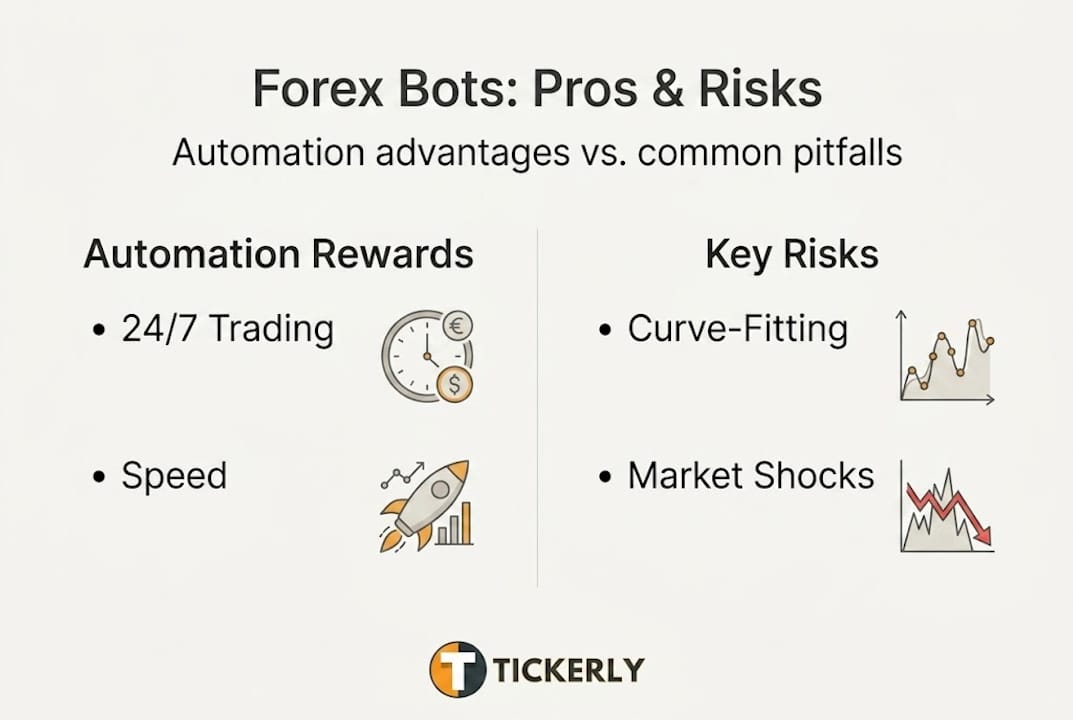
Risks and limitations: Curve-fitting, adaptability, martingale traps
While bots promise consistent performance, the reality is more complex. Every experienced automated trader has encountered at least one of these failure modes firsthand.
Critics of trading bots specifically warn about curve-fitting, lack of adaptability to unprecedented events, martingale risks that cause exponential drawdowns, and over-reliance that leads to silent failures. Each of these deserves a detailed breakdown.
The four critical risks you must understand:
- Curve-fitting (overfitting): This happens when you optimize your strategy so precisely to historical data that it loses predictive power on new data. A strategy with 14 different parameter combinations, each tuned to maximize past performance, is almost certainly overfit. It will look brilliant in backtesting and fail immediately in live markets. The fix is out-of-sample testing: hold back at least 30% of your historical data and test your optimized strategy on data it has never seen.
- Lack of adaptability: Bots operate on fixed rules. When a black swan event hits, such as a central bank emergency rate decision or a geopolitical shock, your bot does not know the context. It only knows its rules. A strategy built for trending markets will get destroyed in a sudden volatility spike it was never designed to handle. You need to build in circuit breakers, maximum daily loss limits, and position size caps that kick in automatically during abnormal conditions.
- Martingale risk: The martingale strategy involves doubling your position size after every loss, betting that a win will eventually recover all previous losses. In theory, it works. In practice, a sustained losing streak produces exponential drawdowns that can wipe an account in hours. Even a well-designed martingale variant carries catastrophic tail risk. Unless you have a very specific, well-tested reason to use position scaling, fixed position sizing is almost always safer.
- Silent bot failures: This is the risk most traders underestimate. Your bot can stop executing for reasons that have nothing to do with your strategy: a webhook timeout, a broker API change, a server outage, or a TradingView alert that stops firing because your plan expired. Meanwhile, you assume everything is running fine. You only discover the failure when you check your account and see no trades for three days. Active monitoring with alert systems is not optional; it is essential.
Here is a comparison of robust versus fragile bot design approaches:
| Design element | Fragile approach | Robust approach |
|---|---|---|
| Parameter count | 10 or more optimized inputs | 3 to 5 simple, logical inputs |
| Position sizing | Martingale or aggressive scaling | Fixed fractional or fixed lot |
| Failure monitoring | Manual account checks | Automated alerts on silence |
| Market regime filter | None | Volatility or trend filter included |
| Out-of-sample testing | Not performed | Mandatory before live deployment |
Understanding these forex bot risks before you deploy is what separates traders who sustain automation long-term from those who blow up in the first three months.
How AI and advanced bots are changing forex automation
The conversation around forex bots in 2026 is increasingly dominated by artificial intelligence. AI-enhanced bots are moving beyond static rule sets into adaptive systems that can learn from new market data, adjust parameters dynamically, and even analyze text-based news inputs in real time.
AI-enhanced bots add adaptive learning and NLP for news analysis, but the primary value still remains in automation itself. Empirical benchmarks show promise, but live degradation remains common, which is why prioritizing simple, robust strategies over complex ones continues to be the right approach for most traders.
Here is what AI specifically brings to forex automation:
- Natural Language Processing (NLP): AI bots can parse central bank statements, economic reports, and news feeds to detect sentiment shifts before they fully register in price action. A bot that reads a Federal Reserve statement and adjusts its USD exposure accordingly operates at a level of contextual awareness that rule-based bots simply cannot match.
- Adaptive parameter adjustment: Machine learning models can monitor strategy performance metrics in real time and adjust inputs like lookback periods or volatility thresholds when market conditions shift. This addresses the adaptability gap that traditional bots struggle with.
- Pattern recognition at scale: AI can identify complex multi-variable patterns across hundreds of currency pairs simultaneously, flagging setups that a human analyst or a simple indicator-based bot would miss entirely.
- Anomaly detection: AI systems can flag unusual execution patterns, such as a sudden spike in slippage or a series of missed fills, and alert you before a small technical issue becomes a significant loss.
Despite these capabilities, a critical pattern persists: complexity does not automatically translate to better live performance. Many traders who deploy sophisticated AI models find that a simple moving average crossover strategy with solid risk management outperforms their machine learning model in live conditions. The reason is that complex models have more parameters to overfit and more failure points to manage.
Pro Tip: When evaluating any AI-based forex bot, demand out-of-sample performance data covering at least 12 months of live trading. Backtest results for AI models are even more susceptible to overfitting than traditional strategies, so live track records matter far more.
The practical path forward for most TradingView users is to use AI tools to enhance specific components of your workflow, such as news filtering or regime detection, while keeping your core execution strategy simple and rule-based. Explore strategy optimization tips to understand how to layer these tools effectively without adding unnecessary complexity to your system.
The uncomfortable truth: Automation doesn’t guarantee success
Here is what most articles on forex bots will not tell you directly: automation amplifies whatever is already in your strategy. A well-designed strategy with solid risk controls becomes more consistent and scalable when automated. A poorly designed strategy with weak risk management fails faster and more efficiently when automated. The bot does not fix your strategy. It executes it with mechanical precision.
We have seen traders spend months building sophisticated Pine Script systems, only to discover that their core entry logic had a negative expected value from the start. The automation just made the losses arrive faster. The discipline required to run a bot successfully, including regular performance reviews, parameter audits, and drawdown protocols, is at least as demanding as disciplined manual trading.
The traders who get the most from automated forex trading are not the ones who find the most complex bot. They are the ones who combine a simple, statistically validated strategy with rigorous ongoing oversight. Automation handles execution. You still handle strategy quality and risk governance. That division of responsibility is what sustainable automated trading actually looks like.
Next steps: Automate your trading with Tickerly
If you are ready to move from TradingView analysis to fully automated execution, the infrastructure matters as much as the strategy itself.
Tickerly is built specifically to bridge that gap. It connects your TradingView bot integration directly to your broker, turning Pine Script alerts into live executed trades without requiring you to manage servers or write custom API code. Whether you are just starting with automation or looking to scale an existing strategy, you can explore forex bot solutions tailored to your trading style. Have questions about how the system works or what brokers are supported? The bot trading questions page covers the most common setup and execution scenarios in detail. Your strategy is ready. The execution layer should be too.
Frequently asked questions
How do bots automate trades on TradingView?
Bots use Pine Script strategies to trigger webhooks, connecting TradingView alerts to brokers for fully automated execution. Pine Script strategies generate alerts that route through webhooks to external servers or MT4/MT5 copiers, enabling hands-free trading around the clock.
Are bots really more successful than manual forex trading?
Bots increase execution discipline and consistency, but live win rates often drop significantly from backtested results. Backtests typically show 55 to 70% win rates that degrade 30 to 50% in live conditions due to slippage, spread changes, and shifting market regimes.
What are the main risks in using forex bots?
The biggest risks are curve-fitting to historical data, inability to adapt to unexpected market events, martingale position sizing causing rapid account drawdowns, and silent execution failures that go undetected without active monitoring. Critics specifically highlight that over-reliance on automation without oversight is one of the most common and costly mistakes traders make.
Can AI-based bots reliably analyze news and market events?
AI bots increasingly use NLP to parse news and adapt to sentiment shifts, but their core strength remains in automating established, rule-based strategies. AI-enhanced bots show empirical promise in benchmarks, though live performance degradation remains a consistent challenge that traders must account for before deployment.