

Tickerly is the strongest Bitsgap alternative if your strategy already lives on TradingView and you need alerts converted into live orders with minimal lag. Pionex fits traders who want built-in bots without a subscription bill, and Cryptohopper suits anyone who wants a ready-made strategy marketplace instead of building from scratch. The right choice depends less on brand reputation and more on bot type, custody model, and execution speed. That comparison follows below.
TL;DR:
Tickerly converts TradingView alert-based strategies into live orders within a fraction of a second, from dedicated servers near major exchanges, across multiple assets.
Pionex provides free, exchange-native bots like grid and DCA, suitable for cost-conscious traders who prefer to pay trading fees rather than a monthly subscription.
Custody models vary: subscription platforms typically hold your API keys on their servers, while exchange-native bots manage your keys directly through the exchange, affecting security and control.
Backtesting and paper trading are key filters, with platforms like Bitsgap charging around $23 to $29 monthly, while Tickerly offers a 30-day trial to evaluate performance before committing.
Review support quality and platform uptime before deployment, as outages or poor customer service can quickly turn profitable strategies into losses, especially for time-sensitive trading.
Table of Contents
Best Bitsgap Alternatives at a Glance
Picking a Bitsgap alternative starts with a blunt question: what does your strategy actually need to do? A grid bot trader has different priorities than someone running Pine Script signals through TradingView, and the “best” platform changes depending on which camp you’re in.
For traders whose entire workflow starts with a TradingView alert, Tickerly stands apart because it turns those alerts into live exchange orders with a focus on execution speed rather than treating TradingView as an afterthought. It supports multiple strategies and alerts across various asset classes, which matters if you run more than one system at once.
Beyond Tickerly, the shortlist that keeps showing up across industry roundups includes a mix of subscription platforms, exchange-native tools, and code-first builders:
-
Pionex runs free built-in grid and DCA bots directly on its exchange, charging trading fees instead of a monthly subscription.
-
3Commas packs in SmartTrade and advanced DCA workflows for traders who want deep customization inside one dashboard.
-
Cryptohopper leans on a strategy marketplace and signal integrations, useful if you’d rather buy a strategy than build one.
-
Coinrule strips automation down to plain-language “if this, then that” rules for non-programmers.
-
Trality hands the keyboard to Python developers who want full scripting control over entry and exit logic.
-
Mudrex curates managed strategies for buyers who prefer a productized approach over raw customization.
-
HaasOnline offers a dense rule engine and backtesting suite built for professionals, not beginners.
-
Altrady bundles a multi-exchange terminal with light automation for traders who want speed across several venues at once.
-
OKX builds bots directly into its exchange, trading some flexibility for deep liquidity and native execution.
Custody is the dividing line that often gets buried in marketing copy. Subscription platforms like Bitsgap, 3Commas, and Cryptohopper typically hold your exchange API keys on their servers, meaning your funds stay on the exchange but your trading permissions run through a third party. Exchange-native bots (Pionex, OKX) skip that middle layer entirely since the exchange already has your keys. Non-custodial and on-chain tools work differently again, trading convenience for a different risk and cost structure, as reviewers comparing architectural tradeoffs have pointed out.
Comparing Pricing, Bot Types, and Custody Side by Side
The table below lines up the purchase drivers that actually separate these platforms once you get past the marketing pages: what you pay, what bot types you get, how many exchanges connect, and who holds your keys.
One trust signal worth flagging directly: reviewers tracking the space have noted historical API key compromises affecting parts of the industry, which is exactly why custody model belongs in this table rather than buried in a footnote. Whatever platform you choose, ask specifically how your API keys are stored, whether withdrawal permissions are disabled by default, and what happens if their servers go down mid-trade.
Backtesting and paper trading availability also separates the pack. Reviewer snapshots consistently flag backtesting depth and demo modes as the fastest way to filter a platform before committing real capital, and that filter applies whether you’re evaluating Bitsgap itself or any name on this list.
Bitsgap’s own pricing anchors the comparison: plans start around $23 to $29 per month with a 7-day trial and no permanent free tier, which puts real pressure on smaller accounts to generate enough edge to cover the subscription. Tickerly’s 30-day trial gives more runway to test strategy performance before that math has to work in your favor.
Mini-Profiles: What Each Alternative Actually Offers
Reading a comparison table only gets you so far. Here’s what each platform looks like once you dig past the pricing page.
-
Tickerly. One-liner: converts TradingView alerts into live exchange orders with a focus on execution speed. Best for TradingView strategy users and Pine Script developers running crypto, forex, stock, or prop firm accounts. Standout: direct alert-to-order automation rather than a separate bot-building interface. Pricing shape: subscription tiers from $19 per month, set by the markets you need and your daily alert volume, with a 30-day free trial. Custody model: exchange API keys stored in your Tickerly connection with trading and read permissions, never withdrawal; MetaTrader runs through a connector in your own terminal with no API keys. One limitation: it’s built specifically around TradingView-driven signals, so traders who don’t already use Pine Script or TradingView alerts won’t get the same value.
-
Pionex. One-liner: exchange-native platform with free built-in bots. Best for cost-conscious traders who’d rather pay trading fees than a monthly bill. Standout: no subscription required for grid and DCA bots. Pricing shape: free, fee-per-trade. Custody model: exchange-native, since Pionex is both the exchange and the bot host. One limitation: bot variety and customization lag behind dedicated subscription platforms.
-
3Commas. One-liner: cloud bot platform with SmartTrade and advanced DCA workflows. Best for advanced users who want deep customization inside a single dashboard. Standout: portfolio-level smart trading tools alongside bot automation. Pricing shape: subscription with a limited free tier. Custody model: API key stored on 3Commas’ servers. One limitation: the interface has a steep learning curve for anyone new to automated trading.
-
Cryptohopper. One-liner: cloud bot with a large strategy marketplace and signal integrations. Best for traders who’d rather buy a proven strategy than build one from scratch. Standout: marketplace breadth and third-party signal feeds. Pricing shape: subscription with a free tier available. Custody model: API key on server. One limitation: marketplace strategy quality varies widely, so due diligence on any purchased strategy matters.
-
Coinrule. One-liner: rule-based automation for plain-language conditional strategies. Best for traders who want “if this, then that” logic without writing code. Standout: a conditional rules interface built for non-programmers. Pricing shape: subscription with a free tier. Custody model: API key on server. One limitation: complex multi-condition strategies can get unwieldy in a rules-only interface.
-
Trality. One-liner: Python-based bot builder for programmatic strategy developers. Best for algorithmic traders comfortable writing their own logic. Standout: full scripting control via Python. Pricing shape: subscription with a free tier. Custody model: API key on server. One limitation: it demands coding skill that most retail traders simply don’t have.
-
Mudrex. One-liner: marketplace and managed strategy platform with curated algo products. Best for buyers who want productized strategies rather than raw building blocks. Standout: curation reduces the noise of an open marketplace. Pricing shape: subscription and managed products. Custody model: API key on server. One limitation: less control over the underlying strategy logic than a fully custom build.
-
HaasOnline. One-liner: advanced rule-engine and scripting platform for professional bot builders. Best for experienced developers who need deep customization and rigorous backtesting. Standout: a powerful rule engine paired with strong backtesting tools. Pricing shape: subscription with a trial. Custody model: API key on server. One limitation: the complexity that makes it powerful also makes it intimidating for casual traders.
-
Altrady. One-liner: multi-exchange trading terminal bundling speed-focused tools with light automation. Best for traders who want a fast unified terminal across several exchanges at once. Standout: the terminal experience itself, more than deep bot logic. Pricing shape: subscription with a trial. Custody model: API key on server. One limitation: automation depth is lighter than dedicated bot platforms.
-
OKX. One-liner: exchange with native bot features and broad liquidity. Best for traders who prefer bots built directly into their exchange rather than a third-party layer. Standout: exchange-native execution with deep market access. Pricing shape: free, exchange fees apply. Custody model: exchange-native. One limitation: bot sophistication trails dedicated multi-exchange platforms, and you’re limited to what OKX itself offers.
How to Choose Between Bitsgap Alternatives
Before you sign up for anything, run through a short evaluation checklist rather than picking based on whichever homepage looks the slickest.
-
Latency: how fast does the platform move from signal to filled order? A grid bot rebalancing every few minutes tolerates more lag than a breakout strategy that needs a fill in seconds.
-
Bot type match: does the platform actually support the logic your strategy needs (grid, DCA, futures, copy trading, TradingView webhook), or are you forcing a square peg into a round hole?
-
Exchange coverage: does it connect to the exchanges where your capital already sits?
-
Custody model: does the platform hold your API keys, and if so, what withdrawal permissions does it require?
-
Backtesting and paper trading: can you validate the strategy on historical data before risking capital? For TradingView-driven automation, backtesting happens in TradingView’s Strategy Tester, and Tickerly covers the paper-trading step through exchange demo accounts.
-
Fee math: does the expected edge on your account size actually clear the subscription cost?
That fee math question matters more than most traders assume. Subscription drag can quietly erase the edge on smaller accounts, since a flat monthly fee represents a much bigger percentage hit on a $2,000 account than a $50,000 one. Run the math before you commit, not after.
During any trial, ask the vendor directly: where are API keys stored, what’s the failover plan if their servers go down mid-position, how long is trade data retained, and can you set hard stop-loss and take-profit rules that execute even if their platform has an outage? Vague answers to any of these are a red flag, along with no demo mode, opaque fee structures, or no documented security policy you can actually read.
Pro Tip: Define your market logic before you shop for a bot. Deciding you need a DCA bot for a ranging market, or a grid bot for sideways chop, narrows your options faster than comparing feature lists platform by platform, a point Coin Bureau’s review makes about matching platform choice to strategy rather than marketing.
A simple three-step test plan works for almost any platform: run the demo or paper-trading mode first, then move to a small live position with tight risk limits, then compare post-test metrics (fill speed, slippage, uptime) against what the platform advertised before scaling up.
Why Tickerly Fits TradingView-Driven Traders
Tickerly’s core capability is to convert a TradingView strategy alert into a live order on connected exchanges or brokers, emphasizing execution speed. It supports multiple exchange APIs as well as MetaTrader 4/5, which is relevant for traders using different asset classes.
The platform handles multiple strategies and alerts simultaneously, allowing users to manage different systems without needing separate tools. That multi-strategy handling is what lets active traders diversify without doubling their operational overhead.
The traders who get the most out of Tickerly are the ones who already write or use Pine Script strategies and want the gap between “alert fires” and “order fills” closed as tightly as possible. If your workflow doesn’t start on TradingView, some of that value disappears.
How We Evaluated These Platforms
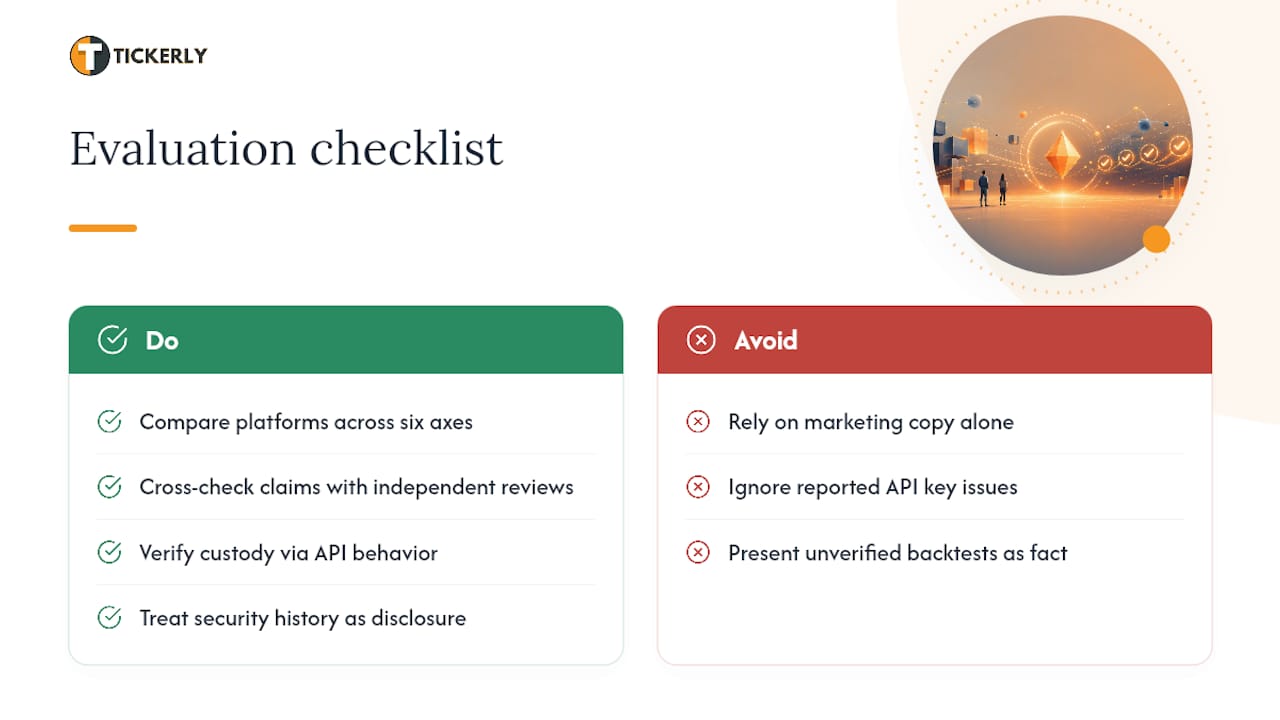
This comparison weighs each platform against the same six axes: pricing model and free trial availability, bot type coverage, exchange connectivity, custody model, backtesting and paper trading support, and documented reliability or security history. Rather than ranking by star ratings alone, the goal was to match platform capability to actual trading workflows, since a grid trader and a TradingView signal trader have almost nothing in common in terms of what they need from a bot.
Pricing and feature claims were cross-checked against current vendor documentation and independent reviews rather than taken from marketing pages at face value. Custody model claims, in particular, were verified against how each platform’s API integration actually works rather than how it’s described in promotional copy. Security history, including any publicly reported API key compromises, was treated as a disclosure point rather than buried, since that history directly affects how much trust you should extend to any platform holding trading permissions on your behalf.
No performance backtest or live trial results are represented here as first-party data. Where a platform’s own claims about execution speed or success rates couldn’t be independently verified, that gap is noted rather than filled with a number pulled from marketing material. Readers running their own evaluation should treat the three-step test plan above as the actual verification step, not this article.
Customer Support: What to Expect Before You Commit
Support quality varies more than most comparison pages admit. Subscription platforms like 3Commas, Cryptohopper, and HaasOnline generally offer tiered support, with faster response times reserved for higher-paying plans and community forums or knowledge bases handling the rest. That tiering matters most when something breaks mid-trade and you need an answer in minutes, not days.
Exchange-native options like Pionex and OKX route support through the exchange’s existing customer service infrastructure, which tends to be more standardized but less specialized in bot-specific troubleshooting. If your bot stops executing and the support agent’s first move is a generic “have you tried logging out and back in,” that’s a sign the support team isn’t bot-literate.
Tickerly’s support model focuses on TradingView integration issues such as webhook setup, alert formatting, and exchange API connections, with responsiveness on these technical matters important for new users.
Before committing to any platform, test its support channel during the trial period, not after you’ve gone live. Send a real question, not a test message, and see how specific and fast the answer is. A platform that can’t answer a technical question clearly during a free trial won’t suddenly improve once you’re a paying customer.
Reliability and Uptime: The Track Record That Matters Most
Uptime history rarely makes it onto a vendor’s homepage, but it should be one of the first things you ask about. A bot that’s down for even twenty minutes during a volatile move can turn a winning setup into a loss, especially for grid or DCA strategies that depend on continuous rebalancing.
Exchange-native bots (Pionex, OKX) inherit the reliability of the exchange itself, which for major exchanges tends to be strong but not immune to outages during high-volume events. Subscription platforms that route through third-party servers introduce an additional point of failure: if the platform’s infrastructure goes down, your bot stops executing even if the exchange itself is fine.
This is exactly why the buyer checklist above includes a direct question about failover plans. A platform with a documented incident history and a clear response process is a better bet than one with no public track record at all, simply because you know what you’re dealing with. Ask any vendor, including Tickerly, for their uptime history and incident response process before relying on it for live capital. Silence on that question is itself useful information.
What Makes Each Platform Different
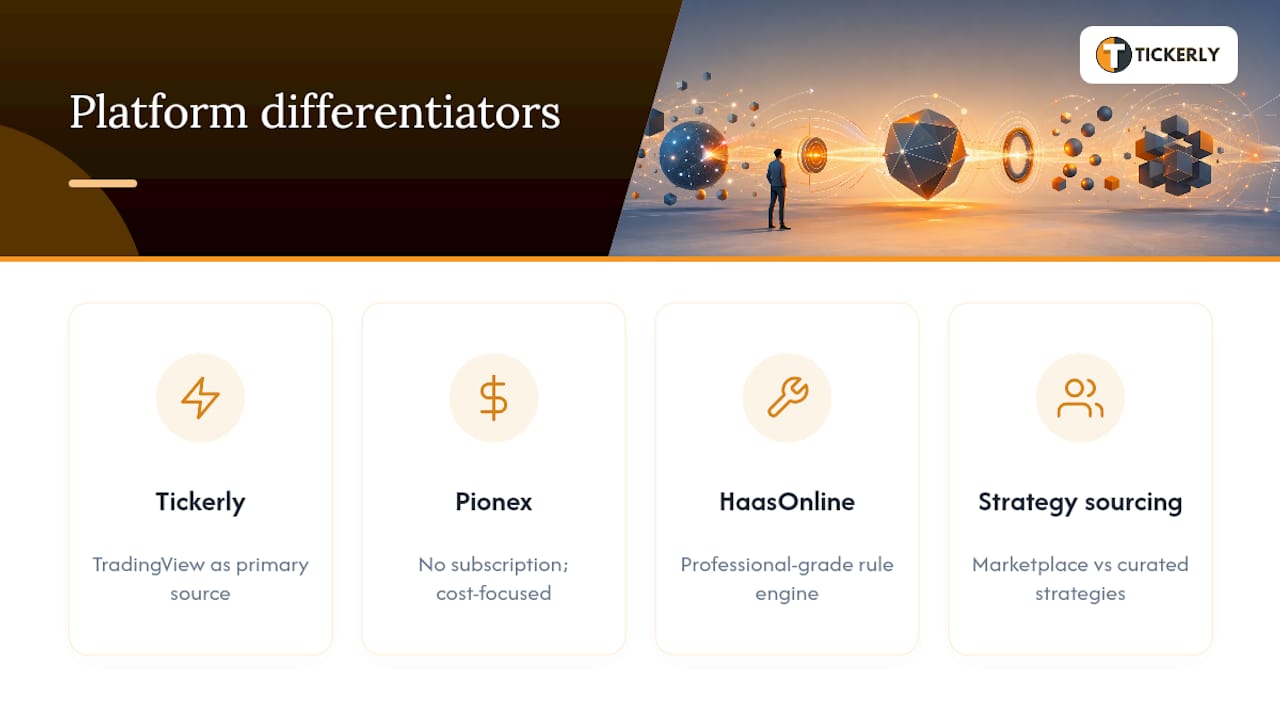
Strip away the marketing language and the real differentiators come down to a handful of design choices. Tickerly’s differentiator is treating TradingView as the primary strategy source rather than a secondary integration, which means an alert becomes an order without rebuilding the strategy in a separate bot interface. Pionex differentiates on cost structure alone, skipping the subscription model entirely. HaasOnline differentiates on depth, offering a rule engine sophisticated enough for professional quant-style strategies but overkill for casual traders.
Cryptohopper’s marketplace and Mudrex’s curated strategies solve the same underlying problem (not knowing how to build a strategy) from opposite directions: one gives you an open marketplace to browse, the other curates a smaller, vetted set. Trality and Coinrule sit at opposite ends of the technical spectrum, one demanding Python fluency and the other requiring none at all. Altrady’s differentiator is the terminal experience itself rather than bot sophistication, useful if your priority is fast manual execution across multiple exchanges with some automation layered on top.
Understanding which differentiator actually matters to your workflow, rather than which platform has the longest feature list, is the fastest way to cut a shortlist of ten down to two or three worth trialing.
What User Reviews Actually Reveal
Review volume and star ratings get cited constantly in roundups, and aggregator sites like Capterra use categories like “top free alternatives” and “most reviewed” as shortcuts for narrowing a list. Those filters are useful for a first pass, but they say more about how long a platform has been around and how aggressively it markets than about whether it fits your specific trading style.
A platform with fewer reviews but a clear technical focus (Trality’s Python-first audience, for instance) may be a better fit for a specific trader than a platform with thousands of reviews spread across every type of user imaginable. Read reviews for the specific complaint patterns, not the star average: recurring mentions of missed fills, support delays, or unexpected fees tell you more than a 4.5-star aggregate ever will.
Reputation also shifts over time as platforms add features. Bitsgap’s LOOP bot addition, for example, changed its positioning within the last year, which is a reminder that any snapshot comparison (this one included) reflects a moment in time, not a permanent ranking.
Integration With Your Existing Trading Stack
How well a platform fits into tools you already use often matters more than its standalone feature list. Tickerly’s integration model is built around TradingView, meaning if your charting, alerting, and strategy backtesting already happen there, the automation layer plugs in without forcing you to rebuild your workflow elsewhere.
Platforms like HaasOnline and Trality expect you to build and maintain strategy logic within their own environment, which works well if you’re starting from scratch but creates friction if you’ve already invested time in TradingView’s Pine Script ecosystem. Exchange-native bots (Pionex, OKX) integrate tightly with their own exchange but offer little flexibility to plug into external charting or signal tools.
Before committing to any platform, check whether it supports webhook-based signal delivery, since that’s the mechanism that lets external tools (TradingView included) trigger trades without manual intervention. A platform without webhook support locks you into whatever internal tools it provides, for better or worse.
Which Markets and Trading Pairs Each Platform Covers
Market coverage varies significantly depending on whether a platform is exchange-native or exchange-agnostic. Pionex and OKX cover whatever pairs their own exchange lists, which for major exchanges means broad crypto coverage but nothing outside crypto. Subscription platforms that connect via API (3Commas, Cryptohopper, HaasOnline) generally support whichever pairs are available on the exchanges you connect, multiplying coverage across however many exchanges you link.
Tickerly extends coverage beyond crypto spot into crypto futures and perpetuals, forex and CFDs through Oanda and Capital.com, and stocks through Alpaca, plus any MetaTrader 4/5 broker or prop firm account, which matters for traders who don’t want to run separate automation tools for separate asset classes. That cross-asset reach is less common among the pure crypto-bot platforms on this list, most of which stay within crypto trading pairs exclusively.
Before assuming a platform covers your pair, verify it directly rather than trusting a general “500+ trading pairs” claim, since that number often reflects total exchange listings rather than pairs the bot itself can actually trade.
When to Stay on Bitsgap and When to Switch
Bitsgap still makes sense if you’re already comfortable with its COMBO bot or need a single dashboard managing multiple exchange portfolios without extra setup. Its Grid, DCA, and LOOP bots cover a lot of ground for traders who aren’t chasing TradingView-specific automation.
Switching becomes the right call the moment your strategy logic lives in TradingView and you’re tired of the gap between “alert fires” and “order executes.” It’s also worth switching if subscription cost is eating into returns on a smaller account, or if you specifically want non-custodial copy trading that a platform like Bitsgap doesn’t offer.
My honest read: don’t switch platforms on a hunch. Run a controlled trial, side by side, with a small position size, and let the fill speed and fee math make the decision for you rather than brand loyalty or a slicker interface.
— Jay
Try Tickerly if TradingView Already Runs Your Strategy
If your charts, alerts, and Pine Script logic already live on TradingView, Tickerly closes the gap that most Bitsgap alternatives leave open: executing the strategy you already have on TradingView, with orders placed within a fraction of a second of the alert from dedicated servers near major exchanges. Instead of rebuilding your strategy inside a separate bot interface, you keep TradingView as the brain and let Tickerly handle execution across your connected exchanges, forex broker, or prop firm account.
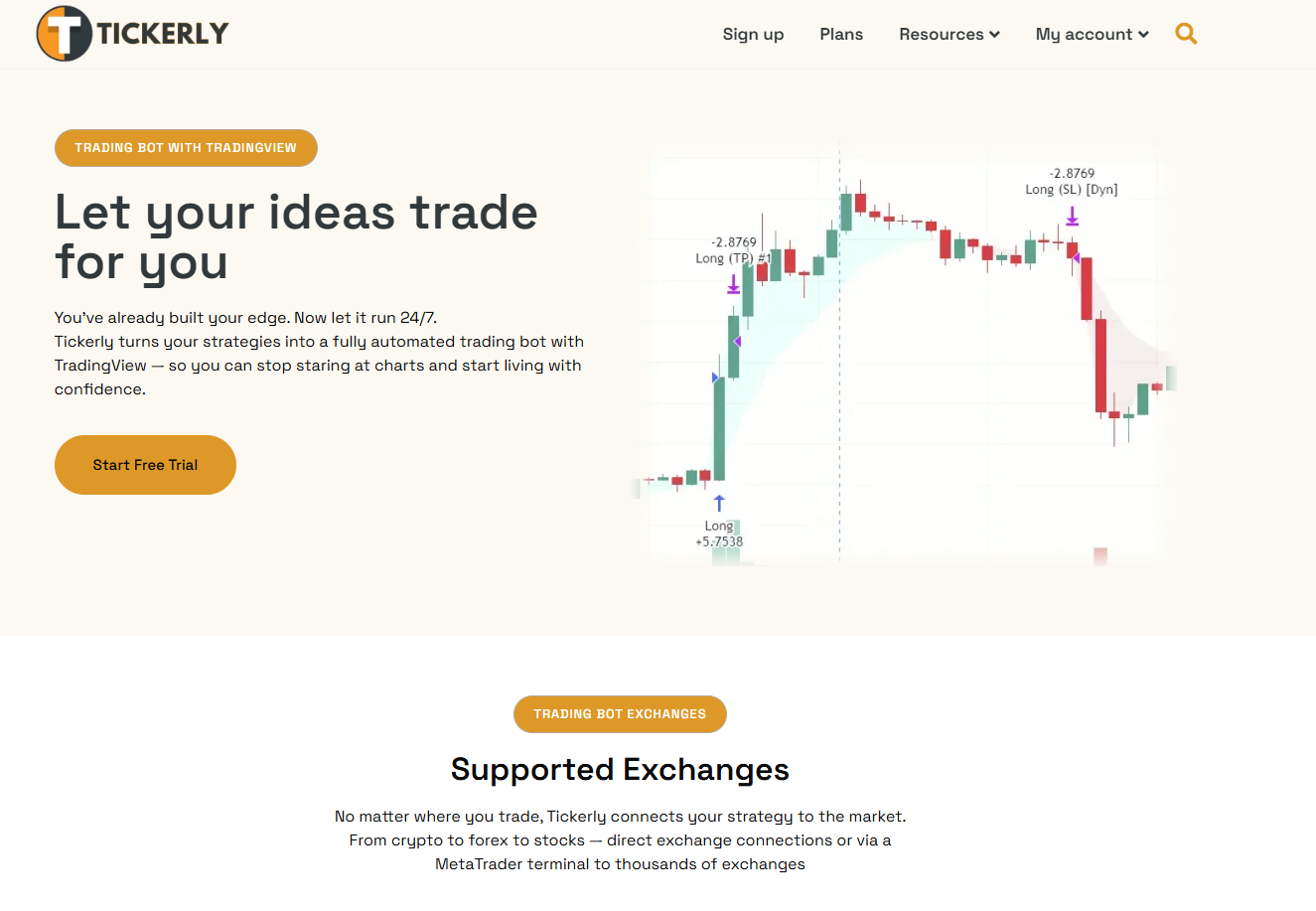
That matters most for active traders running more than one strategy at once, since Tickerly runs many strategies at once (20 active on Level 2, unlimited from Level 3, with 100 to 2,500 alerts a day depending on plan) rather than forcing you to choose which system gets automated first. The TradingView strategy automation page walks through exactly how the alert-to-order flow works, and the step-by-step setup guide shows how to connect your first bot in practice.
Start the 30-day free trial, connect one strategy, and compare the fill speed against whatever you’re using now before deciding if it’s worth switching for good.
Sources
This comparison drew on a handful of platform reviews and roundups rather than a single source, since pricing and feature sets shift often in this category.
FAQ
Which Is Better, Pionex or Bitsgap?
It depends on priorities: Pionex wins on cost since it charges trading fees instead of a subscription, while Bitsgap offers a broader bot lineup, including COMBO and LOOP bots, for around $23 to $29 per month. Cost-conscious traders on smaller accounts often lean toward Pionex; traders who want more bot variety tend to prefer Bitsgap’s subscription model.
What Is the Most Successful AI Trading Bot?
No single bot can be called universally “most successful,” since performance depends heavily on strategy logic, market conditions, and account size rather than the platform alone. The more useful question is which platform’s bot types match your specific strategy, whether that’s grid, DCA, or TradingView-driven automation like Tickerly offers.
What Are the Risks of Using Bitsgap?
The main risks are custody exposure (your API keys are stored on Bitsgap’s servers), subscription cost eating into returns on smaller accounts, and the general risk that comes with automating any live trading strategy without adequate backtesting. Industry reviews have also noted historical API key security incidents across the automation platform space as a reason to scrutinize any vendor’s security policy directly.
Is Bitsgap a Legitimate Company?
Yes, Bitsgap is an established, operating platform with a documented feature set including Grid, DCA, COMBO, and LOOP bots, and public pricing starting around $23 to $29 per month. Legitimacy isn’t the concern most traders should weigh; fit for their specific bot type and custody comfort level is.
Is Tickerly a Good Alternative to Bitsgap?
Tickerly fits traders whose strategies already run on TradingView and who want alerts converted into live orders with minimal execution lag, rather than traders looking for Bitsgap’s built-in grid or DCA bot styles. It’s a strong fit for a specific workflow, not a universal replacement for every Bitsgap use case.
Recommended
-
When TradingView Alerts Need Low Latency: 3Commas vs Cryptohopper
-
Convert TradingView Grid Alerts to Live Orders Without a Bridge
-
TradingView Low Latency Bots: Measure Round Trip Latency Before You Buy
This article was produced with Al assistance and reviewed for accuracy. It is provided for general information only and is not professional or financial advice.