

For traders who want TradingView-native automation with low-latency execution, Tickerly is the recommended pick over both 3Commas and Cryptohopper. If you’d rather buy vetted, prebuilt strategies and let someone else manage the signal logic, Cryptohopper’s marketplace model fits better. 3Commas sits in between, giving hands-on traders granular DCA and grid control without the marketplace overhead.
TL;DR:
Tickerly offers a direct TradingView alert-to-order pipeline that places orders within a fraction of a second of the alert, ideal for Pine Script users who need fast execution across multiple asset classes.
3Commas provides granular control over DCA and grid bots but requires manual setup, with a smaller number of exchange integrations and a higher risk profile related to API key security.
Cryptohopper centers on a strategy marketplace and AI-driven signal subscriptions but can involve hidden costs due to signal provider fees and has broader exchange support.
Both platforms support backtesting and paper trading, but users should verify strategy compatibility and costs, especially regarding futures access at higher subscription tiers.
Running thorough trial tests, including latency, exchange compatibility, and support responsiveness, is essential before committing to any platform for live automated trading.
Table of Contents
3Commas vs Cryptohopper: A Quick Comparison
The real difference between these two platforms comes down to where your trading signal originates. 3Commas focuses on DCA bots, grid bots, and a SmartTrade terminal that you configure directly, while Cryptohopper emphasizes a strategy marketplace and AI-assisted design for subscribing to others’ signals.
That structural gap shapes everything else, from pricing to how much testing you’ll do before going live.
-
Tickerly: best for traders who already write TradingView strategies in Pine Script and need those alerts converted into live bots with minimal delay.
-
3Commas: best for experienced traders who want to hand-tune DCA and grid parameters through a dedicated terminal.
-
Cryptohopper: best for traders who want a copy-trading experience and are comfortable paying for strategies built by others.
-
Coinrule: best for retail traders who want visual, no-code rule building without touching a script.
-
Bitsgap: best for traders juggling multiple exchanges who want arbitrage tools alongside basic bots.
-
unCoded: best for users chasing a niche bot type or integration that the bigger platforms don’t offer.
-
Coinigy: best for portfolio-focused traders who want unified charting and exchange management over pure automation.
-
Trailingcrypto: best for traders who mainly want trailing stop logic without a steep learning curve.
On security, every one of these platforms connects to your exchange through API keys rather than holding custody of your funds directly. That’s the industry standard, but it isn’t risk-free: 3Commas faced scrutiny in 2022 over API key management after a breach exposed how sensitive those permissions really are. Whichever platform you pick, restrict API keys to trading-only permissions with no withdrawal rights.
How Do the Core Trading Dimensions Compare?
The feature checklist matters less than how those features behave once you’re running a live strategy. Here’s where the gap between 3Commas and Cryptohopper actually shows up in day-to-day use.
Bot type and workflow. 3Commas is fundamentally a DCA and grid bot builder wrapped around a SmartTrade terminal, which means you’re setting entry conditions, safety orders, and take-profit targets by hand. Cryptohopper is fundamentally a marketplace: you can build your own strategy with its AI designer, but most users are there to subscribe to someone else’s. Comparison writeups consistently frame the two this way: 3Commas for hands-on control, Cryptohopper for copy-trading convenience.
Pricing and the hidden cost stack. Platform subscription fees are only half the picture on Cryptohopper. Buying or subscribing to a marketplace strategy adds a signal-provider fee on top of your plan cost, so your real monthly spend can run well above the sticker price. Reviews on this point are blunt: paper trade a marketplace strategy before you pay for it live, because the fee stacking only makes sense if the strategy actually performs.
Exchange connectivity. 3Commas connects to a moderate number of exchanges, while Cryptohopper supports a higher number of exchanges. Both route through API keys, so your funds never leave the exchange itself. If you trade on a smaller or regional exchange, check the specific integration list before assuming either platform covers it.
Backtesting and paper trading. Both platforms offer backtesting and demo modes, but the depth varies by plan tier. Don’t take a strategy live, whether it’s your own or a marketplace purchase, without running it through paper trading first.
Futures support. Futures access on both platforms is typically gated behind a mid-to-upper subscription tier rather than the entry-level plan. If futures trading is the point of automating in the first place, budget for that tier from the start.
Onboarding. New users tend to find 3Commas’s SmartTrade terminal denser to learn but more transparent once mastered. Cryptohopper’s marketplace browsing feels faster to start but hides more of the underlying logic. Multiple reviews recommend running both platforms’ trials before committing, since interface comfort ends up mattering as much as the feature list on paper.
Pro Tip: Before funding any live bot, generate an API key with trading permissions only, disable withdrawal access entirely, and enable IP whitelisting if your exchange supports it. This single step blocks the most common attack vector against automated trading accounts.
Analysts who evaluate automation platforms as part of a broader workflow tend to agree on one principle: prioritize the platform that matches your signal’s origin, whether that’s a TradingView webhook, a custom script, or a marketplace subscription, rather than picking based on feature count alone.
What Does Each Platform Actually Offer?
Here’s how the eight platforms stack up when you look past the marketing copy and into what each one is actually built to do.
-
Tickerly. Tickerly converts TradingView strategy alerts directly into live trading bots, which means if you already build strategies in Pine Script, you skip the translation step entirely. Orders go out within a fraction of a second of the alert, from dedicated servers near major exchanges, and the platform runs 20 active strategies on Level 2 and unlimited strategies from Level 3 across crypto spot and futures, forex and CFDs, stocks and MetaTrader. Pricing runs on subscription tiers scaled to strategy count and alert volume, with a free trial available for TradingView traders evaluating the automation before committing.
-
3Commas. Built around DCA bots, grid bots, and the SmartTrade terminal, 3Commas gives experienced traders deep control over entry logic, safety orders, and take-profit conditions. It connects to around 16 exchanges via API keys, and its 2022 API key incident is worth knowing before you grant any platform account-level access.
-
Cryptohopper. The strategy marketplace and AI strategy designer make Cryptohopper the easiest entry point for traders who’d rather copy a working strategy than build one. That convenience comes with the marketplace subscription stacking mentioned earlier, so factor the signal-provider fee into your real cost before subscribing.
-
Coinrule. A visual, no-code rule builder aimed squarely at retail traders who don’t want to touch Pine Script or Python. It won’t match the granularity of 3Commas’s SmartTrade terminal, but it lowers the barrier for straightforward if-this-then-that automation.
-
Bitsgap. Consolidates multiple exchange accounts into one terminal and adds arbitrage tools on top of standard bot types. Good fit if your trading spans several exchanges and you want one dashboard instead of five browser tabs.
-
unCoded. A smaller platform carving out niche bot types and integrations that the bigger names skip. Worth a look only if you have a specific automation need the mainstream platforms don’t cover.
-
Coinigy. Functions more as a unified portfolio manager and charting terminal, with automation as an add-on rather than the core product. Fits traders who care more about seeing everything in one place than about deep bot customization.
-
Trailingcrypto. Focused specifically on trailing stop logic and simplified bot setup, aimed at retail traders who want that one feature done well rather than a full strategy suite.
What Should You Check Before Committing?
Run through this checklist during any free trial before you fund a live bot with real capital.
-
Does the platform accept TradingView webhooks natively, or does it require a third-party bridge?
-
Which exchanges and asset classes (spot, futures, forex) does your target platform actually support?
-
Can you backtest and paper trade the exact strategy type you plan to run, not just a generic template?
-
What’s your real monthly cost once marketplace or signal-provider fees are added to the base plan?
-
Does the platform let you scope API keys to trading-only permissions with no withdrawal rights?
-
Is IP whitelisting available, and does the platform have a documented history of key-related incidents?
During the trial window itself, ask support directly how webhook latency is measured and whether futures require a plan upgrade. For your first 30 days live, size positions small, keep a watchlist of every triggered trade, and check for order-fill discrepancies daily rather than weekly. Our risk management guide walks through position sizing in more depth if you’re automating for the first time.
Pro Tip: Treat the free trial as a stress test, not a demo. Run your actual strategy, on your actual exchange, with the smallest position size the platform allows, before deciding anything about the paid tier.
When Does Tickerly Make the Most Sense?
Tickerly exists for a specific workflow: you build or refine a strategy in TradingView, and you need that alert converted into a live order without the delay that kills an edge in fast markets. The platform runs 20 active strategies on Level 2 and unlimited strategies from Level 3, with 100 to 2,500 alerts a day depending on the plan, integrates with exchange APIs across crypto spot and futures, forex, CFDs and stocks, and connects to MetaTrader 4/5 (from Level 4) for traders working outside pure crypto.
If your entire strategy already lives inside TradingView as a Pine Script alert, the fastest path to automation isn’t rebuilding that logic inside a separate bot builder. It’s connecting the alert directly to execution.
That’s the core case for Tickerly as a 3Commas alternative for TradingView-native traders specifically.
The honest boundary: if you don’t write your own strategies and want to buy a track record instead of building one, a marketplace-first platform like Cryptohopper serves that job better than Tickerly does.
Does Either Platform Have a Solid Mobile App?
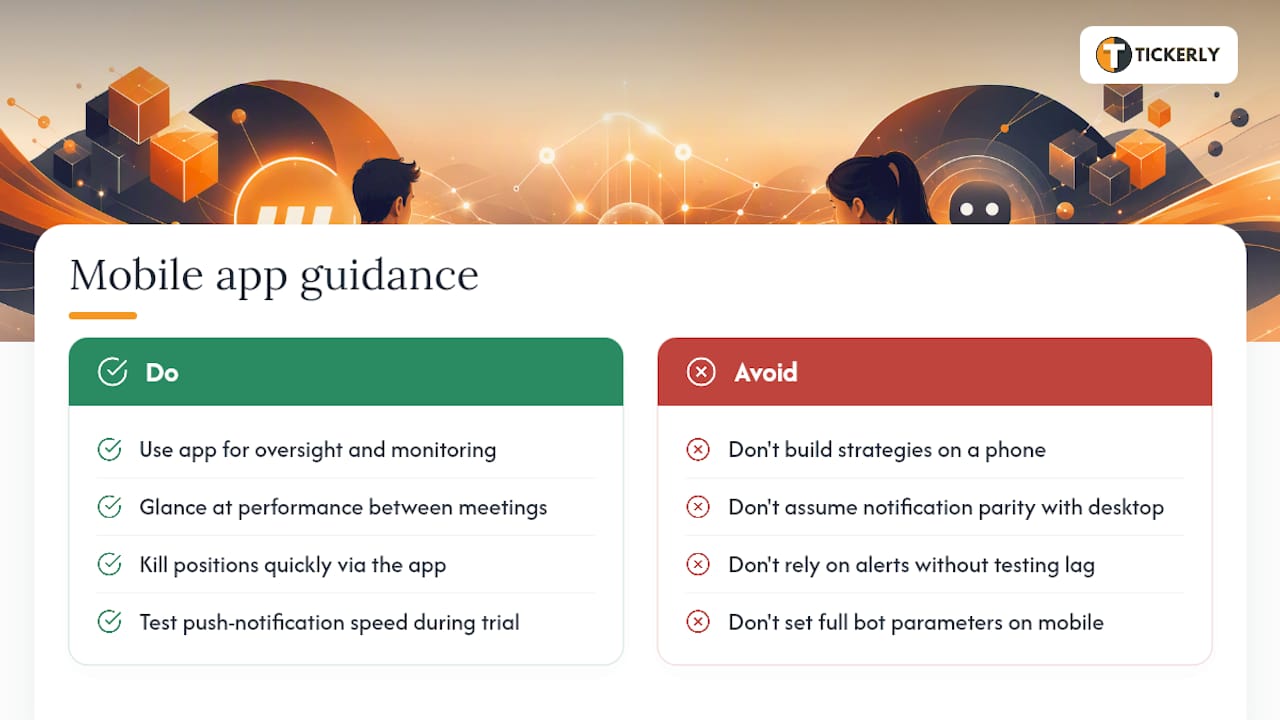
Both 3Commas and Cryptohopper offer mobile apps for iOS and Android, and both cover the basics: monitoring active bots, checking open positions, and getting push notifications when a trade executes. Neither app is designed for building a strategy from scratch on a phone screen, and that’s by design. Strategy construction, whether it’s a DCA ladder in 3Commas or a marketplace subscription in Cryptohopper, happens on desktop where you can see the full parameter set.
What the mobile apps are genuinely good for is oversight. If you’re running a bot live and want to glance at performance between meetings, or kill a position fast if a market moves against you, the app covers that. Push alerts on filled orders matter more than people expect, since a delayed notification on a fast-moving trade defeats some of the point of automating in the first place.
If mobile monitoring is a priority for your workflow, test the notification speed during your trial rather than assuming it matches desktop responsiveness. A bot that executes within a fraction of a second doesn’t help if your phone alert lags by several minutes. Tickerly’s execution architecture is built around minimizing that lag at the order level, but mobile notification speed is still worth confirming with any platform before you rely on it for active position management.
Can You Sync Trades With Portfolio or Tax Software?
Most active traders end up running a bot platform alongside a separate portfolio tracker or tax tool, because neither 3Commas nor Cryptohopper is built to double as a full tax reporting system. Both platforms let you export trade history, typically as CSV files, which you can then feed into third-party portfolio trackers or crypto tax software.
The friction point is usually format consistency. Exported trade logs don’t always match the import format a given tax tool expects, which means some manual cleanup before tax season rather than a clean one-click sync. If you’re running strategies across multiple platforms at once, say 3Commas for DCA bots and Tickerly for TradingView-triggered trades, reconciling trade history across systems becomes part of your monthly routine rather than a one-time setup task. For Tickerly-executed trades, that history lives on your exchange account, while Tickerly’s alert log shows each alert and the exchange’s response.
Before committing to any platform for high-frequency automation, check whether its export format is compatible with the specific portfolio or tax tool you already use. This matters more the higher your trade frequency climbs, since a bot executing dozens of trades a day creates a reconciliation headache if the export doesn’t map cleanly to your tracker’s expected fields.
How Responsive Is Customer Support on Each Platform?
Support quality tends to become a bigger factor after you’ve gone live, not before. During evaluation, most traders skim the FAQ and move on. Once real capital is running through a bot and something behaves unexpectedly, response time and depth of technical knowledge matter a lot more.
Both 3Commas and Cryptohopper offer support through ticketing systems and community channels, with response times that vary by plan tier on some platforms. Neither guarantees instant human response for lower-tier subscribers, so if you’re running a strategy where a stuck order could compound losses fast, factor support responsiveness into your platform choice, not just features.
The best way to judge this before committing capital is to test it directly during your trial: submit a real technical question, not a generic one, and see how specific and fast the answer is. A vague templated response is a signal worth noting. Tickerly’s support process is built around the same TradingView and exchange API questions traders actually run into during setup, which tends to make responses more specific than a generalized bot platform fielding requests across dozens of unrelated use cases.
Do These Platforms Have Community or Social Trading Features?
Cryptohopper’s marketplace is, in effect, a social trading feature. You’re browsing strategies built and published by other users, subscribing based on their track record, and effectively copying their trading decisions. That’s a meaningfully different social layer than 3Commas offers, which leans more toward forums and Discord-style community discussion rather than a built-in copy-trading marketplace.
For traders who value learning from a visible community of strategy builders, Cryptohopper’s marketplace model provides more structure. For traders who’d rather build in isolation and only compare notes informally, 3Commas’s community channels serve that need without pushing you toward buying anyone else’s signals. Tickerly doesn’t include a marketplace layer, since it’s built around automating strategies you’ve already written in TradingView, but TradingView itself has one of the largest public strategy-sharing communities in trading, which means the social discovery happens upstream of the automation step rather than inside the bot platform.
What Do Uptime and Execution Speed Actually Look Like?
Uptime and execution speed are the two metrics that matter most once a bot is live, and they’re also the hardest to verify from marketing pages alone. Neither 3Commas nor Cryptohopper publishes detailed public uptime statistics, which means you’re relying on community reports and your own trial experience rather than a transparent benchmark.
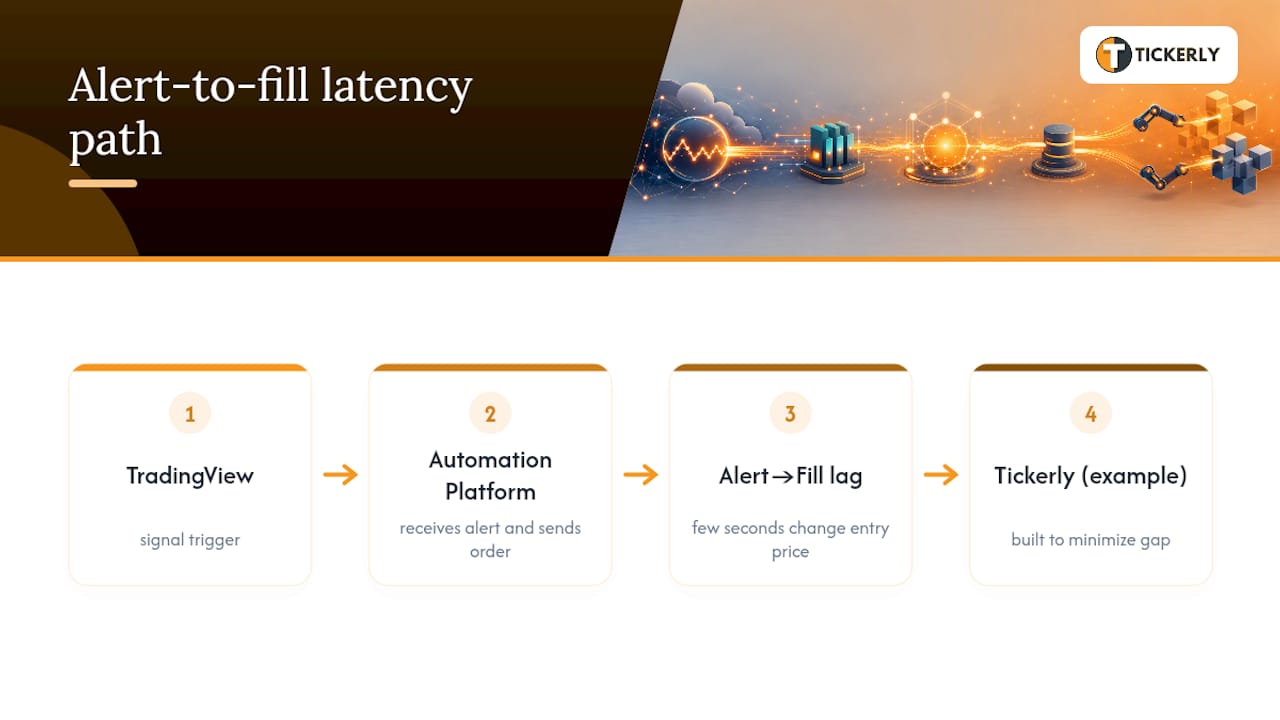
What you can test directly during a trial is order-fill latency: how long it takes from signal trigger to executed order on your exchange. This matters more in fast-moving markets, where a few seconds of delay can mean a materially different entry price. It’s also the exact metric Tickerly’s architecture is built to minimize, since the entire product exists to shorten the gap between a TradingView alert firing and an order landing on your exchange.
There’s no single “most successful” bot across platforms, because bot performance depends entirely on strategy configuration and market conditions rather than the platform running it. A poorly configured DCA ladder loses money on 3Commas just as easily as a poorly vetted marketplace strategy loses money on Cryptohopper. Judge a platform on execution reliability and testing tools, not on anecdotal win-rate claims you can’t verify.
What I’d Actually Do Before Choosing
If your strategy already lives in TradingView, I’d start with Tickerly and skip the detour of rebuilding that logic inside a separate bot builder. If you’re buying a track record instead of writing your own, Cryptohopper’s marketplace is the more honest fit. Either way, run 30 days small: size positions conservatively, log every trade, and watch for fill discrepancies before scaling up.
— Jay
Ready to Automate Your TradingView Strategy?
If you’ve read this far weighing 3Commas’s SmartTrade terminal against Cryptohopper’s marketplace, there’s a third path worth trying first: skip rebuilding your strategy inside either platform’s bot builder, and connect the TradingView alert you already trust straight to execution. Tickerly turns your existing Pine Script alerts into live bots without translation loss, running several strategies at once (20 active on Level 2, unlimited from Level 3) across crypto, forex, CFDs and stocks, with execution built specifically to close the gap between signal and fill.
If low latency and TradingView-native automation matter more to your strategy than buying a prebuilt one, see how to automate trading on TradingView using Tickerly and start a free trial to test it against your own alerts.
Sources
FAQ
Is 3Commas a Good Platform for Trading?
3Commas is a solid choice for experienced traders who want granular control over DCA and grid bot parameters through its SmartTrade terminal, though it requires more manual setup than a marketplace-based platform.
Does Cryptohopper Really Work?
Cryptohopper’s marketplace strategies can perform well, but results depend entirely on the specific strategy you subscribe to. Reviews recommend paper trading any marketplace strategy first before paying for it live.
Are 3Commas Bots Profitable?
Profitability depends on how the DCA or grid bot is configured and current market conditions, not on the platform itself. A well-tuned bot in a trending market can perform well; the same bot misconfigured in a choppy market can lose money.
What Is the Most Successful AI Trading Bot?
No single bot qualifies as universally “most successful,” since outcomes hinge on strategy configuration and market conditions rather than the platform running it. Traders who want TradingView-native automation with fast execution often find Tickerly the strongest fit for that specific workflow.
How Do 3Commas and Cryptohopper Differ From Bitsgap?
Bitsgap adds multi-exchange arbitrage tools and a consolidated terminal, which neither 3Commas nor Cryptohopper prioritizes to the same degree, making it a better fit for traders managing several exchange accounts at once.
Recommended
This article was produced with Al assistance and reviewed for accuracy. It is provided for general information only and is not professional or financial advice.