

For most active Binance traders running TradingView strategies, a trading automation platform that converts Pine Script alerts into live orders with minimal latency and full trade logging is a practical solution. Traders who prefer building and hosting their own logic, or who only want simple dollar-cost-averaging, may still be better served by open-source frameworks or exchange-native tools. Everyone else should prioritize execution speed, transparent logs, and testnet access above flashy backtest screenshots.
TL;DR:
Verify that the trading bot only requests trading permissions, supports testnet or demo mode, and offers exchange-side stop-loss and risk controls before committing real funds.
Ensure your strategy includes realistic backtesting with fees and slippage, and that risk controls are layered at multiple levels to protect your capital in live trading.
Use a trading-only API key with restricted IP access, rotate keys regularly, and start on testnet with small position sizes to minimize account exposure during the deployment phase.
Continuously monitor key metrics such as net profit, maximum drawdown, win rate, and slippage, and maintain detailed logs to diagnose potential issues during live operation.
Recognize that the best strategies suit specific market regimes; combining approaches like grid and trend-following reduces risk and helps adapt to changing conditions.
Table of Contents
-
What Are the Core Binance Bot Strategies, and When Should You Use Each?
-
What Risk Controls and Backtest Standards Should You Demand?
-
How Should You Monitor and Analyze Bot Performance Over Time?
-
Why Tickerly Fits Active Binance Traders Automating TradingView Strategies
What Makes the Best Binance Trading Bots Stand Out?
Picking a Binance bot isn’t about finding the flashiest dashboard. It’s about verifying that the system does what it claims under real market conditions, with your capital at risk. Most traders skip this verification step and pay for it later, usually during a volatility spike when the bot they trusted freezes, slips badly, or ignores a stop.
Here’s what actually separates a credible bot from a marketing page:
-
API security model. The bot should only ever request trading permissions, never withdrawal access. If a platform asks for withdrawal keys “for convenience,” that’s a hard no.
-
Demo or testnet support. You need to run the exact strategy on Binance’s testnet or a simulated feed before committing real funds. If a vendor can’t offer this, walk away.
-
Execution latency. Ask how the bot gets from signal to order. A round-trip through multiple servers adds delay that shows up as slippage on fast-moving pairs.
-
Logging and transparency. Every fill, every rejected order, every slippage event should be recorded and reviewable. Postmortems on losing trades matter more than highlight reels of winners.
-
Risk controls. Look for exchange-side stop-loss and take-profit orders, not just code-side logic that can fail if the bot process crashes.
-
Fee model. Understand whether you’re paying a flat subscription, a percentage of profits, or both, and how that scales as you add strategies.
Treat these as a simple two-tier checklist. “Must-have” items are the API security model, testnet access, and exchange-side risk controls. Reject any platform that fails even one. “Nice-to-have” items, like multi-asset dashboards or social-copy features, can break ties between finalists but shouldn’t override a must-have failure.
Watch for specific red flags during vendor evaluation. So is a bot that can’t run in dry-run mode, because that usually means the vendor never built proper testing infrastructure themselves. The FCA’s ScamSmart guidance is a useful general framework here: verify claims independently, and be suspicious of any product that resists scrutiny.
Pro Tip: Ask a vendor to show you a losing trade and how their system handled it, not just a winning one. How they log and explain failure tells you more about the engineering behind the bot than any win-rate chart.
For a broader look at how different automation platforms stack up on these criteria, Tickerly’s comparison of top crypto trading bots for active traders walks through the tradeoffs in more depth. And no matter which platform you land on, revisit the five elements every trading bot strategy needs before you deploy capital.
What Are the Core Binance Bot Strategies, and When Should You Use Each?
Every Binance trading bot runs on one of a handful of underlying strategies. Knowing which one fits your market view, and where each one breaks down, matters more than which platform you choose to run it on.
-
Grid trading. The bot places buy and sell orders at fixed intervals above and below a set price, profiting from oscillation inside a range. A typical setup might use a $500 range on BTC/USDT with 20 grid lines. Grid bots thrive in choppy, sideways markets and get destroyed in strong trends, since the bot keeps buying into a falling price with no directional exit.
-
Dollar-cost averaging (DCA). The bot buys fixed amounts at fixed intervals, sometimes adding safety orders when price drops a set percentage. A common configuration might trigger a safety order every 2% decline, up to five layers deep. DCA works well for accumulating a long-term position but can compound losses if the safety-order logic isn’t capped with a hard stop.
-
Directional or trend-following. These bots enter positions based on momentum indicators like moving-average crossovers or MACD signals, aiming to ride sustained moves. They perform best in trending markets and lose repeatedly in choppy, range-bound conditions where every signal turns into a whipsaw.
-
Arbitrage. The bot exploits price differences between markets or pairs, such as spot versus futures basis trades. This strategy depends heavily on execution speed and low fees, since the profit margin per trade is often thin. Slow execution or high fees turn a mathematically sound arbitrage into a losing one.
-
Market making. The bot places simultaneous buy and sell limit orders around the current price, collecting the spread. It suits high-liquidity pairs and requires careful inventory management, because a sudden directional move can leave the bot holding an unwanted position.
-
Scalping. Fast, small-margin trades based on short-term price action, often executed across dozens of trades per day. Scalping strategies are extremely sensitive to fees and slippage, which is why execution speed matters more here than in almost any other strategy type.
-
AI or hybrid confluence models. Some bots layer machine-learning signals or funding-rate filters on top of a base strategy. One documented approach uses funding-rate z-scores, since Binance Futures settles funding every eight hours and extreme readings often signal overcrowded positioning worth fading.
No single strategy survives every market regime. Running a grid bot alongside a smaller trend-following allocation, for instance, means the trend bot picks up the breakouts that would otherwise wreck the grid bot’s range assumptions. Multi-strategy portfolios spread that concentration risk across uncorrelated approaches instead of betting everything on one market behavior repeating.
What Risk Controls and Backtest Standards Should You Demand?
The gap between a bot that looks good on paper and one that survives live markets almost always comes down to risk architecture and honest testing. This is where most vendor claims fall apart under scrutiny.
Credible systems layer risk controls independently, so no single point of failure wipes out an account:
-
Exchange-side stop-loss and take-profit orders, placed directly on Binance rather than only tracked in the bot’s own code, so a crashed process doesn’t leave a position unprotected.
-
Position-size caps that limit exposure per trade regardless of signal confidence.
-
Daily and weekly loss caps that halt trading once a threshold is breached, preventing a bad day from becoming a bad month.
-
Streak cooldowns that pause the bot after consecutive losses, since strategies often degrade in clusters rather than randomly.
-
Kill-switches that let you shut everything down instantly, whether triggered manually or by a volatility threshold.
One open-source Binance futures bot documents this layering explicitly, describing a nine-layer risk control design that combines several of the controls above. It’s a useful reference point for what “serious” risk architecture actually looks like, versus a bot that only sets a single take-profit and hopes.
The backtest itself needs the same scrutiny. A backtest run with zero fees and instant fills will always look better than reality. Live-like testing means modeling Binance’s actual taker fees and realistic slippage, especially on lower-liquidity pairs. It also means checking that indicators are implemented correctly. The same project that documents the nine-layer risk design also shows how a version using standard RSI with a 15/85 threshold underperformed, while a later version using a 20/80 threshold materially improved profit factor across three test windows, largely because the indicator implementation itself was recalibrated, not just the strategy logic. That single-digit threshold change was the difference between a losing system and a workable one.
Test across multiple timeframes and hold out an out-of-sample window the strategy never saw during optimization. A strategy that only performs well on the exact data range it was tuned on is memorizing noise, not finding an edge.
Before deploying live capital, require evidence: full trade logs, a written postmortem on at least one losing period, and a backtest methodology that discloses fee and slippage assumptions. Tickerly’s own guide on managing risk in trading bots breaks down how to structure these layers for your own strategy audits.
How Do You Connect and Test a Bot on Binance Safely?
Getting a bot live on Binance without exposing your account to unnecessary risk comes down to sequencing. Skip a step here and you’re trading on faith instead of evidence.
-
Create a trading-only API key. In your Binance account settings, generate an API key with trading permissions enabled and withdrawal permissions explicitly disabled. Restrict it to a known IP address if your bot runs from a fixed server.
-
Rotate keys periodically. Treat API keys like passwords with an expiration date. Regenerate them every few months, and immediately if you suspect any exposure.
-
Run on testnet first. Binance’s public API documentation includes testnet endpoints that let you execute the full strategy logic against simulated order books with zero financial risk.
-
Use dry-run mode if the bot offers it. Many platforms, including self-hosted frameworks, support a dry-run setting that logs what trades would have happened without placing real orders.
-
Roll out live trading in small sizes. Start with a position size you’d be comfortable losing entirely, monitor for at least a few dozen trades, and only scale up once execution matches what the backtest predicted.
-
Know your kill-switch before you need it. Confirm exactly how to halt the bot and cancel open orders, and test that process once during the small-size phase rather than discovering it during a crisis.
Pro Tip: Run your dry-run and live-small phases side by side for a week if the platform allows it. Comparing simulated fills against real fills on the same signals is the fastest way to catch hidden latency or slippage problems.
For account-level hardening beyond API key hygiene, Tickerly’s guide to securing trading accounts covers additional safeguards worth setting up before you go live.
How Should You Monitor and Analyze Bot Performance Over Time?
A bot that runs unmonitored is a liability, not a convenience. Sustained performance depends on watching the right numbers and treating every trading period as data for the next iteration.
Track these metrics on a recurring basis:
-
Net PnL relative to the benchmark you’d have gotten just holding the asset.
-
Maximum drawdown, since a strategy with strong returns but a 40% drawdown is riskier than its headline number suggests.
-
Win rate and profit factor together, because a high win rate with a low profit factor often hides a few catastrophic losses.
-
Realized slippage versus what your backtest assumed.
-
Funding-rate exposure, particularly for futures bots holding positions across funding settlements.
Build in redundancy and alerts. If the bot’s connection drops or an order gets rejected, you want a notification within minutes, not a discovery three days later when you check the dashboard. Schedule regular maintenance windows to review logs rather than only reacting to problems as they surface.
Pro Tip: Keep a running log of every parameter change alongside the market conditions at the time. Treating your bot’s development as a series of documented experiments, rather than one-off tweaks, is what separates traders who improve steadily from those who overfit and never notice.
Iterative tuning should always run through replay and backtest cycles before touching live parameters, and Tickerly’s guide on optimizing automated trading strategies covers how to structure that cycle without sliding into overfitting.
What Have We Learned From Building and Running Live Bots?
Every strategy looks better in a backtest than it performs live, and the gap is almost always fees and slippage that got modeled too optimistically. The second-biggest lesson: a bot without detailed logs is a bot you can’t trust, because you have no way to diagnose why a losing streak happened.
Three rules guide how I evaluate any system now. First, no live capital until it’s run clean on testnet or in dry-run for a real stretch of time. Second, every risk control must exist at the exchange level, not just in code that can silently fail. Third, treat every losing period as a postmortem opportunity, not a reason to panic-tune parameters. Vendor selection should follow the same discipline you’d apply to your own strategy: demand the demo, read the logs, and trust the evidence over the pitch.
— Jay
Why Tickerly Fits Active Binance Traders Automating TradingView Strategies
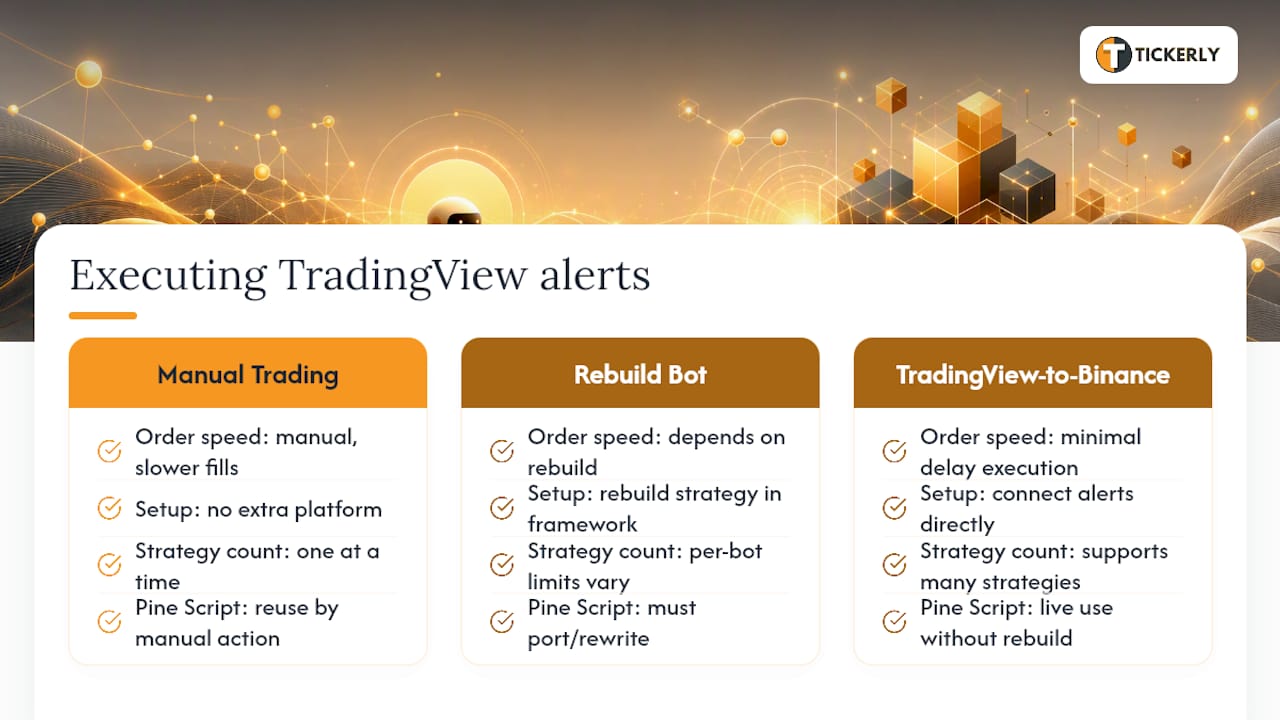
A practical solution addresses a problem every serious TradingView user eventually hits: your strategy generates great alerts, but manually placing every order means missing fast moves and second-guessing your own signals. Instead of rebuilding your Pine Script logic inside a separate bot framework, a platform can connect directly to your TradingView alerts and execute them on Binance with minimal delay between signal and order.
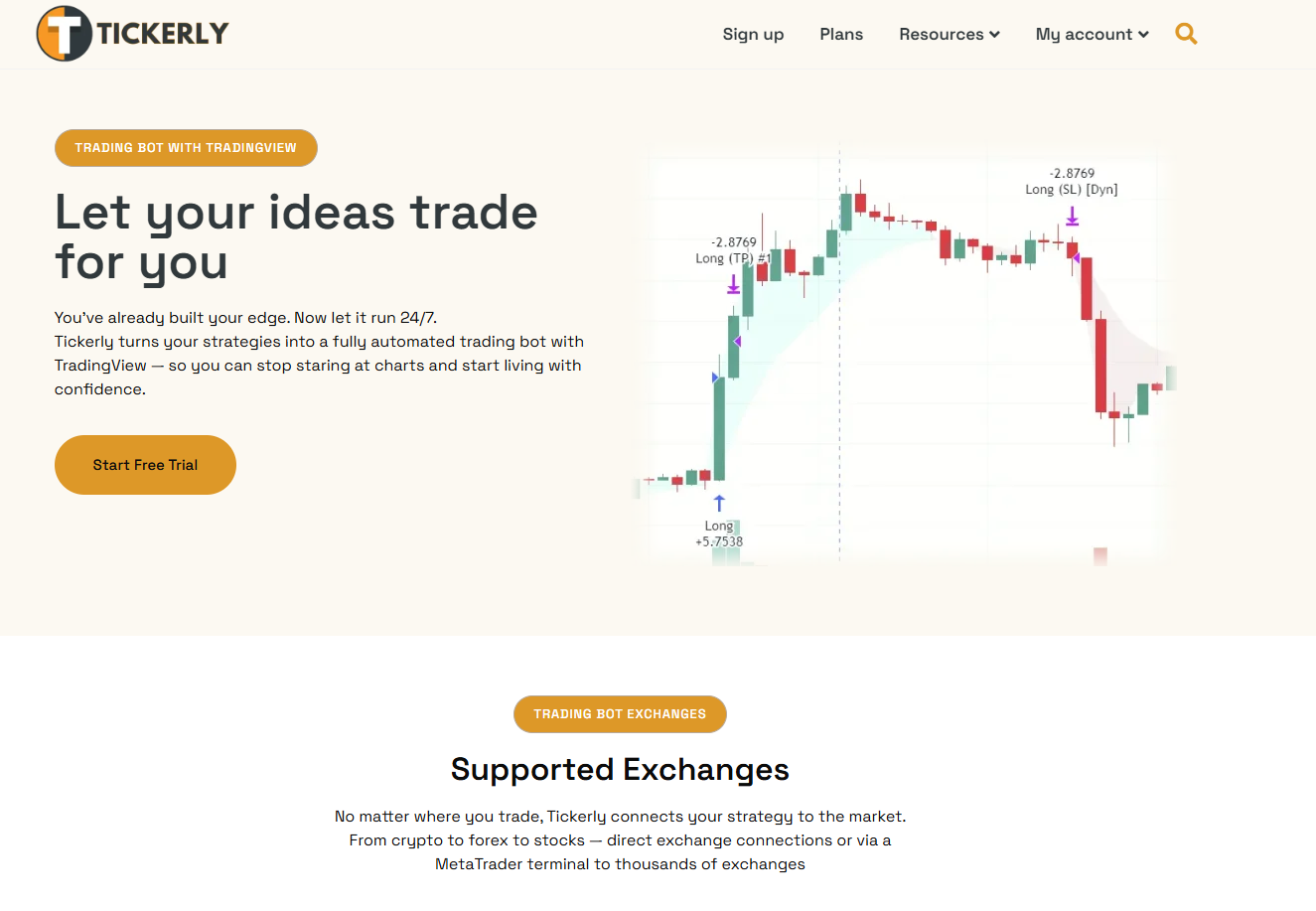
Such a platform is built for traders running multiple strategies at once, Pine Script developers who want their backtested logic to trade live without a rebuild, and active day traders who need execution fast enough that a good signal doesn’t turn into a bad fill. Some platforms support unlimited strategies and alerts, so diversifying across the grid, trend, and confluence approaches covered earlier doesn’t mean juggling five separate tools.
If you’ve been evaluating bots against the checklist in this guide, TradingView-to-Binance automation is worth testing directly. Start with the TradingView strategy automation walkthrough to see exactly how an alert becomes a live order, then explore the full platform overview to check pricing tiers against your own strategy count and trial the setup risk-free for 30 days.
Where to Verify Bot Claims and Learn More
Before trusting any bot with live capital, cross-check its claims against primary sources rather than vendor marketing. Binance’s own API documentation is the definitive reference for endpoints, rate limits, and testnet access. For a hands-on look at self-hosted alternatives, Freqtrade is a mature open-source framework with built-in backtesting and dry-run support, while projects like fatraelkarizm’s algo-trading repository illustrate institutional-style execution methods such as TWAP and VP for larger orders. On the consumer-protection side, ESMA’s investor corner offers useful context on why regulators scrutinize automated trading products sold to retail investors.
Sources
FAQ
Is It Realistic to Make $100 a Day Trading on Binance With a Bot?
It depends entirely on capital and risk tolerance, not the bot itself. A bot can execute a strategy consistently, but daily profit on a small account means taking on proportionally larger risk, and no legitimate platform can guarantee that outcome.
Which Binance Trading Bot Is the Best?
There’s no single best bot; the right one matches your strategy, risk profile, and need for TradingView integration. For active traders running TradingView-based strategies who need fast execution and transparent logs, Tickerly is a strong fit, while self-hosted frameworks like Freqtrade suit traders who want to build and control their own logic.
Does Binance Allow Automated Trading Bots?
Yes, Binance supports automated trading through its public API, and its testnet environment is specifically designed for developers and traders to test bots before running them live.
What’s the Biggest Mistake Traders Make When Choosing a Bot?
Trusting a vendor’s win-rate claims without reviewing actual trade logs or requiring testnet access first. A bot that can’t show you a losing trade and explain what happened almost certainly hasn’t been tested rigorously.
Are Trading Bots Safe to Connect to a Binance Account?
They’re safe when configured correctly: use a trading-only API key with withdrawal permissions disabled, restrict it by IP address, and rotate the key periodically as outlined in Binance’s API documentation.
Recommended
-
Which Trading Bot is the Best? A Complete Guide to Automated Trading in 2026
-
Trading Bot Strategy – The 5 Essential Elements Every Bot Needs
This article was produced with Al assistance and reviewed for accuracy. It is provided for general information only and is not professional or financial advice.