

Automation doesn’t eliminate trading risk. That’s the uncomfortable truth many traders discover only after watching a promising TradingView strategy collapse in live markets. The assumption that flipping on a bot means passive profits is one of the most costly misconceptions in modern trading. Real algorithmic trading success depends on understanding the foundational principles behind every rule, signal, and execution decision your system makes. This guide walks you through the core concepts, strategy-building methodology, key strategy families, TradingView-specific workflows, and the backtesting traps that quietly destroy performance before a single live trade is placed.
Table of Contents
- What is algorithmic trading? The foundation explained
- From trading ideas to backtested rules: How strategies are built
- Key types of algorithmic strategies and what sets them apart
- How TradingView automation works: Signals, alerts, and execution
- Backtesting traps and execution risks: What can go wrong
- Why mastering the basics beats chasing complexity
- Take the next step: Automate with confidence using Tickerly
- Frequently asked questions
Key Takeaways
| Point | Details |
|---|---|
| Automation relies on clear rules | Algorithmic trading eliminates emotion by following precise entry, exit, and risk controls defined in advance. |
| Backtesting uncovers real potential | Thorough testing and validation are crucial to ensure strategies perform as intended, not just in theory. |
| Strategy type impacts outcome | Choosing the right family—trend, mean reversion, or arbitrage—shapes your system’s risk and behavior. |
| TradingView automation has limits | Signals need external relays for live execution and require caution around biases and fill risks. |
| Common pitfalls cause failure | Ignoring costs, slippage, or using repainting logic makes many strategies lose money when live. |
What is algorithmic trading? The foundation explained
At its core, algorithmic trading is the automation of predefined trading rules: a computer program decides when to enter and exit positions and places orders according to explicit criteria such as timing, price levels, and volume, with the goal of removing discretion and emotions while operating faster than any human could.
The keyword there is explicit. Every condition must be precisely defined before a single order is placed. There’s no room for gut feel, intuition, or post-hoc judgment. If your entry rule says “buy when the 50-period moving average crosses above the 200-period moving average on the daily chart,” the algorithm follows that instruction exactly, every time, without second-guessing.
This rule-based structure is why algo trading outperforms discretionary trading in terms of consistency. Emotions, fatigue, and overconfidence don’t influence execution. But consistency cuts both ways: if your rules are flawed, the system will execute those flawed rules consistently at scale. Understanding how automated trading works at a mechanical level is what separates traders who profit from automation and those who automate their losses.
Almost every algorithmic trading system shares these core elements:
- Strategy hypothesis: A testable belief about market behavior (e.g., “trending assets continue trending after a breakout”)
- Translation to rules: Converting that hypothesis into unambiguous, programmable entry, exit, and position-sizing logic
- Execution logic: Order types, timing of order placement, and handling of edge cases like partial fills or slippage
- Risk management layer: Maximum drawdown limits, stop-loss levels, and position exposure constraints
“Algorithmic trading is not a ‘set and forget’ mechanism. The strategy rules must be robust enough to handle changing market conditions, unexpected gaps, and execution variability that simulation environments often mask.”
Without this foundation, automation is just a faster way to make repeatable mistakes.
From trading ideas to backtested rules: How strategies are built
The framework of automation is clear, but how do you transform a trading concept into a working strategy? A common methodology involves converting a trading hypothesis into unambiguous programmable rules, then backtesting rigorously and evaluating whether there is a repeatable statistical edge before committing capital.
Here’s a practical step-by-step breakdown of the process:
- Define your hypothesis. Start with a clear market observation. For example, “price tends to revert after a two-standard-deviation move from the 20-period mean on the 4-hour chart.”
- Translate to code. Write the condition in Pine Script or your preferred language. Every “when” and “if” must be explicit and unambiguous.
- Establish rules for every scenario. Entry signals, exit signals, stop-loss placement, take-profit levels, position sizing, and re-entry logic all need defined rules.
- Run a historical backtest. Apply the rules to historical price data to see how the strategy would have performed. This is called backtesting trading strategies.
- Evaluate key performance metrics. Look at win rate, profit factor (gross profit divided by gross loss), maximum drawdown (the largest peak-to-trough decline), and average risk-to-reward ratio.
- Forward test on out-of-sample data. Test on a data set your strategy has never “seen” to validate that results are not a product of curve-fitting.
- Paper trade before going live. Run the strategy in real-time with simulated capital to confirm execution behavior matches backtest assumptions.
The difference between a trading idea and a working algorithm often comes down to specificity. “Buy the dip” is an idea. “Buy when RSI drops below 30, price is above the 200 EMA, and the prior candle closed with a lower shadow at least twice the body length” is a rule.
| Trading idea | Translated rule |
|---|---|
| Buy the dip | Buy when RSI(14) drops below 30 on daily close |
| Follow the trend | Buy when 50 EMA crosses above 200 EMA |
| Take profits quickly | Close 50% of position when unrealized gain reaches 2R |
| Cut losses fast | Exit fully when price closes below the 20-period ATR stop |

Strong strategy development on TradingView follows this translation discipline consistently.
Pro Tip: Always backtest on out-of-sample data, meaning data your strategy was not optimized on, to detect overfitting. A strategy that performs brilliantly on the optimization window but collapses on fresh data has no real edge.
Key types of algorithmic strategies and what sets them apart
Before you can automate, you need to decide what kind of strategy to build. The strategy family you choose determines the market conditions your system needs, the logic it uses, and the risks it carries. Strategy families frequently used as building blocks include trend following, mean reversion, and arbitrage or statistical arbitrage, plus execution-oriented and liquidity-providing algorithms like market making and VWAP/TWAP execution.
| Strategy type | Core logic | Best market condition | Key advantage | Key risk |
|---|---|---|---|---|
| Trend following | Follow momentum in a direction | Trending, high volatility | Simple, scalable | Whipsaws in ranging markets |
| Mean reversion | Fade extremes, expect return to average | Range-bound, low volatility | High win rate potential | Large losses in trending moves |
| Statistical arbitrage | Exploit price discrepancies between correlated assets | Any, market neutral | Low directional exposure | Requires low latency and complex modeling |
| Market making | Place both bids and offers to capture spread | High liquidity, stable markets | Consistent small gains | Inventory risk during volatility |
| VWAP/TWAP execution | Distribute orders over time to minimize market impact | High-volume institutional trading | Reduces slippage on large orders | Not a directional alpha strategy |
Here’s how to think about which approach fits your goals:
- Trend following strategies suit traders in momentum-driven markets like crypto. Moving average crossovers and breakout systems are common implementations. You can explore trend following strategies built specifically for TradingView automation.
- Mean reversion works best in markets with well-defined ranges and when volatility is mean-reverting. RSI extremes and Bollinger Band touches are typical entry signals.
- Arbitrage requires extremely low latency, API access to multiple venues, and sophisticated order management. It is largely inaccessible to retail traders without institutional infrastructure.
- VWAP/TWAP are execution algorithms, not alpha-generating strategies. They are tools for minimizing market impact on large position entries or exits.
Understanding which category your idea falls into prevents the common mistake of applying a mean-reversion logic in a trending market and wondering why the system keeps losing.
How TradingView automation works: Signals, alerts, and execution

Now that you know strategy options, let’s explore how TradingView connects your strategy to real-world automated trades. The workflow is not as direct as many traders expect when they first start exploring automation on the platform.
Pine Script strategy signals are typically bridged to live trading through TradingView alerts and an external execution layer such as webhooks, because Pine Script itself runs inside TradingView’s sandbox environment rather than directly placing broker orders. This is a critical architectural point. TradingView is a charting and strategy-building platform, not a broker. It cannot place orders on your behalf without an intermediary.
Here is the full execution flow from signal to live trade:
- Write and deploy your Pine Script strategy. Your strategy defines entry and exit conditions and plots them on the chart.
- Set up TradingView alerts. Configure alerts to fire when your strategy generates a signal. You can set up TradingView alerts to trigger on strategy order fills.
- Configure a webhook URL. The alert sends a JSON message payload to an external service via webhook when it fires.
- External execution service receives the signal. This service interprets the alert payload and translates it into an API order request for your broker or exchange.
- Order is placed at the broker or exchange. The broker receives the API request and executes the trade in the live market.
- Position management continues. Subsequent alerts handle stop-loss adjustments, take-profit exits, and position sizing changes.
The most common mistake traders make in this workflow is assuming the backtest fill equals the live fill. In live execution, order latency, partial fills, and slippage all affect the actual entry and exit prices. Understanding TradingView scripts and automation at this architectural level prevents a lot of confusion when live results diverge from backtests.
Pro Tip: Choose signal scripts that are verified as non-repainting. A repainting signal recalculates on previous bars as new data arrives, making historical performance look better than it actually was. Always validate signals on the final close of a bar, not mid-bar.
If you want to understand the complete setup process, automating trading on TradingView with a reliable connector is the most practical path for most retail traders.
Backtesting traps and execution risks: What can go wrong
Before you go live, it’s crucial to understand the dangers and design limitations that trip up even advanced traders in simulation and execution. TradingView-specific edge cases that frequently invalidate backtests include look-ahead bias, incorrect handling of costs and slippage, repainting signals, and overfitting from excessive parameter tuning. These cause strategies that look exceptional in backtests to fail immediately in live trading.
Here is a checklist to avoid the most common backtesting mistakes:
- Avoid look-ahead bias. Never use "security()
calls withlookahead=barmerge.lookahead_on` when it accesses future bar data in live execution. - Model realistic commissions and slippage. TradingView’s default backtest settings often use zero commission and instant fills. Set commissions to match your actual broker fees and use slippage values representative of your asset’s bid-ask spread.
- Test for signal repainting. Add your strategy to a real-time chart and watch whether signals appear on closed bars or move on the current bar. If they move, your signals repaint.
- Avoid over-optimization. Testing dozens of parameter combinations until you find the best historical result is curve fitting, not strategy discovery. The resulting strategy has no predictive power.
- Account for gap risk. In TradingView/Pine, execution risk under price gaps is a common issue: if price gaps past a stop-loss level between bars, the simulated fill can occur at the bar open rather than the intended stop level, making simulated performance look more favorable than live execution.
- Test across multiple market regimes. A strategy validated only on a bull market will look very different in a bear or sideways market.
“Robust algorithmic strategies require two layers of correctness: the signal logic must accurately identify the intended pattern without look-ahead or repainting, AND the fill modeling must realistically represent how and when orders would actually execute in live conditions.”
Managing automated trade exits and risk is especially vulnerable to the gap-fill problem. Stop-losses that appear clean in backtests can produce far worse fills in fast-moving or low-liquidity conditions.
Why mastering the basics beats chasing complexity
Here’s a perspective that runs counter to what most algo trading content promotes: complexity is not your edge. More indicators, more conditions, more parameters do not produce better live results. In almost every case we observe with TradingView automation users, the traders who succeed long-term are the ones who apply simple, robust logic with rigorous risk controls rather than elaborate multi-factor models that have been optimized to oblivion.
The most painful failures we see don’t come from lacking advanced features. They come from skipping the basics: no out-of-sample testing, no realistic slippage modeling, no understanding of what the strategy is actually trying to exploit in the market. A trader with a 3-indicator mean reversion system who understands why it works, when it stops working, and how to size positions correctly will consistently outperform someone running a 15-factor neural-network model they don’t understand.
The professional approach is to iterate toward simplicity, not away from it. Test your core hypothesis with the fewest possible rules. Add complexity only when you can demonstrate it improves out-of-sample performance without increasing sensitivity to parameter changes. Focus on long-term strategy optimization as an ongoing discipline, not a one-time configuration.
The hardest truth in algorithmic trading is that most of what you learn in the first year is unlearning overcomplicated approaches and returning to clean, testable, honest rules.
Take the next step: Automate with confidence using Tickerly
You now have the foundational knowledge to build, test, and evaluate algorithmic trading strategies on TradingView with clear eyes. The next move is putting it into practice without having to build a custom execution infrastructure from scratch.
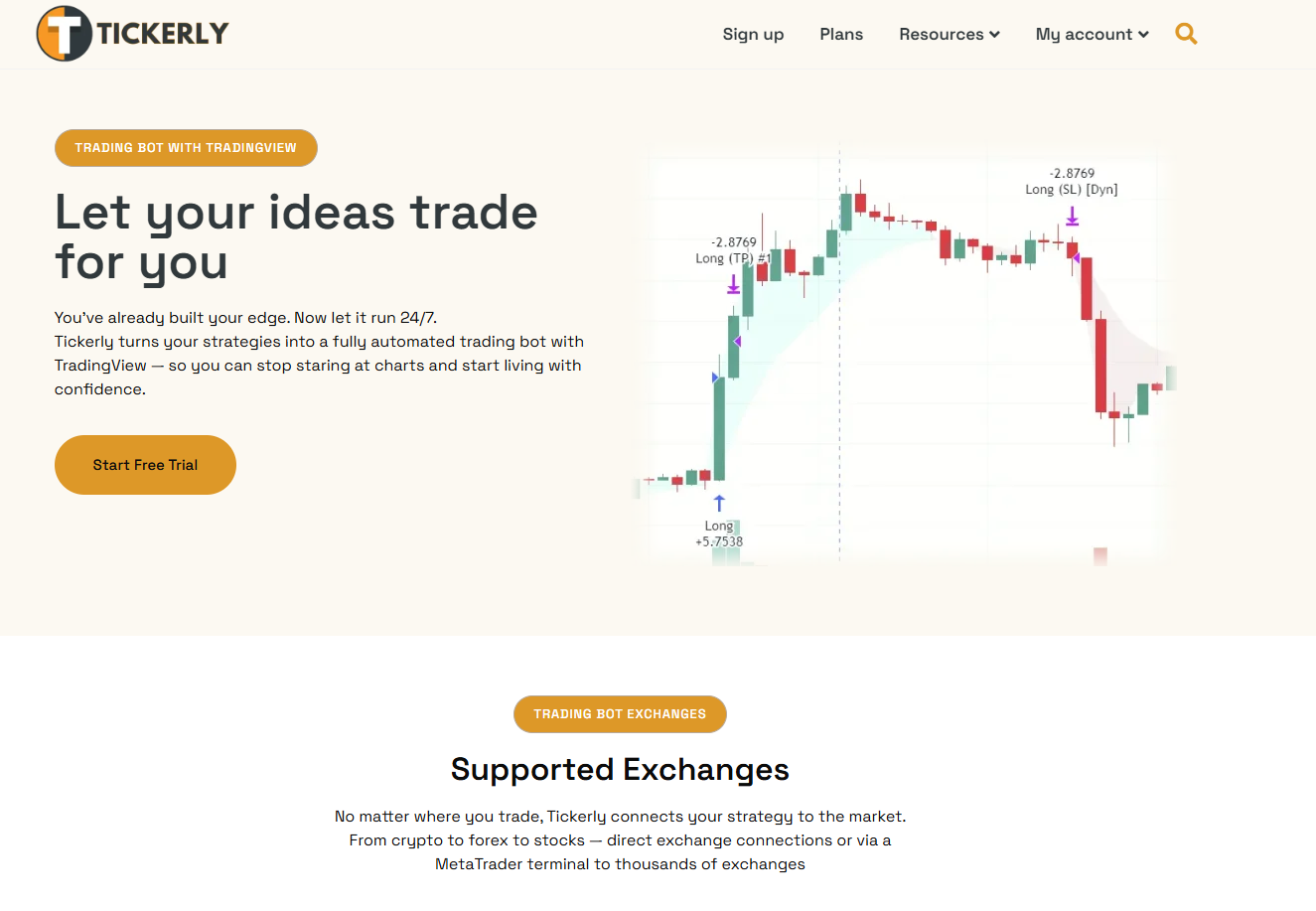
Tickerly is built precisely for this moment. It turns your TradingView strategies into a fully automated trading bot, handling the webhook relay, order routing, and execution management so you can focus on strategy quality. Whether you’re starting with top TradingView strategies or bringing your own Pine Script system, Tickerly’s infrastructure helps you avoid the common execution and fill pitfalls covered in this guide. If you’re still weighing the value of automation, understanding why automated bots matter for execution consistency and speed is a solid next step before you commit.
Frequently asked questions
What makes a trading system “algorithmic”?
Algorithmic systems execute rules-based trades automatically without manual discretion, aiming for consistency and speed across every market condition.
Can I connect TradingView strategies directly to my broker?
No. Pine Script signals are bridged to live trading through TradingView alerts and an external execution layer such as a webhook service, because Pine runs in a sandbox and cannot place broker orders directly.
What’s the biggest mistake in algorithmic backtesting?
Relying on backtests without accounting for real costs, look-ahead bias, or signal repainting. Backtest failures frequently stem from overfitting and improper slippage modeling, which creates false confidence in a strategy before live deployment.
How do I avoid “repainting” in TradingView strategies?
Write your Pine Script so that signal generation only uses data from fully closed bars. Non-repainting signal logic is essential for reliable automation and ensures what you see in backtests matches what fires as a live alert.
Why do my live trading results differ from backtests?
Discrepancies typically arise from execution slippage, latency in order delivery, and stop-loss behavior under price gaps that simulate fills at bar opens rather than at your intended stop level, producing better-than-real historical results.