

If you want a straight answer: Tickerly is the strongest pick for futures traders who build strategies on TradingView and want them executed automatically, without writing a line of code. It converts Pine Script alerts into live orders with low alert-to-execution latency and connects to multiple exchange APIs, so your strategy fires the moment your indicator does.
For traders whose workflow doesn’t start on TradingView, a short list of alternatives covers the rest of the field:
- MetaTrader Expert Advisors for forex-heavy futures traders already inside the MT4/5 ecosystem
- Exchange-native bots (grid, martingale, DCA) for traders who want strategy automation built directly into their broker
- Open-source algo platforms for developers who want full control over execution logic and don’t mind writing code
Pro Tip: Before trusting any leaderboard, check whether the results come from exchange-executed trade logs or self-reported screenshots. TradingBotExperts ranks bots using a combination of verified reviews, real performance data, and expert scoring, which is the standard worth demanding from every vendor you evaluate.
Key Takeaways
The most reliable futures trading bot for any trader is the one with verified live execution data that matches their specific strategy and risk tolerance.
| Point | Details |
|---|---|
| Verification beats marketing | Prioritize exchange-executed trade logs and disclosed sample sizes over screenshots or vendor claims. |
| Match strategy to account size | Grid and DCA suit smaller accounts; martingale requires deep capital reserves to survive drawdowns. |
| Check latency and API depth | Ask vendors directly how fast an alert becomes a filled order and which exchanges they support. |
| Use the trial to test, not trust | Run small live trades during any trial period to confirm real execution, not just backtests. |
| Tickerly fits TradingView-native traders | Its no-code Pine Script automation and multi-exchange API support make it the strongest fit for TradingView users seeking fast execution. |
Table of Contents
- Which Are the Best Futures Trading Bots Right Now?
- How Do You Choose the Right Futures Trading Bot?
- How Do You Verify That a Trading Bot’s Performance Is Real?
- Which Bot Strategy Fits Your Trading Style?
- Why Tickerly Stands Out for TradingView-Native Traders
- Ready to Automate Your Own Futures Strategy?
- Sources
- FAQ
Which Are the Best Futures Trading Bots Right Now?
No single bot wins every category, so the right answer depends on how you trade. Tickerly leads for TradingView-native execution. MetaTrader EAs lead for forex-adjacent futures traders. Open-source platforms lead for developers who want to own their code. The table below lines up nine options against the metrics that actually predict whether a bot will hold up in live futures markets: verification, strategy fit, pricing shape, exchange coverage, scripting depth, backtesting, risk controls, and execution speed.
| Bot | Best For | Pricing Model | Exchange/Broker Support | Scripting & Customization |
|---|---|---|---|---|
| Tickerly | TradingView users, Pine Script developers wanting fast execution | Subscription tiers by strategy/alert volume | Multiple exchanges via API, including MT4/5 | No-code, Pine Script alert based |
| MetaTrader Expert Advisors (EAs) | Forex-adjacent futures traders on MT4/5 brokers | Varies by EA vendor; many one-time purchase | MetaTrader-compatible brokers | Full MQL scripting, deep backtesting |
| Gunbot | Traders wanting a self-hosted bot with public leaderboard tracking | One-time license fee | Multiple exchange integrations | Strategy presets plus custom scripting |
| Hummingbot | Developers running market-making and arbitrage strategies | Free, open-source core | Broad exchange connector library | Full Python-level customization |
| QuantVue | Traders who want built-in strategy automation with visual setup | Subscription | Select broker integrations | Preset strategies, limited custom code |
| TradersPost | Traders routing TradingView or other signals into brokerage execution | Subscription tiers | Multiple brokers and exchanges | Webhook-based, no-code setup |
| TrendSpider | Technical traders who want automated scanning plus alerting | Subscription tiers | Broker integrations for execution | Visual strategy builder, some scripting |
| 3Commas | Traders wanting bot templates across crypto exchanges | Subscription tiers | Multiple crypto exchanges | Preset bots plus some custom rules |
| Shrimpy | Portfolio-focused traders wanting rebalancing automation | Subscription tiers | Multiple crypto exchanges | Preset rebalancing logic |
A few one-line reads on what separates these entrants:
- Tickerly: wins on alert-to-execution speed and zero-code setup, but it depends on you already having a TradingView strategy to automate.
- MetaTrader EAs: the deepest backtesting inside the platform itself, though the ecosystem’s quality varies wildly EA to EA.
- Gunbot: a public leaderboard gives you a real performance reference, but self-hosting means you own the uptime risk.
- Hummingbot: unmatched flexibility for developers, at the cost of needing real coding effort to get a strategy live, a tradeoff Bookmap’s survey of algo bots flags as the core tension in open-source tooling.
- TradersPost: strong for signal routing across brokers, but it’s an execution layer, not a strategy engine.
- 3Commas and Shrimpy: both lean crypto-first, which limits their fit for futures-specific traders compared to the rest of this list.
Where a platform sits by category matters more than its name. Exchange-native bots like the ones Cleo.Finance, CryptoRobotics, and GoodCrypto represent tend to bundle grid and DCA presets directly into the exchange interface, trading customization for convenience. SignalStack and Zenbot fall into the developer-tooling category alongside Hummingbot: powerful, but they assume you can write or adapt code. TradingView itself isn’t a bot at all, it’s the charting and alerting layer that feeds bots like Tickerly and TradersPost their signals in the first place.
How Do You Choose the Right Futures Trading Bot?
Start with your strategy, not the bot’s marketing page. A grid bot solves a different problem than a trend-following system, and a martingale-based tool behaves nothing like a DCA bot during a drawdown. Match the bot’s supported strategy types to what you actually trade before you look at anything else.
Once strategy fit is confirmed, run every vendor through the same due-diligence checklist:
- Verified live results. Does the vendor show exchange-executed trade logs, or just backtests and screenshots?
- Exchange API integration. Can it connect directly to your broker or exchange without manual intervention?
- Latency guarantees. How fast does an alert become a filled order, and is that number disclosed anywhere?
- Security and audit statements. Has the platform published anything about how it handles API keys and account access?
- Support responsiveness. Can you get a real answer within hours, not days, when execution behaves unexpectedly?
Watch for a few red flags that show up constantly in this market: no live verification anywhere on the site, backtests with no disclosed sample size, risk controls that are vague or entirely absent, and marketing that leans on martingale scaling as the “secret” to consistent profit. Martingale systems can look flawless right up until the drawdown that wipes the account.
Pro Tip: Weight verification signals over marketing claims by a wide margin. A bot with three months of exchange-verified trades beats one with a slick landing page and unverifiable “10x” screenshots every time. If you want a deeper framework for vetting risk controls specifically, Tickerly’s guide on managing risk in trading bots walks through the checklist in more detail.
How Do You Verify That a Trading Bot’s Performance Is Real?
Leaderboard numbers are only useful if you know what’s behind them. Five metrics matter most: daily profit per $1,000 deployed, maximum drawdown, win rate, slippage, and the sample size and timeframe the results cover. The same return sustained over six months, with disclosed sample size, tells you a lot.

Backtests and live results diverge for predictable reasons: backtests don’t account for slippage, partial fills, or the latency between a signal firing and an order executing. Vendors sometimes inflate backtest numbers by curve-fitting parameters to historical data that will never repeat. That’s why TradingBotExperts’ verified-review methodology matters. It combines real performance data with user reviews and expert scoring rather than relying on vendor-submitted backtests alone.
A workable verification checklist:
- Trade logs generated by the exchange itself, not vendor-formatted spreadsheets
- Independent confirmation beyond screenshots, which are trivially easy to fake or cherry-pick
- Clear disclosure of timeframe and sample size behind any advertised return
- A stated methodology for how “verified” results were collected
Traders who apply this checklist before deploying capital avoid the single most common failure mode in automated futures trading: mistaking a lucky short-term run for a repeatable edge.
Which Bot Strategy Fits Your Trading Style?
Every automated strategy solves a different problem, and picking the wrong one for your account size is how most beginners get burned.
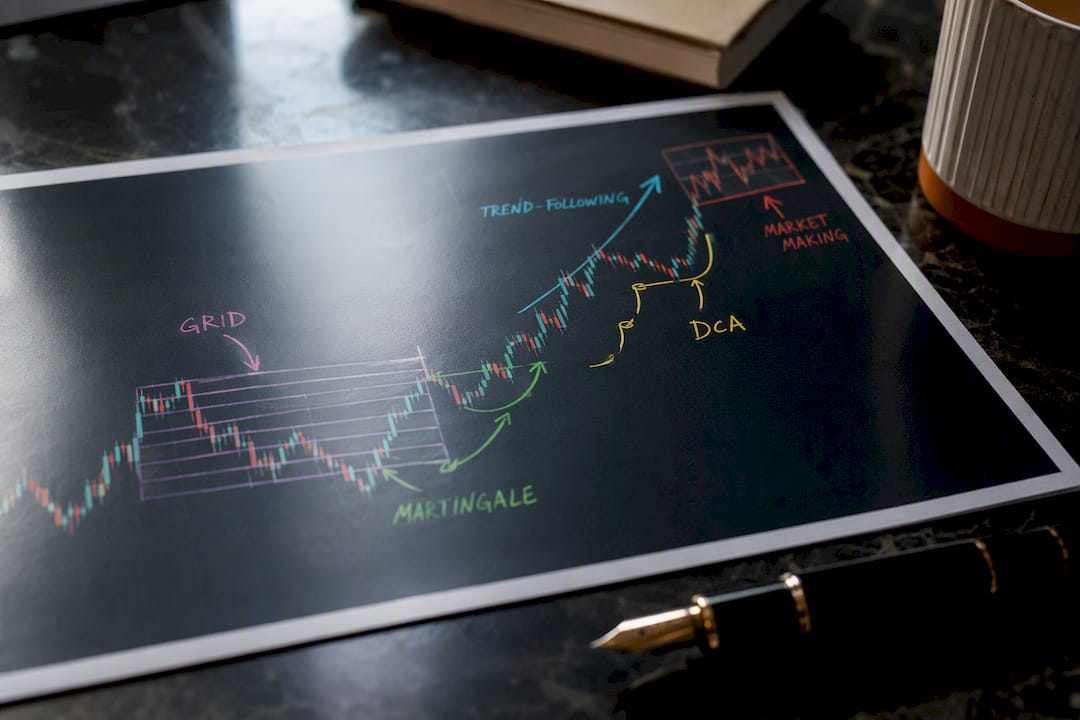
- Grid trading places buy and sell orders at set intervals around a price, profiting from range-bound movement. Best for traders expecting sideways markets; controls include step size and grid boundaries.
- Martingale doubles position size after a loss to average down. High risk, only appropriate for well-capitalized accounts that can absorb a long losing streak.
- Combo (grid plus trend) blends range trading with directional bias, adapting better to mixed market conditions than a pure grid.
- Trend-following enters in the direction of a confirmed move, exiting on reversal signals. Fits traders comfortable holding through volatility for a bigger payoff.
- Dollar-cost averaging (DCA) buys at scheduled intervals regardless of price, reducing timing risk over a longer horizon.
- Market making places simultaneous buy and sell orders to capture the spread. Best suited to high-frequency setups with tight latency requirements.
Bybit’s own suite of built-in bot strategies reflects this exact taxonomy, which is a useful reference point since most exchange-native tools categorize their offerings the same way.
| Strategy | Risk Profile | Best For |
|---|---|---|
| Grid | Moderate | Range-bound markets |
| Martingale | High | Large, well-capitalized accounts only |
| Trend-following | Moderate to high | Directional conviction, longer holds |
| DCA | Low to moderate | Long-horizon accumulation |
| Market making | High (execution risk) | Low-latency, high-frequency setups |
Pro Tip: If your account is small, skip martingale-only bots entirely. A losing streak that a larger account absorbs comfortably can blow through a small account’s margin in a handful of trades. Tickerly’s breakdown of grid strategy parameters is a solid starting point if range-bound setups fit your risk tolerance better.
Why Tickerly Stands Out for TradingView-Native Traders
We recommend Tickerly for one clear reason: it removes the gap between a strategy idea on a TradingView chart and a live order on an exchange. No-code setup means Pine Script developers don’t need to rebuild their logic in a separate language, and the multi-exchange API connectivity means one strategy can run across several accounts at once.
The exception is highly specialized institutional setups that need custom, colocated, ultra-low-latency execution infrastructure. Retail and semi-professional traders rarely need that level of engineering, but it’s worth naming honestly.
Ready to Automate Your Own Futures Strategy?
Manually watching charts to catch every signal is how good setups turn into missed trades. Tickerly closes that gap by turning your TradingView alerts into live executions the moment your strategy fires, across multiple exchanges, with no coding required.
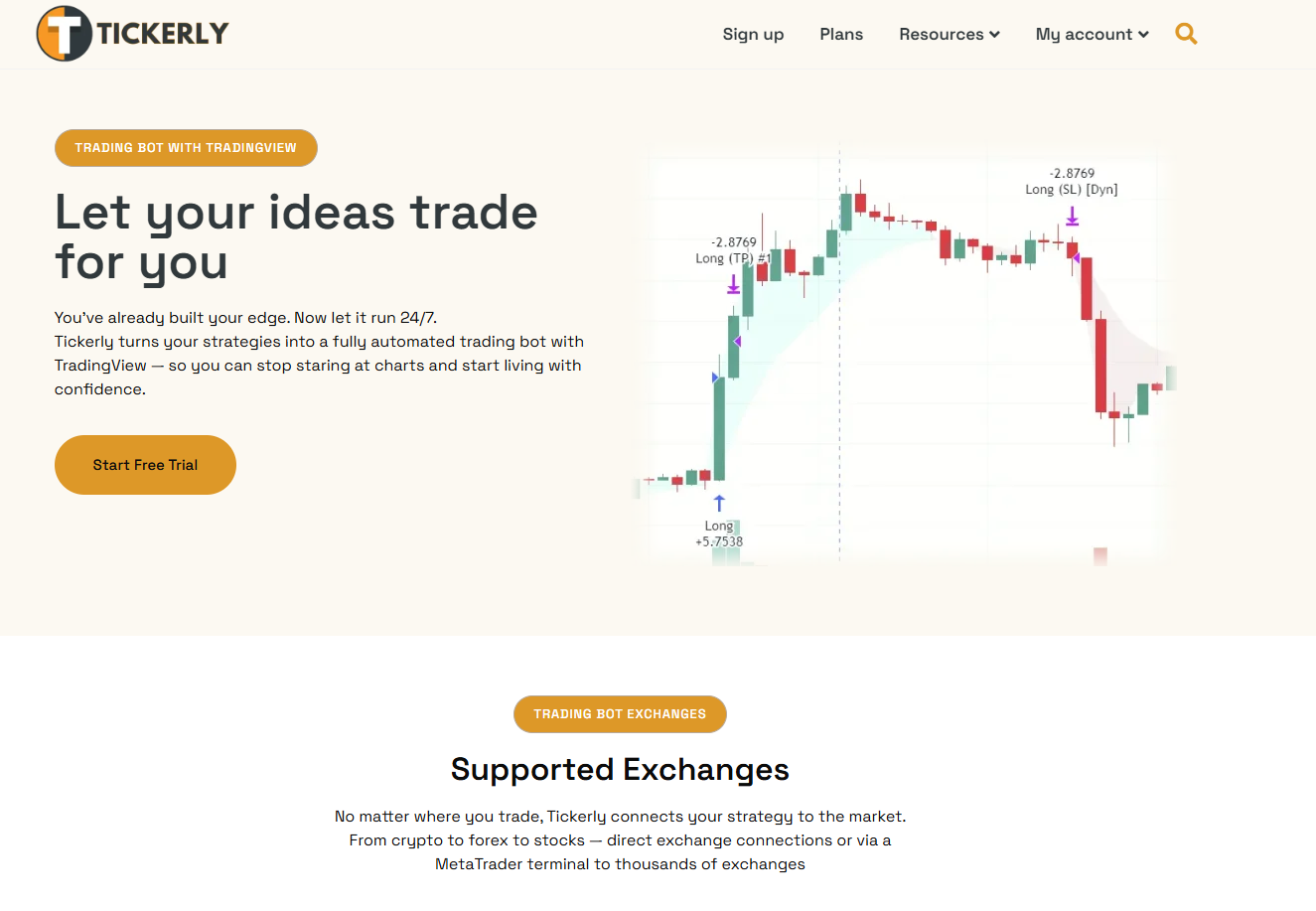
Every plan starts with a free trial, and that window is exactly where you should do your own verification work rather than take any vendor’s word for it, including ours. Use the trial to check three things: whether executions actually happen in real time, how much slippage shows up between signal and fill, and how long the alert-to-fill gap runs under normal market conditions. Start with small position sizes, review your execution logs directly, and layer in strict risk controls before scaling up.
Ready to see it running on your own strategy? Start your free trial with Tickerly and watch your first alert convert into a real trade.
Sources
- Best Bots for Trading Futures: 2026 Ranked | TradingBotExperts
- Top Trading Algo Bots: Automating Your Trading Strategy
This article is general information, not a substitute for advice from a qualified financial advisor. Consult a qualified financial professional about your own circumstances before acting on anything here.
FAQ
Which AI Is Best for Futures Trading?
No single AI model is “best” for futures trading; the more useful question is which automation platform executes your strategy reliably. Tickerly focuses on execution speed and TradingView integration rather than predictive AI, which matters more for consistent live results than a black-box prediction engine.
What Is the Most Successful Trading Bot?
There’s no universally “most successful” bot because success depends on verified results matched to a specific strategy and market. The most trustworthy approach is comparing verified live performance, using resources like TradingBotExperts’ ranked list, rather than chasing a single named winner.
Is $5,000 Enough to Trade Futures?
A few thousand dollars can be enough to trade futures depending on the contract’s margin requirements and your risk controls, but it leaves little room for martingale-style strategies or wide stop-losses. Smaller accounts generally fare better with grid or DCA approaches that manage position size carefully.
What Is the Best Futures Trading Simulator?
Many futures brokers and platforms, including MetaTrader and TradingView-connected tools, offer paper trading or simulation modes for testing strategies before going live. The most useful simulator for you is one that mirrors your actual execution environment, including the same alerts and automation you plan to trade with live.