

TL;DR:
- Grid trading automates buy-low and sell-high orders within fixed price ranges, generating profits from market oscillations. It performs best in sideways markets but risks inventory buildup and losses during strong trends; managing stop-losses and adjusting parameters are essential. Using proper sizing, active monitoring, and automation tools enhances success across various assets and market conditions.
Grid trading is defined as a systematic method that places buy and sell orders at fixed price intervals above and below a set price, forming a grid of orders that captures profit from price oscillations without requiring directional forecasting. Traders across crypto, forex, and stocks use grid strategies because they turn market noise into repeatable income. The core appeal is mechanical: the system buys low and sells high automatically, removing emotional decision-making from every trade. Understanding why use grid strategies comes down to one fact: markets spend more time consolidating than trending, and grids are built precisely for that environment.
How do grid strategies generate profit in different market conditions?
Grid trading profits from the spread between each grid level. Every time price bounces between two levels, the bot sells at the upper level and buys at the lower one, locking in a small gain. Repeat that process dozens of times per day across a tight range, and those small gains compound into meaningful returns.

The strategy excels in sideways or consolidation phases. Grid trading monetizes volatility in consolidation phases where trend-following strategies often fail, turning frustration into opportunity. That is a structural advantage: when trend followers are stopped out repeatedly, grid traders are collecting profits on every swing.
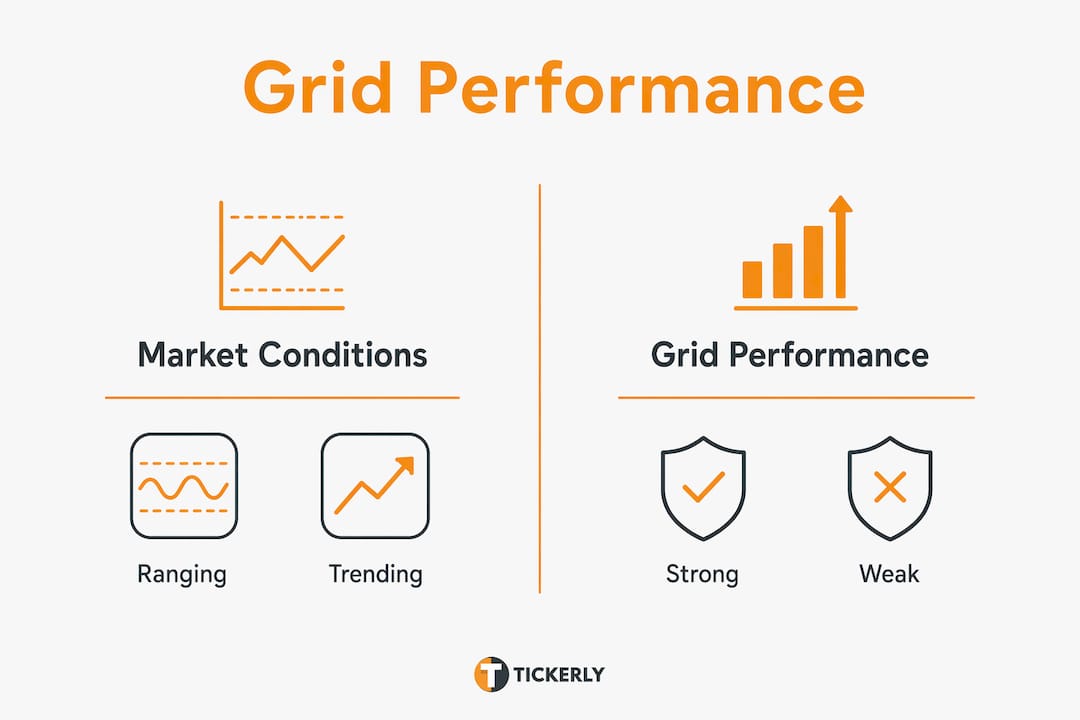
The risk flips in trending markets. Grid bots underperform in strong trends due to inventory build-up on the wrong side. If price breaks out upward, the bot keeps selling too early. If price drops hard, the bot accumulates a growing long position at a loss.
| Market condition | Grid performance | Notes |
|---|---|---|
| Ranging/sideways | Strong | Repeated fills at each level generate consistent income |
| Mild trend | Moderate | Partial fills still profitable; requires wider grid spacing |
| Strong uptrend | Weak | Bot sells too early; misses upside gains |
| Strong downtrend | Dangerous | Inventory accumulates at a loss; stop-loss critical |
Pro Tip: Use the 14-day ATR (Average True Range) to size your grid. Setting bounds at 1.5–2x ATR above and below the current price captures typical market noise without overextending your capital.
What are the key advantages of using grid trading strategies?
Grid trading removes the hardest part of trading: predicting direction. Grid systems automate buy-low/sell-high cycles at fixed intervals, eliminating emotional bias from every execution. That mechanical discipline is what most manual traders struggle to maintain consistently.
The advantages stack up across several dimensions:
-
No forecasting required. The grid profits from price movement in either direction within the defined range. You set the parameters; the system does the rest.
-
Systematic execution. Every order fires at the exact price level, every time. There is no hesitation, no second-guessing, and no missed entries.
-
Scalability across assets. Grid systems scale across 3–4+ instruments simultaneously, allowing diversification without proportionally increasing your workload.
-
Built-in dollar-cost averaging. As price dips, the grid buys more at lower levels. This accumulation effect works in your favor during mild pullbacks.
-
24/7 operation. Automated grid bots operate nonstop, capturing overnight moves and weekend volatility that manual traders miss entirely.
-
Captures market noise. Trend-following strategies ignore small oscillations. Grid strategies profit from them directly.
Pro Tip: Run grids on multiple uncorrelated assets to reduce the impact of any single asset trending against you. Crypto and forex pairs with low correlation make strong candidates.
What are the risks and pitfalls of grid trading, and how to manage them?
Grid trading carries real risks that traders must address before deploying capital. The three primary dangers are inventory risk, fee drag, and trend risk. Each one can turn a profitable setup into a losing position if left unmanaged.
Inventory risk is the most serious. If price drops below the lowest grid level, the bot holds maximum inventory at a loss with no sell orders left to execute. Stop-losses set 3–5% below the lowest grid line are the standard defense against catastrophic drawdowns. Without this control, a single strong downtrend can wipe out weeks of accumulated gains.
Fee drag is a quieter killer. Grid spacing must exceed 3–4x combined maker/taker fees per cycle to remain net positive after costs. A grid that fires 50 trades per day at a 0.1% fee per side needs at least 0.6–0.8% spacing per level just to break even. Tight grids on high-fee exchanges destroy profitability fast.
Trend risk requires active monitoring. Static grids cannot adapt when volatility spikes or a new trend begins. Dynamic grids adjust spacing and range based on ATR or Bollinger Bands to maintain their edge when market conditions shift. Reviewing and recalibrating your grid weekly is not optional; it is part of the strategy.
Follow these risk management steps before and during any grid deployment:
-
Set a hard stop-loss at 3–5% below your lowest grid level before activating the bot.
-
Calculate fee-adjusted spacing by multiplying your exchange’s combined round-trip fee by at least 4x to determine minimum grid spacing.
-
Allocate limited capital per grid. Never commit more than you can afford to hold through a full drawdown to the stop-loss level.
-
Monitor market regime weekly. If ATR expands sharply or price breaks a key support level, pause the grid and reassess.
-
Use dynamic recalibration. Adjust grid bounds when volatility indicators signal a regime change. A static grid in a volatile breakout is a liability.
For a deeper look at controlling bot-related risk, Tickerly’s guide on managing bot risk effectively covers position sizing and exit frameworks in detail.
Pro Tip: Before going live, calculate your maximum loss scenario: grid width multiplied by number of levels multiplied by position size per level. If that number exceeds your risk tolerance, reduce position size, not grid levels.
How to implement an effective grid strategy: practical steps and tools
Setting up a grid strategy correctly takes more than picking a price range. The parameters you choose determine whether the system profits or bleeds slowly. Start with these steps.
Define your grid bounds
Use support and resistance levels identified on the daily or 4-hour chart as your outer bounds. Confirm those levels with ATR: calibrate bounds at 1.5–2x the 14-day ATR above and below the current price. This method anchors your grid to actual market behavior rather than arbitrary numbers.
Choose grid spacing and type
Grid spacing must cover fees and generate net profit. The minimum is 3–4x your combined maker/taker fee per cycle. Beyond that, wider spacing means fewer fills but larger profit per trade. Narrower spacing means more fills but thinner margins and higher fee exposure.
| Grid type | Spacing | Best for | Key risk |
|---|---|---|---|
| Static grid | Fixed intervals | Stable, low-volatility ranges | Fails when volatility expands |
| Dynamic grid | ATR-adjusted intervals | Volatile or shifting markets | Requires active recalibration |
| Spot grid | Buys underlying asset | Long-term accumulation | Inventory risk on downtrends |
| Futures grid | Uses leverage | Short-term profit capture | Amplified losses in trends |
Test before deploying capital
Backtesting is non-negotiable. Run your grid parameters through historical data to verify profitability across both ranging and trending periods. Historical backtests show grid strategies can achieve 15–40% annualized returns in favorable ranging conditions but produce negative returns during sustained breakdowns. That range tells you exactly what conditions your grid needs to succeed.
Tickerly connects directly to multiple exchange platforms and supports automated bot deployment from TradingView strategies, making it straightforward to move from backtested parameters to live execution without manual order placement.
Pro Tip: Start with 20–30% of your intended capital allocation for the first two weeks. Monitor fill rates, fee costs, and drawdown before scaling up. Incremental scaling after confirmed performance protects capital during the learning phase.
Key Takeaways
Grid trading strategies generate consistent profits in ranging markets by automating buy-low/sell-high cycles at fixed intervals, but require disciplined stop-losses, fee-aware spacing, and active regime monitoring to remain profitable.
| Point | Details |
|---|---|
| Profit mechanism | Grid bots capture spreads between fixed price levels during price oscillations. |
| Best market condition | Sideways, consolidating markets produce the strongest grid returns. |
| Fee-aware spacing | Grid spacing must exceed 3–4x combined trading fees per cycle to stay net positive. |
| Stop-loss discipline | Place hard stop-losses 3–5% below the lowest grid level to limit inventory risk. |
| Dynamic recalibration | Adjust grid bounds using ATR or Bollinger Bands when volatility or market regime shifts. |
Grid trading works, but only if you respect the conditions
I have watched traders deploy grids with real enthusiasm, only to blow up their accounts within a month. The pattern is almost always the same: they set the grid, turn on the bot, and stop watching. Then a trend hits, inventory piles up, and there is no stop-loss in place.
The traders who succeed with grids treat them like any other rules-based system. They define the regime first. Is this asset ranging? What does the ATR say? Is there a macro catalyst that could break the range? Only after answering those questions do they activate the bot.
Fee sensitivity surprises most beginners. A grid that looks profitable on paper often loses money in practice because the spacing was too tight relative to exchange fees. I have seen traders run 20-level grids on assets with 0.2% fees per side and wonder why they are losing money on 30 fills per day. The math does not work unless spacing covers costs with room to spare.
The strongest use case I have seen for grids is as a complement to a broader portfolio. Running grids on two or three consolidating assets while holding directional positions elsewhere gives you income during flat periods without abandoning trend exposure. That combination is more resilient than either approach alone.
Grids also pair well with trend-following strategies when you use them on different assets or timeframes. The grid earns during consolidation; the trend system earns during breakouts. Together, they cover more market regimes than either one covers alone.
Automate the execution, but never automate your judgment about when to run the grid. That distinction is what separates profitable grid traders from the ones who quit after their first drawdown.— Jay
Tickerly and automated grid trading
Grid strategies demand precision and speed that manual execution cannot reliably deliver. Tickerly converts your TradingView strategies into fully functional trading bots that execute at the exact price levels you define, with no latency and no emotional interference.
Tickerly connects to major exchange platforms and supports multi-asset bot deployment, so you can run grids on crypto, forex, and stocks from a single interface. The platform’s real-time alert system fires orders the moment your grid conditions are met, capturing opportunities that disappear in seconds. For traders ready to put grid strategies to work with full automation, explore how automated bots boost efficiency and results with Tickerly’s purpose-built tools.
FAQ
What is a grid trading strategy?
A grid trading strategy places buy and sell orders at fixed price intervals above and below a set price, profiting from repeated price oscillations within that range without requiring directional prediction.
Why use grid strategies instead of trend following?
Grid strategies profit during consolidation phases where trend-following strategies fail, making them a strong complement to directional systems rather than a replacement.
Is grid trading effective in crypto markets?
Grid trading is effective in crypto during ranging conditions. Backtests show 15–40% annualized returns in favorable ranges, but strong directional moves require active stop-loss management to prevent losses.
How do I set grid spacing correctly?
Grid spacing must be at least 3–4x your combined maker/taker fee per cycle. Use the 14-day ATR to set outer bounds at 1.5–2x ATR above and below the current price for optimal range coverage.
Can I run grid strategies on stocks and forex?
Grid strategies apply to any liquid market with regular price oscillations, including forex pairs and automated stock trading. The same fee-aware spacing and stop-loss rules apply regardless of asset class.