

TL;DR:
- A structured daily trading checklist from pre-market to post-session review helps traders turn their strategies into consistent results. Following strict risk parameters, disciplined entries, and regular review minimizes impulsive trades and enhances long-term performance. Automation of rules-based tasks and having contingency plans reduce errors and protect capital during technical failures.
A concise, repeatable day trading session checklist — running from pre-market through post-session review — is the most direct path from a written strategy to consistent, measurable results. Day trading requires positions to open and close within the same session, which means every decision happens under time pressure, in real capital, with no margin for improvisation. The checklist below is your session-by-session operating procedure.
Your one-page daily checklist:
Pre-market (7–10 minutes before open)
- Check economic calendar; flag high-impact events
- Review overnight price action and higher-timeframe bias
- Mark key support/resistance levels and set price alerts
- Build or update your watchlist (2–5 symbols max)
- Set three hard limits: per-trade risk %, daily max loss, max trade count
- Read yesterday’s one-sentence lesson from your journal
Market open (first 15 minutes)
- Observe only for the first 5–10 minutes; no entries
- Confirm opening range direction aligns with pre-market bias
- Wait for a qualifying setup from your approved list before entering
Intraday (active session)
- Log every entry: reason, stop level, size, R-risk, timestamp
- Check emotional state every 30–60 minutes (rate 1–10)
- Adjust stops only by rule, never by feel
Pre-close (30–60 min before session end)
- Decide: hold, scale out, or flatten all positions
- Cancel open orders; confirm no unintended overnight exposure
- Export trade log and screenshot key charts
Post-session (within 60 minutes of close)
- Log all trades in your journal
- Calculate win rate, average R, and discipline score
- Write one lesson per trade; convert the best lesson into tomorrow’s action item
Three rules for skipping the session entirely:
- Your daily max loss has already been hit.
- A high-impact news event is live and your setup has no edge around news.
- Your pre-session mental check scores below your personal threshold (see Section 9).
A documented 3-phase routine — 7–10 minutes pre-market, active session management, and a 10-minute post-session review — measurably increases consistency for traders who follow it daily.
Table of Contents
- What does your pre-market checklist look like?
- How should you handle the market open and first-hour volatility?
- How do you manage open positions without micromanaging them?
- What should you do before and after the session closes?
- What are the exact risk rules every trader needs on their checklist?
- How do you build a watchlist and trading plan that keep you on strategy?
- What mental checks should you run before every trade?
- When should you automate parts of your session checklist?
- What’s your backup plan when technology fails mid-session?
- Key Takeaways
- Why most traders ignore the checklist that would save them
- Tickerly turns your TradingView alerts into live bot execution
- Useful sources & references
- FAQ
What does your pre-market checklist look like?
The pre-market window is where your session is won or lost before the first candle prints. A compact 7–10 minute pre-market routine that hits five specific checkpoints reduces reactive trading and sharpens decision quality throughout the day.
Step-by-step pre-market routine (time-boxed):
- Minutes 1–2: Economic calendar. Open Forex Factory, the CME Group economic calendar, or your broker’s calendar. Flag any high-impact releases (FOMC, CPI, NFP, earnings) within 60 minutes of your planned entries. If a release lands inside your trade window, decide now whether you’ll sit out or reduce size.
- Minutes 3–4: Overnight context. Check where price closed relative to yesterday’s range, any gap at the open, and whether futures are confirming or contradicting your higher-timeframe bias. Multi-timeframe market analysis — weekly, daily, then intraday — gives you the structural context that prevents trading against the dominant trend.
- Minutes 5–6: Mark key levels. Draw yesterday’s high and low, the prior session’s close, and any obvious supply/demand zones on your intraday chart. Set price alerts at those levels so you’re not staring at the screen waiting for price to arrive.
- Minutes 7–8: Watchlist review. Trim your list to 2–5 symbols that have a catalyst (earnings, sector news, unusual volume pre-market) and sufficient liquidity. Illiquid names widen spreads at the open and make stops unreliable.
- Minutes 9–10: Set your three daily limits and read yesterday’s lesson. Write your per-trade risk percentage, daily max loss in dollars, and maximum trade count on a sticky note or your trading platform’s notepad. Then read the one-sentence lesson you wrote after yesterday’s session. That single habit closes the feedback loop.
Pro Tip: Verbalize your key levels out loud before the open. Saying “resistance at $482.50, support at $479.20” forces your working memory to encode the levels more reliably than reading them silently. Traders who verbalize their plan before the session make fewer impulsive entries at random price points.
How should you handle the market open and first-hour volatility?
The first 15 minutes of the U.S. equity session (9:30–9:45 AM ET) are often among the highest-volume and widest-spread periods of the day. Liquidity and volatility peak at the open and again near the close, which is precisely why intraday traders target those windows — and why undisciplined entries during that period cause outsized losses.
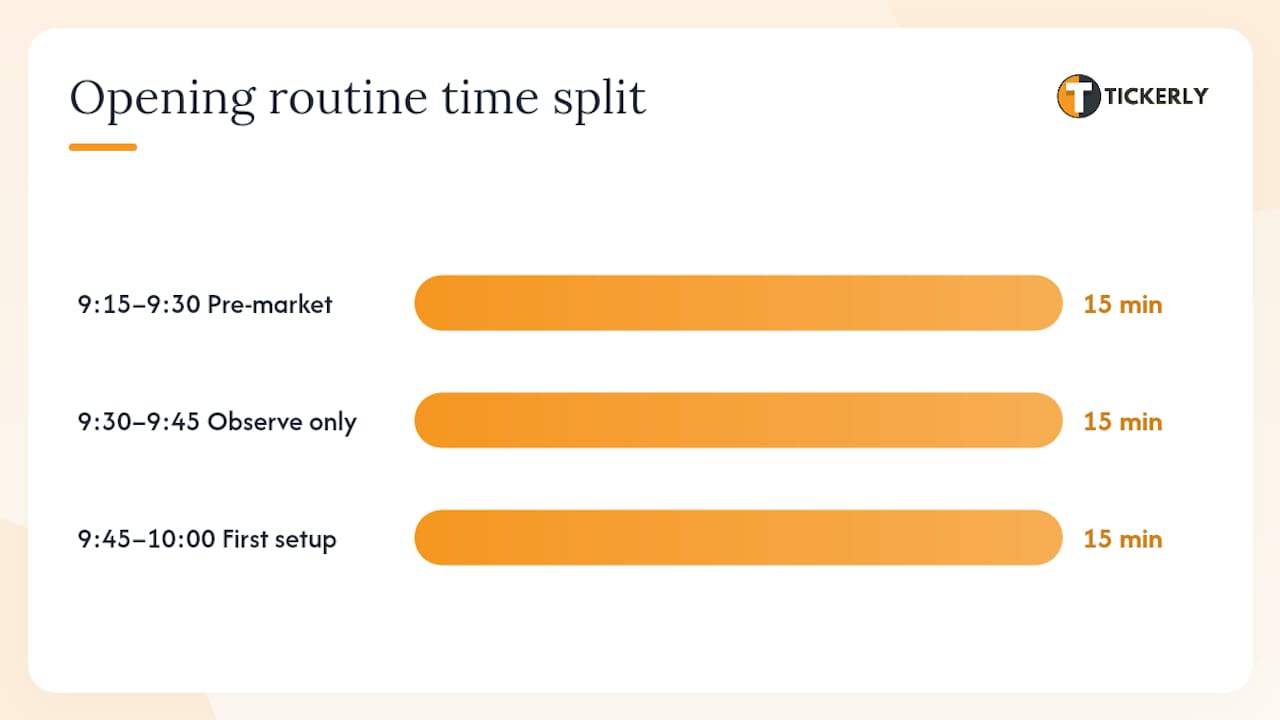
Opening routine (9:15–10:00 AM ET):
- 9:15–9:30 AM: Final pre-market scan. Confirm your watchlist, check for any last-minute news, verify your platform is connected and orders are clear.
- 9:30–9:45 AM: Observe only. Watch how price reacts to your pre-marked levels. Note whether the opening gap fills, holds, or extends. Do not enter.
- 9:45 AM onward: Look for your first qualifying setup.
Order types and when to use them at the open:
- Limit orders are the default for the open. They protect you from slippage in wide-spread conditions. Place them at your pre-marked level, not at the current bid/ask.
- Market orders are appropriate only when you need to exit a position immediately (stop-loss execution). Never use a market order for a planned entry at the open.
- Opening-range breakout (ORB): Wait for the first 15-minute candle to close, then enter a breakout above or below that range with a stop just inside the range. This is a rules-based entry that avoids the initial noise.
- Opening-range fade: If price spikes sharply into a major resistance level on the first candle, a fade entry (short at resistance, long at support) can work — but only when the higher-timeframe bias supports the reversal.
No-trade triggers at the open:
- Gap direction is against your higher-timeframe bias and the gap is large (more than 0.5% on equities).
- A high-impact news release is scheduled within 30 minutes.
- Your watchlist symbol has no pre-identified setup — you’re just watching it move.
Pro Tip: Scale into opening trades in two tranches. Enter half your planned size on the initial signal, then add the second half only if price confirms direction after the first 5-minute candle closes. This cuts your average loss on failed opening trades significantly.
How do you manage open positions without micromanaging them?
Position management is where most traders lose edge they earned at entry. The goal is a rules-based management protocol that removes the temptation to exit early, hold too long, or move stops arbitrarily.
At entry, log immediately:
- Entry reason (which setup triggered, which level)
- Stop-loss price and the logic behind it (below swing low, above key level)
- Position size and the R-risk in dollars (how much you lose if stopped out)
- Timestamp
This takes under 30 seconds per trade and creates an auditable record. Without it, post-session review becomes guesswork.
Stop and target management rules:
- Never move a stop against you. If price moves toward your stop, the stop stays. Moving it wider is a decision made under emotional pressure, not analysis.
- Move to break-even when price reaches 1R profit (your initial risk distance). This is a mechanical rule, not a judgment call.
- Trail the stop once price reaches 2R. A structural trailing method works well: move the stop to just below the most recent swing low (for longs) after each new higher low forms. An ATR-based trail (stop trails at 1.5x the 14-period ATR below price) is an alternative for traders who prefer a volatility-adjusted rule.
- Scale out at your first target (typically 1R–2R), then let the remainder run with the trailing stop. This locks in profit without abandoning the trade.
Timed emotion check-ins:
Every 30–60 minutes, pause and rate your emotional state from 1–10. If you score 7 or above (anxious, frustrated, overconfident), step away from the screen for 10 minutes before making any management decision. The protocol is simple: close your eyes, take five slow breaths, and return only when you can state your current position’s stop and target from memory without looking.
What should you do before and after the session closes?
The 30 minutes before the close and the 60 minutes after it are the two most neglected parts of the trading day. Getting them right prevents overnight surprises and makes tomorrow’s pre-market faster.
Pre-close checklist (30–60 min before session end):
- Decide on each open position: hold through close (and accept overnight risk), scale to a partial position, or flatten entirely. Most day traders flatten all positions by 3:45 PM ET to avoid after-hours gaps.
- Cancel any open limit orders that are no longer valid.
- Confirm your broker shows zero unintended overnight exposure.
- Screenshot your P&L summary and any open charts with annotations.
End-of-day data archiving:
- Export your trade log from your broker’s platform (most brokers offer CSV export).
- Save annotated chart screenshots to a dated folder (format: YYYY-MM-DD).
- Back up your trading journal file to cloud storage.
Pro Tip: Create a simple end-of-day folder template: one subfolder per date, containing your trade CSV, chart screenshots, and a one-paragraph session note. After 90 days, you’ll have a searchable archive that makes pattern recognition across sessions straightforward.
Short tech checklist before logging off:
- Confirm all positions are closed or intentionally held.
- Check for any pending orders left open by mistake.
- Verify API connections are stable (relevant if you run automated alerts).
- Note any platform issues to report or investigate before tomorrow.
What are the exact risk rules every trader needs on their checklist?
Risk management is the only part of trading where mechanical rules outperform discretion every time. The pre-market routine that includes hard daily limits — per-trade risk, daily max loss, and max trade count — is the single most effective guard against account-destroying sessions.
Core risk rules (write these on a desk card):
- Per-trade risk: Risk no more than 1% of your account equity on any single trade. At a $25,000 account, that’s $250 maximum loss per trade.
- Daily max loss: Stop trading for the day when cumulative losses reach 2%–3% of account equity. At $25,000, that’s a $500–$750 hard stop.
- Max consecutive losses: After three consecutive losing trades, stop for the day regardless of whether the daily loss limit is hit. Consecutive losses signal that conditions have shifted or your execution is off.
- Max trade count: Set a daily maximum (typically 5–10 trades for most strategies). More trades rarely means more profit; it usually means more noise.
Position-size calculation table:
| Account Size | 0.5% Risk | 1% Risk | 2% Risk |
|---|---|---|---|
| $10,000 | $50 | $100 | $250 |
| $25,000 | — | $250 | $500 |
| $25,000 | $250 | $500 | $1,000 |
| $100,000 | $500 | $1,000 | — |
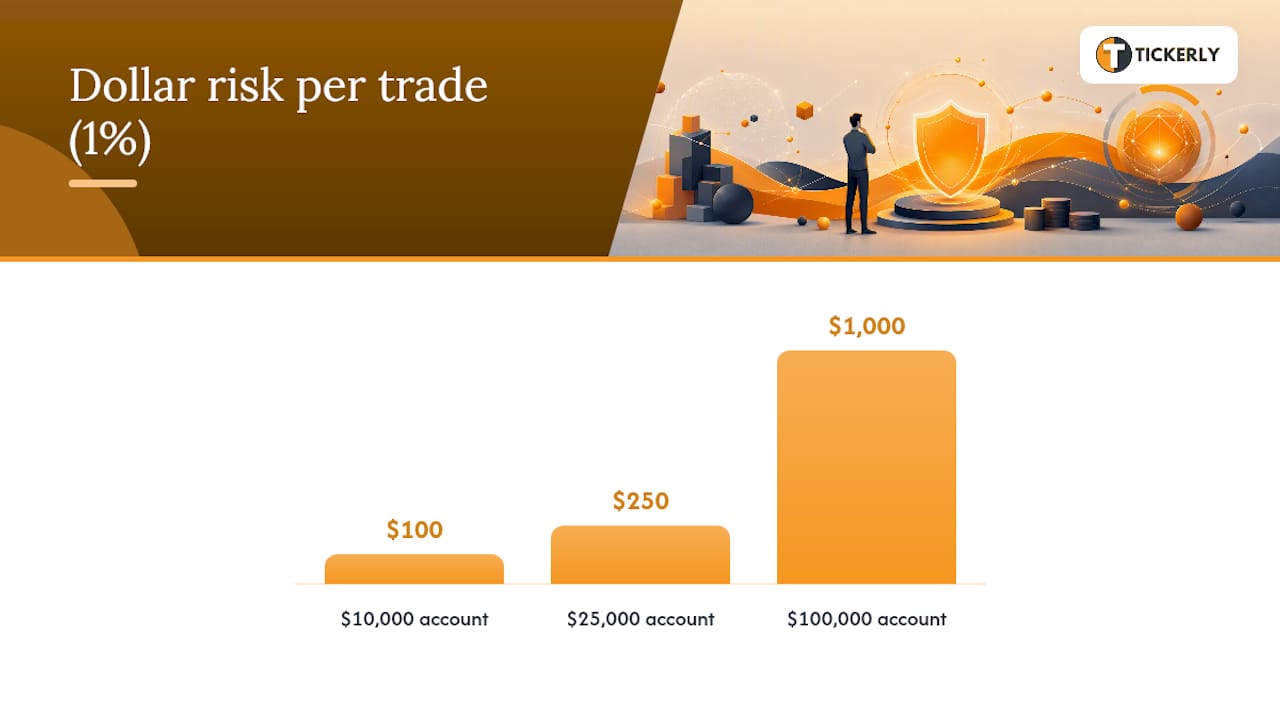
To convert dollar risk to share size: divide your dollar risk by the distance from entry to stop in dollars per share. A $250 risk with a $0.50 stop distance means 500 shares maximum.
Reduced-size triggers (add these to your desk card):
- Two consecutive losses: drop to 0.5% risk per trade for the remainder of the session.
- High-impact news within 30 minutes: cut size by 50%.
- Emotional state check scores 6 or above: reduce to minimum size or skip.
How do you build a watchlist and trading plan that keep you on strategy?
A watchlist without a trading plan attached to it is just a list of tickers. The most effective day trading strategies — momentum, breakout, range, and news-based — all require pre-defined entry triggers, stop logic, and time-of-day rules before the session starts.
Daily watchlist filters:
- Liquidity: Average daily volume above 1 million shares (equities) or equivalent for futures and forex pairs.
- Volatility: Average True Range (ATR) large enough to produce at least 2R of movement from your typical stop distance.
- Catalyst: A news event, earnings release, sector rotation, or technical breakout in progress.
Watchlist template (copy into your journal or spreadsheet):
| Symbol | Catalyst | Key Level Long | Key Level Short | Setup Type | Notes |
|---|---|---|---|---|---|
| AAPL | Earnings beat | $250 | $250 | ORB | Gap up; watch for fill |
| SPY | CPI data | $480.00 | $479.20 | Trend fade | High-impact news 8:30 AM |
Per-setup trading plan checklist:
For each setup type you trade, your plan must answer:
- What is the entry trigger? (e.g., 15-minute ORB breakout with volume confirmation)
- Where does the stop go? (e.g., below the breakout candle’s low)
- What is the first target? (e.g., 1.5R or the next key level, whichever is closer)
- What time of day is this setup valid? (e.g., ORB only valid 9:45–10:30 AM ET)
Limit yourself to 1–2 setup families per session. Switching between momentum, range, and news setups within a single session multiplies cognitive load and confirmation bias. Pick your two strongest setups and trade only those.
What mental checks should you run before every trade?
Psychological state is a variable in every trade, whether you account for it or not. A two-question pre-trade mental check takes under 10 seconds and prevents the most common emotional entries.
Pre-trade mental check:
- Question 1: Rate your focus from 1–10. If you score 5 or below, reduce position size by 50% or skip the trade.
- Question 2: Is there an external stressor present right now (personal news, a prior loss you’re still processing, fatigue)? If yes, reduce to minimum size.
Timed session check-ins:
- Every 30–60 minutes, pause and re-run the two questions.
- If your score rises to 7 or above (anxious, frustrated, revenge-trading impulse), execute the reset protocol: step away from the screen for 10 minutes, do a brief breathing exercise (4 counts in, hold 4, out 4), and return only when you can state your current plan without looking at your notes.
Do-not-trade conditions (add to your desk card):
- You’ve hit your daily max loss.
- You’ve taken three consecutive losses.
- Your focus score is 4 or below.
- You feel a strong urge to “make back” a loss immediately.
Pro Tip: Before entering any trade, say out loud: “My entry is [price], my stop is [price], my target is [price], and my risk is [dollar amount].” This verbal rehearsal activates deliberate thinking and short-circuits the impulsive pattern-matching that causes most emotional entries.
When should you automate parts of your session checklist?
Automation handles repetitive, rules-based tasks faster and more reliably than manual execution. The right question is not whether to automate, but which checklist items are safe to automate and which require your judgment.
Suitable for automation:
- Price alerts at pre-marked levels (set once, fire automatically)
- Position-size calculations (a simple spreadsheet formula or a bot parameter)
- Order execution for mechanical entry signals (e.g., a TradingView Pine Script alert triggers a limit order via API)
- Stop-loss and take-profit placement at entry
Keep manual:
- Final discretionary entry decision (is this setup actually clean right now?)
- Daily limit resets and override decisions
- Post-session review and lesson writing
Safe testing protocol before going live:
Per Nasdaq’s guidance on automation, staged rollouts are the standard for responsible automation. The sequence is: backtest the strategy on historical data, paper-trade it for a minimum of 20–30 sessions, then run it live at minimum size for another 20 sessions before scaling. At each stage, monitor execution quality (fill price vs. expected price), drawdown, and alert latency.
Automation safety checklist:
- Kill switch configured (a single button or API call that cancels all open orders and stops the bot)
- Maximum daily automation loss set (separate from your manual daily limit)
- Redundant internet connection active (mobile hotspot as backup)
- Alert logging enabled so every fired alert is timestamped and stored
- Rate limits checked for your exchange API (exceeding them causes missed fills)
For traders using TradingView strategies, connecting Pine Script alerts to an execution layer via API is the most practical automation path. The risk management framework for trading bots covers how to set guardrails that keep automation within your session checklist’s risk parameters.
Pro Tip: Log every automation failure — missed alerts, rejected API calls, unexpected fills — in a separate error log. Review it weekly. Most automation problems are systematic and repeat; catching them early prevents compounding errors across sessions.
What’s your backup plan when technology fails mid-session?
Technology failures happen at the worst possible moments: during a fast-moving open, mid-trade, or right before a major news release. A written contingency plan, prepared before the session, is the only thing that prevents a technical failure from becoming a financial one.
Hardware failure protocol:
- Keep a second device (laptop or tablet) logged into your broker’s web platform and ready. Do not rely on a single machine.
- Know your broker’s direct phone number for order entry. Most U.S. brokers (TD Ameritrade/Schwab, Interactive Brokers, Tastytrade) offer phone-based order entry as a backup. Save that number in your phone before every session.
- If your primary machine fails mid-trade, call your broker immediately to flatten the position or confirm your stop is active.
Internet connection failure:
- A 4G/5G mobile hotspot is the standard backup for home traders. Test it monthly to confirm it connects to your broker platform without issues.
- If you lose connectivity with an open position, your stop-loss order (placed at entry, as a standing order at the broker) is your safety net. This is why stop orders must be placed at the broker level, not just as a mental note.
Platform or broker outage:
- Monitor your broker’s status page (most publish real-time system status). Bookmark it.
- If the platform is down and you have an open position, call the broker’s trade desk. Document the call time and the representative’s name.
- For automated strategies, confirm your execution platform has a redundant exchange connection so a single API endpoint failure does not halt all order routing.
Software failure checklist (add to your pre-close routine):
- Confirm all open orders are visible in the broker’s order management system, not just your charting platform.
- Verify that stop-loss orders are live at the broker level.
- Check that your automation platform’s API connection is active and authenticated.
Key Takeaways
A structured day trading session checklist — covering pre-market preparation, disciplined entries, mechanical position management, and a 10-minute post-session review — is the most reliable way to convert a trading strategy into consistent daily execution.
| Point | Details |
|---|---|
| Pre-market is non-negotiable | A 7–10 minute pre-market routine covering the calendar, key levels, and daily limits reduces reactive trading. |
| Risk rules must be mechanical | Cap per-trade risk at 1% of equity and stop trading when cumulative daily loss hits 2–3% of account. |
| Post-session review compounds gains | Grade each trade on adherence (1–5), write one lesson, and update win rate and average R within 60 minutes of the close. |
| Automate only what is proven | Run any automated checklist item through backtesting and 20–30 paper-trade sessions before live deployment. |
| Tickerly for execution automation | Tickerly converts TradingView Pine Script alerts into live bot orders, handling mechanical entries while you retain discretionary oversight. |
Why most traders ignore the checklist that would save them
The conventional wisdom says discipline is a personality trait — you either have it or you don’t. That framing is wrong, and it’s why so many traders keep repeating the same mistakes. Discipline at the trading desk is a system design problem, not a character problem.
A checklist works because it removes the moment-to-moment decision of whether to follow your rules. When the pre-market routine is a fixed sequence you run every morning at the same time, you stop spending cognitive energy deciding whether to check the calendar or mark levels. The habit runs automatically, and your mental resources stay available for actual trading decisions.
The traders who struggle with consistency usually have a perfectly good strategy and a perfectly good understanding of risk. What they lack is a repeatable process that runs the same way regardless of how they feel that morning. Starting small matters more than starting perfectly. A five-item checklist you run every day beats a 30-item checklist you abandon after two weeks. Build the minimum viable routine first, then add items as each one becomes automatic.
The post-session review is the most skipped step and the most valuable one. Grading your trades by rule-following rather than P&L is the specific habit that separates traders who improve from those who plateau. A losing day with a 5/5 adherence score tells you your process is intact. A winning day with a 2/5 score tells you your edge is fragile.
Tickerly turns your TradingView alerts into live bot execution
The mechanical parts of your session checklist — entry execution, stop placement, position sizing — are exactly where manual trading introduces the most error. Slow fills, hesitation at the trigger, and fat-finger sizing mistakes are execution problems, not strategy problems.
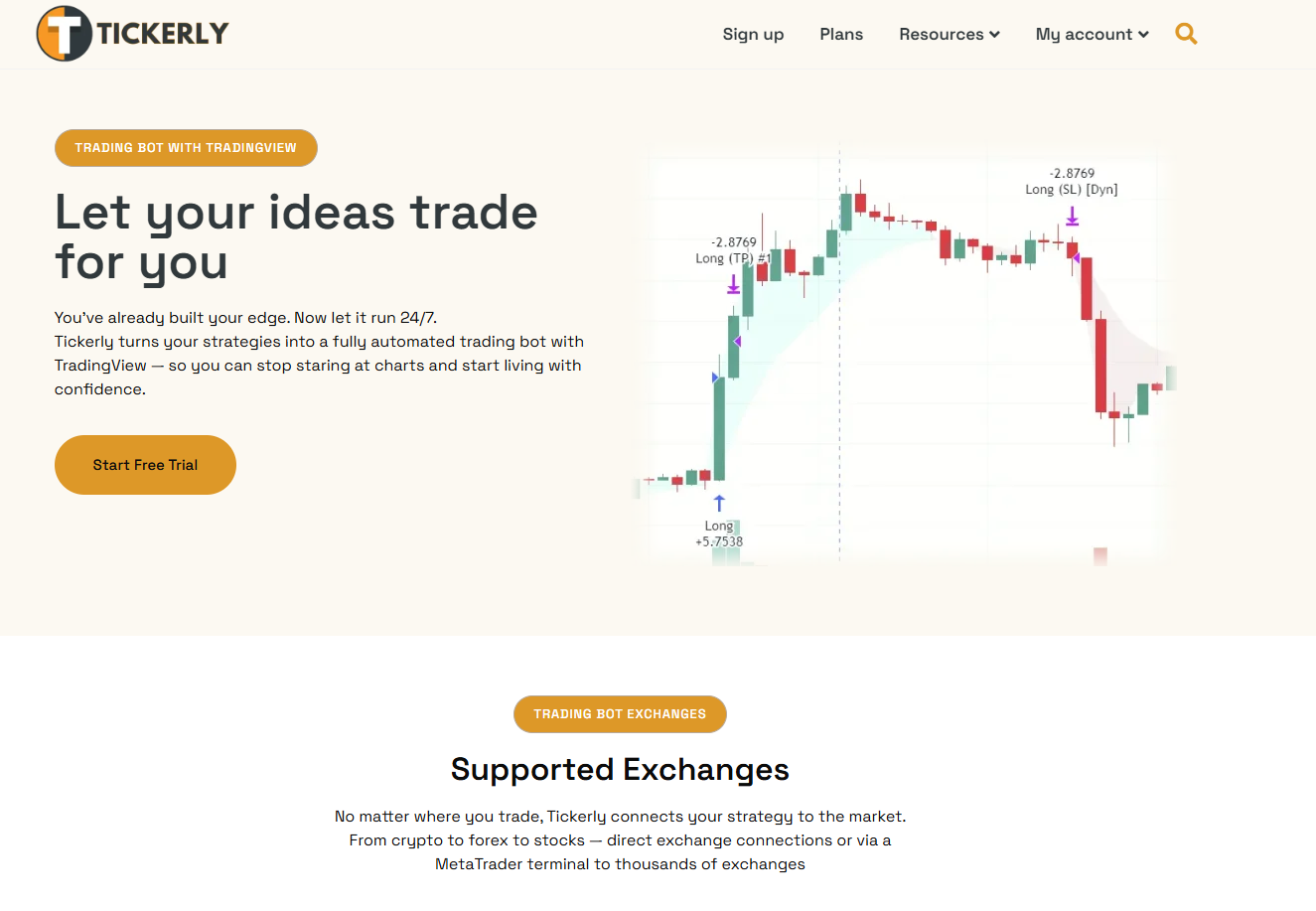
Tickerly converts your TradingView Pine Script strategy alerts into fully functional trading bots that execute on your connected exchange or broker in real time, with ultra-low latency. You keep discretionary control over your watchlist, your daily limits, and your post-session review. Tickerly handles the mechanical execution layer: firing orders the instant your alert triggers, applying your pre-set position size, and placing stops automatically. It supports crypto, forex, stocks, and futures across multiple exchanges simultaneously, so traders running more than one setup family can manage both without switching platforms.
The right starting point is a 30-day free trial — no commitment, and you can paper-trade your first automated strategy before going live. If you’re evaluating which automation approach fits your setup, the complete bot guide for 2026 walks through the key decision points. Start with one strategy, monitor execution quality for 20 sessions, then scale.
Useful sources & references
- Day trading — Investopedia
- Trading Routine 2026: Pre-Market to Post-Session Framework
- Pre-Market Trading Routine: The 10-Minute Checklist
- Day Trading Checklist: 5 Checks Before Every Trade (Free PDF)
- Pre-Market Routine for Traders (Build One That Sticks) | TradingPlan
- Top 9 Successful Day Trading Strategies for Better Results
- Day trading strategies for stocks and options — Nasdaq
- Market analysis — Coursera
FAQ
What is the 3-5-7 rule in day trading?
The 3-5-7 rule is a risk-management guideline where you risk no more than 3% of your account on any single trade, keep total open risk across all positions below 5%, and aim for winning trades to return at least 7% — ensuring your winners outpace your losers structurally. Definitions vary across educators, so confirm which version your trading plan uses before applying it.
Can you realistically make $1,000 a day with day trading?
It depends entirely on account size and risk parameters. A trader risking 1% per trade on a $100,000 account with a $1,000 risk limit can reach $1,000 profit on a 2R winning trade, but that requires both a large account and a high-probability setup. Consistent daily targets of that size are achievable for well-capitalized, experienced traders — not a realistic starting benchmark for most.
Is it true that 97% of day traders lose money?
High failure rates among retail day traders are widely documented, though the exact figure varies by study and market. The consistent finding is that the majority of retail day traders underperform over time, primarily due to poor risk management, overtrading, and lack of a structured routine — which is exactly what a session checklist addresses.
Is $10,000 enough to start day trading?
$10,000 is workable for futures and forex day trading, where margin requirements are lower. For U.S. equity day trading, the SEC’s pattern day trader rule requires a minimum of $25,000 in a margin account to make more than three day trades per week. Starting with $10,000 in equities limits you to three round-trip trades per rolling five-day period.