

TL;DR:
- The strategy automation process transforms manual trading rules into self-executing systems that react automatically to market signals. Successful automation relies on clean data, thorough documentation, and continuous monitoring to prevent errors and data drift. Connecting strategies from platforms like TradingView to live exchanges with tools like Tickerly enables fast, reliable, and scalable automated trading.
The strategy automation process is a systematic method for converting manual trading rules into self-executing systems that act on market signals without human intervention. Early adopters of automated strategy management report revenue increases up to 86% and productivity gains of 45%. Those numbers reflect a fundamental shift in how serious traders compete. When your system executes trades in milliseconds while you sleep, you stop reacting to markets and start anticipating them. This guide walks you through the prerequisites, implementation steps, and pitfalls of building a trading strategy automation process that actually holds up under real market conditions.
What does the strategy automation process require to get started?
The foundation of any successful automation effort is clean, reliable data. Automated data integration eliminates manual delays and creates a unified, real-time environment where your trading signals, position data, and market feeds all update together. Without that foundation, your bot acts on stale or conflicting information, which is worse than acting manually.

Before you write a single line of code or configure any platform, you need a single source of truth (SSOT). A siloed data setup causes version control chaos and conflicting signals across your systems. Data silos in automation are one of the most common causes of failed automation projects. Your SSOT should centralize price feeds, portfolio state, and execution logs in one place that every component of your system reads from.
Your infrastructure checklist before starting:
-
A live or paper trading account connected via API to your chosen exchange
-
A strategy platform that supports backtesting and real-time signal generation (TradingView with Pine Script is the gold standard for retail traders)
-
An automation layer that receives alerts and routes orders to your exchange
-
Role-based access controls so your system only touches what it needs to
-
A logging mechanism that records every alert, order attempt, and execution result
Pro Tip: Document your manual trading process completely before automating it. Map every decision point, condition, and exception. If you cannot describe your strategy in writing, you cannot automate it reliably.
What are the key steps to build your trading strategy automation?
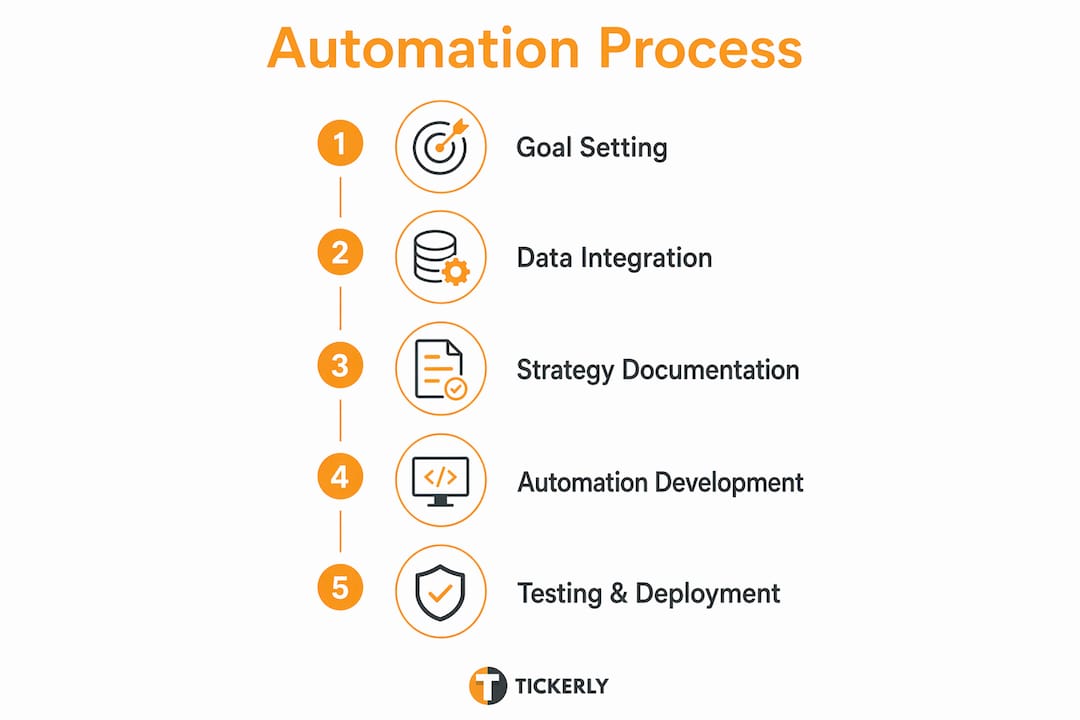
A structured rollout separates traders who succeed at automation from those who burn capital on broken bots. The process follows six distinct phases, and skipping any one of them creates compounding problems later.
-
Define your goals and success metrics. Decide what you want automation to achieve: faster execution, 24/7 coverage, emotion-free entries, or all three. Set measurable targets like maximum acceptable latency or minimum win rate before you build anything.
-
Document and refine your manual strategy. Automating a broken process simply executes its flaws at machine speed. Backtest your strategy manually first. Identify edge cases, slippage conditions, and market states where your rules break down.
-
Identify automation candidates using process discovery. Not every part of your workflow needs automation. Focus on repetitive, rule-based tasks: entry signals, stop-loss adjustments, position sizing, and exit triggers. Higher-frequency decisions with clear logic are the best candidates.
-
Prioritize by impact and complexity. Quick-win processes score high on impact and low on technical complexity. Start with your most frequently triggered, best-performing signal. Build confidence before adding complexity.
-
Design your architecture and governance framework. Map the full signal flow: strategy fires an alert, the alert reaches your automation layer, the layer sends an order to the exchange, and the exchange confirms execution. Define what happens at each failure point.
-
Run a focused pilot, then scale. Automate one strategy end-to-end on a small position size. Measure execution speed, fill quality, and error rates. Only scale after the pilot proves stable across at least several weeks of live trading.
| Phase | Primary focus | Complexity | Key learning outcome |
|---|---|---|---|
| Goal setting | Metrics and scope | Low | Clear success criteria defined |
| Process documentation | Manual workflow mapping | Low | Edge cases and exceptions identified |
| Candidate selection | Rule-based task identification | Medium | Automation scope narrowed |
| Prioritization | Impact vs. complexity scoring | Medium | Quick wins identified first |
| Architecture design | Signal flow and governance | High | Failure points mapped |
| Pilot and scale | Live testing and iteration | High | Real-world performance validated |
How does automation build strategic agility and what pitfalls should you avoid?
Strategic agility is the ability to detect a market shift and act on it before it becomes a loss. Automation transforms reactive problem-solving into proactive decision-making through continuous monitoring and AI-powered analytics. A well-built system flags anomalies in real time rather than surfacing them in your next portfolio review. That speed advantage compounds over hundreds of trades.
Approximately 80% of core strategy tasks in trading are susceptible to AI automation or augmentation. That figure tells you automation is not a niche tool. It is becoming the baseline for competitive trading. The traders who treat automation as a living system rather than a one-time setup will consistently outperform those who set it and forget it.
Automation also sharpens human judgment by handling routine execution tasks, freeing you to focus on higher-level decisions like strategy selection, risk allocation, and market regime identification. Your edge as a trader shifts from execution speed to strategic thinking.
Common pitfalls and maintenance best practices:
-
Automating a flawed strategy. Fix your strategy’s logic before automating it. Automation amplifies both strengths and weaknesses.
-
Ignoring data drift. Market microstructure changes over time. A signal that worked in 2024 may degrade by mid-2026 without retraining or recalibration.
-
Skipping error handling. API timeouts, exchange downtime, and partial fills all happen. Your system needs defined responses for each scenario.
-
No alerting on failures. Silent failures are the most dangerous. Build notifications for missed executions, rejected orders, and connectivity drops.
-
Over-automating too fast. Running too many strategies simultaneously before validating each one creates overlapping exposures you cannot monitor effectively.
Pro Tip: Build a governance layer into your automation from day one. Set position limits, daily loss caps, and kill switches that halt all activity if predefined thresholds are breached. Human judgment must always have an override path.
Which platform features matter most for trading strategy automation?
The right platform does not just execute your signals. It connects your strategy layer to your exchange with minimal latency while giving you visibility into every step of the process. Successful strategy automation requires integration of business intelligence, automation, and governance to avoid becoming a liability. For traders, that translates to three categories of tooling working together.
Workflow automation platforms handle the signal routing between your strategy and your exchange. Look for webhook support, conditional logic, and multi-step execution chains. The platform should process incoming alerts in under one second to avoid slippage on fast-moving instruments.
AI-powered analytics layers monitor your strategy’s live performance and flag deviations from expected behavior. Predictive analytics can identify when a strategy is entering a drawdown phase before it becomes critical. This is the component that turns your automation from reactive to proactive.
Data integration and governance tools maintain your SSOT and enforce access controls. They also handle the logging and audit trail you need to diagnose problems after the fact. Without this layer, debugging a failed trade becomes a manual forensic exercise.
| Feature category | What to look for | Why it matters for traders |
|---|---|---|
| Signal reception | Webhook support, sub-second processing | Reduces slippage on time-sensitive entries |
| Exchange connectivity | Multi-exchange API support, order type coverage | Enables diversification across markets |
| No-code configuration | Visual alert builders, drag-and-drop logic | Lowers barrier for non-developer traders |
| Monitoring and alerting | Real-time dashboards, failure notifications | Catches silent errors before they compound |
| Governance controls | Position limits, kill switches, audit logs | Protects capital during system failures |
Automated trading platforms that combine these three layers give you the best chance of running a stable, scalable system. Platforms that handle only one layer force you to stitch together multiple tools, which introduces its own failure points. For traders connecting TradingView strategies to live exchanges, the priority is finding a platform that handles the full signal-to-execution chain natively.
Key Takeaways
The strategy automation process succeeds when you build on clean data, document your logic before automating it, and treat the system as a living process that requires ongoing monitoring and governance.
| Point | Details |
|---|---|
| Start with clean data | Build a single source of truth before connecting any automation layer to your exchange. |
| Document before automating | Map every decision point in your manual strategy to prevent flawed logic from running at machine speed. |
| Prioritize quick wins first | Automate your highest-impact, lowest-complexity signal first to build confidence before scaling. |
| Build governance from day one | Set position limits, loss caps, and kill switches before your bot goes live. |
| Treat automation as ongoing | Monitor for data drift, API changes, and silent failures continuously, not just at launch. |
Why I think most traders automate in the wrong order
Working with traders across crypto, forex, and equities, I keep seeing the same mistake. They find a platform, connect their exchange, and start routing signals before they have fully documented what their strategy actually does. The automation works technically. Then it loses money in ways the trader did not expect, because the strategy had undocumented exceptions that the human brain handled intuitively but the bot cannot.
The uncomfortable truth about strategy execution automation is that it forces you to be explicit about everything. Markets reward vagueness in manual trading because your intuition fills the gaps. Automation has no intuition. Every gap becomes a bug.
My strongest recommendation is to run your strategy manually for at least two weeks while writing down every decision you make and why. That document becomes your automation specification. When you build from that spec, your bot behaves the way you expect because it reflects how you actually trade, not how you think you trade.
The future of this field points toward AI-driven proactive monitoring, where your system does not just execute signals but flags when market conditions have shifted enough to suspend a strategy entirely. That capability is arriving fast. But it only works if the underlying automation is built correctly in the first place. Get the foundation right, and the advanced features become genuinely powerful. Skip it, and you are just automating your losses faster.— Jay
Tickerly and your trading strategy automation
Traders who have built their strategy logic in TradingView can connect it directly to live exchanges through Tickerly, without writing custom execution code. Tickerly converts your Pine Script alerts into fully functional trading bots that execute in real time, across crypto, forex, and stock markets.
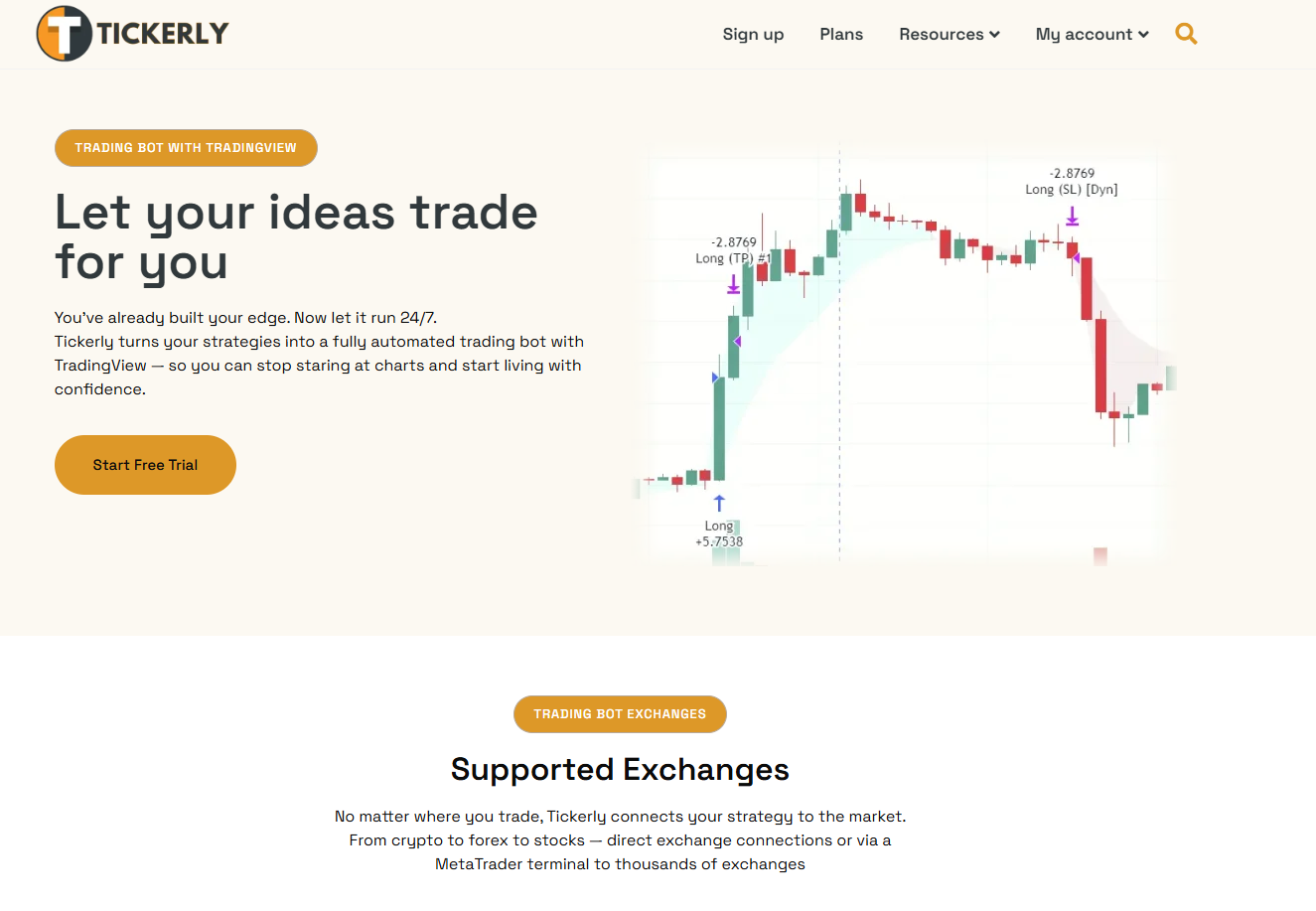
Tickerly’s execution speed is built for markets where milliseconds determine fill quality. Its real-time alert system processes incoming TradingView signals and routes orders to your exchange with minimal latency. You can run multiple strategies simultaneously, which means your automation covers different instruments and timeframes without manual switching. For traders ready to move from manual execution to a fully automated workflow, getting started with Tickerly is the direct path from strategy to live bot.
FAQ
What is the strategy automation process in trading?
The strategy automation process converts manual trading rules into self-executing systems that respond to market signals without human input. It covers everything from signal generation and alert routing to order execution and performance monitoring.
How do I know if my trading strategy is ready to automate?
Your strategy is ready to automate when you can document every entry, exit, and position-sizing rule without relying on intuition. If you cannot write it down completely, refine the manual process first before building any automation.
What is the biggest risk in trading strategy automation?
The biggest risk is automating a flawed or undocumented strategy, which causes the system to execute bad logic at high speed. Silent failures from API errors or data drift are the second most common cause of unexpected losses in automated systems.
How does Tickerly fit into the strategy automation process?
Tickerly connects TradingView strategies to live exchanges by converting Pine Script alerts into real-time bot executions. It handles the signal-to-execution chain natively, covering automated trading on TradingView without requiring custom code from the trader.
How often should I review my automated trading strategy?
Review your automated strategy at minimum once per month, and immediately after any significant market regime change. Ongoing monitoring for data drift and error rates prevents silent degradation from compounding into major drawdowns.