

TL;DR:
Copy trading automatically replicates experienced traders’ positions in real time, proportional to your capital.
It requires active risk management and careful provider selection to avoid significant losses and maximize profitability.
Copy trading is defined as an investment method where your brokerage account automatically replicates the trades of an experienced trader in real time, proportional to your allocated capital. The practice removes the need to analyze charts or time entries yourself. Instead, you link your account to a signal provider, and every position they open, modify, or close mirrors instantly in your account. For traders who want professional-grade execution without years of market study, copy trading offers a direct path. Understanding what is copy trading, how it works mechanically, and where it fails is the foundation of using it without destroying your capital.
How does copy trading work in practice?
Copy trading links your account to a signal provider, executing trades automatically and proportionally to your allocated capital in real time. If a lead trader opens a 2% position in Bitcoin and you have allocated $5,000 to copy them, your account opens a $100 Bitcoin position at the same moment. The entire process runs through an automated connection between your account and the provider’s account on the same platform.
The mechanics go beyond simple mirroring. Platforms replicate three types of actions:
-
Open positions: When the lead trader enters a trade, your account enters the same trade at the proportional size.
-
Modify positions: If the lead trader adjusts a stop-loss or take-profit level, your account updates automatically.
-
Close positions: When the lead trader exits, your position closes at the next available price.
Most platforms also give you control tools. A Copy Stop-Loss (CSL) lets you set a maximum loss threshold at the copy level, not the individual trade level. A pause copying feature lets you freeze new trades without closing existing ones. These controls matter because you are not just a passive observer. You are managing a live account.
Pro Tip: Start with a small allocation, such as 5–10% of your total trading capital, when copying a new provider. This limits your exposure while you evaluate their real-time behavior over several weeks.

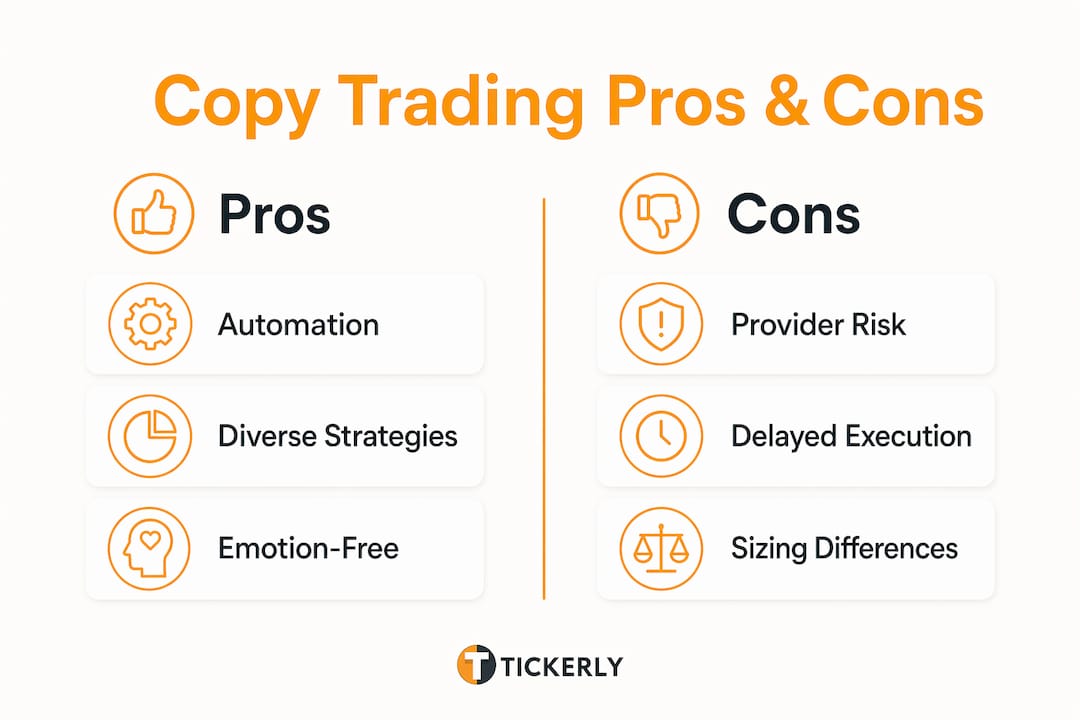
The proportional sizing system also means account size differences create real discrepancies. A lead trader with a $100,000 account opening a $500 trade translates to a $25 trade in your $5,000 account. That math works cleanly in theory, but execution slippage and minor delays mean your fill price will rarely be identical to the lead trader’s fill price. The gap is usually small, but it compounds over hundreds of trades.
Is copy trading profitable? What the data actually shows
Only about 48% of copy traders achieve short-term profitability, and fewer than 33% sustain profits beyond six months. That statistic reframes the entire premise of copy trading as passive income. The majority of participants lose money, and the ones who survive long-term do so through active risk management, not by picking the right trader once and walking away.
“Success in copy trading is linked to rigorous risk management rather than merely following top performers.” — Multi-exchange profitability study
The profitability gap between short-term and long-term results points to a specific problem: provider selection based on recent performance. A trader who returned 40% last quarter may be running a martingale strategy, doubling position sizes after each loss to recover quickly. The win rate looks impressive until a losing streak wipes out months of gains in a single session.
Win rate is the most misleading metric in copy trading evaluation. Traders with win rates above 57% regularly lose money because their losing trades are disproportionately large compared to their winners. Maximum drawdown is a far more reliable indicator of a provider’s actual risk profile. A provider with a 45% win rate and a maximum drawdown of 12% is safer than one with a 70% win rate and a 40% drawdown history.
To evaluate trading results properly, you need to look at risk-adjusted returns over at least three to six months, not just headline profit figures. Platforms typically display equity curves, drawdown charts, and trade history. Use all three before allocating capital.
| Metric | What it tells you | Why it matters |
|---|---|---|
| Win rate | Percentage of profitable trades | Misleading without loss size context |
| Maximum drawdown | Largest peak-to-trough loss | Indicates worst-case risk exposure |
| Risk-to-reward ratio | Average win size vs. average loss size | Reveals true profitability structure |
| Months active | Length of verified track record | Filters out short-term luck |
What are the risks and limitations of copy trading?
Copy trading does not eliminate market risk. It transfers decision-making risk to the signal provider, which means a single bad decision by your lead trader hits your account immediately. This is a fundamentally different risk profile than traditional trading, where your losses come from your own analysis errors.
The most dangerous provider behaviors to watch for include:
-
Martingale strategies: The provider doubles position size after each loss. Win rates appear high until a multi-trade losing streak causes catastrophic account damage that followers cannot recover from.
-
Over-leverage: Some providers use 10x to 20x leverage on volatile assets. A 5% adverse move wipes 50–100% of the allocated capital.
-
Inconsistent risk sizing: Providers who vary position sizes dramatically between trades create unpredictable drawdown patterns for followers.
-
Low liquidity assets: Trades in thinly traded markets cause severe slippage for followers, since the lead trader’s order moves the price before yours fills.
Account size differences compound these risks. Differences in account size and minor delays cause non-identical trade performance for copy traders, making built-in protective features like Copy Stop-Loss critical for smaller accounts. A lead trader with a large account can absorb a 15% drawdown as a normal fluctuation. Your smaller account may hit a margin call at the same drawdown level.
Pro Tip: Set a Copy Stop-Loss at 20–25% of your allocated copy trading capital. This gives the lead trader room to operate while protecting you from catastrophic losses if their strategy breaks down.
The passive income misconception is the root cause of most copy trading losses. Treating copy trading as a set-and-forget system is the equivalent of hiring a fund manager and never reviewing their quarterly reports. Active monitoring and auditing of lead traders’ performance is necessary to avoid reckless copying.
How can you use copy trading effectively as part of your strategy?
Copy trading works best as a hybrid tool that teaches professional position sizing and stop-loss management while you maintain personal control of account safety. The traders who profit long-term treat it as one component of a broader strategy, not the entire strategy.
Follow these steps to build a copy trading approach that holds up over time:
-
Screen providers by drawdown first. Filter for a maximum drawdown below 20% over at least six months. This eliminates the majority of high-risk providers before you review any other metric.
-
Check the risk-to-reward profile. A provider whose average win is smaller than their average loss will eventually lose money regardless of win rate. Look for a ratio of at least 1:1.5 in favor of wins.
-
Diversify across three to five providers. Concentrating all copy capital in one provider creates single-point-of-failure risk. Spreading across providers with different asset classes and time frames reduces correlation.
-
Allocate small capital per provider. Limit each provider to no more than 10–15% of your total trading capital. This keeps any single provider’s bad month from damaging your overall portfolio.
-
Set a Copy Stop-Loss for every provider. Never copy a trader without a defined maximum loss threshold at the copy level.
-
Review performance monthly. Check equity curves, drawdown changes, and trade frequency. A provider who suddenly increases trade frequency or position size may be changing their strategy.
-
Use copy trading as an education tool. Study the trades your providers make. Observe their entry timing, position sizing, and exit discipline. This builds your own trading skills over time.
Integrating copy trading with personal research and automated bots improves overall effectiveness. Copy trading handles the human expertise side. Automated bots handle rule-based execution without emotional interference. Together, they cover more market conditions than either approach alone.
Combining copy trading with a multi-strategy approach also reduces the risk of any single market regime destroying your portfolio. When a trend-following provider underperforms in a ranging market, a mean-reversion bot or a different copy provider can offset those losses.
Key Takeaways
Copy trading is profitable for fewer than half of participants short-term and fewer than one-third long-term, making active risk management and provider selection the defining factors of success.
| Point | Details |
|---|---|
| Core definition | Copy trading automatically mirrors a lead trader’s positions in your account, proportional to your capital. |
| Profitability reality | Fewer than 33% of copy traders sustain profits beyond six months without active risk management. |
| Win rate is misleading | Evaluate maximum drawdown and risk-to-reward ratio, not win rate alone. |
| Copy Stop-Loss is critical | Set a copy-level stop-loss to protect your account from a lead trader’s catastrophic drawdown. |
| Treat it as a hybrid tool | Combine copy trading with personal research and automated strategies for the best long-term results. |
My honest take on copy trading after years of watching traders use it
Copy trading is one of the most misunderstood tools in retail trading. The marketing around it leans hard on the idea of passive income, and that framing causes real financial damage. The traders I have seen use it successfully treat it the way a professional treats a subcontractor. You hire someone with a specific skill, you monitor their work, and you fire them when the quality drops.
The biggest mistake I see repeatedly is copying a provider based on a 30-day or 60-day return. Short track records in favorable market conditions tell you almost nothing about how a provider handles drawdowns, volatility spikes, or regime changes. A provider who returned 80% in a bull run may have never been tested in a sharp correction. You find that out the hard way if you copy them without checking their full history.
The psychological benefit of copy trading is real and underrated. It removes the emotional decision-making that causes most retail traders to buy high and sell low. But that benefit disappears the moment you start manually overriding copied trades because you are nervous. If you cannot trust the provider enough to let the system run, you have chosen the wrong provider, not the wrong method.
Copy trading also has genuine educational value that most traders ignore. Watching how a skilled provider sizes positions relative to account equity, places stop-losses, and manages open trades teaches you more than most trading courses. Use it actively as a learning tool, not just a profit mechanism.
The traders who combine copy trading with their own automated trading strategies consistently outperform those who rely on copy trading alone. The combination gives you professional expertise on one side and rule-based, emotion-free execution on the other.— Jay
How Tickerly fits into your copy trading strategy
Copy trading handles the human expertise side of your portfolio. Tickerly handles the automation side, and the two work well together.
Tickerly converts your TradingView strategies into fully functional trading bots that execute in real time across crypto, forex, and stock exchanges. While your copy trading providers manage their positions, Tickerly’s bots run your personal rule-based strategies simultaneously, without emotional interference or manual execution delays. You can run multiple strategies at once, which means your portfolio stays active even when your copy providers are sitting out of the market. Traders who want to go deeper into automated bot trading will find Tickerly’s execution speed and exchange integrations built for exactly this kind of multi-strategy setup. The automated trading FAQ is a solid starting point if you have questions about how automation fits alongside copy trading.
FAQ
What is copy trading in simple terms?
Copy trading is a method where your account automatically replicates the trades of an experienced trader in real time, proportional to the capital you allocate to them.
How does copy trading work technically?
Your account connects to a signal provider via an API link on a trading platform. Every trade the provider opens, modifies, or closes executes in your account at a proportional size based on your allocated capital.
Is copy trading profitable for most investors?
Only about 48% of copy traders achieve short-term profitability, and fewer than 33% sustain profits beyond six months. Success depends on provider selection and active risk management.
What is the biggest risk in copy trading?
The biggest risk is provider-driven strategy failure, particularly from martingale tactics or over-leverage, which can cause rapid, large losses in your account before you can react.
What is a Copy Stop-Loss and why does it matter?
A Copy Stop-Loss is a copy-level risk tool that closes all copied trades and stops copying when your allocated capital drops by a set percentage, protecting smaller accounts from a lead trader’s full drawdown.