

TL;DR:
- Trading logs record both objective trade data and psychological insights, leading to measurable performance improvements. Consistent review and honest reflection help traders reduce losses, increase win rates, and recognize patterns faster. Using a simple, real-time log fosters better habits and strategic growth, especially when automated tools minimize manual effort.
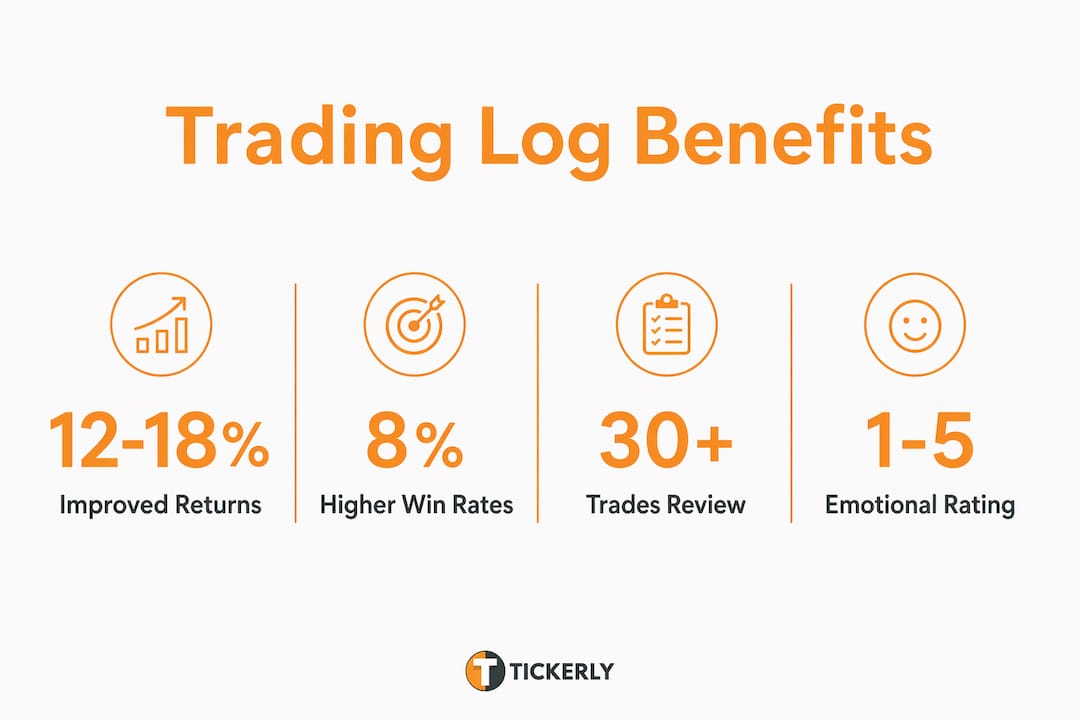
A trading log is a structured record of every trade you make, capturing both objective execution data and the psychological context behind each decision. Traders who understand why use trading logs gain a measurable edge: systematic trade review improves risk-adjusted returns by 12%–18% over one year. The standard industry term for a comprehensive version of this practice is a trading journal, which goes beyond raw data to include emotional state, rationale, and self-reflection. Whether you call it a log or a journal, the core principle is the same: you cannot fix what you cannot see.
What benefits do trading logs provide to traders?
Trading logs deliver measurable performance gains that no amount of screen time alone can replicate. The trading log advantages are backed by hard data, not theory.
Here is what the research shows:
-
Reduced drawdowns. Traders with structured emotion logs reduce maximum drawdowns by 23% in a single quarter. Drawdown reduction is the fastest path to capital preservation, which is the foundation of long-term profitability.
-
Higher win rates. Consistent logging leads to 8 percentage point higher win rates compared to partial logging, based on a TradesViz analysis of 500,000+ trades. Eight percentage points is the difference between a marginal strategy and a profitable one.
-
Faster pattern recognition. Trading psychologist Brett Steenbarger notes that patterns visible within weeks of journaling would otherwise take a year to notice unaided. Speed of feedback is a genuine competitive advantage.
-
Reduced hindsight bias. Externalizing your decisions in writing forces you to commit to a rationale before you know the outcome. That single habit dismantles the mental trick where every losing trade “obviously” looked bad in retrospect.
The psychological benefits are just as concrete as the financial ones. When you track your emotional state alongside entry and exit data, you create a feedback loop that connects your mental condition to your P&L. That connection is invisible without a log. With one, it becomes the most actionable data point you have.
Fewer than 15% of retail traders maintain consistent trade logs despite their recognized importance. That gap is your opportunity. The traders who do log consistently are pulling ahead of the 85% who rely on memory and instinct alone.

How do trading logs differ from trading journals?
The distinction matters more than most traders realize. Mechanical logs record what happened; trading journals capture why trades were made and the lessons learned. One is a spreadsheet. The other is a performance system.
| Feature | Trade log | Trading journal |
|---|---|---|
| Entry and exit prices | Yes | Yes |
| Position size and P&L | Yes | Yes |
| Emotional state at entry | No | Yes |
| Trade rationale | No | Yes |
| Rule adherence score | No | Yes |
| Post-trade reflection | No | Yes |
| Behavioral pattern analysis | No | Yes |
A trade log alone rarely improves performance. It tells you that you lost $400 on a EUR/USD short. It does not tell you that you entered 20 minutes after a news release because you were chasing a move you had already missed. That context is the difference between data and insight.
TradeZella expert guidance confirms that trading logs must connect quantitative broker data with qualitative emotional and rule adherence input to drive real improvement. The quantitative side is easy. Most brokers export it automatically. The qualitative side requires discipline and honesty, which is exactly why most traders skip it.
Pro Tip: Add a single “emotional state” field rated 1–5 to every trade entry. After 30 trades, filter by emotional state and compare your average P&L. The correlation will tell you more about your edge than any indicator.
The traders who treat their journal as a mirror rather than a ledger are the ones who compound their learning fastest. The importance of trading logs is not in the data itself. It is in the honest conversation you have with yourself about why you traded the way you did.
What are the best practices for using trading logs effectively?
Consistency beats complexity every time. The most common reason traders abandon their logs is that they built a 25-field system on day one and burned out by week two. Start with the minimum viable log and add fields only when you have a specific question you need to answer.
-
Start with seven fields. A simple 7-field log is the recommended starting point before adding complexity. Those fields are: date, instrument, direction, entry price, exit price, position size, and one sentence of rationale. That is enough to build the habit.
-
Log in real time, not at end of day. Memory degrades fast. Your emotional state at 2:00 PM on a volatile trading day is not what you will remember at 9:00 PM. Log your rationale and emotional state within five minutes of entry.
-
Review weekly after 30+ trades. Weekly reviews after 30 trades reveal performance insights that daily reviews miss. You need enough data for patterns to emerge before you draw conclusions.
-
Make one concrete adjustment per review. Reviewing data weekly and making a single concrete adjustment is more impactful than logging alone. Do not try to fix five things at once. Fix one, trade for two weeks, then review again.
-
Use automation to reduce friction. Tools that sync directly with your broker or exchange remove the manual data entry barrier. When logging is automatic for the objective fields, you can focus your energy on the qualitative entries that actually drive growth.
-
Start during demo trading. Starting journaling during demo trading builds the neural pathways for consistency before you risk real capital. By the time you go live, logging feels automatic rather than effortful.
Pro Tip: Set a calendar reminder for the same time every Sunday to review your log. Treat it like a mandatory pre-market session. Traders who schedule their reviews are far more likely to act on what they find.
The biggest pitfall in trading log best practices is delayed logging. A trade you log three days later is a story you told yourself, not a record of what actually happened. Timeliness is not a nice-to-have. It is the entire point.
How can trading logs drive strategic improvements?
The real payoff from logging comes when you move from recording trades to acting on patterns. Raw data sitting in a spreadsheet does not improve your P&L. The analysis does.
Here are the most impactful ways to translate log data into strategy changes:
-
Identify revenge trading triggers. Psychological and contextual information recorded in journals prevents revenge trading and other common pitfalls. Filter your log for trades taken within 30 minutes of a losing trade. If your win rate on those entries is significantly lower, you have found a rule worth adding to your system.
-
Track process adherence, not just P&L. Process adherence scores are a more reliable growth metric than focusing purely on profit and loss. A trade that followed your rules perfectly but lost money is a good trade. A trade that broke your rules and made money is a dangerous one. Your log should reflect that distinction.
-
Correlate emotional state with outcomes. After 50+ trades, sort your log by emotional state rating. Most traders discover that their worst entries cluster around specific emotional conditions, such as overconfidence after a winning streak or anxiety during high-volatility sessions.
-
Analyze performance by session and instrument. You may be profitable in crypto but consistently losing in forex. You may perform well in the morning session and give it all back in the afternoon. Your log reveals this. Your memory does not.
The table below shows how specific log fields connect to the strategic adjustments they enable:
| Log field | Pattern it reveals | Strategic adjustment |
|---|---|---|
| Emotional state at entry | Emotional trading clusters | Add a pre-trade checklist |
| Time of entry | Session-based performance gaps | Restrict trading hours |
| Rule adherence score | Frequency of rule-breaking | Tighten entry criteria |
| Trade rationale | Impulsive vs. planned entries | Require written setup before entry |
| P&L by instrument | Asset-specific edge or weakness | Focus on or eliminate instruments |
You can also evaluate trading results more systematically once your log contains 30 or more trades. Before that threshold, sample size is too small to distinguish skill from noise. Patience with the data collection phase pays off in the quality of insights you extract.
Key takeaways
Trading logs improve performance only when they capture both objective trade data and honest psychological context, reviewed consistently on a fixed schedule.
| Point | Details |
|---|---|
| Logs beat memory | Consistent logging produces 8 percentage point higher win rates than partial logging, per TradesViz analysis. |
| Journals outperform logs | Adding emotional state, rationale, and rule adherence turns a log into a performance system. |
| Start simple | A 7-field log builds the habit; add complexity only when you have a specific question to answer. |
| Review drives results | Weekly reviews after 30+ trades, paired with one concrete adjustment, create compounding improvement. |
| Process score matters | Tracking rule adherence is a more reliable growth metric than P&L alone. |
The gap between knowing and doing is where most traders lose
The theory of trading logs is not controversial. Every serious trader agrees that recording and reviewing trades improves performance. The practice is where things fall apart.
What I have observed is that most traders treat their log as a confession booth rather than a coaching tool. They log when things go wrong and skip it when things go right. That selective recording destroys the data integrity you need for honest pattern analysis. A log that only captures your bad days tells you nothing useful about what your good days have in common.
The shift happening in 2026 is real and worth paying attention to. Automation and AI tools are lowering the friction of logging to the point where the “I don’t have time” excuse is disappearing. When your broker data syncs automatically and your journal prompts you for emotional state at entry, the only remaining barrier is honesty. That is a personal choice, not a technical one.
The traders I respect most treat their journal the way institutional desks treat their trade review meetings: mandatory, structured, and focused on process rather than outcome. Retail traders who adopt that mindset close the information gap between themselves and professional trading operations. Your log is the one tool that levels that playing field, and it costs nothing but consistency.— Jay
How Tickerly fits into your trading log workflow
Logging trades manually while managing multiple positions across crypto, forex, and stocks creates friction that erodes consistency. Tickerly automates your TradingView strategies into fully functional trading bots, which means your execution data is captured systematically every time a signal fires.
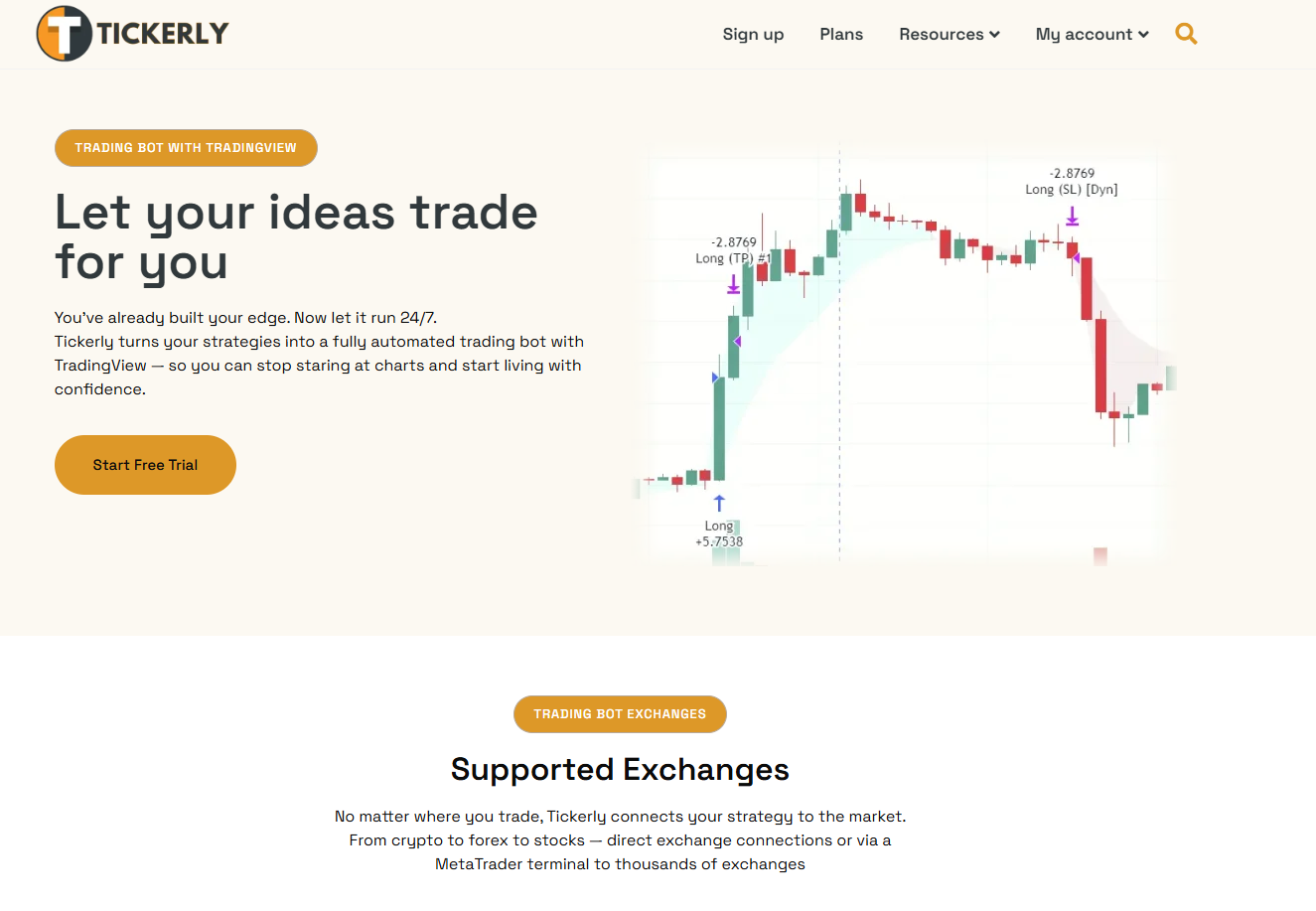
When your entries and exits are executed by a bot, the objective fields in your log populate without manual effort. That frees you to focus entirely on the qualitative side: rationale, emotional state, and rule adherence. Traders using automated trading bots report fewer impulsive entries and cleaner data for post-trade review. Tickerly connects to major exchanges with low latency, so your log reflects actual execution rather than intended execution. That accuracy is the foundation of any analysis worth acting on. Explore how trading journal automation can make your logging habit sustainable at scale.
FAQ
What is the difference between a trade log and a trading journal?
A trade log records objective data like entry price, exit price, and position size. A trading journal adds emotional state, trade rationale, and rule adherence, which are the fields that drive actual performance improvement.
How many trades do I need before reviewing my log?
Weekly reviews become meaningful after 30 or more trades. Below that threshold, sample size is too small to distinguish genuine patterns from random variance.
Does keeping a trading journal actually improve results?
Yes. Systematic trade review improves risk-adjusted returns by 12%–18% over one year, and consistent loggers show 8 percentage point higher win rates than partial loggers, based on TradesViz data.
What fields should a beginner include in a trading log?
Start with seven fields: date, instrument, direction, entry price, exit price, position size, and a one-sentence rationale. Add emotional state and rule adherence once the habit is established.
When should I start keeping a trading journal?
Start during demo trading. Building the logging habit before risking real capital means the practice is automatic by the time your money is on the line.