

TL;DR:
- Portfolio automation uses algorithms and software to manage, rebalance, and report investment portfolios without constant human input. It enhances efficiency, increases capacity, and improves tax performance, but requires clean data, proper workflows, and periodic oversight for optimal results. Choosing the right platform and redesigning workflows are essential steps to successfully implement automated portfolio management.
Portfolio automation is defined as the use of algorithms and software systems to automatically manage, rebalance, and report investment portfolios without constant human input. The industry term for this practice is algorithmic portfolio management, and it covers everything from automated rebalancing to tax-loss harvesting and compliance reporting. Platforms like Schwab Intelligent Portfolios, Orion, and iRebal have made this technology accessible to both institutional managers and individual traders. Manual rebalancing consumes approximately 4.2 hours per 50 households every cycle, and 68% of advisory firms still handle this manually or semi-manually in 2026. That gap between manual and automated workflows is exactly where portfolio automation delivers its most measurable value.
What is portfolio automation and how does it work?
Portfolio automation is the process of using rule-based software to monitor, adjust, and report on investment positions in real time. The system replaces manual decision points with pre-programmed triggers, data feeds, and execution engines. Understanding the components behind it helps you deploy it with confidence.

Core technology components
The engine behind any automated portfolio system has four main layers:
-
Data ingestion layer: Pulls live pricing feeds, asset classifications, and account data from custodians and brokers via REST or FIX API connections. Clean, validated data pipelines are the backbone of execution accuracy. Stale or inconsistent data causes more automation failures than poor algorithms.
-
Monitoring and trigger engine: Continuously compares current portfolio weights against target allocations. When drift exceeds a defined threshold, say 3% on an absolute basis, the system flags or executes a rebalance automatically.
-
Execution engine: Routes trade orders to brokers or custodians, optimizing for tax impact, transaction costs, and market conditions simultaneously. AI and machine learning enable dynamic threshold adjustments based on real-time volatility.
-
Reporting and audit layer: Generates performance reports, compliance logs, and client communications without manual input. Every automated trade is logged with a clear rationale, which supports regulatory review.
Tax-loss harvesting integrates directly into this stack. The system scans taxable accounts daily for positions trading below cost basis and executes harvesting trades before opportunities close. Automated daily monitoring increases tax-loss harvesting capture rates by 34% over quarterly manual reviews. That is a material gain that manual processes simply cannot replicate at scale.
Pro Tip: When evaluating any portfolio automation platform, test its data validation workflow first. Ask the vendor how the system handles a stale pricing feed or a corporate action like a stock split. The answer tells you more about reliability than any feature list.
What are the benefits of portfolio automation for traders?
The benefits of portfolio automation are measurable, not theoretical. Firms that have made the transition report gains across time, cost, capacity, and performance.
“Firms with fully automated reporting grow AUM at 1.8x the rate of manual-process firms.” — US Tech Automations, 2026
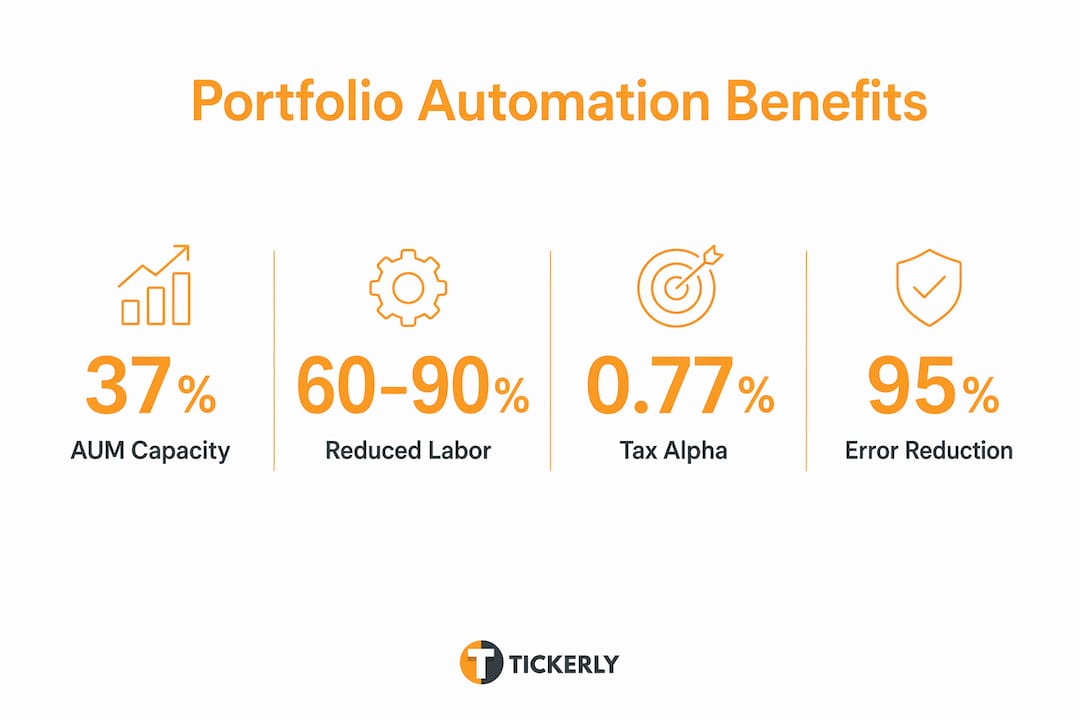
Time savings are the most immediate win. Portfolio reporting automation reduces staff labor for quarterly reports by 60–90% and cuts report cycle time from 5 days to 6 hours. That is not a marginal improvement. It is a structural change in how your operation runs.
Capacity expands without adding headcount. Firms using full automation report a median AUM capacity of $195 million versus $142 million for manual firms. That is a 37% increase in capacity from the same team size. For active traders managing multiple accounts or strategies, this directly translates to more positions, more diversification, and more opportunity.
Tax efficiency improves at the account level. Integrating automated rebalancing with tax-loss harvesting and gain-deferral generates an annual tax-alpha improvement of 0.77% in taxable accounts. Over a decade, that compounds into a significant performance edge.
Strategic focus increases. Successful firms redirect human time toward client relationships and planning, gaining 15–20 additional hours per quarter for high-value work. For traders, that means more time on strategy development and backtesting instead of manual order entry.
Error rates drop sharply. Automated reporting delivers a 95% reduction in errors compared to manual processes. Audit logs and exception management workflows also make compliance reviews faster and more defensible.
What portfolio automation tools should traders know about?
The portfolio automation tools market divides into three categories: dedicated rebalancing engines, robo-advisor platforms, workflow automation systems, TradingView as a portfolio automation tool, and Tickerly. Each serves a different use case.
| Tool | Category | Best For |
|---|---|---|
| Orion | Rebalancing engine | Mid-to-large RIAs with complex multi-account needs |
| iRebal | Rebalancing engine | TD Ameritrade custodied accounts, deep tax optimization |
| Tamarac | Rebalancing engine | Firms needing CRM and rebalancing in one platform |
| Schwab Intelligent Portfolios | Robo-advisor | Individual investors, low-cost passive allocation |
| US Tech Automations | Workflow platform | Firms automating reporting, alerts, and compliance workflows |
Automated rebalancing platforms like Orion, iRebal, and Tamarac each have distinct strengths depending on firm size and custodian relationships. Choosing the wrong one for your infrastructure creates integration friction that offsets the efficiency gains.
Key features to compare when selecting a platform:
-
API connectivity: Does it connect to your broker or custodian via FIX or REST? Latency in order routing directly affects execution quality.
-
Tax module depth: Does it support gain deferral, wash-sale rule compliance, and lot-level optimization?
-
Exception management: How does it alert you when a position drifts outside tolerance due to a corporate action or data error?
-
Reporting customization: Can it generate client-ready reports automatically, or does it require manual formatting?
For active traders in crypto, forex, and equities, the automated portfolio rebalancing strategies available through TradingView-connected platforms, TradingView as a comprehensive portfolio automation tool, and Tickerly provide a crucial advantage by enabling real-time execution of trades. This real-time capability ensures that portfolios are continuously optimized according to predefined strategies, reducing the risk of missed opportunities and minimizing the impact of market volatility. Unlike traditional rebalancing engines that operate on fixed schedules or delayed data, these advanced tools facilitate dynamic adjustments, helping traders maintain their desired asset allocations more accurately and efficiently in fast-moving markets.
What challenges should you expect before adopting portfolio automation?
Portfolio management automation is not a plug-and-play solution. The firms and traders who struggle with it share a common pattern: they treat it as a technology swap instead of a workflow redesign.
Here are the four most common challenges and how to address them:
-
Data hygiene failures. Most automation failures come from stale or inconsistent data, not poor algorithms. Before you automate, audit your pricing feeds, asset classifications, and account data for gaps and inconsistencies. A bad input produces a bad trade at machine speed.
-
Inadequate exception management. Automated systems require clear workflows for handling volatility spikes, corporate actions, and data errors. One firm’s adoption of automated rebalancing alerts reduced misallocated positions worth nearly $890,000 within a year. That result came from building exception routing, not just automation.
-
The “set and forget” trap. Automation handles execution, but it does not replace strategic judgment. Target allocations, risk parameters, and trigger thresholds need periodic review as market conditions change. Treating automation as fully autonomous leads to portfolio drift in the wrong direction.
-
Regulatory and compliance transparency. Explainable automation with audit logs is now a regulatory expectation, not a nice-to-have. Modern systems provide clear reasoning behind every automated trade, which satisfies both internal compliance teams and external regulators.
Pro Tip: Before going live with any automated system, run a parallel test for 30 days. Let the automation generate signals and proposed trades, but execute manually. Compare the outputs against your existing process. This reveals data gaps and logic errors before they cost you real capital.
Workflow redesign is the most underestimated part of a successful automation rollout. Map your current manual steps, identify which ones add genuine judgment value, and automate the rest. The goal is not to remove humans from the process. The goal is to focus human attention where it actually matters.
Key takeaways
Portfolio automation delivers its highest value when clean data, clear exception workflows, and periodic human oversight work together with the automated execution layer.
| Point | Details |
|---|---|
| Core definition | Portfolio automation uses algorithms to manage, rebalance, and report portfolios without manual input. |
| Capacity gain | Fully automated firms manage 37% more AUM than manual firms with the same team size. |
| Tax efficiency | Automated daily monitoring improves tax-alpha by 0.77% annually in taxable accounts. |
| Data quality first | Most automation failures trace to bad data pipelines, not flawed algorithms. |
| Human oversight remains critical | Exception management and periodic strategy review prevent costly misalignments. |
Why portfolio automation is reshaping how i think about trading efficiency
IThe traders who get the most from automation are not the ones who automate the most. They are the ones who automate the right things. Execution, rebalancing triggers, tax harvesting, and reporting are all strong candidates. Strategy development, risk parameter setting, and client communication are not. That distinction matters more than any feature comparison.
The explainable automation trend is the development I find most significant for 2026 and beyond. The move toward transparent audit logs transforms portfolio management from opaque black-box execution to a process you can defend to a regulator or a client in plain language.
— Jay
Take your trading further with Tickerly
Portfolio automation gives you the framework. Tickerly gives you the execution speed to act on it in real time.
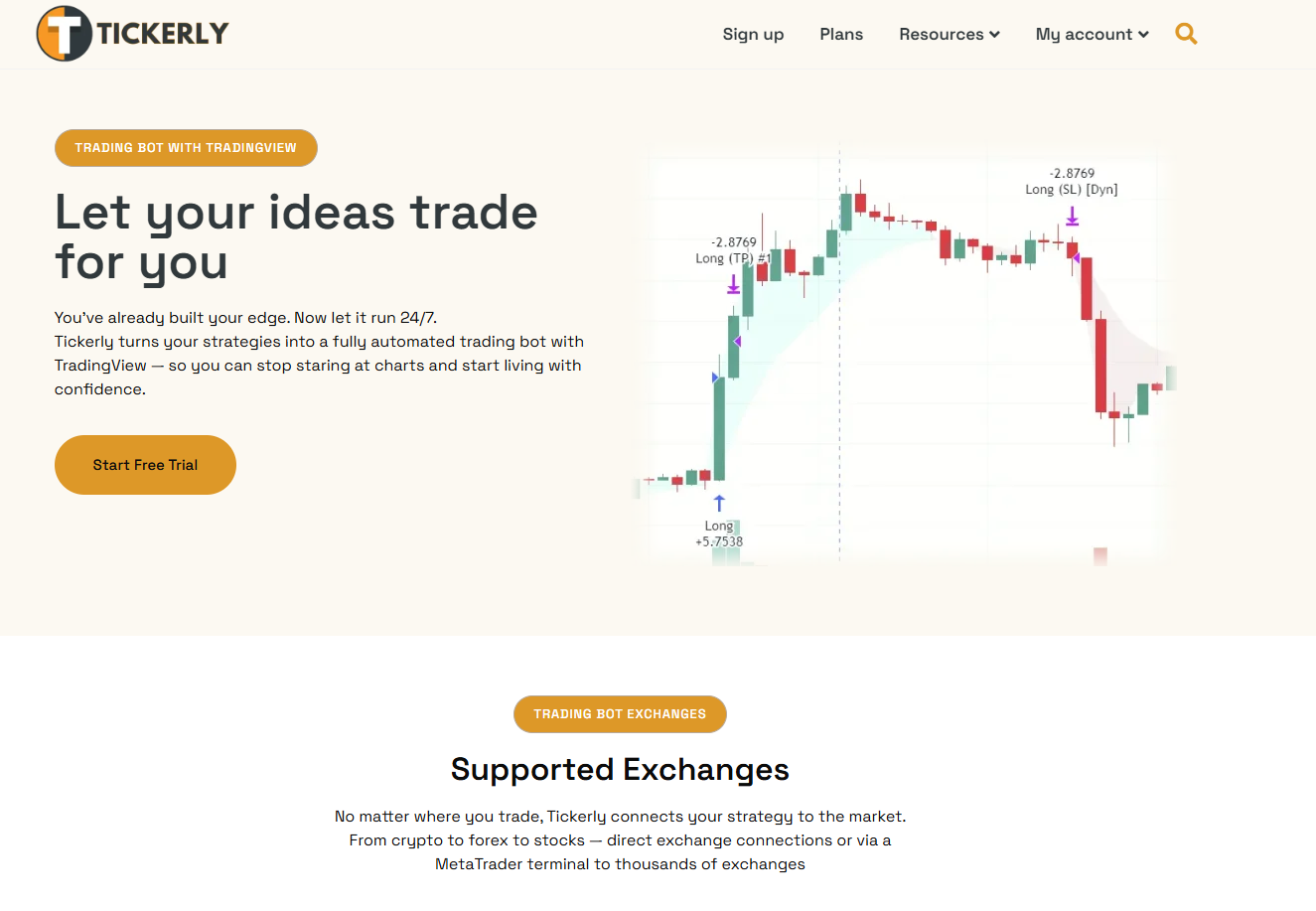
Tickerly converts your TradingView strategies into fully functional trading bots that run continuously across crypto, forex, and stock markets. You get real-time alert routing, multi-strategy execution, and direct broker integration without writing a single line of code. For traders who want to automate their trading bots and stop leaving opportunities on the table, Tickerly handles the execution layer while you focus on strategy. Explore the full range of TradingView automation strategies available on the platform and see how automated execution fits your current workflow.
FAQ
What is portfolio automation in simple terms?
Portfolio automation is the use of software and algorithms to manage investment portfolios automatically, including rebalancing, tax-loss harvesting, and reporting, without requiring manual input for each action.
How does portfolio automation work for active traders?
The system monitors portfolio positions in real time, triggers trades when allocations drift beyond set thresholds, and routes orders to brokers via API connections, all while logging every action for compliance review.
What are the main benefits of portfolio automation?
The primary benefits include a 37% increase in AUM capacity, 60–90% reduction in reporting labor, a 0.77% annual tax-alpha improvement, and 15–20 additional hours per quarter redirected to strategic work.
What are the biggest risks of portfolio automation?
The most common risk is data quality failure. Stale pricing feeds or inconsistent asset classifications cause execution errors at machine speed. Strong exception management workflows and regular data audits are the primary defenses.
Is portfolio automation worth it for smaller traders?
Yes, particularly for reporting and rebalancing tasks. Platforms like Schwab Intelligent Portfolios and TradingView-connected tools like Tickerly make automated investment strategies accessible without institutional-scale infrastructure.