

TL;DR:
- Arbitrage trading involves buying and selling the same asset simultaneously across different markets to profit from price discrepancies. Speed, fee management, and risk controls are crucial for consistent profitability, especially in fast-moving markets like crypto and forex. Automated trading bots significantly enhance arbitrage effectiveness by executing trades rapidly and efficiently.
Arbitrage trading is defined as the simultaneous purchase and sale of the same asset across different markets to profit from temporary price discrepancies. Known formally as price arbitrage, this strategy exploits the law of one price, which holds that identical assets should trade at the same price across all markets. When they don’t, a window opens. Traders who move fast enough capture the spread before the market corrects itself. This guide covers how arbitrage works, the main strategy types, the real risks involved, and how it plays out across stocks, forex, and crypto markets.
What is arbitrage trading and how does it work?
Arbitrage trading works by identifying a price gap for the same asset on two or more markets, buying at the lower price, and selling at the higher price at the same time. The profit is the spread between the two prices, minus transaction costs. The core mechanic sounds simple. The execution is where most traders struggle.

Price gaps exist because markets are not perfectly connected. Information travels at different speeds, liquidity varies by exchange, and order flow is fragmented. These inefficiencies create short-lived arbitrage opportunities that close within milliseconds once other traders or algorithms spot them.
Speed and execution are the defining factors in arbitrage profitability. In crypto and forex markets, price gaps can vanish in under a second. A trader relying on manual order entry will almost always miss the window. This is why professional arbitrageurs use automated systems with low-latency connections to multiple exchanges.
Fees are the silent profit killer. Every transaction carries a cost: trading commissions, withdrawal fees, and in crypto, gas fees for on-chain transactions. A spread that looks profitable on paper can turn negative once all costs are accounted for. Transaction and financing costs are the primary reason beginners fail at arbitrage. You must calculate the full cost stack before placing a single order.
Here is what a basic arbitrage workflow looks like:
-
Identify the spread: Monitor the same asset across two or more exchanges simultaneously.
-
Confirm net profitability: Subtract all fees, commissions, and transfer costs from the gross spread.
-
Execute simultaneously: Place both the buy and sell orders at the same time to avoid exposure to price movement.
-
Monitor fill status: Confirm both legs of the trade complete. A partial fill creates unintended directional risk.
-
Transfer and repeat: Move funds between exchanges as needed and look for the next opportunity.
Pro Tip: Never calculate profitability based on the gross spread alone. Build a cost model that includes trading fees, withdrawal fees, and any currency conversion costs before you commit capital.
What are the main types of arbitrage trading strategies?
Arbitrage trading strategies fall into several distinct categories, each with its own mechanics, risk profile, and profit potential. Understanding the differences helps you choose the right approach for your capital, tools, and market access.
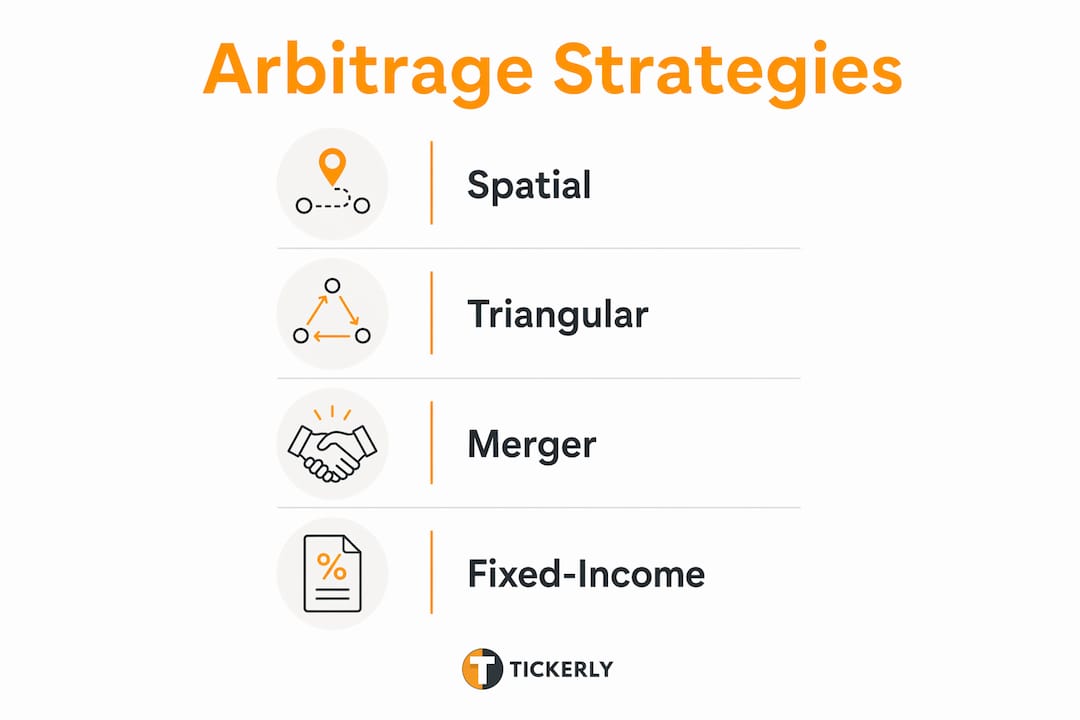
Spatial arbitrage
Spatial arbitrage is the most straightforward type. You buy an asset on one exchange where the price is lower and sell it on another where the price is higher. Bitcoin trading at $67,000 on Exchange A and $67,150 on Exchange B is a classic example. The $150 gross spread is your starting point. After fees, the net profit may be $30 to $80 depending on the platforms involved.
Triangular arbitrage
Triangular arbitrage involves three currency or asset pairs in a closed loop. In forex, a trader might convert USD to EUR, EUR to GBP, and GBP back to USD. If the exchange rates are slightly misaligned, the final USD amount exceeds the starting amount. In crypto, the same logic applies to token pairs on a single exchange. Triangular arbitrage in crypto yields 0.05%–0.15% per cycle and requires sub-200 millisecond execution to stay profitable after fees. That margin is thin, but at high volume and frequency, it compounds quickly.
Merger arbitrage
Merger arbitrage, also called risk arbitrage, targets the price gap between a company’s current stock price and its announced acquisition price. When Company A announces it will acquire Company B at $50 per share and Company B trades at $47, the $3 gap represents the potential profit. The risk is deal failure. If the merger falls through, the stock price drops sharply. This strategy is less “pure” than spatial or triangular arbitrage because it carries real directional risk.
Fixed-income arbitrage
Fixed-income arbitrage exploits pricing differences between related bond instruments, such as Treasury bonds and interest rate futures. Hedge funds like Long-Term Capital Management famously used this strategy at massive scale. The spreads are tiny, so the strategy requires significant leverage, which amplifies both gains and losses.
Here is a side-by-side comparison of the four main types:
| Strategy | Asset Class | Typical Spread | Risk Level | Speed Required |
|---|---|---|---|---|
| Spatial Arbitrage | Stocks, Crypto | 0.1%–0.5% | Low to Medium | High |
| Triangular Arbitrage | Forex, Crypto | 0.05%–0.15% | Low to Medium | Very High |
| Merger Arbitrage | Stocks | 1%–5% | Medium to High | Low to Medium |
| Fixed-Income Arbitrage | Bonds, Futures | 0.01%–0.1% | High (leveraged) | Medium |
What risks and challenges come with arbitrage trading?
Arbitrage is rarely truly risk-free. The label “risk-free profit” is a theoretical description, not a practical guarantee. Real-world arbitrage carries several risks that can turn a profitable setup into a loss.
-
Execution risk. Execution risk occurs when one leg of the trade fills but the other does not. You are now holding a directional position you did not intend to take. If the market moves against you, the loss can exceed the spread you were targeting. Professional systems use coordinated order execution and smart routing to minimize this risk.
-
Liquidity risk. Thin order books mean your order may not fill at the price you see. Slippage pushes your actual fill price away from the quoted price, shrinking or eliminating the spread. This is especially common in smaller crypto tokens and low-volume stock pairs.
-
Fee and cost risk. Fee structures in crypto require spreads of 0.15%–0.25% on centralized exchanges just to break even after trading and withdrawal costs. On-chain DEX transactions add gas fees that can make sub-0.5% spreads unprofitable entirely.
-
Convergence risk. Prices may not converge as expected. In merger arbitrage, a deal can collapse. In fixed-income arbitrage, spreads can widen before they narrow, triggering margin calls if you are leveraged.
-
Technology risk. API downtime, network latency spikes, and exchange outages can prevent order execution at the critical moment. A system that misses a fill by 50 milliseconds can turn a profitable trade into a loss.
Pro Tip: Before going live, test your execution system under real market conditions with small position sizes. Confirm that both legs of your trade fill within your target latency window before scaling up.
Institutional traders mitigate these risks through co-location services, redundant API connections, and capital reserves large enough to absorb occasional execution failures. Individual traders need to build equivalent safeguards at their scale.
Arbitrage in stocks, forex, and crypto: how do they compare?
Arbitrage trading looks different depending on the asset class. The spreads, speed requirements, fee structures, and tools vary significantly across stocks, forex, and cryptocurrencies.
| Market | Typical Spread | Execution Speed Needed | Key Fee Factors | Primary Strategy Type |
|---|---|---|---|---|
| Stocks | 0.1%–1% | Seconds to minutes | Brokerage commissions, SEC fees | Spatial, Merger |
| Forex | 0.01%–0.1% | Milliseconds to seconds | Spread, swap rates | Triangular, Spatial |
| Crypto | 0.05%–0.5% | Sub-200 milliseconds | Trading fees, gas fees, withdrawal | Triangular, Spatial |
Stocks offer the most accessible entry point for arbitrage beginners. Price gaps between NYSE and Nasdaq-listed securities or between ADRs and their underlying foreign shares are real and exploitable. The spreads are wider than in forex, and execution speed requirements are more forgiving. However, brokerage commissions and regulatory fees reduce net margins.
Forex is the most liquid market in the world, with over $7 trillion in daily volume. That liquidity means spreads are extremely tight. Triangular arbitrage in forex requires institutional-grade infrastructure to be consistently profitable. Retail traders can explore automated forex trading tools to compete, but the margins leave little room for error.
Crypto is where individual traders find the most accessible arbitrage opportunities today. Price differences between exchanges like Binance, Coinbase, and Kraken appear regularly due to fragmented liquidity and varying user bases. Triangular arbitrage within a single exchange is also common. The key constraint is fees. You need a minimum spread of 0.15%–0.25% on centralized exchanges to profit after all costs. For on-chain DEX arbitrage, gas fees raise that floor even higher.
Here are the practical tools and practices that matter most across all three markets:
-
Use automated trading exchanges that offer low-latency API access and co-location options.
-
Monitor multiple markets simultaneously with real-time price feeds, not delayed data.
-
Maintain pre-funded accounts on multiple exchanges to eliminate transfer delays.
-
Use backtesting to validate your spread thresholds and fee models before deploying capital.
-
Review your risk management approach for bot-driven strategies to avoid runaway losses from execution failures.
Crypto arbitrage also benefits from the 24/7 market structure. Unlike stocks or forex, crypto never closes. That means more opportunities per day, but also more overnight exposure if your system is not monitored continuously.
Key takeaways
Arbitrage trading is profitable only when execution speed, fee management, and risk controls are all working together at the same time.
| Point | Details |
|---|---|
| Core definition | Arbitrage means buying and selling the same asset across markets to capture price gaps. |
| Speed is critical | Crypto arbitrage requires sub-200 millisecond execution to stay profitable after fees. |
| Fees determine viability | Spreads below 0.15%–0.25% on centralized crypto exchanges rarely produce net profit. |
| Execution risk is the top threat | One unfilled leg exposes you to directional market risk you did not plan for. |
| Automation is necessary | Manual trading cannot compete with algorithmic systems in speed-sensitive arbitrage. |
Arbitrage trading is not passive: my honest assessment
The assumption is that arbitrage is essentially free money. The logic seems airtight: buy low here, sell high there, pocket the difference. The reality is more demanding than that framing suggests.
The traders who actually profit from arbitrage consistently are not smarter than everyone else. They are better prepared. They have pre-funded accounts on multiple exchanges, automated execution systems, and a clear cost model that accounts for every fee before a trade is placed. Arbitrageurs who maintain market efficiency are doing real work, and the market rewards that work with thin but consistent margins.
The biggest mistake I see from newer traders is treating the gross spread as the profit. It is not. The net spread after fees, slippage, and transfer costs is the only number that matters. I have seen traders run what looked like a 0.3% spread strategy, only to discover their actual net was negative after accounting for withdrawal fees they had not modeled.
My view on automation is straightforward: if you are serious about arbitrage in crypto or forex, a manual approach is not viable at scale. The profitability of automated strategies over the long term depends on consistent execution, and consistent execution requires bots. The human advantage in arbitrage is in system design and cost modeling, not in clicking buttons faster.
Arbitrage also plays a genuinely useful role in markets. By correcting mispricings, arbitrageurs push prices toward fair value. That benefits every participant in the market, not just the trader capturing the spread. That broader function is worth understanding, especially as regulators and exchanges pay more attention to high-frequency strategies.
— Jay
How automated bots make arbitrage trading more effective
Arbitrage trading demands speed that no manual trader can match consistently. Automated bots solve this problem directly.
Tickerly converts your TradingView strategies into fully functional trading bots that execute across multiple exchanges with minimal latency. For arbitrage traders, that execution speed is the difference between capturing a spread and watching it disappear. Tickerly connects to major crypto, forex, and stock exchanges through direct API integrations, so your bot is always positioned to act the moment an opportunity appears. If you want to understand why automated bots consistently outperform manual execution in speed-sensitive strategies, Tickerly’s platform is built exactly for that use case. You can also explore the full crypto trading bot guide to see how bot-driven arbitrage works in practice.
FAQ
What is arbitrage trading in simple terms?
Arbitrage trading means buying an asset at a lower price on one market and selling it at a higher price on another market at the same time. The profit is the price difference minus all transaction costs.
Is arbitrage trading profitable for individual traders?
Arbitrage trading can be profitable, but thin margins require low fees, fast execution, and automated systems. Most consistent arbitrage profit comes from institutional traders with low-latency infrastructure, though crypto markets offer more accessible opportunities for individual traders.
What is triangular arbitrage in crypto?
Triangular arbitrage in crypto involves trading three token pairs in a loop on a single exchange to exploit misaligned prices. It typically yields 0.05%–0.15% per cycle and requires execution speeds under 200 milliseconds to remain profitable after fees.
What are the biggest risks in arbitrage trading?
Execution risk is the leading threat, occurring when one leg of a trade fills but the other does not. Liquidity risk, fee overruns, and technology failures also erode margins in real-world arbitrage.
How does arbitrage benefit the overall market?
Arbitrageurs correct mispricings by buying underpriced assets and selling overpriced ones, pushing prices back toward equilibrium. This process improves market efficiency and benefits all participants, not just the traders capturing the spread.