

TL;DR:
- Adaptive trading is a dynamic approach where systems continuously update models and parameters based on real-time market data, reducing model obsolescence during regime shifts. It employs rolling evaluations, regime filters, and feedback-driven risk adjustments to maintain alignment with current conditions, outperforming static strategies that rely solely on historical data. Implementing adaptive trading requires robust infrastructure, risk controls, and regular evaluation, with tools like Tickerly facilitating automation and real-time adjustment.
Adaptive trading is defined as a continuously evolving approach where systems adjust their models, parameters, and behaviors in real time based on current market data rather than fixed historical rules. Unlike static strategies that lock in logic at build time, adaptive systems recalibrate as conditions shift. Platforms like Interactive Brokers have built this concept directly into their order routing infrastructure, while algorithmic frameworks like darwintIQ use genetic and ensemble methods to keep strategy selection aligned with the current market regime. If you run automated strategies and have watched a once-profitable system quietly decay, understanding adaptive trading is the most direct path to solving that problem.
What is adaptive trading and why does it matter?
Adaptive trading is the practice of continuously updating a trading system’s logic, parameters, or model selection in response to real-time market signals. The core distinction from traditional algorithmic trading is that adaptive systems do not assume the future will resemble the past. They treat market conditions as a moving target and adjust accordingly.

The practical implication is significant. A static strategy optimized on 2021 data may perform well during trending crypto bull markets but collapse during the sideways, low-volatility conditions of 2023. An adaptive system detects that regime shift and either adjusts its parameters or hands control to a model better suited to the new environment. This is not theoretical. Adaptive trading systems use rolling evaluation windows and regime filters to update model rankings continuously, matching strategy behavior to current conditions rather than historical ones.
The term “adaptive trading” is the widely used descriptive phrase, but within quantitative finance the concept is also referred to as dynamic strategy allocation or regime-aware trading. Both terms describe the same core mechanism: feedback loops that keep your system calibrated to what the market is doing right now.
How does adaptive trading work under the hood?
The mechanics of adaptive trading rest on four interconnected components: continuous model evaluation, parameter adjustment, regime filtering, and feedback-driven risk control.
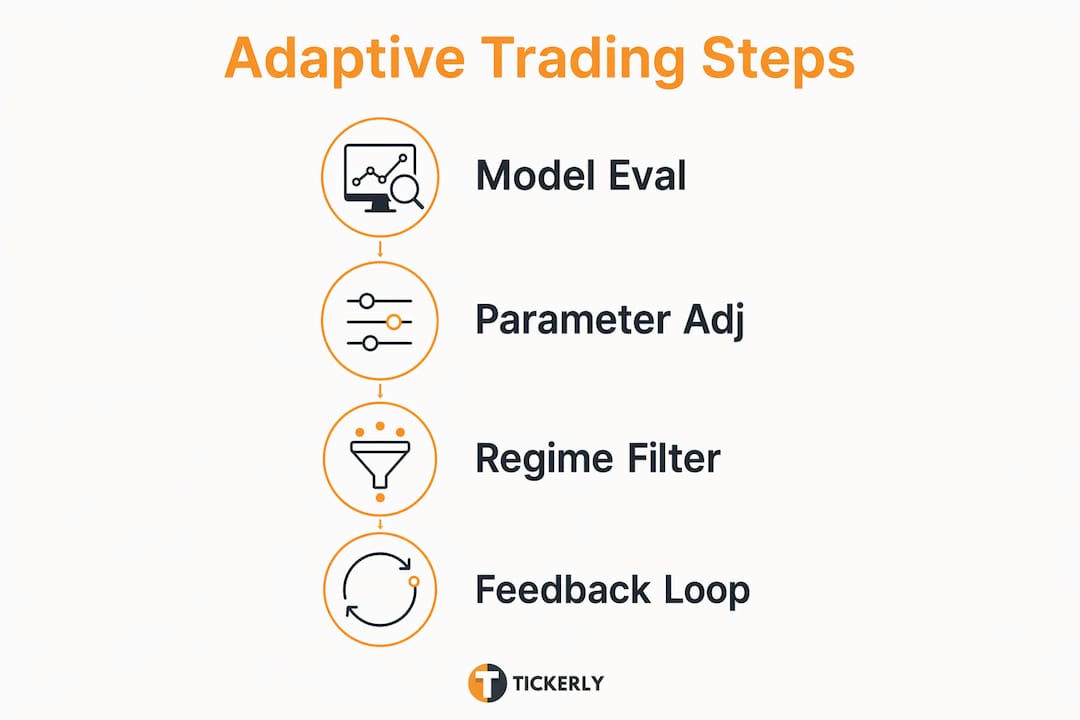
Continuous model evaluation
Adaptive systems do not run a single strategy indefinitely. They maintain a pool of candidate models and rank them based on recent performance. Rolling evaluation windows, such as a 4-hour lookback, score each model on metrics like Sharpe ratio, win rate, or drawdown. The highest-ranked model gets allocated capital. This process runs continuously, not just at the end of a trading day.
Parameter adjustment in real time
Beyond model selection, adaptive systems modify execution parameters on the fly. Order size, timing, price limits, venue selection, and participation rates all shift based on live inputs like liquidity depth, bid-ask spread width, and realized volatility. A system trading a thinly liquid altcoin at 3 AM adjusts its order size and timing differently than it would during peak New York session volume.
Regime filters and meta-layer logic
One of the more sophisticated elements is the regime filter, sometimes called veto logic. Even if a trend-following model ranks highly, a regime filter can block it from trading if current conditions are clearly range-bound. Regime filters prevent model-environment mismatch by requiring that market conditions match a model’s intended operating environment before it receives any capital allocation.
Many advanced systems go further by running an ensemble of behavior styles, such as trend, range, and volatility models, and dynamically shifting trust among them based on recent reward signals. This meta-layer sits above individual strategies and acts as the allocation brain.
Feedback loops and risk exposure
Adaptive systems also adjust position sizing and risk exposure dynamically. Metrics like Average True Range (ATR), realized volatility, and drawdown distance feed into scaling factors that shrink or grow your base position size. This means your system automatically reduces exposure during high-volatility periods without requiring manual intervention.
Pro Tip: When building your first adaptive system, start with a single feedback signal, such as ATR-based position sizing, before adding regime filters or model ensembles. Complexity added before you understand the base behavior creates debugging nightmares.
Adaptive trading vs. traditional static trading
The clearest way to understand adaptive trading is to compare it directly against the static approach most traders start with.
| Feature | Static trading | Adaptive trading |
|---|---|---|
| Strategy logic | Fixed at build time | Updates continuously using live data |
| Parameter adjustment | Manual or periodic | Automated, real-time |
| Regime awareness | None | Built-in via filters and model switching |
| Response to volatility shifts | Delayed or absent | Immediate via feedback loops |
| Risk of model obsolescence | High | Significantly reduced |
| Complexity to implement | Lower | Higher, requires data infrastructure |
| Typical performance in regime shifts | Degrades sharply | Maintains or improves relative performance |
Static strategies are optimized on historical data and assume that the patterns they learned will persist. This works until a structural break occurs, such as a central bank policy reversal, a new market participant class entering, or a liquidity regime change. At that point, static strategies often continue executing logic that no longer fits the environment.
Adaptive strategies address model obsolescence directly. A 2019 to 2022 study using recursive fixed-size window forecasting demonstrated that adaptive rolling mechanisms outperformed buy-and-hold strategies during both volatile bull and bear phases. That result matters because it shows adaptation adds value precisely when conditions are most hostile to static approaches.
The tradeoff is real, though. Adaptive systems require more data infrastructure, more rigorous backtesting, and a deeper understanding of algorithmic trading trends to implement correctly. They are not a plug-and-play upgrade over static strategies.
Real-world applications and examples of adaptive trading
Adaptive trading is not confined to hedge fund quant desks. It appears in retail broker platforms, open-source TradingView scripts, and institutional execution algorithms.
-
Interactive Brokers’ Adaptive Algo. This order type uses urgency settings labeled Urgent, Normal, and Patient to balance execution speed against price improvement. The urgency settings adjust scanning speed and fill quality tradeoffs by trading between bid and ask spreads rather than hitting the market immediately. A Patient setting prioritizes price improvement over speed, while Urgent prioritizes fill certainty. This is adaptive trading applied directly to order routing.
-
Adaptive position sizing protocols. Rather than trading a fixed lot size, adaptive position sizing applies scaling factors derived from ATR, realized volatility, and drawdown distance to your base size. Scaling factors adjust position size dynamically, preserving capital during high-volatility periods while allowing larger exposure when conditions are favorable. This is one of the most practical adaptive techniques any trader can implement immediately.
-
Ensemble model allocation in TradingView scripts. Open-source Pine Script implementations exist that run multiple strategy styles simultaneously and shift capital allocation based on recent performance scores. These scripts demonstrate the meta-layer concept in a form accessible to retail traders, not just institutional quants.
-
Machine learning-driven regime detection. More advanced adaptive systems use supervised or unsupervised machine learning to classify the current market regime, such as trending, mean-reverting, or high-volatility, and route signals accordingly. The role of data in powering these classifications is critical. Without clean, high-frequency data feeds, regime detection produces unreliable signals.
Pro Tip: Interactive Brokers’ Adaptive Algo is an excellent low-risk way to experience adaptive execution without building your own system. Use it on liquid instruments first and compare fill quality against standard market orders over 50 to 100 trades.
Benefits and challenges of adaptive trading strategies
Understanding the advantages and limitations of adaptive trading helps you decide where it fits in your overall approach.
Key benefits
-
Reduced strategy decay. Because the system continuously recalibrates, the performance degradation that kills static strategies over time is significantly slowed. Continuous evaluation rather than periodic switching is what makes this effective.
-
Real-time responsiveness. Adaptive systems react to intraday liquidity shifts, volatility spikes, and microstructure changes without waiting for a manual review cycle. Execution adaptiveness optimizes order timing, size, and routing dynamically.
-
Improved risk-adjusted returns. By scaling position size with volatility metrics and applying regime filters, adaptive systems tend to produce smoother equity curves than static counterparts during turbulent periods.
-
Alignment with market microstructure. Adaptive order algorithms account for market structure conditions like liquidity depth and spread width, which static limit orders ignore entirely.
Key challenges
-
Overfitting risk. An adaptive system that updates too aggressively on short windows can overfit to noise rather than signal. This is the adaptive equivalent of curve-fitting a static backtest.
-
Data infrastructure requirements. Real-time parameter adjustment requires clean, low-latency data feeds. Poor data quality produces unreliable feedback signals and can destabilize the system.
-
Complexity in risk controls. Robust risk controls including position limits, loss thresholds, volatility constraints, and liquidity awareness are non-negotiable in adaptive systems. Without them, a feedback loop gone wrong can amplify losses rather than contain them.
-
Debugging difficulty. When an adaptive system underperforms, isolating the cause is harder than with a static strategy. The system’s behavior at any given moment depends on the current state of multiple feedback loops simultaneously.
For traders new to adaptive methods, managing risk in trading bots is the most critical skill to develop before adding adaptive complexity to your setup.
Key takeaways
Adaptive trading outperforms static strategies in volatile and regime-shifting markets because it continuously recalibrates models, parameters, and risk exposure using real-time feedback rather than fixed historical logic.
| Point | Details |
|---|---|
| Core definition | Adaptive trading updates strategy logic and parameters continuously using live market data. |
| Mechanism | Rolling evaluation windows, regime filters, and feedback loops drive real-time adjustments. |
| Vs. static trading | Adaptive systems reduce model obsolescence and respond to regime shifts that static strategies miss. |
| Real-world use | Interactive Brokers’ Adaptive Algo and ATR-based position sizing are accessible starting points. |
| Primary risk | Overfitting and inadequate risk controls can destabilize adaptive systems if not properly managed. |
Why most traders underestimate the cost of staying static
I have watched traders spend months optimizing a strategy on historical data, deploy it live, and then watch it slowly bleed out over the following quarter. The instinct is always to blame the backtest. The real problem is almost always regime mismatch. The strategy was built for a world that no longer exists by the time it goes live.
What strikes me most about adaptive trading is not the sophistication of the algorithms. It is the underlying philosophy: the market is not a fixed puzzle with a permanent solution. It is a dynamic system that changes its own rules as participants adapt to each other. A strategy that worked in a trending, low-volatility environment will behave like a broken tool in a choppy, high-volatility one.
The traders I have seen succeed with adaptive approaches share one habit. They treat their strategy as a hypothesis under constant testing, not a finished product. They build in evaluation cycles, monitor regime indicators, and adjust position sizing before a drawdown forces their hand. They also understand their models well enough to know when the feedback signals are producing noise rather than genuine adaptation.
My caution is this: do not add adaptive complexity as a fix for a fundamentally flawed strategy. Adaptation amplifies what is already there. A well-designed base strategy with adaptive position sizing and a simple regime filter will outperform a poorly designed strategy with a full ensemble and machine learning overlay. Start with the fundamentals of algo trading before layering in adaptive mechanics. The order of operations matters more than the sophistication of the tools.
— Jay
Put adaptive trading to work with Tickerly
Tickerly turns your TradingView strategies into fully automated trading bots, making it practical to implement adaptive techniques without building execution infrastructure from scratch. You can connect Pine Script strategies that include regime filters, ATR-based position sizing, or ensemble logic directly to live markets through Tickerly’s bot framework.
Tickerly supports backtesting, execution optimization, and risk management integration, giving you the feedback loop infrastructure that adaptive trading requires. If you are ready to move beyond static, set-and-forget strategies, automated trading bots built on TradingView’s signal engine are the most direct path to deploying adaptive logic at speed. Explore Tickerly at tickerly.net and see how your existing strategies can be made to adapt.
FAQ
What is adaptive trading in simple terms?
Adaptive trading is a method where a trading system continuously updates its rules, parameters, or model selection based on current market conditions rather than fixed historical logic. The goal is to stay aligned with the market regime that exists right now, not the one the strategy was originally built for.
How does adaptive trading differ from algorithmic trading?
All adaptive trading is algorithmic, but not all algorithmic trading is adaptive. Standard algorithmic trading executes a fixed set of rules automatically. Adaptive trading adds a feedback layer that modifies those rules in real time based on live performance data and market signals.
Is adaptive trading effective for retail traders?
Yes, particularly through accessible tools like Interactive Brokers’ Adaptive Algo order type and ATR-based position sizing. Research from 2019 to 2022 shows that rolling-window adaptive forecasting outperformed buy-and-hold during volatile market phases, a result relevant to retail traders in crypto and equities alike.
What are the biggest risks of adaptive trading strategies?
Overfitting to short-term noise and inadequate risk controls are the two primary risks. Adaptive systems that update too aggressively can chase noise rather than genuine regime signals, while systems without position limits and volatility constraints can amplify losses during unstable periods.
Can I implement adaptive trading using TradingView?
Yes. Pine Script supports ATR-based position sizing, regime detection logic, and conditional strategy switching. Connecting those scripts to a live execution layer through a platform like Tickerly allows you to run adaptive strategies automatically without manual order management. You can also review risk management for beginner traders to build the discipline needed before deploying adaptive systems live.