

Most traders encounter trading signals early in their career and immediately misunderstand them. A trading signal is not a hot tip, a guaranteed profit, or a prediction. It is a specific, condition-based trigger derived from technical, fundamental, or quantitative analysis that points to a potentially favorable moment to enter or exit a position. Get that definition wrong and you will chase noise instead of managing probability. This guide breaks down exactly what trading signals are, how they work in practice, and how you can build them into a disciplined strategy.
Table of Contents
Key takeaways
| Point | Details |
|---|---|
| Signals are rule-based triggers | A trading signal tells you when and where to act, not whether you will profit. |
| Components define a complete signal | Every solid signal includes an asset, direction, entry point, stop-loss, and take-profit target. |
| Confluence raises probability | Combining multiple independent signals from different indicators significantly improves setup quality. |
| Signals remove emotional bias | Defining entries and exits in advance keeps discipline intact when markets get volatile. |
| Automation accelerates execution | Automated bots act on signals instantly, removing latency and execution errors from the equation. |
What is a trading signal: components and characteristics
A trading signal is a precisely defined, rules-based instruction generated by analyzing market data. It tells you what asset to trade, which direction to go, and at what price levels to manage the trade. Think of it as a green light that only turns on when a specific set of conditions is met, not whenever you feel like crossing.
A complete trading signal includes five core components:
-
Asset: The instrument being traded (e.g., BTC/USD, EUR/USD, AAPL)
-
Direction: Buy (long) or sell (short)
-
Entry point: The exact price or condition at which to open the trade
-
Stop-loss level: The price at which the trade is invalidated, capping potential loss
-
Take-profit target: The price at which you close for a gain
What separates a real signal from a vague opinion is specificity. “I think Bitcoin might go up” is an opinion. “Buy BTC/USD at $62,400 when RSI crosses above 30, stop-loss at $60,200, take-profit at $67,000” is a signal. One is tradeable. The other is noise.
Signals are also probabilistic by nature. No signal guarantees a winning trade. What they do is stack the odds in your favor by triggering action only when the defined conditions are met. That distinction matters enormously, especially when you are evaluating signal services or building your own system.
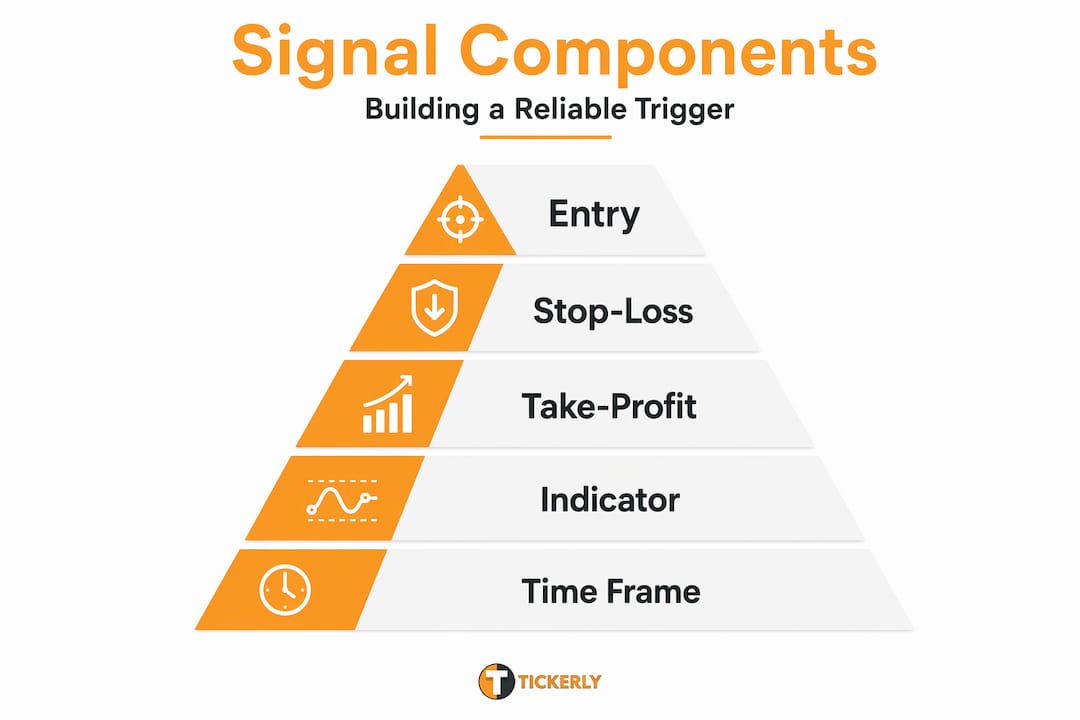
Pro Tip: Always write out all five components before entering any trade. If you cannot define your stop-loss and take-profit in advance, you do not have a signal yet. You have a guess.
Common types of trading signals and how they are generated
Understanding the different types of trading signals helps you choose the right tools for your strategy and market. Signals generally fall into three main categories: technical, fundamental, and sentiment. Most professional traders use a combination of all three.
Technical signals
These are the most common type. They are generated by applying mathematical indicators to price and volume data. Common indicators include RSI, MACD, Bollinger Bands, and Moving Averages, each with a distinct role in the signal-generation process.
Technical signals split into two critical subtypes. Leading indicators like RSI try to forecast reversals before they happen, which gives you earlier entries but at the cost of more false signals. Lagging indicators like Moving Average crossovers confirm trends after they are already in motion, reducing false signals but delaying your entry.
| Indicator | Type | Signal example | Weakness |
|---|---|---|---|
| RSI below 30 | Leading | Potential buy on oversold condition | High rate of false signals in trends |
| Moving Average crossover | Lagging | Golden cross as trend confirmation | Delayed entry, missed early move |
| MACD histogram flip | Lagging | Direction change confirmation | Lags in fast-moving markets |
| Bollinger Band squeeze | Leading | Breakout anticipation setup | Direction uncertain before breakout |
Fundamental signals
These are triggered by real-world events: earnings surprises, analyst upgrades, central bank rate decisions, or insider buying. A company beating earnings by 20% and raising guidance is a fundamental buy signal for many traders. These signals are powerful but require context since markets often price in expectations before the event.
Sentiment and volume signals
Sentiment data, such as the put/call ratio or the Crypto Fear & Greed Index, tells you how the crowd is positioned. When extreme readings appear, contrarian signals can be highly effective. Volume is equally critical. A breakout on 200% average daily volume is far more reliable than one on thin volume, which is why volume confirmation is a non-negotiable filter for most experienced traders.
Pro Tip: Never rely on a single indicator. The most reliable setups come from confluence, where multiple independent signals align at the same time. An RSI divergence combined with a volume spike and a key support level is a far stronger signal than any one of those factors alone.
How trading signals work in practice
Knowing what a signal is and actually applying it in a live trade are two different skills. Trading signals function as probabilistic triggers within a structured decision framework built on three sequential stages. Working through these stages systematically prevents you from acting on isolated data points.
-
Context: Identify the broader market environment first. Is the asset in an uptrend, downtrend, or consolidation? Signals behave differently depending on the regime. An RSI oversold reading in a strong downtrend is far less reliable than the same reading at a major support level in a broader uptrend.
-
Setup: Narrow down to assets that meet your structural criteria. You are looking for a specific chart pattern, a price level, or a fundamental condition that makes the asset a candidate worth watching. This filters out the majority of noise before a trigger even fires.
-
Trigger: This is the actual signal. A Moving Average crossover fires. RSI crosses a threshold. Volume spikes above its 20-day average. The trigger confirms that conditions are right and execution should begin.
Once a trigger fires, risk management takes over immediately. Stop-loss levels tied to signals define exactly where a trade is invalidated, which preserves capital and prevents small losses from becoming catastrophic drawdowns. Take-profit targets lock in gains before greed takes over.
False signals, known as whipsaws, are an unavoidable part of trading. Filtering them requires multi-indicator confirmation, volume analysis, and awareness of broader market volatility. A sell signal that fires during extremely low-volume pre-holiday trading carries far less weight than the same signal on a high-volume institutional trading day.

Sell signals deserve the same attention as buy signals. Technical patterns like a death cross or a failed breakout above resistance, paired with declining earnings guidance, create high-confidence exit conditions. Treating sell signals with the same rigor as entry signals is what separates disciplined traders from reactive ones.
Pro Tip: Set your stop-loss and take-profit the moment you enter a trade, not after. Waiting until price moves against you to decide your exit is how emotional decision-making takes over.
Common pitfalls and misconceptions
Trading signals are genuinely useful tools, but the space around them is filled with unrealistic claims and predatory services. Knowing the red flags protects both your capital and your confidence.
-
Signals are not profits: A signal with a 65% historical win rate still loses 35% of the time. Every signal is a probability statement, not a guarantee.
-
Single indicators fail: No single indicator works reliably in all market conditions. The alignment of multiple independent signals is what produces genuinely high-quality setups.
-
Unregistered providers are dangerous: Investors should be skeptical of auto-trading services that promise guaranteed performance without transparent technology disclosures. Registered advisers follow strict rules. Unregistered ones often provide zero investor protection.
-
Automation without understanding is risky: Running a signal-based bot without understanding what triggers it is like driving with a blindfold. Automation should execute a strategy you understand and have backtested.
-
Your risk tolerance matters: Even a high-quality signal is wrong for you if the required position size exceeds what you can afford to lose without deviating from the plan.
“A trading signal is a tool for executing a strategy with discipline. It is not a substitute for having a strategy.”
Treat signal providers the way you would treat any financial service. Verify their registration status, demand transparent performance metrics with audited trade history, and never trust equity curves that only go up.
Examples of trading signal strategies
Theory becomes real when you see how signals combine in actual strategies. Here are some of the most widely used approaches and what makes each of them work.
Swing traders frequently combine a 50-period Moving Average crossover with RSI thresholds as their primary signal for swing trading entries. When price crosses above the 50 MA while RSI moves from below 40 toward 50, it creates a confluence setup that signals trend resumption rather than a random bounce.
Trend-following strategies use a different combination. They wait for the 20-period EMA to cross above the 50-period EMA while price holds above the 200-period MA, confirming the macro trend. Volume must exceed the 20-day average to validate the signal. This three-layer filter eliminates most false breakouts. You can explore top trend-following strategies built specifically for TradingView automation to see how these layers are coded in practice.
Platforms like TradingView have become the gold standard for building, backtesting, and deploying signal-based strategies. Pine Script allows you to define exact conditions for every signal, backtest them against historical data, and then fire real-time alerts when conditions are met.
| Strategy type | Primary signal | Confirmation filter | Best market condition |
|---|---|---|---|
| Swing trading | 50 MA crossover + RSI threshold | Volume above 20-day average | Trending with pullbacks |
| Momentum breakout | Price breaks resistance | Volume spike above 200% average | High-volatility trending market |
| Mean reversion | RSI below 30 at support | Bullish candlestick pattern | Range-bound market |
| Trend following | EMA 20 crosses EMA 50 | Price above 200 MA | Strong macro trend |
The benefits of trading signals become clearest when you automate their execution. Automation removes latency, eliminates emotional interference, and makes signal-based strategies scale across multiple assets simultaneously without degrading execution quality.
My take: signals as discipline, not magic
I’ve reviewed hundreds of trading setups and spoken with traders across every experience level, and the pattern is consistent: the ones who succeed treat signals as a discipline system, not a prediction machine.
What I’ve found is that the signal itself rarely separates profitable traders from losing ones. The difference is almost always in how rigidly someone follows the rules they set in advance. I’ve seen traders with technically superior signal systems blow up accounts because they overrode their stop-loss when a trade moved against them. I’ve also seen traders with simple, two-indicator setups outperform because they never deviated from the plan.
The concept of confluence took me longer to fully trust than I care to admit. For a while, I kept entering trades when just one indicator fired. The win rate was mediocre at best. Once I required at least two independent signals to align before any entry, the quality of setups improved noticeably. Not because I was trading more. Because I was trading less, and more selectively.
My honest caution is this: automated signals and signal bots are genuinely powerful, but only after you fully understand what the bot is doing and why. Running automation on a strategy you have not personally backtested is one of the most expensive mistakes you can make. The signal fires correctly. You just did not understand the conditions under which it should not.
Treat every signal as a hypothesis. Test it. Track it. Refine it. That process is what turns signals from noise into an actual edge.
— Jay
Put your signals to work with Tickerly
Understanding trading signals is only half the equation. Acting on them fast enough and consistently enough to matter is where most manual traders fall short.
Tickerly turns your TradingView strategies into a fully automated trading bot, executing signals the moment conditions are met with no manual intervention and no hesitation. If you have built a signal system in Pine Script or are using an existing TradingView strategy, Tickerly connects directly to your broker via API and fires trades in real time. Learn more about why automated bots outperform manual execution, or check the automated trading FAQ to understand exactly how signal automation works in practice. For traders who are ready to move from theory to execution, Tickerly is where signals become trades.
FAQ
What is a trading signal in simple terms?
A trading signal is a rule-based trigger that tells you when to enter or exit a trade based on specific market conditions. It is not a prediction; it is a defined set of criteria that, when met, suggests a favorable opportunity.
What are some examples of trading signals?
Common examples include a Moving Average golden cross (buy signal), RSI dropping below 30 at a support level (potential reversal buy), and a death cross on high volume (sell signal). Each one is a measurable, repeatable condition.
How do trading signals work with automated bots?
An automated bot monitors the market 24/7 and fires a trade the instant a signal’s conditions are met. This removes execution latency and emotional hesitation, both of which erode returns over time with manual trading.
Can I trust paid trading signal services?
Only those that provide audited performance records, transparent methodology, and are registered with the relevant financial regulatory authority. Unregistered signal providers often lack investor protections and cannot be held accountable for losses.
How many signals should I combine before entering a trade?
Most experienced traders require at least two or three independent signals to align before entering. Multiple aligned signals significantly improve setup quality compared to acting on any single indicator alone.