

Automated trading bots have a reputation problem. Many traders assume they work like a vending machine: deposit your strategy, press start, and watch profits roll in while you sleep. That picture is dangerously incomplete. Bots are force multipliers, not autonomous profit machines. When you pair a well-tested strategy with disciplined oversight and the right automation tools, the results can be genuinely transformative. But when you run a flawed strategy through a bot, you lose money faster and at greater scale. This guide cuts through the noise and shows you exactly how automation works, where it delivers real value, and how to use it responsibly.
Table of Contents
- Unlocking efficiency: How automated bots enhance trading
- Mechanics of automation: How TradingView bots translate strategy to execution
- Bots versus manual trading: Performance and limitations
- Best practices: Maximizing benefits while avoiding common bot pitfalls
- The uncomfortable truth: Automation magnifies both wins and mistakes
- Take the next step with Tickerly’s automation tools
- Frequently asked questions
Key Takeaways
| Point | Details |
|---|---|
| Bots amplify your strategy | Automation magnifies both good and bad trading decisions so your strategy’s quality matters. |
| Speed is a major advantage | Trading bots execute trades in milliseconds, capturing opportunities impossible by hand. |
| Oversight is essential | Continuous monitoring and adjustment are crucial to avoid costly mistakes. |
| Practical step-by-step setup | Connecting TradingView strategies to bots is fast and can be done with alerts and webhooks. |
| Avoid common pitfalls | Audit strategies, install safeguards, and never trust automation as a set-and-forget solution. |
Unlocking efficiency: How automated bots enhance trading
The most immediate benefit of automation is speed. Manual execution requires you to watch the chart, recognize the signal, open your broker, size your position, and place the order. By the time all that happens, the opportunity has often moved. Bots eliminate every step between signal and execution, capturing entries and exits at the precise moment your strategy calls for them.
Beyond speed, automation removes the emotional drag that undermines even disciplined traders. Fear and greed are powerful forces. A bot does not hesitate at a stop loss or second-guess a take profit. It executes the rule every single time, which means your live trading performance finally reflects your backtesting results rather than drifting away from them.
Here is what automation realistically gives you:
- Execution speed: Orders fire within milliseconds of a signal, not seconds or minutes.
- Consistency: Every trade follows the same rules with zero deviation.
- Time freedom: You can monitor multiple markets and timeframes simultaneously without being physically present.
- Reduced stress: You set the rules in advance, which lowers the cognitive load during volatile sessions.
- Scalability: One bot can manage positions across several pairs or assets at once.
However, automation is not an excuse to disengage. As expert research confirms, bots amplify good strategies but expose flaws, and human oversight remains essential for adaptability. They are not a set-and-forget solution. Market conditions shift, correlations break down, and volatility regimes change. A bot running unchecked during a major news event or a liquidity crisis can rack up losses at machine speed.
“The trader who benefits most from automation is not the one who steps away entirely. It is the one who uses automation to execute better while staying alert to when conditions require human judgment.”
For a broader picture of the dangers, reviewing bot risk awareness before you go live is time well spent. The risks are real, but they are manageable with the right approach. TradingView automation gives you the infrastructure to act on your strategy with precision, provided the strategy itself is sound.
Pro Tip: Before you automate anything, run your strategy through at least six months of backtesting across different market conditions, including trending, ranging, and high-volatility environments. Only automate what has proven itself in data first.
Mechanics of automation: How TradingView bots translate strategy to execution
Now that you understand why efficiency matters, let’s unpack how bots actually operate with TradingView. The workflow is more straightforward than most traders expect, but each step matters for reliability.
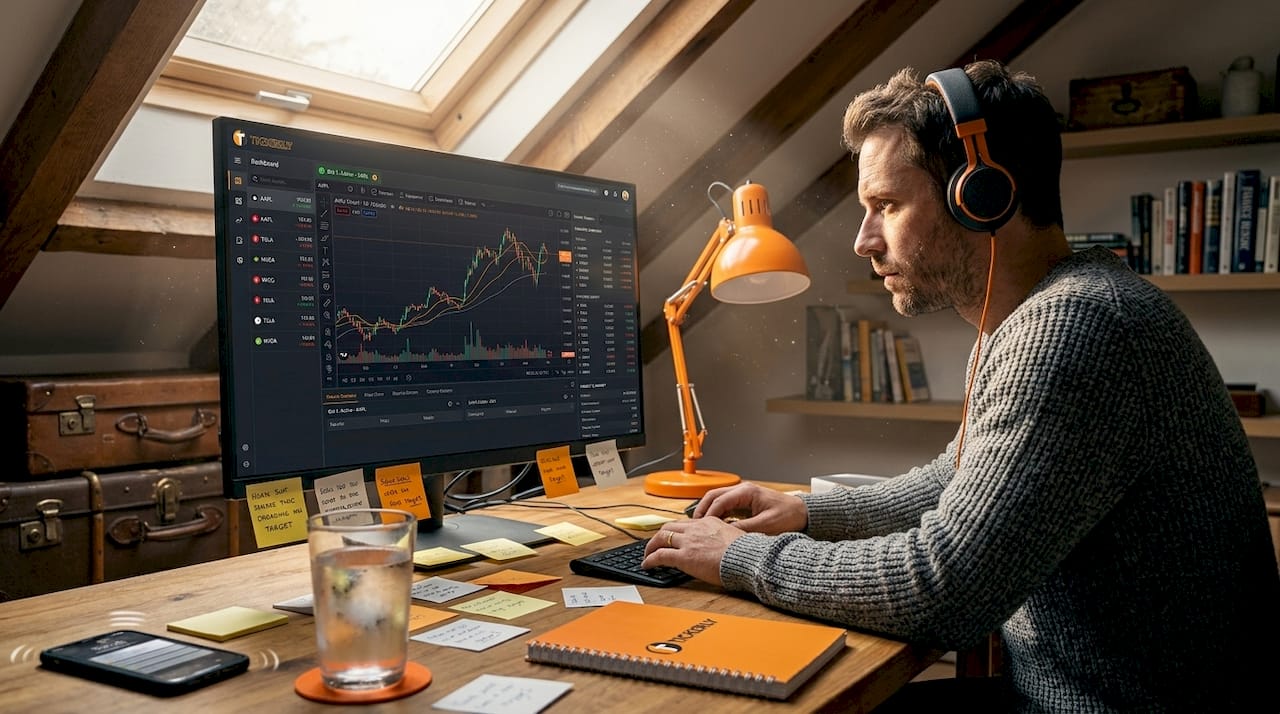
TradingView strategies are written in Pine Script, the platform’s native scripting language. When your Pine Script strategy detects a buy or sell condition, it fires an alert. That alert contains a payload, a small block of text or JSON data that tells your bot what to do. The alert is delivered to a webhook URL, which is essentially a web address your bot is listening to. Within milliseconds, the bot receives the signal, interprets the payload, and sends an order to your exchange or broker via its API (Application Programming Interface).
This end-to-end process, from chart signal to executed order, can happen in under 50ms latency. That is faster than any human can react, which is the entire point.
Execution speed comparison: Manual vs. automated trading
| Factor | Manual trading | Automated bot |
|---|---|---|
| Signal to order time | 5 to 60 seconds | Under 50 milliseconds |
| Emotional influence | High | None |
| Multi-pair management | Limited | Unlimited |
| Overnight/24/7 execution | No | Yes |
| Consistency across trades | Variable | 100% rule-based |
To get your TradingView strategy connected and running, follow these steps:
- Write or select your Pine Script strategy in TradingView’s strategy editor and confirm it produces the signals you expect.
- Set up alerts on your strategy using TradingView’s alert system. Configure the alert to trigger on your entry and exit conditions. Detailed guidance on TradingView alerts helps you structure these correctly.
- Configure your webhook URL in the alert settings. This is the address your bot is listening to for incoming signals.
- Connect your bot to your exchange or broker using the exchange’s API key and secret. Make sure the API permissions are set to trade only, never to withdraw funds.
- Test with a paper trading account or small position sizes before committing real capital. Check that each alert type, buy, sell, and stop triggers the correct order.
- Go live and monitor the first several trades manually to confirm the entire chain works as expected.
This workflow is the foundation of algorithmic trading on TradingView and, once configured, is remarkably reliable. The full guide to automating TradingView walks through every detail if you want to follow a step-by-step walkthrough alongside this explanation.
Bots versus manual trading: Performance and limitations
Understanding the mechanics sets the stage for comparing bots with manual trading honestly. Both approaches have genuine strengths, and the best traders know when to rely on each.
Performance comparison: Bots vs. manual trading
| Dimension | Bot trading | Manual trading |
|---|---|---|
| Execution speed | Under 50ms | 5 to 60+ seconds |
| Emotional bias | Eliminated | Present |
| Strategy adherence | Perfect | Varies with discipline |
| Adaptability to news | Requires manual override | Immediate human judgment |
| Operating hours | 24 hours, 7 days | Limited by trader availability |
| Learning from mistakes | Requires strategy update | Intuitive feedback loop |
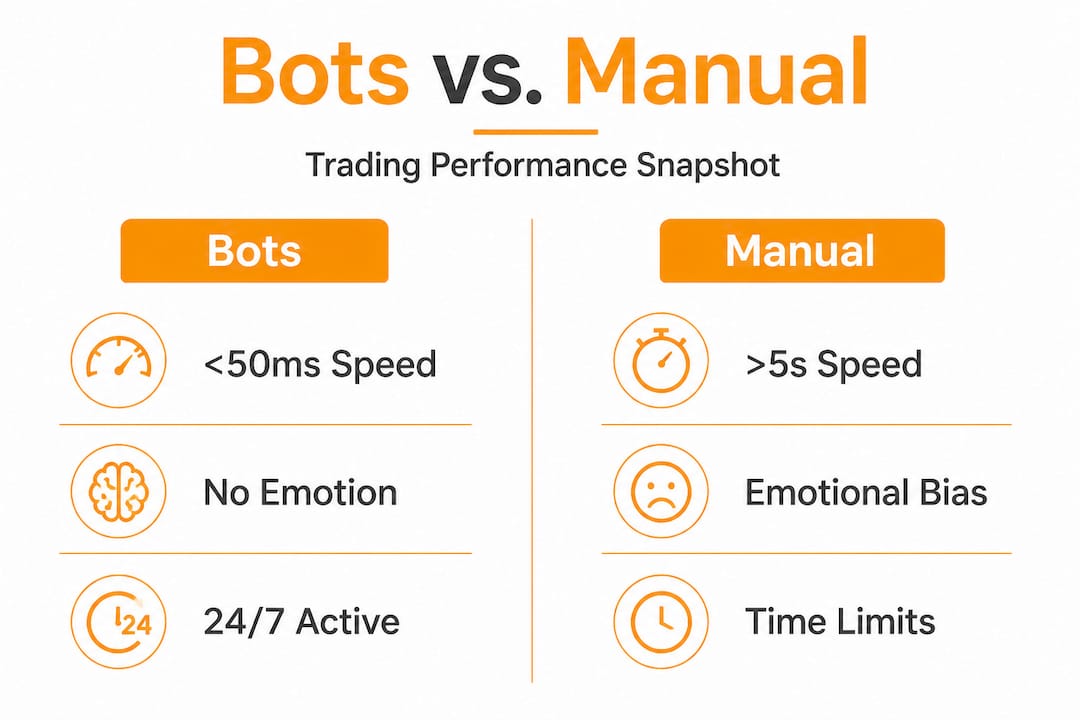
The latency advantage alone is decisive in fast-moving markets. Crypto markets in particular can move several percent in seconds during high-impact events. A bot captures the signal at the exact moment Pine Script identifies it. A manual trader reading the same chart might enter 30 seconds later, which in a volatile moment can mean a materially worse fill price.
That said, AI bot limitations are worth taking seriously. Common pitfalls include:
- Strategy decay: A strategy optimized for one market regime may stop working when conditions change. The bot will not recognize this on its own.
- Over-fitting: If you optimize your strategy too aggressively on historical data, it performs well in backtests but poorly in live markets.
- Exchange downtime or API errors: Technical failures can prevent orders from executing at critical moments.
- Runaway losses: Without hard stop losses and position size limits built into your strategy, a bot can execute losing trade after losing trade without pausing.
- Market regime changes: Major macro shifts, regulatory actions, or black swan events require human intervention that bots cannot provide.
The solution is not to avoid bots but to use them intelligently. Pair your bot with solid trading strategy selection from the start, and commit to a regular review schedule. The bot-building process itself is also an education in what makes a strategy robust enough to automate.
As research makes clear, bots expose strategic flaws at scale. What might be a manageable losing streak for a manual trader becomes a rapid drawdown for an unmonitored bot running the same flawed logic across multiple positions.
Best practices: Maximizing benefits while avoiding common bot pitfalls
After weighing bots against manual trading, it is important to focus on safe and effective practices for automation. The traders who get the most from bots are not necessarily the most technically sophisticated. They are the most disciplined.
Here are the steps that consistently separate successful automated traders from those who blow up their accounts:
- Backtest rigorously before going live. Use at least 12 months of historical data, covering both bull and bear conditions. A strategy that only performs well in trending markets will fail badly when the market ranges.
- Set hard risk controls in your strategy. Define maximum position size, stop loss levels, and daily drawdown limits within your Pine Script code before you automate. Do not rely on manual intervention to cut losses.
- Start with small position sizes. Even a well-backtested strategy behaves differently in live markets due to slippage, liquidity, and spread. Scale up only after confirming live performance matches expectations.
- Configure real-time notifications. Set up alerts for order fills, errors, and unusual activity so you know immediately if something goes wrong. Understanding how automated trading works at a systems level helps you anticipate where failures can occur.
- Review performance weekly. Compare your live results to your backtest benchmarks. If there is significant divergence, investigate before continuing to run the bot.
- Update your strategy when market conditions shift. Bots do not adapt on their own. You are responsible for recognizing regime changes and updating your logic accordingly.
Pro Tip: Schedule a weekly 30-minute bot review session. Check your equity curve, compare average trade metrics to your backtest, and verify that no API or webhook errors occurred. This simple habit catches problems before they become expensive.
Common pitfalls to avoid:
- Over-optimizing on backtests: Chasing perfect historical performance usually creates a strategy that fails in real markets.
- Ignoring slippage and fees: Backtests often look better than live results because they underestimate trading costs. Model these realistically.
- Running too many bots simultaneously: Managing multiple bots without a clear monitoring system leads to missed errors.
- Skipping the paper trading phase: Going directly from backtest to live trading removes a critical safety layer.
- Neglecting security: API keys must be restricted to trading only. Never grant withdrawal permissions to a bot.
For a thorough safety check, running an audit of your trading bot before full deployment is one of the highest-value activities you can do. It surfaces vulnerabilities in both your strategy logic and your technical setup before they cost you money.
As evidence consistently shows, bots are not set-and-forget. The traders who treat automation as an ongoing practice rather than a one-time setup are the ones who build durable, profitable systems.
The uncomfortable truth: Automation magnifies both wins and mistakes
Most guides present automation as a straightforward upgrade. Deploy a bot, remove emotions, profit more consistently. That framing is accurate as far as it goes, but it leaves out the part that actually determines whether automation works for you.
Bots are force multipliers. If your strategy has an edge, a bot extracts that edge more consistently than any human can. But if your strategy has a hidden flaw, a bot finds it faster than any market will. We have seen traders lose in a single week what took months to build, not because the bot malfunctioned, but because it executed a flawed strategy with perfect fidelity.
The “set-and-forget” myth is genuinely dangerous in 2026. Markets are faster, more interconnected, and more susceptible to sudden regime shifts than at any previous point. A strategy that worked through 2024 and 2025 may need meaningful adjustment by mid-2026 as liquidity conditions and correlations evolve. The bot will not tell you this. Your weekly review will.
Here is what we believe separates traders who succeed with automation from those who don’t: disciplined traders use bots to execute better, not to think less. They invest time in strategy development, monitor their systems consistently, and treat every performance divergence as a signal to investigate. The bot handles the execution. The trader handles the judgment. Long-term bot optimization is not a one-time task but a continuous commitment to keeping your system aligned with market reality.
The traders who benefit most from automation are not the ones chasing fully passive income. They are the ones who respect that automation demands a different kind of attention, not less attention, but more focused attention on strategy quality and system health.
Take the next step with Tickerly’s automation tools
Ready to put automation into action? Here’s how Tickerly can help you leverage bots safely and effectively.
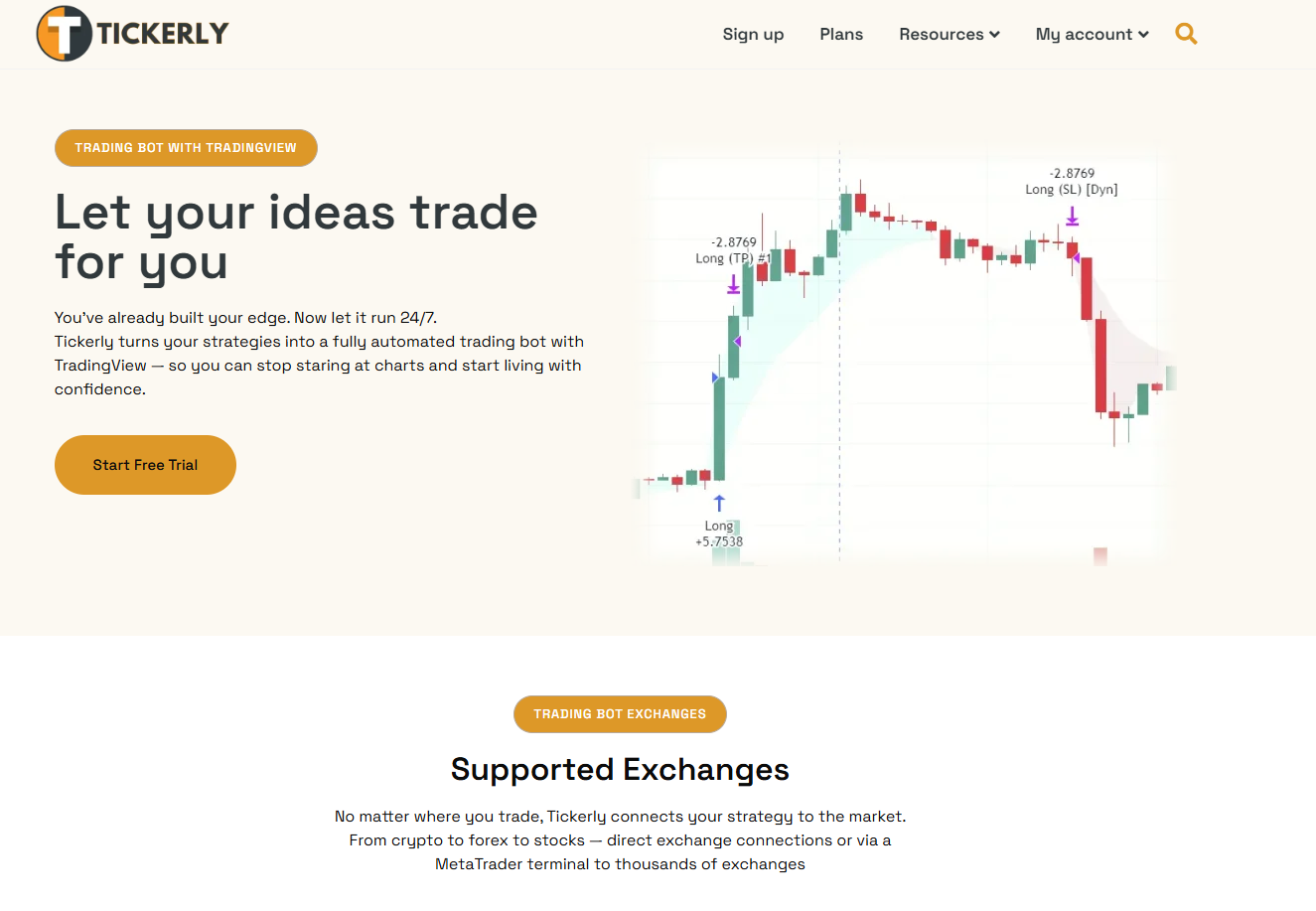
Tickerly bridges the gap between your TradingView strategy and fully automated execution across forex, crypto, and stock markets. Whether you are setting up your first webhook or refining a multi-asset system, the platform is built to make the process reliable and accessible.
Explore the full range of options through algotrading solutions that cover every major asset class. If you are ready to set up your first automated strategy, the step-by-step Tickerly automation guide walks you through every stage of the process, from writing your Pine Script alerts to executing your first live trade. Start with a clear strategy, set your risk controls, and let Tickerly handle the execution layer while you focus on continuous improvement.
Frequently asked questions
Can bots fully replace manual trading?
Bots handle routine execution efficiently, but human oversight is essential for adapting to shifting market conditions and fine-tuning strategy logic over time.
How fast do TradingView bots execute trades?
TradingView bots can trigger trade execution in under 50 milliseconds by routing Pine Script alerts through webhooks directly to your exchange or broker.
What are the risks of using trading bots?
Bots can amplify losses rapidly when strategy flaws exist, and ongoing monitoring is necessary to catch performance degradation caused by changing market conditions.
Do I need programming skills to use TradingView bots?
Many TradingView bots work with prebuilt Pine Script strategies and alert configurations, so basic coding is optional. Advanced customization and strategy adjustments do benefit from familiarity with Pine Script syntax.
Recommended
- Trading Bots: How Automation is Changing the Game – Tickerly
- Which Trading Bot is the Best? A Complete Guide to Automated Trading in 2026 – Tickerly
- Trading Bot Crypto: Complete Guide to Automation 2026
- TradingView Automated Trading solution
- AI Trading Bots & Agents in 2026: What They Can and Can’t Do | Crypto Watchdog
- How to Automate Trade Execution for Proven Results – My Framer Site