

TL;DR:
- Automated order execution uses software to place and manage trades instantly, reducing delays and errors. It offers faster, more precise, and consistent trades while managing market impact and queue position. Traders should start with thorough backtesting and incremental deployment to optimize performance and maintain strategic oversight.
Automated order execution is defined as the use of software and algorithms to place, route, and manage trades without manual input at the moment of execution. For active traders in crypto, forex, and equities, this is the single most direct way to close the gap between a signal and a filled order. Platforms like TradingView have made webquest-driven automation accessible to individual traders, not just institutional desks. The core argument for why automate order execution matters is simple: human reaction time cannot compete with the speed, consistency, and precision that software delivers at scale.
Why automate order execution: speed and accuracy
Automation removes the two biggest sources of execution failure in manual trading: delay and human error. When you enter an order by hand, you introduce latency measured in seconds. Algorithms act in sub-millisecond ranges, capturing liquidity that disappears before a human finger reaches the keyboard. That speed difference is not marginal. In volatile markets, a ten-second delay can mean the difference between filling at your target price and chasing a move that has already passed.

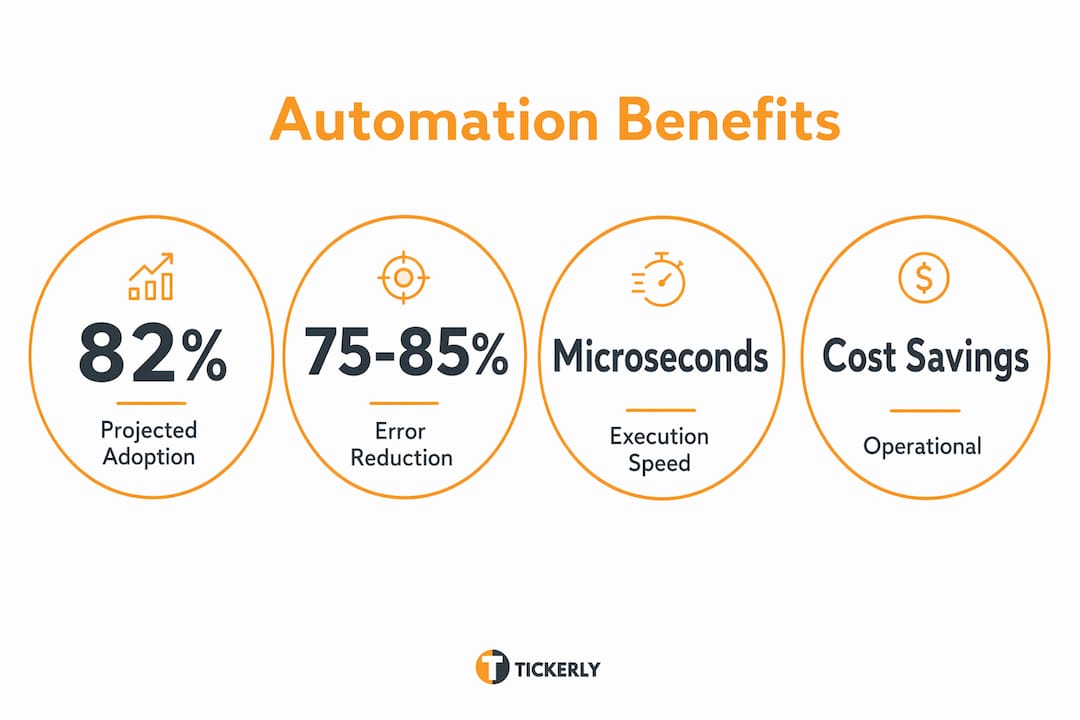
The accuracy gains are equally significant. Automation reduces manual error rates by 75–85% in order processing environments, and cuts per-order costs from over $6 to under $2. Those numbers come from B2B order processing, but the mechanics apply directly to trading: fewer fat-finger errors, no missed decimal places, and no orders sent to the wrong instrument. Every mistake in manual order entry has a direct cost in slippage, cancellation fees, or missed fills.
The benefits of order automation extend beyond raw speed:
-
Consistent rule execution. Automated systems apply your entry and exit rules identically on every trade, removing the inconsistency that comes from fatigue or second-guessing.
-
24/7 market coverage. Intraday markets and 24/7 crypto sessions create compressed time windows that no manual trader can monitor continuously.
-
Parallel strategy management. Software runs multiple strategies simultaneously across different instruments, a task that is physically impossible for a single trader to replicate manually.
-
Exception queue monitoring. Automated systems flag order exceptions in real time, so you catch failed fills or partial executions immediately rather than discovering them after the fact.
AI-driven execution management adoption is projected to reach 82% by 2029, with 63% of companies already prioritizing automation investment in 2025–2026. That trajectory tells you where professional trading infrastructure is heading.
What role do execution algorithms play in managing market impact?
Execution algorithms are the core technology behind professional order automation. They solve a problem that manual traders rarely think about explicitly: how you trade is as important as when you trade.
The fundamental trade-off in execution is between market impact and timing risk. Trading a large order quickly moves the price against you. That is market impact. Trading slowly reduces price impact but exposes you to the risk that the market moves away before your order is complete. That is timing risk. Algorithms manage this trade-off by slicing a large parent order into smaller child orders, each sized and timed to blend into normal market flow.
| Factor | High market impact (fast execution) | High timing risk (slow execution) |
|---|---|---|
| Execution speed | Immediate | Extended over time |
| Price impact | Significant, moves market | Minimal per child order |
| Exposure to price drift | Low | High |
| Best suited for | Urgent, time-sensitive trades | Large positions in liquid markets |
| Algorithm examples | Market orders, aggressive TWAP | VWAP, passive limit strategies |
Each child order is sized and timed to appear as normal market flow, preserving anonymity and minimizing signaling effects on price. If a large order is visible in the order book, other participants trade against it. Algorithms prevent that by disguising intent.
Queue position is the other critical variable. In a limit order book, price-time priority means the earliest order at a given price fills first. Queue priority is managed at the matching engine level using FIFO rules. Automation tools optimize submission timing to secure early queue positions, which directly improves fill rates at target prices.
Pro Tip: Do not treat queue position as a secondary concern. In liquid markets with tight spreads, getting filled at the front of the queue versus the back can represent a meaningful difference in execution quality over hundreds of trades.
Execution quality compounds returns over time. Simply automating order entry without managing queue priority and market impact leaves significant performance on the table.
How does automated trading compare to manual order execution?
The comparison between manual and automated trading comes down to four operational dimensions: speed, accuracy, capacity, and focus.
Speed. Human reaction time operates in the range of 200–300 milliseconds at best. Algorithms execute in microseconds. In fast markets, that gap is the entire opportunity window.
Accuracy. Manual entry produces errors at a rate that scales with volume and fatigue. Automation applies the same logic every time, with no degradation in performance after hour six of a trading session.
Capacity. A single trader can actively manage a limited number of positions at once. Automated systems handle dozens of strategies across multiple instruments and exchanges simultaneously. That capacity difference is what makes diversification at scale possible.
Focus. Automation shifts the trader’s role from repetitive order entry to strategy oversight and risk management. That is a better use of human judgment. Deciding when to adjust a strategy, when to pause automation during unusual market conditions, and when to add a new instrument requires human analysis. Clicking “buy” at the right millisecond does not.
The operational cost advantage is also real. Automated systems process orders at a fraction of the cost of manual workflows, and they scale without adding headcount. For traders running multiple strategies, that scalability is a direct competitive advantage.
How to start automating order execution effectively
Getting automation right requires more than connecting an API and pressing start. The implementation process has distinct steps, and skipping any of them creates risk.
-
Choose the right platform and API. TradingView’s Pine Script environment connects to brokers and exchanges via webhook alerts using tools like Tickerly. Alpaca offers a commission-free API built for algorithmic trading in U.S. equities. NinjaTrader provides advanced order routing with direct market access. Your choice depends on the asset class you trade and the complexity of your strategy.
-
Select an execution algorithm suited to your trading style. Scalpers need aggressive, low-latency execution. Swing traders benefit from VWAP or TWAP algorithms that minimize market impact on larger positions. Match the algorithm to the order size and urgency of your strategy.
-
Set and tune your execution parameters. Define volume limits per order, price thresholds that trigger or cancel execution, and timing rules that prevent orders from firing during low-liquidity windows. These parameters are not set-and-forget. They require regular review as market conditions change.
-
Backtest your algorithm’s behavior. Run your execution logic against historical data before deploying live capital. Backtesting reveals how your parameters perform across different volatility regimes and liquidity conditions. It also exposes edge cases that are not obvious in theory.
-
Monitor performance and handle exceptions. Track fill rates, slippage versus benchmark, and rejection rates. Any metric that drifts from baseline is a signal that your parameters need adjustment or that market conditions have changed.
-
Scale incrementally. Start with a single strategy on one instrument. Verify that execution performs as expected before adding complexity. Adding multiple strategies simultaneously makes it impossible to isolate the source of any performance problem.
Pro Tip: Run your automation in paper trading mode for at least two weeks before committing live capital. Real-time paper trading exposes latency issues, API connectivity gaps, and parameter edge cases that backtesting alone will not catch.
Platforms like Tickerly make this process accessible by connecting TradingView strategies directly to exchange APIs, converting Pine Script alerts into live bot execution without requiring custom code. That removes the most common technical barrier for traders who want to automate but lack a software development background.
Key takeaways
Automating order execution gives traders a measurable edge in speed, accuracy, and market impact management that manual methods cannot replicate at scale.
| Point | Details |
|---|---|
| Speed advantage | Algorithms execute in sub-millisecond ranges; human reaction time cannot compete in fast markets. |
| Error reduction | Automation cuts manual order errors by 75–85%, directly reducing slippage and failed fills. |
| Market impact control | Execution algorithms slice large orders into child orders to minimize price impact and preserve anonymity. |
| Queue position matters | Price-time priority rules mean early queue placement improves fill rates at target prices. |
| Incremental implementation | Start with one strategy, backtest thoroughly, and scale only after verifying live performance. |
Automation is not a shortcut. It is a discipline.
I have watched traders treat automation as a way to step away from the screen entirely, and that is where things go wrong. The technology handles execution mechanics better than any human can. But the strategic layer still requires active judgment.
The traders who get the most from automation are the ones who understand what their algorithms are actually doing. They know whether their execution logic is optimized for speed or for minimizing market impact. They review fill quality reports weekly. They adjust parameters when volatility regimes shift. They treat their bots as tools that need calibration, not as autonomous systems that run forever without oversight.
The insight I keep coming back to is this: automation augments human judgment, it does not replace it. Your edge as a trader comes from your ability to read market structure, manage risk, and adapt your strategy. Automation’s job is to execute that strategy with precision and consistency that your hands and eyes cannot deliver. When you divide those responsibilities clearly, the combination is genuinely powerful.
The traders I have seen struggle with automation are those who treat it as a black box. They do not understand why their algorithm fires when it does, and they cannot diagnose why performance drifts. Understanding your execution mechanics is not optional. It is the foundation that makes everything else work.
— Jay
Tickerly and automated order execution
Tickerly connects your TradingView strategies to live exchange execution through a direct API integration, converting Pine Script alerts into real bot orders across crypto, forex, and stock markets.
For traders who want to move from manual order entry to fully automated execution, Tickerly removes the technical barriers without sacrificing control. You set the strategy in TradingView, define your execution parameters, and Tickerly handles the routing. The platform supports multiple simultaneous strategies, so you can diversify across instruments without multiplying your workload. Read the full breakdown of automated trading efficiency to see how bot-driven execution compares to manual trading across key performance metrics. If you are new to the platform, the Tickerly automated trading FAQ covers setup, exchange connections, and execution parameters in detail.
FAQ
What is automated order execution?
Automated order execution is the use of software to place and manage trades based on predefined rules, without manual input at the moment of the trade. It eliminates human reaction time delays and applies strategy rules consistently on every order.
How much faster is automated execution than manual trading?
Algorithms execute orders in sub-millisecond ranges. Human reaction time operates in the range of thousands of milliseconds at best, meaning automation is orders of magnitude faster in fast-moving markets.
Does automation improve order accuracy?
Automation reduces manual order error rates by 75–85% compared to manual entry processes. Fewer errors mean less slippage, fewer failed fills, and lower per-order costs.
What is the difference between market impact and timing risk?
Market impact is the price movement caused by trading a large order quickly. Timing risk is the exposure to price drift when trading slowly. Execution algorithms balance both by slicing large orders into smaller child orders timed to blend into normal market flow.
Can individual traders access automated order execution tools?
Individual traders can access automation through platforms like TradingView, Alpaca, NinjaTrader, and Tickerly, which provide API connectivity and bot execution without requiring custom software development.