

TL;DR:
- Auto optimization automatically tunes trading strategies using data-driven algorithms, improving performance by 35% over manual methods. Traders should define clear objectives, monitor results, and treat it as an assistive tool rather than a complete replacement for human judgment. Proper implementation and oversight ensure adaptive, efficient, and durable trading systems.
Auto optimization is defined as the automated, data-driven process of continuously adjusting system parameters to maximize performance without manual intervention. For traders and financial analysts, this means your strategy’s variables, from entry thresholds to position sizing rules, get tuned by algorithms rather than by hand. Systems using auto optimization achieve 35% higher performance scores over 12 months compared to manual tuning. That gap is not a minor efficiency gain. It represents the difference between a strategy that adapts to market shifts and one that slowly decays.
What is auto optimization and how does it differ from manual tuning?
Auto optimization, also called automated parameter tuning or autotuning, replaces the traditional trial-and-error approach to strategy refinement with algorithmic precision. Manual tuning requires a trader to adjust parameters, run backtests, evaluate results, and repeat. That cycle consumes weeks of time and introduces human bias at every step. Manual tuning causes performance regressions and consumes extensive maintenance resources, whereas automatic optimization delivers continuous, stable improvements.
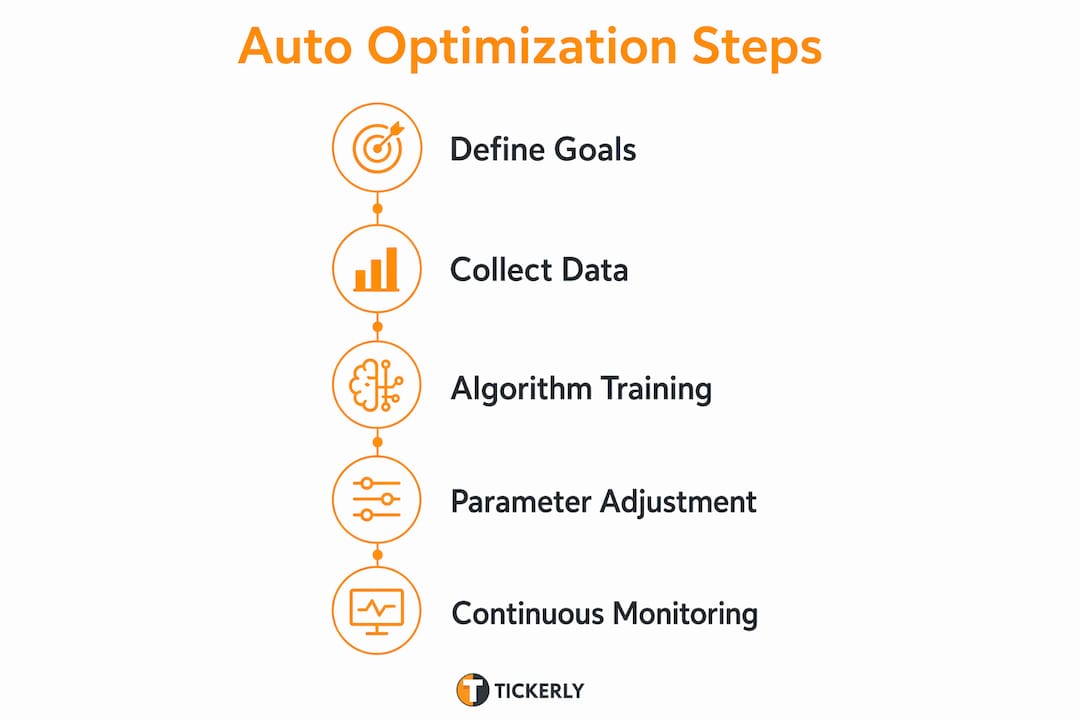
The core distinction is feedback speed. Manual processes react to problems after they appear. Auto optimization systems detect parameter drift in real time and correct it before performance degrades. For traders running strategies across crypto, forex, and equities simultaneously, that speed advantage is critical.
Auto optimization also removes emotional decision-making from the tuning process. A trader who has held a losing configuration for weeks may resist changing it. An algorithm has no such attachment. It evaluates performance data objectively and applies the configuration that the evidence supports.
Understanding why you optimize trading strategies in the first place makes the case for automation even clearer. The goal is always to find parameter sets that perform well across a range of market conditions, not just the conditions you tested against.
How does auto optimization work in trading systems?
Auto optimization relies on a class of algorithms designed to learn from outcomes and adjust behavior accordingly. The two most relevant frameworks for trading are reinforcement learning and multi-armed bandit algorithms.

Reinforcement learning trains a model by rewarding configurations that produce good outcomes and penalizing those that do not. Over many iterations, the model converges on parameter sets that maximize the reward signal, which in trading terms is typically risk-adjusted return or Sharpe ratio.
Multi-armed bandit algorithms solve a specific problem called the explore-exploit tradeoff. The algorithm must balance two competing needs: exploring new parameter configurations that might outperform the current best, and exploiting the current best configuration to generate returns. Explore-exploit balance is managed through ensemble approaches like exploration-biased and exploitation-biased Thompson sampling bandits. That ensemble structure is what makes the optimizer adaptive rather than static.
Here is how a typical auto optimization execution flow works in a trading context:
-
Parameter space definition: You define the variables to tune, such as moving average periods, stop-loss percentages, or RSI thresholds, along with acceptable ranges for each.
-
Background execution: The optimization job runs asynchronously, meaning it does not block your live trading pipeline while it evaluates configurations.
-
Performance scoring: Each configuration is scored against your defined KPIs, such as maximum drawdown, win rate, or net profit factor.
-
Recommendation delivery: Optimized configurations are delivered within 30–60 minutes, compared to weeks for manual tuning.
-
Retraining cycle: The model retrains on fresh data, with update cycles as frequent as every 6 hours to stay current with market shifts.
Pro Tip: Set your retraining frequency based on market volatility. A crypto strategy trading 15-minute bars benefits from 6-hour retraining cycles. A swing strategy on daily equity charts may only need weekly retraining.
What are the key benefits of auto optimization for traders and financial analysts?
The benefits of auto optimization go beyond raw performance numbers. They change how you allocate your time and how your strategies behave under pressure.
-
Consistent performance improvement. Systems using automated tuning outperform manually tuned counterparts by 35% over a 12-month period. That consistency compounds. A strategy that degrades slowly under manual tuning loses ground every quarter. An auto-optimized strategy adapts and holds its edge.
-
Dramatically reduced time investment. Algorithmic tuning tools shorten what used to be weeks of manual testing into hourly or real-time updates. For analysts managing multiple strategies, that time savings translates directly into capacity for higher-value work.
-
Adaptive response to market regime changes. Markets shift between trending, ranging, and volatile regimes. A parameter set optimized for a trending market will underperform in a ranging one. Auto optimization detects these shifts through performance data and adjusts configurations before losses accumulate.
-
Lower compute and operational costs. Performance improvements come from ongoing micro-adjustments rather than infrequent large-scale tuning jobs. Smaller, more frequent updates consume fewer computational resources than periodic full-scale reoptimizations.
-
Scalability across complex strategy portfolios. Running 10 strategies manually requires 10 separate tuning workflows. Auto optimization handles all of them simultaneously, applying the same algorithmic rigor to each without additional analyst time.
The scalability point matters most for professional trading desks and quantitative analysts. Manual tuning creates a hard ceiling on how many strategies you can maintain at acceptable quality. Auto optimization removes that ceiling.
What challenges should traders be aware of when using auto optimization?
Auto optimization is not a plug-and-play solution. Several specific challenges can undermine its effectiveness if you do not address them upfront.
-
Goal misalignment. Misalignment between user-set goals and automated system objectives leads to technically optimal yet strategically ineffective results. If you tell the optimizer to maximize win rate, it may find configurations that win frequently but lose large amounts on each losing trade. Your KPIs must reflect your actual trading objectives.
-
Premature convergence. An optimizer that exploits too aggressively will lock onto a local optimum and stop exploring better configurations. This is the explore-exploit tradeoff in practice. Without a well-designed exploration policy, your system stops improving before it finds the best solution.
-
Latency from asynchronous operation. Asynchronous background optimization models require traders to understand update latencies and their impact on strategy responsiveness in volatile markets. If your model retrains every 6 hours but the market moves sharply in hour 3, you are trading on stale parameters until the next update cycle completes.
-
Safe exploration failures. Handling massive configuration spaces safely is a primary challenge. Without safe exploration policies, the optimizer may test parameter combinations that produce catastrophic drawdowns during the evaluation phase.
-
Over-reliance on automation. Auto optimization is best understood as an expert assistant, not a replacement for human strategic judgment. You still need to validate that the optimizer’s recommendations align with your risk framework and market thesis.
Pro Tip: Before deploying any auto-optimized configuration live, run it through a forward-test period on paper trading. This catches cases where the optimizer found a curve-fitted solution that works on historical data but fails on new price action.
The relationship between manual and automated trading is not adversarial. The most effective traders use automation to handle repetitive parameter tuning while reserving human judgment for strategy design and risk oversight.
How to implement auto optimization effectively in trading strategies?
Effective implementation starts with clear definitions, not with selecting a tool. You need to specify what you are optimizing for before any algorithm touches your parameters.
The table below outlines the core implementation framework:
| Implementation Step | Key Action | Common Mistake |
|---|---|---|
| Define optimization objectives | Set KPIs: Sharpe ratio, max drawdown, profit factor | Using win rate alone as the objective |
| Set parameter bounds | Define min/max ranges for each variable | Allowing ranges so wide the search space becomes unmanageable |
| Configure retraining frequency | Match update cycles to strategy timeframe | Using 6-hour cycles for a weekly swing strategy |
| Validate data quality | Confirm clean, sufficient historical data before running | Optimizing on data with gaps or survivorship bias |
| Monitor and review outputs | Check recommendations before deploying live | Applying optimizer outputs automatically without human review |
Data quality deserves special attention. An optimizer trained on corrupted or insufficient data will produce confident but wrong recommendations. For intraday crypto strategies, you need tick-level or 1-minute data going back at least 12 months. For daily equity strategies, 5 years of clean OHLCV data is a reasonable minimum.
Continuous monitoring is the final and often neglected step. Auto optimization does not mean set-and-forget. You need to track whether the optimizer’s recommended configurations are actually performing as predicted in live markets. If they are not, the issue is usually either data quality, goal misalignment, or a market regime the training data did not include.
Machine learning techniques like feature selection and dimensionality reduction can also help narrow the parameter space before optimization begins. A smaller, well-defined search space produces faster and more reliable results than an exhaustive grid search across hundreds of variables.
Key Takeaways
Auto optimization delivers its strongest results when traders combine well-defined objectives, quality data, and continuous human oversight with algorithmic tuning.
| Point | Details |
|---|---|
| Core definition | Auto optimization adjusts trading parameters automatically using data-driven algorithms, eliminating manual trial-and-error. |
| Performance advantage | Automated systems outperform manually tuned strategies by 35% over 12 months. |
| Speed of delivery | Optimized configurations are ready in 30–60 minutes versus weeks for manual tuning. |
| Primary risk | Goal misalignment between your KPIs and the optimizer’s objective produces technically optimal but strategically wrong results. |
| Human oversight remains critical | Treat auto optimization as an expert assistant. Validate every recommendation before deploying it live. |
Auto optimization is a tool, not a strategy
Traders adopt auto optimization with two very different mindsets, and the mindset determines the outcome more than the technology does.
The first group treats it as a black box. They connect it to their strategy, let it run, and deploy whatever it recommends. For a while, results look good. Then a market regime change hits, the optimizer’s training data no longer reflects current conditions, and the strategy bleeds out before anyone notices.
The second group treats it as a highly capable analyst. They define the objectives carefully, review the recommendations critically, and maintain clear rules about when to override the system. Their results are not just better in the short term. They are durable.
The misconception that auto-optimizers are one-size-fits-all solutions limits adoption and causes failures. Every optimizer reflects the objectives you give it. If those objectives are vague or misaligned with your actual risk tolerance, the algorithm will find a solution to the wrong problem with impressive efficiency.
My honest view is that the explore-exploit tradeoff is the most underappreciated concept in this space. Traders focus on the performance gains and skip past the question of how the optimizer balances exploration and exploitation. That balance, specifically the sophistication of the exploration policy, determines whether you get a genuinely adaptive system or one that locks onto a local optimum and stagnates.
The traders who get the most from auto optimization in 2026 are the ones who understand what the algorithm is doing well enough to catch it when it goes wrong. That requires learning the fundamentals, not just the outputs.
— Jay
Tickerly and automated strategy tuning for active traders
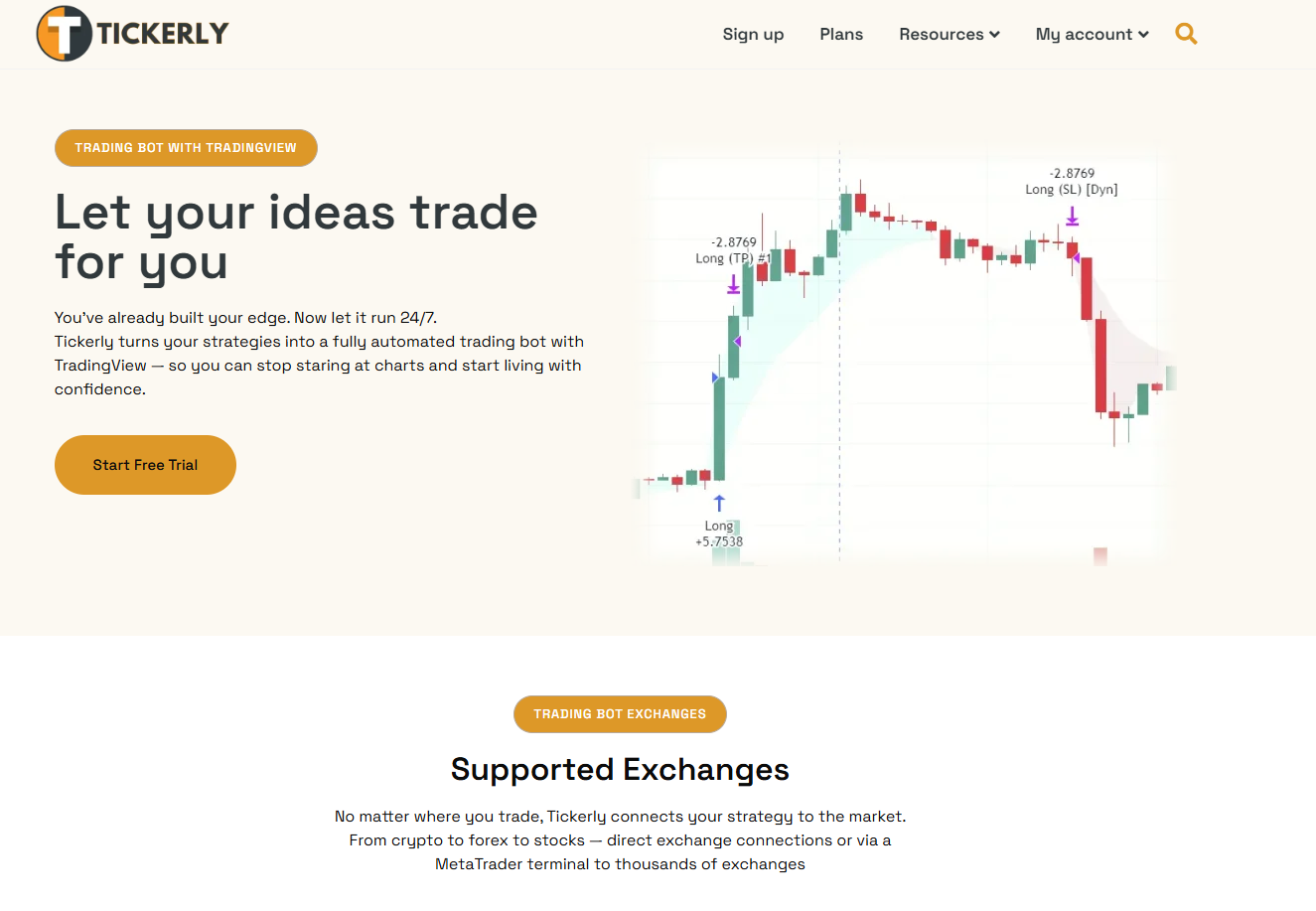
Tickerly converts your TradingView strategies into fully functional trading bots that execute in real time across crypto, forex, and stock exchanges. The platform handles continuous execution so your strategy runs without gaps, even when you are not at your desk.
For traders looking to put auto optimization into practice, Tickerly’s automated bot efficiency features let you run multiple strategies simultaneously, each operating on its own execution logic without interference. The platform connects to major exchanges via API with low-latency execution, which matters when your optimized parameters depend on precise entry timing. If you are ready to move from manual tuning to automated strategy execution, Tickerly gives you the infrastructure to do it without writing a single line of code.
FAQ
What is auto optimization in simple terms?
Auto optimization is the automated process of adjusting a system’s parameters using algorithms and real-time data to improve performance without manual input. In trading, it means your strategy variables get tuned continuously by software rather than by hand.
How often does an auto optimization system retrain?
Retraining frequency depends on the system and strategy timeframe. Some systems retrain as frequently as every 6 hours to stay current with market shifts, while others update daily or weekly based on the strategy’s holding period.
Is auto optimization necessary for trading?
Auto optimization is not strictly necessary, but it delivers a measurable edge. Automated systems achieve 35% higher performance scores over 12 months compared to manually tuned strategies, making it a strong advantage for traders managing multiple strategies or operating in fast-moving markets.
What is the biggest risk of using auto optimization?
The biggest risk is goal misalignment. If the KPIs you set do not accurately reflect your trading objectives, the optimizer will find a technically correct solution to the wrong problem. Clear, specific objective definitions are the most important safeguard.
Can auto optimization replace a trader’s judgment?
Auto optimization handles parameter tuning, but it does not replace strategic judgment. Traders still need to define objectives, validate recommendations, and monitor live performance. The system works best as an expert assistant within a human-supervised workflow.