

TL;DR:
- A trade exit strategy is a predefined plan that guides when and how to close a position to lock in profits or limit losses. Exit execution accounts for 70% of a trade’s outcome, making it more impactful than entry signals. Properly matching exit methods to your trading style is crucial to avoid significant performance decline.
A trade exit strategy is a predefined plan that tells you exactly when and how to close a position to lock in profits or cap losses. Exit execution accounts for 70% of a trade’s outcome, making it far more impactful than your entry signal. Yet most traders spend the majority of their preparation time on entries. This trade exit strategy guide covers the core exit methods, how to set risk parameters correctly, and the behavioral mistakes that quietly destroy accounts. Whether you trade crypto, forex, or stocks, the principles here apply directly.
What are the main types of trade exit strategies?
No single exit method works for every trading style. The key is matching your exit technique to your strategy type. Mismatching exit methods to strategy types can degrade performance by 20–40%, which is a significant and avoidable drag on returns.
The five core exit types are:
-
Fixed stop-loss orders. You set a hard price level below your entry where the trade closes automatically. This works best for range traders and scalpers who need a defined maximum loss per trade. The downside is that fixed stops do not adjust to changing volatility.
-
Take profit targets. You close the trade at a predetermined price. This is the cleanest exit method for mean-reversion strategies, where price is expected to snap back to a level and then stall.
-
Trailing stops. The stop price moves up as the trade moves in your favor, locking in gains while keeping you in a trend. Trend-following strategies benefit most from trailing stops because they let winners run without requiring you to predict the exact top.
-
Scaling out. You close portions of the position at multiple price levels. Scaling out reduces variance and psychological stress by locking in partial profits while leaving some exposure to further moves.
-
Time-based exits. You close the trade after a fixed period regardless of price. Day traders use this to avoid holding positions overnight, and mean-reversion traders use it when a trade fails to reach its target within the expected window.
Pro Tip: Match your exit type to your strategy before you enter. Trend-following trades need trailing stops. Mean-reversion trades need fixed take profit targets and time-based exits. Mixing these up is one of the most common performance killers.
How to set risk-reward ratios and stop-loss levels

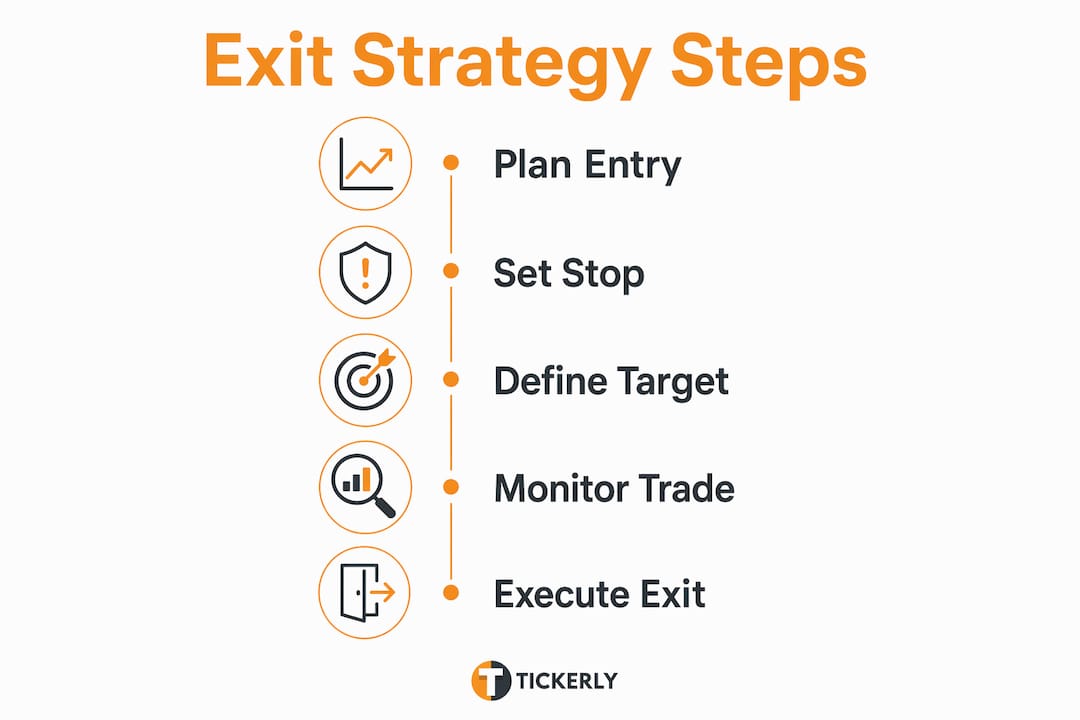
Effective risk management starts with one non-negotiable rule: define your stop and target before you enter the trade. Changing these levels after entry is where discipline breaks down.
The 1:2 risk-reward minimum
Professional trading standards require at least a 1:2 risk-to-reward ratio to stay profitable even with a 40% win rate. That means for every dollar you risk, you target two dollars in profit. At this ratio, you can be wrong more than half the time and still grow your account.
Using ATR to set stop distances
Average True Range (ATR) is the most reliable tool for sizing your stop-loss to current market conditions. Standard exit parameters include fixed stop-losses set at 1.5–2x ATR, with profit targets at 2–4x risk or at technical resistance levels such as Fibonacci extensions. ATR adjusts automatically as volatility expands or contracts, so your stop is never arbitrarily tight in a fast market or unnecessarily wide in a quiet one.
Here is a practical framework for setting your levels:
-
Calculate ATR. Use the 14-period ATR on your trading timeframe.
-
Set your stop. Place it 1.5–2x ATR below your entry for a long trade.
-
Calculate your risk in dollars. Multiply stop distance by position size.
-
Set your target. Multiply your dollar risk by 2 to get the minimum take profit level.
-
Check against technicals. Confirm the target sits near a resistance level or Fibonacci extension for added confluence.
Stop placement errors to avoid
Stop placement should avoid round numbers and be set beyond key technical or volatility zones to reduce stop hunting risks. Round numbers like $50,000 on Bitcoin or $100 on a stock attract clusters of stops, which institutional players actively target. Place your stop a few ticks beyond a swing low or ATR-based level instead.
| Stop placement error | Why it hurts | Better approach |
|---|---|---|
| Round number stops | Clustered with other traders, easy to hunt | Use ATR-based levels beyond swing points |
| Too tight (under 1x ATR) | Premature exits on normal volatility | Set at 1.5–2x ATR minimum |
| Too wide (over 3x ATR) | Excessive loss per trade | Reduce position size, not stop distance |
| Moving stop further away | Turns a defined risk into an open loss | Honor the original stop level |
Pro Tip: Never widen a stop-loss after entry. If the trade requires a wider stop to survive, the position size was too large. Reduce size before entry, not risk after.
Best practices for executing trade exits
Execution discipline separates profitable traders from break-even ones. Knowing the right exit method means nothing if you abandon your plan mid-trade.
The core best practices for trade exits are:
-
Place stop-loss and take-profit orders immediately after entry. Do not wait to see how the trade develops. Orders placed in the market remove the temptation to override them manually.
-
Use OCO (one-cancels-other) order types. Automated order types like OCO combine stop-loss and take-profit into brackets that enforce disciplined exit execution. When one order fills, the other cancels automatically.
-
Treat stop-losses as business insurance. Stop-losses viewed as predefined business risk expenses reduce emotional trading and improve discipline. A stop is not a failure. It is the cost of operating in uncertain markets.
-
Do not move profit targets outward. Moving profit targets outward driven by hope reduces realized gains. Set your target, and honor it.
-
Switch to trailing stops when in strong trends. Once a trend-following trade moves 1.5x your initial risk in profit, convert your fixed stop to a trailing stop. This locks in gains while keeping you exposed to further upside.
-
Avoid exits during low-liquidity windows. Thin markets around major news events or market opens can cause slippage that turns a planned exit into a much worse one. Use limit orders instead of market orders when liquidity is questionable.
Pro Tip: Simpler exit rules outperform complex ones in live markets. Complex exit logic tends to be overfit to historical data and breaks down when conditions shift. A fixed ATR stop and a 2:1 target will outperform a five-condition exit rule in most real-world environments.
How to troubleshoot common exit strategy mistakes
Most exit errors fall into a small number of repeatable patterns. Identifying yours is the fastest way to improve your results.
-
Stops that are too tight. If you are being stopped out repeatedly on trades that eventually move in your direction, your stop is inside normal market noise. Measure your stop distance against ATR. If it is below 1x ATR, widen it and reduce position size to compensate.
-
Stops that are too wide. A stop set at 5x ATR means you absorb enormous losses on losing trades. Your win rate would need to be exceptionally high to survive this. Tighten the stop and accept that some trades will not work out.
-
Moving profit targets out of greed. This is one of the most documented behavioral errors in trading. Predefined exit targets with discipline conserve profits. When you move a target out, you are making a new trade decision without a new trade plan. That is speculation, not strategy.
-
Using the wrong exit type for your strategy. A mean-reversion trader who uses trailing stops will give back most of the profit when price reverses. A trend follower who uses fixed take profits will exit too early and miss the bulk of the move. Match the method to the strategy.
-
Ignoring changing market conditions. A stop-loss calibrated to a low-volatility environment will be triggered constantly in a high-volatility one. Recalibrate your ATR-based stops when the market regime shifts. Tools like the VIX for equities or implied volatility metrics for crypto signal when recalibration is needed.
“The goal of a stop-loss is not to avoid losses. It is to make losses predictable, small, and survivable.” This reframe is the foundation of long-term trading discipline.
Key Takeaways
Exits drive trade outcomes more than entries, and applying the right exit method to the right strategy type is the single highest-impact change most traders can make.
| Point | Details |
|---|---|
| Exits dominate outcomes | Exit execution drives 70% of a trade’s result, making it the primary focus for improvement. |
| Match exit type to strategy | Use trailing stops for trend-following and fixed targets for mean-reversion to avoid performance drag. |
| Use the 1:2 minimum ratio | A 1:2 risk-to-reward ratio keeps you profitable even when you lose more than half your trades. |
| Set stops with ATR | Place stop-losses at 1.5–2x ATR to account for real market volatility, not arbitrary percentages. |
| Automate your exits | OCO orders and automated bots remove the emotional override that causes most exit errors. |
Why exit discipline matters more than finding the perfect entry
Traders obsess over entries. They backtest entry signals for hundreds of hours, refine their indicators, and debate setups endlessly. Then they exit on gut feel. I have watched this pattern play out across every market and every experience level.
The research is unambiguous: exits account for 70% of trade outcomes. The entry gets you in the door. The exit determines whether you leave with a profit or a loss. Spending 90% of your preparation time on the entry and 10% on the exit is working on the wrong problem.
The traders who perform consistently over years are not the ones with the best entry signals. They are the ones with the simplest, most consistently applied exit rules. Simple exit strategies outperform complex ones because they hold up across different market conditions. A complex exit rule that worked in 2023 backtesting often fails in 2026 live markets because it was fit to historical noise, not real edge.
Build your exit plan before you build your entry criteria. Define your stop, your target, and your exit type for each strategy you run. That is the standard professional traders hold themselves to, and it is the standard that produces consistent results.
— Jay
Automate your exits and trade with full discipline
Manual exits fail because humans override their own plans. Automation removes that variable entirely.

Tickerly converts your TradingView strategies into fully functional trading bots that execute stop-loss, take-profit, trailing stop, and OCO orders automatically, at execution speeds no manual trader can match. Your predefined exit plan triggers reliably, every time, without hesitation or second-guessing. Day traders and active investors in crypto, forex, and stocks use Tickerly to run multiple strategies simultaneously, capturing exits across markets without being glued to a screen. If you are ready to stop overriding your own plan, automate your trading on TradingView with Tickerly. You can also explore why automated bots consistently outperform manual execution for disciplined exit management.
FAQ
What is a trade exit strategy?
A trade exit strategy is a predefined plan that specifies the exact conditions under which you will close a position. It includes stop-loss levels, profit targets, and the order types used to execute the exit.
What is the best exit strategy for trading?
No single best exit strategy exists. The most effective approach matches the exit method to the trading style: trailing stops for trend-following, fixed take-profit targets for mean-reversion, and time-based exits for day trading.
What risk-reward ratio should I use?
Professional standards require at least a 1:2 risk-to-reward ratio. At this level, you remain profitable with a win rate as low as 40%.
How do I set a stop-loss correctly?
Place your stop-loss at 1.5–2x ATR beyond your entry point, away from round numbers and obvious swing levels. This accounts for normal market volatility and reduces the risk of being stopped out by routine price noise.
What is an OCO order and why does it matter for exits?
An OCO (one-cancels-other) order pairs a stop-loss and a take-profit into a single bracket. When one order fills, the other cancels automatically, enforcing your exit plan without requiring manual intervention.