

TL;DR:
- Swing trading is a short to medium-term approach that profits from market oscillations over days to weeks. It offers a manageable commitment of one to three hours daily, making it ideal for active traders seeking continuous engagement.
Swing trading is defined as a short to medium-term trading approach that captures price moves over a period of days to weeks by exploiting predictable oscillations within larger market trends. The role of swing strategies is to position traders at the intersection of opportunity and discipline, filling the gap between the rapid-fire pace of day trading and the patience required for long-term investing. Active traders in crypto, forex, and stocks use swing strategies to profit from market momentum without needing to watch charts all day. This guide breaks down how swing strategies work, what technical components drive them, and how to implement them without falling into the most common traps.

How do swing strategies enhance short-term trading performance?
Swing strategies work by targeting the most productive segment of a price move. Swing trades held for 2–10 days captured 68% of the S&P 500’s total return over the last decade. That means you do not need to hold a position for months to capture the bulk of a trend’s value.
The mechanics behind this performance come down to three factors: holding period, trade frequency, and risk management.
-
Holding period: Most swing trades run 2–14 days, long enough to ride a meaningful price move but short enough to exit before the trend exhausts itself.
-
Trade frequency: Swing traders execute 10–20 trades per month, compared to 50 or more for day traders. That lower frequency reduces transaction costs and decision fatigue.
-
Risk management: Professional traders limit risk to 1–2% of account balance per trade and target a minimum 2:1 reward-to-risk ratio. This means one winning trade offsets two losing ones, keeping the account growing even with a sub-50% win rate.
The importance of swing strategies becomes clearest when you compare them to alternatives. Day trading demands constant attention and generates high stress. Buy-and-hold investing misses short-term swings entirely. Swing trading captures those swings with a manageable time commitment of roughly 1–3 hours per day.
Pro Tip: Disciplined execution matters more than finding the perfect entry. A trader who cuts losses at the right stop-loss level and holds winners to target will outperform one who picks entries brilliantly but exits emotionally.
What are the key technical components of swing setups?
High-probability swing setups are built on price action first, with indicators serving as secondary confirmation. Relying on indicators alone is one of the most common mistakes swing traders make. Price action establishes the setup; indicators confirm it.
The core technical building blocks are:
-
Support and resistance levels: These are price zones where buyers or sellers have historically stepped in. A breakout above resistance or a bounce off support forms the foundation of most swing setups.
-
Swing highs and lows: Identifying the structure of a trend, whether higher highs and higher lows or the reverse, tells you which direction to trade.
-
Volume confirmation: Breakouts with above-average volume signal genuine momentum rather than a false move.
-
Moving average crossovers: A shorter moving average crossing above a longer one (for example, the 20-period crossing the 50-period) signals a shift in momentum.
-
RSI and VWAP: The Relative Strength Index flags overbought or oversold conditions. VWAP anchors intraday context for swing entries on shorter timeframes.
Multi-timeframe alignment is what separates high-probability setups from random entries. You identify the trend on the daily chart, then drop to the 4-hour chart to time the entry. This confluence of signals dramatically improves the odds of a trade working in your favor.
| Setup type | Primary signal | Confirmation tool |
|---|---|---|
| Pullback buy | Price retraces to support in uptrend | RSI below 40, bouncing |
| Breakout trade | Price closes above resistance with volume | Volume above 20-day average |
| Moving average crossover | Short MA crosses above long MA | Price holds above crossover level |
| VWAP anchor | Price reclaims VWAP after dip | Bullish candlestick pattern |
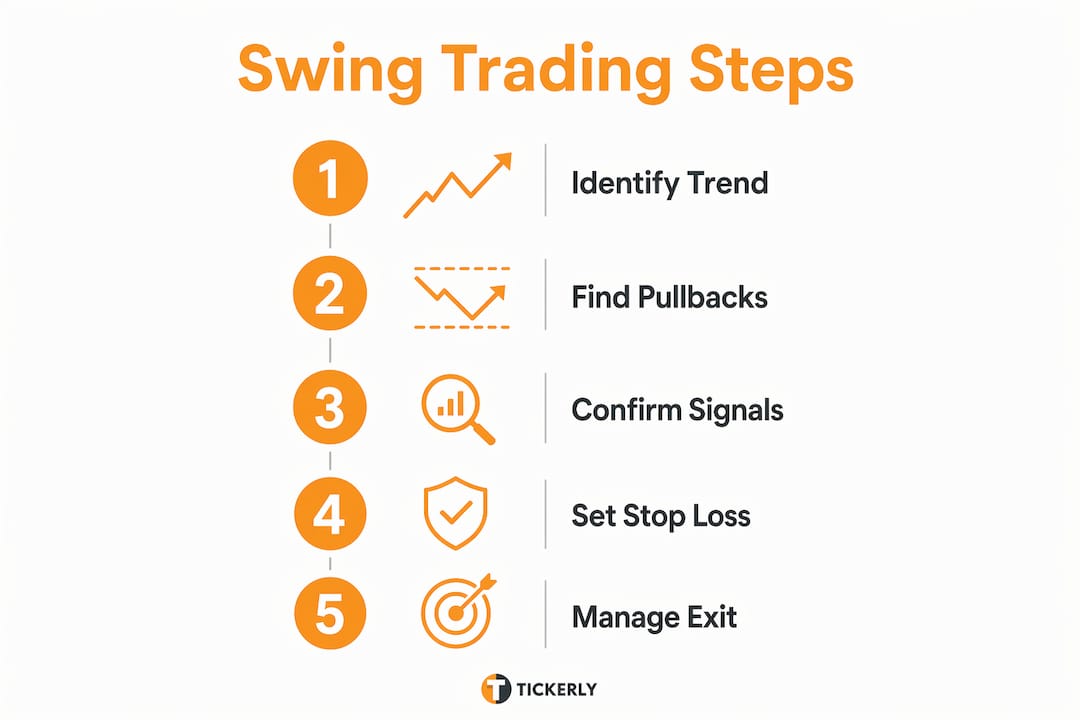
Pro Tip: Never initiate a swing trade because an indicator flashed a signal. Wait for price action to confirm the setup first, then use the indicator to validate your read.
What are common pitfalls and how to implement swing strategies effectively?
The biggest pitfall in swing trading is “indicator chasing,” which means entering trades based on indicator signals without waiting for price action to confirm the setup. This leads to poor entries, wider stops, and emotional losses that compound over time. The fix is a rules-based trading system with defined entry criteria, exit targets, stop-loss levels, and position sizing rules written down before you place a trade.
A practical implementation process for swing strategies for beginners looks like this:
-
Choose one setup to master. Start with a moving average crossover or a simple pullback buy. Jumping between strategies before mastering one is a primary cause of failure.
-
Define your entry rules. Write down the exact conditions that must be met before you enter. For example: “Price closes above the 50-day moving average on the daily chart with RSI above 50 and volume above average.”
-
Set your stop-loss before entry. Place the stop below the most recent swing low for a long trade. This is non-negotiable. Stop-loss discipline determines long-term profitability more than entry accuracy.
-
Calculate position size. Use the 1% risk rule. If your account is $10,000 and your stop is $0.50 away from entry, you can buy 200 shares. This prevents any single trade from causing a catastrophic drawdown.
-
Keep a trading journal. Log every trade with the setup, entry, exit, and result. Patterns in your journal reveal whether your edge is real or imagined.
-
Avoid trading around earnings or major news events. These create gap risk that can blow through stop-losses. Swing strategies work best in trending or range-bound conditions, not during binary events.
Success in swing trading depends more on exit discipline and position sizing than on finding the perfect entry. That is a counterintuitive truth that separates profitable traders from those who break even or lose. You can also review why trading strategies fail to understand the behavioral patterns that undermine even technically sound systems.
Pro Tip: Treat each trade as one instance in a series of 100. No single trade defines your results. This mindset removes emotional attachment to individual outcomes and keeps you focused on executing your rules consistently.
How does swing trading fit into a broader portfolio?
Swing trading occupies a specific and valuable role in a broader trading or investment portfolio. Moving average crossover systems generated approximately 8.7% annualized returns from 2000 to 2020, outperforming buy-and-hold during bear markets. That outperformance comes from the ability to exit positions and move to cash when trends break down, something a passive portfolio cannot do.
The psychological benefits of swing trading are also significant. Day trading creates constant stress because every tick matters. Buy-and-hold investing can feel passive and disconnected during volatile periods. Swing trading requires roughly 1–3 hours of daily attention, which gives you active engagement without the burnout that comes from staring at a screen all day.
For traders managing multiple assets across crypto, forex, and stocks, automation becomes a practical necessity. Manually monitoring 10 or 15 swing positions across different markets is difficult. Automated alerts and execution tools let you define your swing trading alerts in advance and act on them the moment conditions are met, without hesitation or delay.
The benefits of swing trading within a portfolio also include diversification across timeframes. A long-term investor holding index funds can add a swing trading allocation to capture short-term momentum without abandoning their core strategy. The two approaches are not mutually exclusive. Protecting capital through margin of safety principles applies equally to swing positions and long-term holdings.
Key Takeaways
Swing strategies deliver the most consistent results when price action, multi-timeframe alignment, and strict risk management work together as a single system.
| Point | Details |
|---|---|
| Holding period drives returns | Trades held 2–10 days captured 68% of S&P 500 returns, making that window the most productive. |
| Risk management beats entry skill | Limiting risk to 1–2% per trade and targeting 2:1 reward-to-risk determines long-term profitability. |
| Price action leads indicators | Initiate setups based on price structure; use RSI, VWAP, and moving averages only as confirmation. |
| Master one setup first | Jumping between strategies before mastering one is a primary cause of swing trading failure. |
| Automation enforces discipline | Automated alerts and execution remove emotional decision-making from defined swing trading rules. |
Why swing trading rewards the disciplined, not the clever
The most underrated aspect of swing trading is how forgiving it is when you respect the risk parameters. You do not need a 70% win rate. You need a 2:1 reward-to-risk ratio and the discipline to cut losses when the trade does not work. That math works in your favor even at a 40% win rate. Most traders intellectually understand this but emotionally cannot execute it.
My honest view is that swing trading is the best entry point for serious traders who want real market engagement without sacrificing their lives to a screen. The 1–3 hour daily commitment is real and manageable. The returns are achievable. But the psychological demand is higher than most people expect. You will face losing streaks. Your rules will feel wrong in the moment. The traders who succeed are the ones who trust the system over their gut when those two things conflict.
Start with one setup. Backtest it. Trade it small. Journal every result. Only after 50 or more trades do you have enough data to know whether your edge is real. That process is not exciting, but it is the only path to consistent profitability.— Jay
Tickerly and the mechanics of automated swing trading
Swing trading’s biggest practical challenge is execution consistency. You define a perfect set of rules, then hesitate at the entry or hold a losing trade too long because the exit feels premature. Tickerly addresses this directly by converting your TradingView strategies into automated trading bots that execute your defined rules without hesitation.
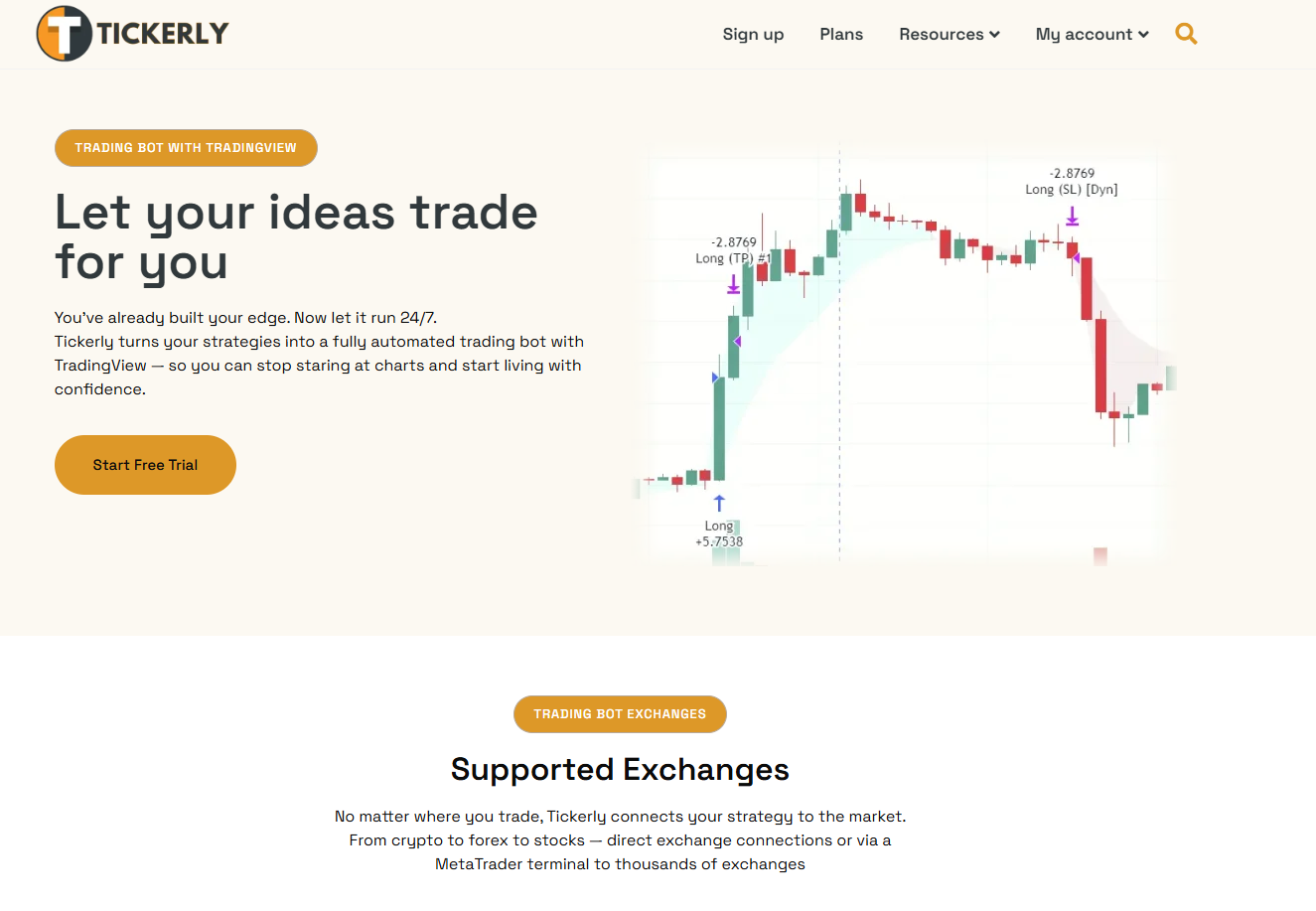
Tickerly connects to crypto, forex, and stock exchanges with real-time alert execution, so your swing strategy fires the moment conditions are met. That speed matters in fast-moving markets where a delayed entry changes the risk/reward profile of the entire trade. If you want to see how automation enforces the discipline that manual trading makes difficult, the guide on automating TradingView strategies walks through the full setup. For a broader look at why automation improves trading outcomes, the case for automated bots covers the core efficiency and profitability arguments in detail.
FAQ
What is the role of swing strategies in trading?
Swing strategies capture short to medium-term price moves over days to weeks by exploiting predictable oscillations within larger market trends. Their primary function is to generate returns from market momentum without requiring full-time screen time.
How many trades do swing traders typically execute per month?
Swing traders execute 10–20 trades per month, significantly fewer than day traders but more active than long-term investors. That frequency balances opportunity with time efficiency.
What is the most important risk rule in swing trading?
Limiting risk to no more than 1–2% of account balance per trade prevents catastrophic drawdowns and keeps recovery mathematically achievable after losing streaks.
Can swing trading outperform buy-and-hold investing?
Moving average crossover systems generated approximately 8.7% annualized returns from 2000 to 2020, outperforming buy-and-hold during bear markets when discipline and exit rules are applied consistently.
What is the biggest mistake swing traders make?
The most common mistake is entering trades based on indicator signals alone without waiting for price action to confirm the setup, which leads to poor entries and emotional losses.