

TL;DR:
- Automation leverage in trading multiplies output by increasing speed, efficiency, and strategy capacity. Agentic AI systems outperform basic bots by delivering up to three times higher productivity and significantly reducing cycle time. Proper measurement, risk management, and gradual scaling are essential to maximize its benefits and avoid losing leverage.
Leverage in automation is defined as the ability to multiply trading output relative to the effort or capital a system expends. In automated trading, this concept, known in industry terms as operational leverage, determines how much a bot or algorithm can accomplish per unit of input, whether that input is time, capital, or processing capacity. The role of leverage in automation goes far beyond simple cost savings. It shapes execution speed, position sizing, risk exposure, and ultimately profitability. Traders who understand how automation amplifies both gains and losses hold a structural advantage over those who treat bots as simple order-entry tools. This article breaks down how operational leverage works inside automated trading systems, where it creates real value, and where it can destroy a portfolio if left unmanaged.
How does leverage in automation drive efficiency and profitability?
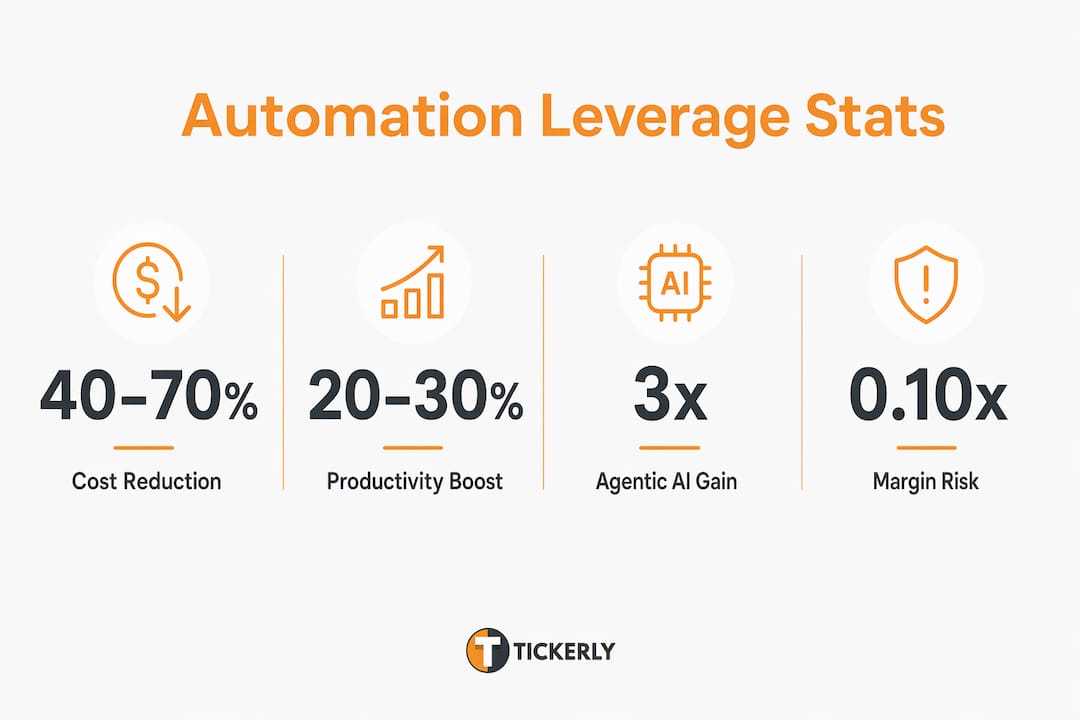
Financial institutions using AI-powered RPA report 40–70% reductions in processing costs and 20–30% productivity improvements as of early 2026. Those numbers reflect what happens when repetitive, rule-based tasks are removed from human workflows and handed to systems that never sleep, never hesitate, and never second-guess a signal.
The productivity gap widens further when systems move beyond basic bots. Transitioning to agentic AI systems yields a 3x productivity increase and 80% cycle time reduction compared to early-wave AI adoption, which delivered only 10–20% gains. That gap matters for traders because cycle time in trading directly translates to execution latency. A system that cuts cycle time by 80% can enter and exit positions faster, capture tighter spreads, and run more strategies in parallel.
The ROI case is concrete. Automating 10 work hours per week for an employee costing $35 per hour saves roughly $18,200 annually. For a trading operation, those freed hours represent analyst capacity redirected toward strategy development, backtesting, and risk review rather than manual order management.
| Metric | Early-wave automation | Agentic AI systems |
|---|---|---|
| Productivity gain | 10–20% | 3x increase |
| Cycle time reduction | Minimal | 80% |
| Processing cost reduction | Moderate | 40–70% |
| Human oversight required | High | Reduced |
Pro Tip: Before deploying a bot, benchmark your current manual execution time per trade. That baseline lets you calculate actual cycle time reduction and justify the automation investment with real numbers.
What practical forms does leverage take in automated trading?
Technology creates leverage by automating repetitive pattern work, freeing human capacity for strategic tasks that drive revenue growth. In trading, this takes several distinct forms, each with its own risk and return profile.

The most direct form is signal automation. A bot connected via API to a platform like TradingView processes Pine Script alerts and executes orders in milliseconds. No human reaction time. No emotional hesitation on a volatile candle. The bot applies the same logic to the 500th trade as it did to the first.
Margin leverage is the second form. Automated systems can manage leveraged positions at a scale and speed no manual trader can match. A bot running a 5x leveraged futures strategy on a crypto exchange can monitor margin ratios, adjust position sizes, and trigger stop-losses faster than a human can read a price feed. This is where automation leverage and financial leverage intersect most directly.
The third form is portfolio-level parallelism. A single automated system can run multiple uncorrelated strategies simultaneously across different assets and timeframes. That is operational leverage in its purest form: one system doing the work of many traders.
Common leverage mechanisms in automated trading include:
-
Algorithmic signal execution: Bots execute buy and sell orders based on predefined conditions without manual input, removing latency from the decision loop.
-
Position sizing automation: Systems calculate lot sizes based on account equity and risk parameters, applying consistent risk management across every trade.
-
Multi-strategy deployment: Running several independent strategies in parallel multiplies exposure to profitable setups without multiplying headcount.
-
Automated risk controls: Stop-loss, take-profit, and trailing stop orders execute automatically, protecting capital even when markets move overnight.
-
Backtesting pipelines: Automated backtesting lets you test hundreds of parameter combinations in hours rather than weeks, accelerating strategy refinement.
You can explore how brokers power efficient trading through these automation layers to understand the infrastructure behind each mechanism.
What are the risks and pitfalls of leveraging automation for trading?
Automation that adds complexity without clear output destroys leverage rather than creating it. Agentic AI requires redesigning processes end-to-end rather than automating broken workflows. A bot built on a flawed manual strategy does not fix the strategy. It executes the flaw faster and at greater scale.
The measurement gap is the most common failure point. Failure to measure ROI on automation, such as hours saved and revenue impact per task, leads to budget cuts within 90 days and project failure. Traders who deploy bots without tracking execution quality, slippage, and net P&L per strategy cannot distinguish a profitable automation from a costly one.
Financial leverage compounds this risk. Every 100 basis points of margin retained by automation corresponds to a 0.10x to 0.25x DSCR uplift on financed projects, which shows how automation affects creditworthiness and debt capacity. For traders using margin accounts, automation that mismanages position sizing can trigger margin calls at machine speed, turning a manageable drawdown into a forced liquidation.
The role of automation in risk management is well documented, but the risk of over-automation is underappreciated. Deploying too many bots across too many strategies without governance creates tool sprawl. Each bot becomes a liability rather than an asset.
Pro Tip: Audit every automated process quarterly. If a bot has not generated measurable positive P&L or saved documented time within 90 days, shut it down and reallocate resources to a higher-leverage use case.
Strategies to maximize automation leverage in trading
The highest-leverage AI use cases are repeatable, customer-facing tasks with measurable outputs. In trading, the equivalent is any process that runs on fixed rules and produces a quantifiable result: signal generation, order routing, position sizing, and performance reporting.
Start with the processes that run most frequently. A strategy that generates 50 signals per day benefits more from automation than one that generates two signals per week. Frequency multiplies the value of each percentage point of efficiency gained.
Set measurement metrics before you deploy, not after. Track time saved per trade, cost per execution, slippage versus backtested results, and net P&L per strategy. Companies embedding AI as a strategic asset achieve long-term margin expansion beyond short-term cost savings. Traders who treat their bots as strategic infrastructure, not just convenience tools, build compounding advantages over time.
Scale gradually. Start with one strategy on one asset class. Validate performance over 30–60 days. Then add a second strategy only after the first shows consistent results. This approach minimizes disruption and keeps your risk exposure legible.
| Strategy | Leverage level | Risk level | Best for |
|---|---|---|---|
| Single-strategy signal bot | Moderate | Low | Beginners validating automation |
| Multi-strategy parallel deployment | High | Moderate | Active traders with tested systems |
| Agentic AI workflow automation | Very high | Moderate to high | Experienced traders with governance frameworks |
| Leveraged position management bot | High | High | Futures and margin traders with strict risk controls |
For traders building their first automated system, automation strategies for beginners provide a structured starting point that avoids the most common deployment mistakes.
Key Takeaways
Automation leverage multiplies trading output only when built on tested strategies, clear metrics, and disciplined risk controls.
| Point | Details |
|---|---|
| Operational leverage defined | Automation multiplies output per unit of input, cutting cycle time and processing costs by up to 70%. |
| Agentic AI outperforms basic bots | Agentic systems deliver 3x productivity gains versus 10–20% from simple bot deployments. |
| Measurement prevents failure | Track P&L, slippage, and time saved before and after deployment to sustain funding and results. |
| Financial leverage amplifies risk | Automated margin management can trigger forced liquidations at machine speed without proper controls. |
| Scale gradually with governance | Validate one strategy before adding more; tool sprawl destroys leverage and creates unmanageable risk. |
Tickerly puts automation leverage to work for your trading
Tickerly converts your TradingView strategies into fully functional trading bots without requiring you to write a single line of code. The platform connects directly to major exchange platforms via API, delivering execution speed that captures opportunities manual trading misses entirely.
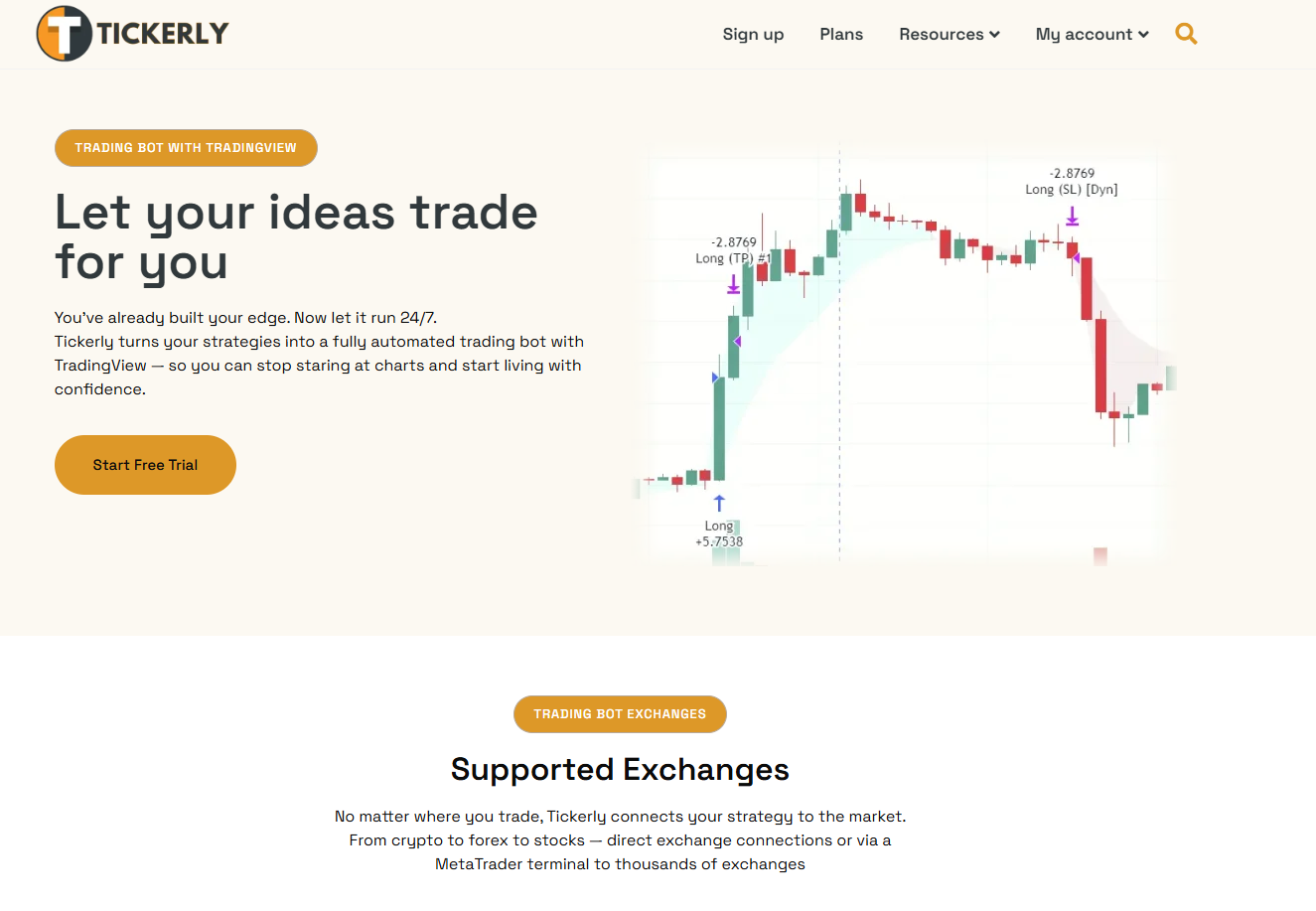
Tickerly handles multiple strategies simultaneously, giving you the parallel deployment that defines true operational leverage. Whether you trade crypto, forex, or stocks, the platform’s real-time alert system and automated bot capabilities keep your strategies running continuously, emotion-free. Traders who want to go deeper can review the automated trading FAQ or explore TradingView automation setup to get their first bot live.
FAQ
What is the role of leverage in automation for trading?
Leverage in automation multiplies a trader’s output by executing strategies at scale and speed no manual process can match. Operational leverage in this context means more trades, more strategies, and more consistent risk management from a single automated system.
How does automation improve trading profitability?
AI-powered automation reduces processing costs by 40–70% and improves productivity by 20–30%, according to financial institution data from 2026. In trading, those gains show up as lower execution costs, faster fills, and the ability to run multiple profitable strategies in parallel.
What are the biggest risks of using leverage in automated trading?
The primary risks are over-leverage in margin positions, failure to measure bot performance, and deploying automation on flawed strategies. Automated systems execute errors at machine speed, so a broken strategy becomes a larger problem faster than it would in manual trading.
How do I measure the ROI of my trading automation?
Track slippage versus backtested results, net P&L per strategy, and execution time per trade before and after deployment. Failing to establish these baselines before launch is the leading cause of automation project failure within the first 90 days.
What is the difference between basic bots and agentic AI in trading?
Basic bots execute predefined rules and deliver 10–20% productivity gains. Agentic AI systems manage entire workflows autonomously, redesigning the process end-to-end, and deliver up to 3x productivity increases with 80% cycle time reduction.