

TL;DR:
- Tickerly offers real-time, multi-asset automation for TradingView alerts without coding, making it a strong Gainium.io alternative. It supports fast execution across crypto, forex, stocks, and futures, with unlimited strategies and a free trial. Choosing the right platform depends on your latency needs, asset coverage, and preferred setup complexity.
For TradingView-driven day traders who need real-time, multi-asset execution, Tickerly is the strongest Gainium.io alternative — it converts your Pine Script alerts into live bot orders across crypto, forex, stocks, futures, and prop firm accounts with no-code setup and ultra-fast execution.
Here is the short list of viable gainium.io alternatives ranked by use case:
-
Tickerly — Best overall for TradingView-native automation, multi-asset support, and fast migration. Recommended.
-
PineConnector — Best for traders who want a lightweight TradingView-to-MetaTrader webhook bridge with minimal overhead.
-
Autoview — Best for simple, browser-extension-based alert routing when you do not need a full bot platform.
-
3Commas — Best for traders who want a managed bot marketplace with DCA and grid strategies and do not require TradingView as the primary signal source.
-
DIY webhook + serverless — Best for developers who need maximum customization and are comfortable with cloud infrastructure.
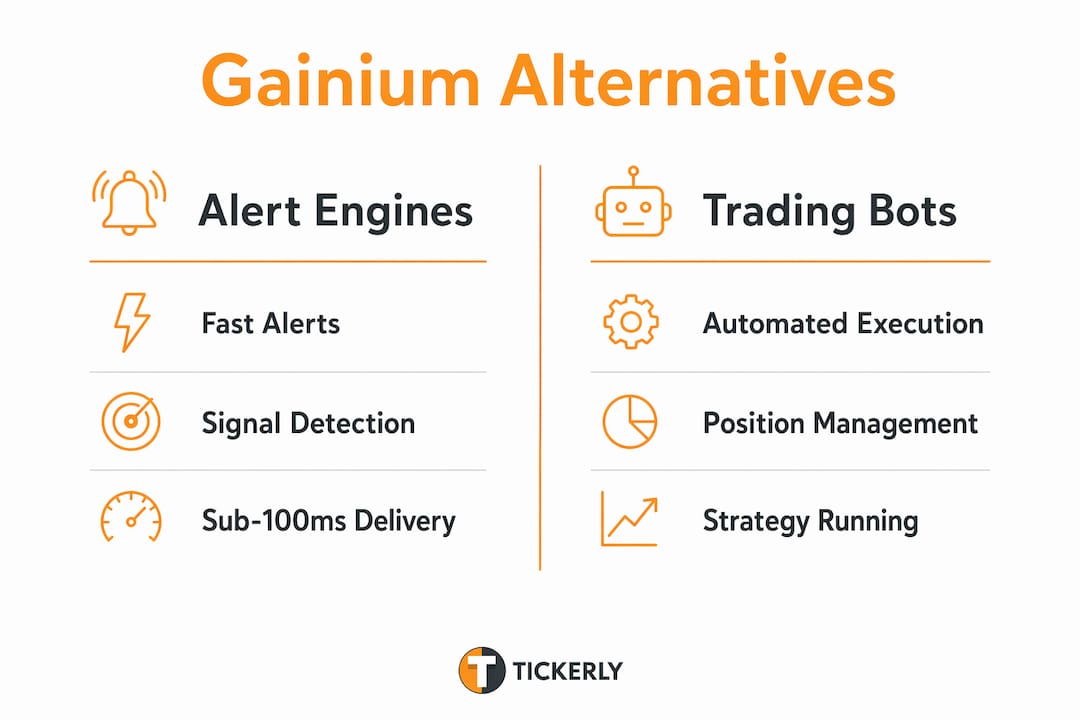
The core mistake most traders make when searching for similar sites to gainium.io is conflating alert engines with bot platforms. Knowing which category your edge actually belongs to is the decision that determines everything else.
Table of Contents
-
How do you choose the right Gainium alternative for your TradingView workflows?
-
Alert engine vs. continuous trading bot — which does your edge actually need?
-
The case for getting the category right before you pick a platform
-
Tickerly: the fastest path from TradingView alert to live trade
How do Gainium.io alternatives compare side by side?
The table below covers the dimensions that matter most for active TradingView traders evaluating gainium.io competitors.

| Dimension | Tickerly | Gainium | PineConnector | Autoview | 3Commas | DIY Webhook + Serverless |
|---|---|---|---|---|---|---|
| Best for | TradingView multi-asset bot automation | Crypto bot trading (grid, DCA, TA) | TradingView-to-MT4/MT5 forex execution | Simple alert routing via browser | DCA/grid bot marketplace | Full custom control |
| Pricing / trial | Tiered subscription; 30-day free trial | Free-forever plan; paid for screener | Subscription; trial available | Subscription; trial available | Subscription; free trial | Infrastructure cost only |
| Asset classes | Crypto, forex, stocks, futures, prop firm | Crypto | Forex (MT4/MT5) | Crypto, forex | Crypto | Any (developer-defined) |
| Exchange integrations | Multiple via API | Crypto exchanges via API | MT4/MT5 brokers | Multiple exchanges | Multiple crypto exchanges | Any (self-built) |
| TradingView integration | Webhook (native) | Webhook | Webhook | Browser extension | Webhook | Webhook (custom) |
| Execution latency | Sub-100ms target | Bot-execution focused | Low (broker-dependent) | Extension-dependent | Bot-execution focused | Developer-defined |
| Setup complexity | No-code | Low-code | Low-code | Very low | No-code | High (developer) |
| Alert / strategy limits | Unlimited strategies and alerts | Plan-dependent | Plan-dependent | Plan-dependent | Plan-dependent | Unlimited (self-managed) |
| API key security | Encrypted storage | Encrypted storage | Broker-side | Browser-stored | Encrypted storage | Self-managed |
Key differentiators at a glance:
-
Tickerly: Widest asset class coverage among no-code options; TradingView-native webhook with unlimited strategy compatability.
-
Gainium: Configurable bot workflows (grid, DCA, combo, TA bots) with backtesting and paper trading; crypto-only.
-
PineConnector: Purpose-built for forex traders on MT4/MT5; not a general multi-asset platform.
-
Autoview: Lowest barrier to entry; browser extension limits reliability for production trading.
-
3Commas: Strong bot marketplace; TradingView is a signal source, not the core workflow layer.
-
DIY: Maximum flexibility; requires meaningful engineering time and ongoing maintenance.
Pro Tip: If your edge fires on breakout conditions and you need sub-100ms alert delivery, pair a dedicated alert engine with a bot platform rather than relying on a single tool for both jobs.
How do you choose the right Gainium alternative for your TradingView workflows?
The single most important question is this: does your strategy require sub-100ms alert latency, or does it run on continuous bot logic? Choosing the wrong category leads to poor platform fit regardless of how polished the UI looks.
Work through these criteria in order:
-
Latency requirement. Breakout scalps and order-book signals need sub-100ms execution. Grid and DCA strategies tolerate higher latency.
-
Asset class coverage. Confirm the platform supports every market you trade — crypto, forex, stocks, futures, or prop firm accounts.
-
TradingView integration method. Webhook is the most reliable path; browser extensions introduce browser-uptime risk.
-
Concurrency and alert limits. If you run multiple strategies simultaneously, unlimited alert throughput matters.
-
API key handling. Look for encrypted storage, read-only key options, and documented audit logs.
-
Backtesting and paper trading. A paper-trade mode lets you validate fills before going live.
-
Pricing model. Flat monthly subscriptions are easier to budget than per-trade or per-alert fees.
Questions to ask during a trial:
-
What is the documented end-to-end latency from TradingView alert to exchange fill?
-
Where are API keys stored, and are they encrypted at rest?
-
Does the platform provide an alert log and audit trail?
-
What is the support response time for production issues?
Red flags to avoid:
-
Unverifiable latency claims with no published benchmarks.
-
No audit logs or alert history.
-
Unclear API key storage policy.
-
No paper-trade or sandbox mode before live deployment.
Large software directories list dozens of automation tools, but directory popularity is not a proxy for integration quality or latency performance. Prioritize platforms with documented exchange integrations and published trial tiers over those that simply appear on aggregator lists.
What does each alternative actually offer?
Tickerly
-
Core product: Converts TradingView Pine Script alerts into live bot orders via webhook across multiple exchanges.
-
Best for: Active day traders and algo traders who author strategies in TradingView and want no-code, multi-asset execution.
-
Pros: Unlimited strategies and alerts; covers crypto, forex, stocks, futures, and prop firm markets; 30-day free trial.
-
Cons: Requires a TradingView subscription to generate webhook alerts.
-
US availability: Yes.
Gainium
-
Core product: Crypto bot platform built around grid, DCA, combo, and TA bots with backtesting and paper trading; screener available on paid plans.
-
Best for: Crypto-only traders who want configurable continuous bots without writing code.
-
Pros: Free-forever plan; solid backtesting environment.
-
Cons: Crypto-only; screener locked to paid tiers; not optimized for TradingView-first workflows.
-
US availability: Yes.
3Commas
-
Core product: Cloud-based bot marketplace with DCA, grid, and signal bots; TradingView alerts supported as a signal source.
-
Best for: Traders who want pre-built bot templates and a managed environment.
-
Pros: Large bot marketplace; multi-exchange support.
-
Cons: TradingView is a secondary signal layer, not the primary workflow; pricing scales with active bots.
-
US availability: Yes.
Autoview
-
Core product: Browser extension that routes TradingView alerts to exchange APIs.
-
Best for: Traders who want the fastest possible setup with minimal configuration.
-
Pros: Extremely low barrier to entry; no server required.
-
Cons: Browser-dependent uptime; not suitable for 24/7 production trading.
-
US availability: Yes.
PineConnector
-
Core product: Webhook bridge connecting TradingView alerts to MT4/MT5 brokers.
-
Best for: Forex traders already on MetaTrader who want to automate Pine Script signals.
-
Pros: Direct MT4/MT5 integration; low setup friction for forex traders.
-
Cons: Forex and CFD focus; not a multi-asset bot platform.
-
US availability: Yes (broker-dependent).
DIY webhook + serverless
-
Core product: Custom-built pipeline using TradingView webhooks, a serverless function (AWS Lambda, Google Cloud Functions), and exchange APIs.
-
Best for: Developers who need logic that no commercial platform supports.
-
Pros: Unlimited customization; no vendor lock-in.
-
Cons: Requires engineering time, ongoing maintenance, and self-managed security. Community-driven open-source projects can accelerate the build, but production reliability is your responsibility.
-
US availability: Yes.
Alert engine vs. continuous trading bot — which does your edge actually need?
Many retail traders search for “trading bots” when their actual edge requires real-time alerting. These are different tools solving different problems.
Use a sub-100ms alert engine when your strategy depends on:
-
Breakout scalps triggered by price crossing a key level.
-
Order-book or CVD-based signals that decay within seconds.
-
Scanning hundreds of pairs simultaneously for pattern triggers.
Use a continuous execution bot when your strategy runs on:
-
Grid or DCA logic that rebalances on a schedule or price band.
-
Longer intraday mean-reversion setups where a few hundred milliseconds of latency is irrelevant.
-
Multi-leg position management that needs persistent state.
Specialized breakout alert engines can scan 500+ pairs and fire alerts in under 100 milliseconds. General-purpose bot platforms prioritize continuous execution over raw alert speed. Neither is universally better — the right choice depends entirely on your edge.
Pro Tip: For the best of both worlds, use an alert engine to detect your signal and a bot platform like Tickerly to execute it. TradingView sits in the middle as the strategy authoring layer, sending webhooks to whichever execution engine fits your trade type.
How do you migrate from Gainium to another provider?
A one-day pilot is realistic. A full production switch takes about a week if you are methodical.
Day 1 — Pilot:
-
Inventory all active Gainium strategies: note bot type (grid, DCA, TA), asset pairs, and alert conditions.
-
Export or document your Pine Script logic and webhook payload formats.
-
Create new API keys on your target exchange with read-only permissions first; upgrade to trade permissions only after paper-trade validation.
-
Connect TradingView to your new platform using the TradingView webhook setup guide.
-
Run paper trading for at least 4–6 hours across your primary strategy.
-
Confirm end-to-end latency and fill accuracy against your Gainium baseline.
Days 2–7 — Production switch:
-
Move one live strategy at a time; keep Gainium running in parallel until each migrated strategy has 48 hours of clean fills.
-
Verify audit logs and alert history on the new platform daily.
-
Keep a rollback plan: do not close your Gainium account until all strategies are confirmed stable.
Cost estimate: Most platforms offer a free trial period, so direct subscription cost during the pilot is minimal. DIY webhook builds add engineering time — typically several hours to a full day for a basic serverless setup, plus ongoing maintenance.
Key Takeaways
For TradingView traders evaluating gainium.io alternatives, Tickerly is the recommended starting point: it covers the widest asset class range with no-code setup, unlimited strategies, and a 30-day free trial.
| Point | Details |
|---|---|
| Match tool to edge type | Sub-100ms latency matters for breakout scalps; continuous bots suit grid and DCA strategies. |
| Tickerly covers the most ground | Crypto, forex, stocks, futures, and prop firm markets — all from TradingView webhooks, no code required. |
| Migration takes one day to pilot | Inventory strategies, run paper trading, confirm latency and fills before going live. |
| Red flags to reject fast | No audit logs, unverifiable latency claims, and unclear API key storage are disqualifying. |
| Start with a free trial | Tickerly’s 30-day trial lets you validate TradingView integration and execution speed before committing. |
The case for getting the category right before you pick a platform
Most comparison articles focus on feature checklists. The more useful question is whether you have correctly identified what your edge actually requires. A breakout trader who picks a DCA bot platform because it has a polished UI will get poor fills and blame the tool — when the real problem was a category mismatch from the start.
Gainium is a well-built product for crypto bot trading. Traders who are leaving it are usually doing so because they need broader asset coverage, a tighter TradingView integration, or faster execution on signal-driven strategies. Those are legitimate reasons to switch, and they point toward a specific category of replacement rather than a generic “better” platform.
The hybrid setup — alert engine for detection, bot platform for execution, TradingView for strategy authoring — is the architecture that most active day traders end up at after enough trial and error. Starting there deliberately saves weeks of iteration.
This article is published by Tickerly, which is one of the platforms compared above. The 30-day free trial exists precisely so you can validate execution quality against your own strategies before paying anything.
Tickerly: the fastest path from TradingView alert to live trade
If you have been running strategies in TradingView and want them executing automatically across crypto, forex, stocks, or futures without writing infrastructure code, Tickerly closes that gap directly. The 30-day free trial gives you enough time to run a full pilot: connect your TradingView account, configure a webhook alert on one strategy, and watch it execute on a paper account before touching live capital.
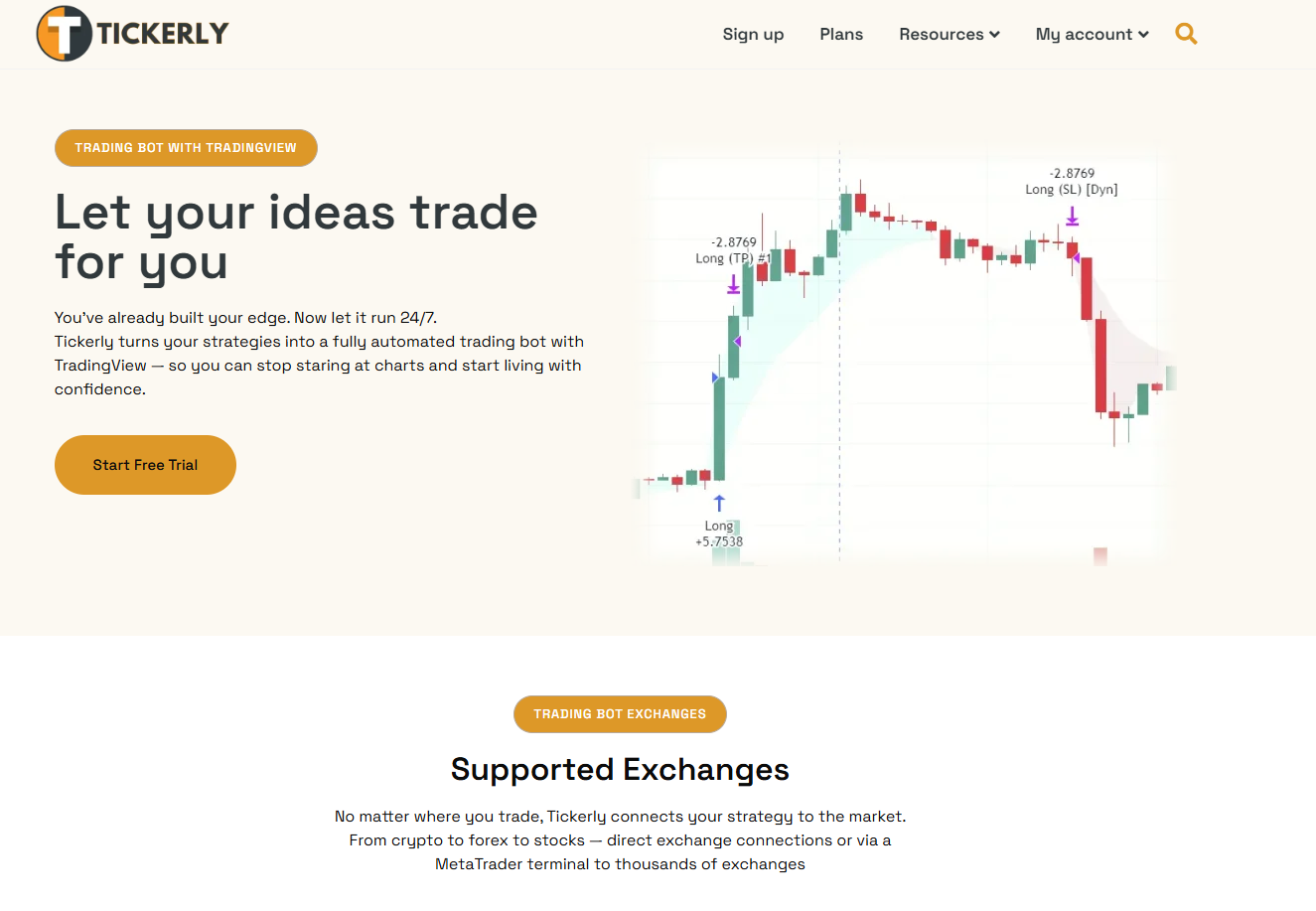
During your trial, verify four things: end-to-end latency from alert to fill, accuracy of fills against your Pine Script logic, the alert log and audit trail for every order, and support response time if something breaks. Tickerly supports automated trading on TradingView across all major asset classes, with encrypted API key storage and no cap on the number of strategies you can run simultaneously.
Start your free trial at Tickerly and run your first automated strategy today.
Useful sources and docs to read next
-
Tickerly: How to Automate Trading on TradingView — Step-by-step integration guide for connecting TradingView webhooks to Tickerly bots.
-
Tickerly: Supported Exchanges — Full list of exchange API integrations.
-
Tickerly: Alert Log Documentation — Audit trail and alert history reference.
-
Best Gainium Alternative (2026) — Crypto Breakout Scanner — Latency benchmarks and alert engine vs. bot platform analysis.
-
Open-Source Gainium Alternatives — SaaSHub — Community-driven and self-hosted options for developers.
-
Tickerly: Manual vs. Automated Trading Guide — Decision framework for traders choosing between manual and automated workflows.
FAQ
What is the best Gainium.io alternative for TradingView users?
Tickerly is the top pick for TradingView-driven traders: it converts Pine Script alerts into live bot orders across crypto, forex, stocks, futures, and prop firm markets with no-code setup and a 30-day free trial.
Does Gainium support TradingView webhooks?
Gainium supports webhook-based alerts from TradingView, but its platform is optimized for continuous crypto bot strategies (grid, DCA, TA bots) rather than real-time, signal-driven execution across multiple asset classes.
What is the difference between an alert engine and a trading bot platform?
An alert engine detects signals and fires notifications in sub-100ms; a bot platform executes and manages ongoing positions. Breakout scalpers need the former; grid and DCA traders need the latter.
How long does it take to migrate from Gainium to Tickerly?
A one-day pilot is realistic: inventory your strategies, configure a TradingView webhook, run paper trading, and confirm fills. A full production switch with parallel running takes about one week.
Are there free alternatives to Gainium.io?
Gainium offers a free-forever plan for basic bot trading. Tickerly provides a 30-day free trial. DIY webhook builds have no subscription cost but require engineering time and infrastructure management.