

Most traders who attempt automation for the first time don’t fail because they chose the wrong tool. They fail because they started too complex, too fast. The good news: automation strategies for beginners don’t require a coding background or a finance degree. What they require is a clear framework, the right entry points, and an honest understanding of risk. This article walks you through the criteria you need to evaluate before you start, five practical strategies you can implement now, a side-by-side comparison, and a step-by-step first implementation guide.
Table of Contents
Key takeaways
| Point | Details |
|---|---|
| Start with rule-based tasks | Automate repetitive, predictable tasks first before adding complexity or AI layers. |
| Risk guardrails are non-negotiable | Every automation setup needs stop-loss limits, kill switches, and manual override capability. |
| No-code tools lower the barrier | Platforms with prebuilt connectors let you automate workflows without writing a single line of code. |
| Paper trade before going live | Test your automation strategy in simulation mode before connecting it to real capital. |
| Verify any provider you use | Unregistered auto-trading services frequently mislead beginners with false profit claims. |
1. Criteria every beginner should assess before starting
Before you pick a tool or build a workflow, there are four foundational factors that will determine whether your automation actually helps you trade better or just adds noise and risk.
Is the task repeatable and rule-based?
The best candidates for automation are tasks you do the same way every time. Setting a price alert, logging a trade in a journal, pulling daily market data — these follow fixed rules. Process automation works by replacing sequences of manual steps with consistent, error-free workflows. If a task requires judgment calls that change every session, it’s not ready to automate yet.

Do you understand the risk exposure?
Automation executes without hesitation. That’s powerful and dangerous. Before you automate any trade-related action, you need a clear answer to this question: what happens if the automation fires at the wrong moment? Programmatic guardrails like daily loss limits, order size caps, and manual kill switches are not optional features. They are the foundation of safe trading automation.
Are you using beginner-friendly tools?
Not every automation platform is built for traders. Look for tools with visual workflow builders, prebuilt integrations, and active support communities. Microsoft Power Automate, for example, offers over 1,400 prebuilt connectors that let non-technical users build cloud-based automations without code. For trading-specific automation, TradingView-integrated platforms like Tickerly give you signal generation and execution in one ecosystem.
Can you measure and adjust?
Automation that you can’t monitor is automation you can’t trust. Before you flip the switch on any workflow, define what success looks like. Track execution accuracy, missed signals, and any unexpected behavior. Incremental building and measurement are the two habits that separate traders who scale automation successfully from those who abandon it after one bad week.
Pro Tip: Before automating anything, write down the exact steps you take manually. If you can’t describe a task in five steps or fewer with no judgment required, it’s too complex to automate right now.
2. Rule-based price alerts and trade monitoring
This is the single most accessible entry point for automation techniques for newbies. Rule-based alerts watch the market for you and fire a notification when specific conditions are met: a price crosses a moving average, volume spikes above a threshold, or RSI hits an oversold level.
You don’t execute trades from these alerts automatically at first. You receive the signal, review it, and decide. This semi-manual approach builds familiarity with how automation logic works without putting capital at risk from an untested system. TradingView Pine Script makes this particularly accessible. You define your conditions in plain logic, and the platform handles the monitoring 24 hours a day.
This is also where you begin learning to think in rules, which is the core skill behind every more advanced automation strategy you will build later.
3. No-code workflow automation for journaling and data handling
Trade journaling is one of the highest-value habits in trading and one of the most neglected because it’s tedious. No-code workflow tools solve this directly. You can set up a workflow that automatically logs every completed trade into a spreadsheet, pulls in the timestamp, ticker, and price, and even categorizes it by strategy.
Tools with large connector libraries make this kind of setup achievable in under an hour without writing code. The result is a living, searchable record of your trading activity that you can analyze weekly.
Beyond journaling, these tools handle data aggregation. You can pull news feeds, economic calendar events, or price data from multiple sources into a single dashboard automatically. This is the intro to automation that most beginners don’t think of because it doesn’t feel like “trading automation.” It is. Cleaner data leads to sharper decisions.
4. API-based trade execution with hard risk limits
This is where automation moves from notification to action. API-based execution connects your strategy logic directly to your broker or exchange. When conditions are met, orders are placed automatically. The speed advantage here is real: automated execution happens in milliseconds versus the seconds it takes a human to click.
The non-negotiable requirement is to embed risk controls directly into your TradingView strategy script. Before any trade is executed, the script must verify: Is the order size within limits? Has the daily loss threshold been exceeded? Is the kill switch activated? These risk checks should be integrated into the decision-making logic and cannot be bypassed.
Start with paper trading. Automating pre-trade tasks before going live gives you a chance to catch logic errors and unexpected behavior without losing real capital. Most TradingView-integrated execution platforms support simulation modes.
5. Layering automation complexity gradually
The most common mistake in beginner automation is trying to build a fully autonomous trading system on day one. That approach fails. What works is the simple, repeatable task first approach: pick one workflow, make it reliable, then add a layer.
A practical progression looks like this:
-
Week 1: Automate one price alert and one journaling workflow
-
Week 2: Add a signal filtering layer to your alert system
-
Week 3: Run a paper trading execution bot using your TradingView strategy
-
Week 4: Review results, fix logic errors, and extend the testing period
-
Month 2: Move to live execution with strict position size and loss limits
Each layer builds on a stable foundation. You don’t add API execution until your signals are reliable. You don’t scale position sizes until your execution is consistent. This pacing is not caution for caution’s sake. It’s the architecture of a system you can actually trust.
Comparing beginner automation strategies
| Strategy | Technical skill required | Risk level | Best tool type | Success scenario |
|---|---|---|---|---|
| Rule-based price alerts | Low | Very low | TradingView, Pine Script | Consistent signal monitoring without manual watching |
| No-code journaling workflows | Very low | None | Power Automate, Zapier | Automated trade logs, data aggregation |
| API-based trade execution | Medium | Medium to high | Tickerly + TradingView bot | Faster execution with risk guardrails in place |
| Layered complexity approach | Grows over time | Scales with system | All of the above | Full semi-automated strategy after 60 to 90 days |
Pro Tip: If you’re evaluating a platform or service that promises automated profits with no risk, check whether they are registered with FINRA. Unregistered services frequently make misleading claims and offer no investor protections.
How to implement your first automation strategy
Follow these steps to get from zero to a working automation in your first week.
-
Identify one repetitive task. Choose something you do manually at least three times per week: setting alerts, logging trades, or pulling price data. This is your automation target.
-
Choose an accessible tool. For alerts and execution, start with TradingView. For data workflows and journaling, start with a no-code tool that has prebuilt trading or spreadsheet connectors.
-
Map the workflow in plain language. Write out every step the automation needs to take. “When price crosses above the 50-day moving average, send me a Telegram notification” is a complete, automatable instruction.
-
Build and test in simulation. Run the automation in paper trading or test mode for at least one full week. Log every trigger and check whether the logic fired correctly. Version your workflow from day one so you can roll back changes if something breaks.
-
Review and iterate weekly. Check execution logs, missed signals, and any unexpected behavior. Small adjustments compound over time into a system that genuinely fits your trading process.
Pro Tip: Beginners get the best early results by starting with repetitive weekly tasks they already understand well, then expanding gradually. Avoid the temptation to jump straight to full execution automation.
My honest take on beginner automation mistakes
I’ve seen dozens of traders start their automation journey with the same blind spot: they treat automation as a shortcut to profits rather than a tool for consistency. The result is always the same. They build something complex too quickly, it behaves unexpectedly, and they either lose money or abandon automation entirely.
What I’ve found actually works is the opposite approach. Start so small it almost feels pointless. Automate one alert. Then one journal entry. Get comfortable with the fact that the system does what you told it to do, not what you meant to tell it. That gap between intent and instruction is where most beginner losses come from.
The other issue I keep seeing is trust in unverified providers. SEC litigation in 2025 exposed services that falsely marketed automated trading bots promising unrealistic returns, while never actually using bots at all. That’s not an edge case. It’s a pattern. If someone is selling you a black box system with guaranteed returns, walk away.
The traders who succeed with automation treat it as an operational discipline. They version their workflows, assign clear ownership, set failure alerts, and review their setups quarterly. That discipline is what separates a system that compounds improvements from one that slowly drifts into chaos.
— Jay
Ready to automate your TradingView strategy?
If you’ve read this far and you’re ready to move from theory to execution, Tickerly is built for exactly this moment. Tickerly turns your TradingView Pine Script strategies into fully automated trading bots without requiring you to build your own infrastructure.
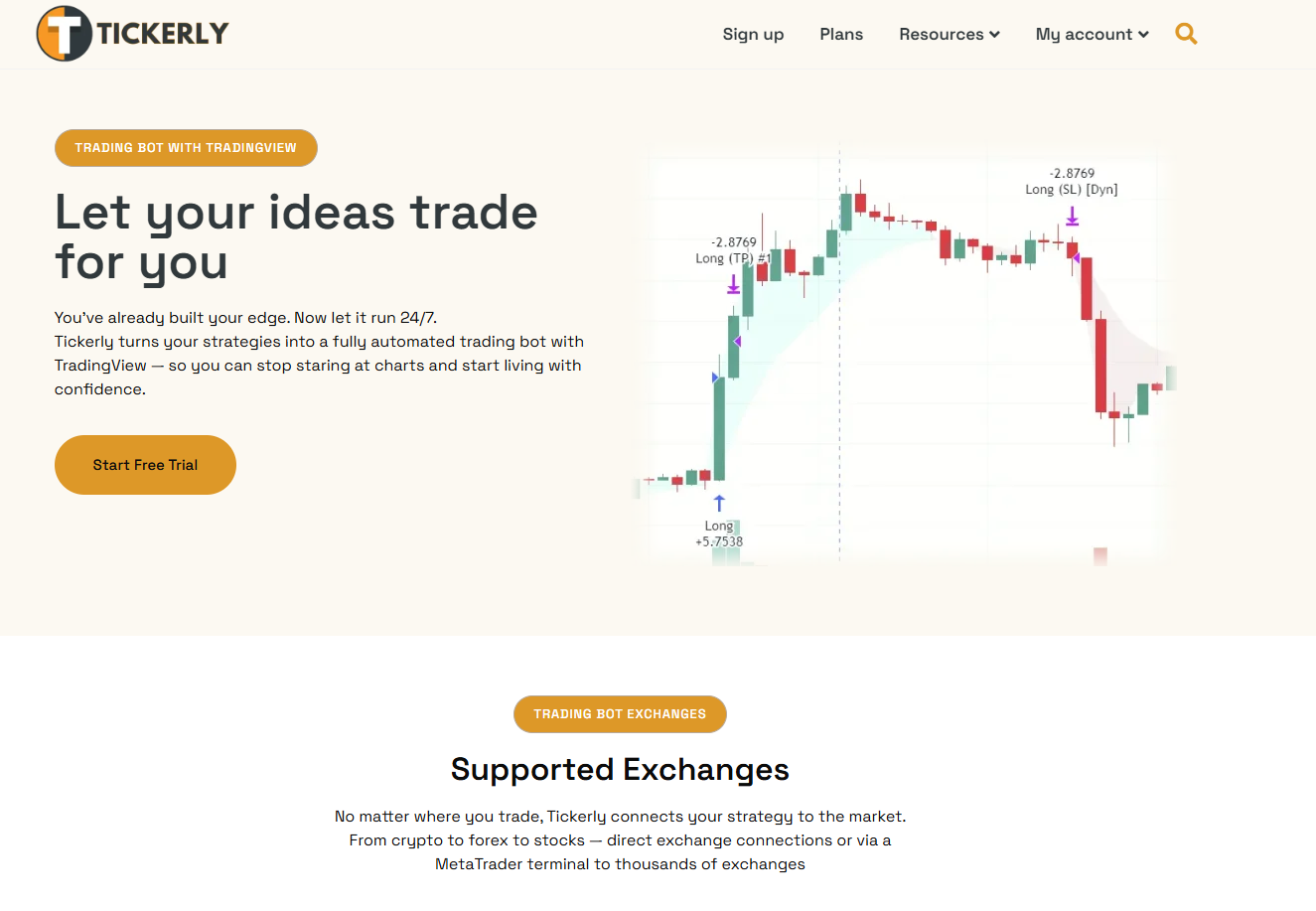
You connect your TradingView strategy, set your risk parameters, and Tickerly handles the execution layer. It’s designed for traders who understand their strategy and want reliable, fast execution without managing servers or writing API code from scratch. Explore automated bot benefits to see how automation translates into real trading efficiency. If you’re just getting started, the Tickerly automated trading FAQ covers the most common beginner questions about setup, safety, and getting your first bot live.
FAQ
What are the best automation strategies for beginners?
The best automation strategies for beginners start with rule-based price alerts and no-code journaling workflows, then layer in semi-automated signal filtering and API-based execution only after testing in simulation. Building incrementally with clear measurement at each stage produces the most reliable outcomes.
Do I need coding skills to automate trading tasks?
No. Many beginner automation tools, including TradingView for alerts and no-code workflow platforms for data handling, require no programming. TradingView Pine Script uses a readable syntax that most beginners can learn through examples, and platforms like Tickerly remove the execution infrastructure entirely.
How do I stay safe when using automated trading tools?
Use programmatic risk guardrails including daily loss limits, position size caps, and a manual kill switch on every automation. Verify that any third-party service you use is registered with FINRA or the relevant regulatory body before connecting it to your capital.
What is the biggest mistake beginners make with automation?
Most beginners skip the simulation phase and move directly to live execution without testing their logic. Starting with paper trading before going live catches logic errors and edge cases that are invisible until the market creates an unusual condition your workflow wasn’t designed to handle.
How long before I can run a fully automated trading strategy?
A realistic timeline for most beginners is 60 to 90 days of layered progression, starting from simple alerts and ending with a tested, risk-controlled execution bot. Rushing this timeline increases the chance of meaningful losses from untested logic.