

The algorithmic trading market is on pace to grow from $21.9 billion in 2025 to $25.0 billion in 2026, driven by a compound annual growth rate of 14.4%. For traders using TradingView, this expansion signals both opportunity and pressure. The strategies and automation tools that delivered consistent returns in previous years are facing new tests from adaptive AI systems, regime-driven volatility, and deeper execution complexity. This article breaks down the most important trends reshaping algorithmic trading in 2026, compares competing strategies with real performance data, and gives you a practical framework for choosing and deploying your best-fit approach.
Table of Contents
Key Takeaways
| Point | Details |
|---|---|
| AI-rule hybrids lead | Combining AI methods with rule-based filters outperforms using either approach alone in 2026. |
| Adaptive systems win | Dynamic, regime-aware bots consistently outperform static strategies amid market changes. |
| Simplicity wins on risk | Momentum and equal-weight strategies deliver the best risk-adjusted returns, beating many complex models. |
| Robust deployment is key | Strong real-world results require careful attention to execution, live regime adaptation, and step-by-step system deployment. |
How 2026 reshapes the criteria for winning with algorithms
With the stakes and speeds rising in 2026, let’s clarify what matters most when evaluating automated trading approaches.
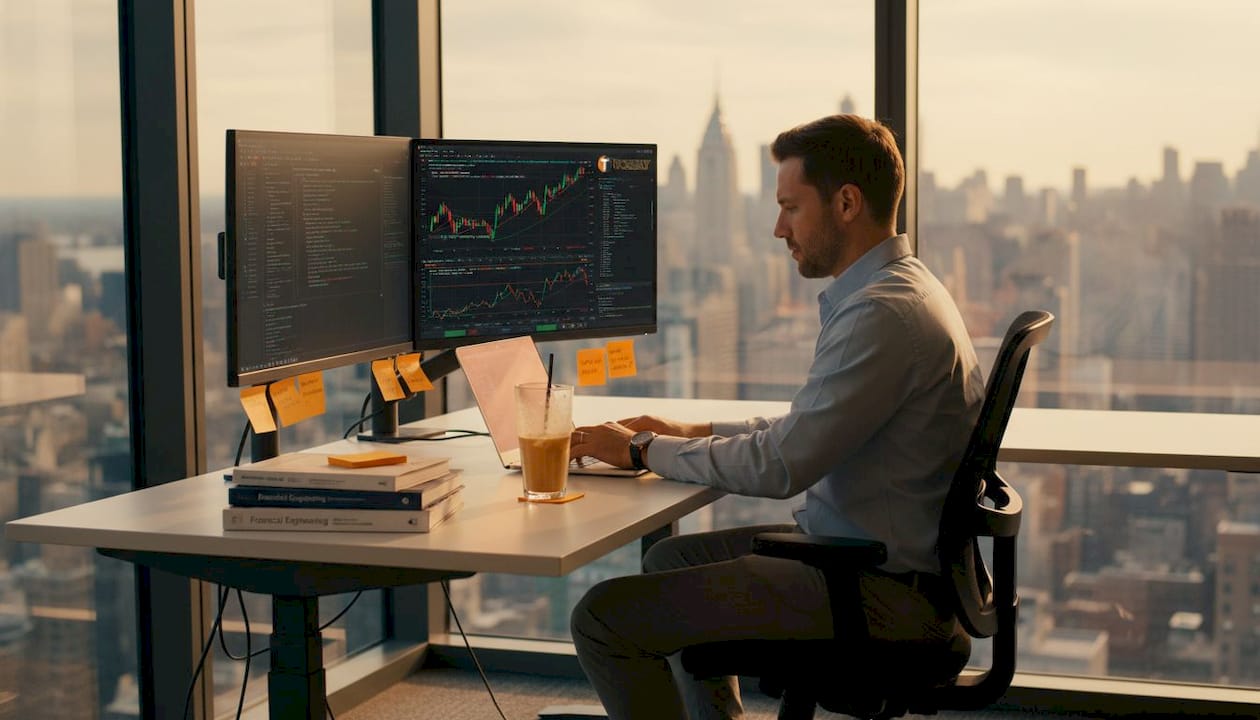
The automated segment alone is projected to grow from $24 billion in 2025 to $27.17 billion in 2026, reflecting a CAGR of 13.2%. This is not just incremental growth. It represents a structural shift in how capital flows through markets, with more participants using automation than ever before. That creates a more competitive environment where execution quality, latency, and adaptiveness all matter more than they did just two years ago.
What’s driving this growth? Three forces are converging simultaneously:
-
AI integration at the indicator and execution layer, enabling faster signal generation
-
Improved connectivity between platforms like TradingView and live brokers
-
Regime volatility from macroeconomic conditions that punish static, fixed-rule systems
The challenge is that not all traders are ready to capitalize on AI. 54% of quants are not integrating generative AI into their trading systems, citing data quality and governance concerns as the primary blockers. This matters because governance gaps in AI-driven systems can lead to over-trading, drawdown amplification, and unpredictable behavior during market stress.
The new evaluation criteria for algorithmic strategies in 2026 go well beyond historical Sharpe ratios:
-
Adaptiveness: Can the strategy adjust its parameters in response to regime changes?
-
AI integration quality: Does the AI component improve signal clarity or add noise?
-
Real-world robustness: Does performance hold up under live execution conditions, not just backtests?
-
Regime awareness: Is the strategy calibrated for the current volatility environment?
You can read more about boosting efficiency through trading bots to understand why basic automation is now a baseline, not a differentiator.
The top 5 algorithmic trading trends for 2026
Now, with the framework clear, let’s break down the specific innovations and approaches leading the pack this year.
-
Hybrid AI and rule-based indicators on TradingView. The most consistent performers in 2026 are not pure AI systems or pure rule-based systems. They are hybrids. Research shows that hybrid AI indicators combining rule-based SMC concepts like order blocks and fair value gaps with adaptive filtering consistently outperform either approach alone. On TradingView, this translates to Pine Script strategies that use structural price logic as a base filter while an AI layer adjusts entry thresholds based on recent volatility or momentum.
-
Agentic and adaptive bots replacing static models. Static bots with fixed parameters are increasingly losing edge to agentic systems that monitor their own performance and adjust in real time. These bots treat market conditions as dynamic inputs rather than fixed variables. The result is a strategy that behaves differently in a trending market versus a ranging one, without requiring manual reconfiguration from the trader.
-
Regime-aware grid bots for crypto. Grid bots have made a strong comeback, but only in their more sophisticated form. A regime-adaptive grid bot tested on SOL delivered out-of-sample returns of +149.2% over 15 months with a Sharpe ratio of 2.27 and Sortino ratio of 2.87 using walk-forward analysis. This is a meaningful benchmark. It shows that when grid spacing, upper and lower bounds, and position sizing are tied to regime detection, the performance gap between grid bots and more complex models narrows significantly. You can explore crypto grid bot performance benchmarks to see how these results compare across different asset classes.
-
Classic momentum strategies remain dominant. Despite all the attention on AI, momentum-based strategies continue to attract the majority of capital in algorithmic trading. Trend-following and breakout models remain reliable across multiple asset classes. They are transparent, easier to monitor, and their failure modes are well understood. Most experienced traders keep a momentum core in their portfolio even when layering in more advanced approaches.
-
Multi-agent systems and reinforcement learning. This is the frontier. Multi-agent reinforcement learning systems, where multiple specialized bots interact and learn from each other, are beginning to move from research environments into live trading. They are not yet mainstream on retail platforms, but understanding them now gives you an advantage as tooling becomes more accessible.
“The most effective approach is not choosing between AI and rules, but designing systems where each component compensates for the other’s known weaknesses.”
Pro Tip: When testing any hybrid or AI-based strategy, run a minimum of 12 months of out-of-sample data before evaluating live performance. Backtesting on the same data used for optimization is one of the most common reasons strategies fail in live markets.
For a practical starting point, see how automating TradingView strategies works end-to-end, or explore the broader landscape of algotrading innovations available on the platform.
Comparing performance: New vs traditional strategies
-
Complexity does not guarantee better risk-adjusted returns. The equal-weight benchmark outperformed more sophisticated models on a risk-adjusted basis.
-
Regime-adaptive systems shine in volatile asset classes. The SOL grid bot result is context-specific. It works because crypto exhibits well-defined ranging and trending regimes.
-
Transformer models need more data to win. AI approaches based on deep learning require significantly more training data and computational overhead to outperform simpler momentum strategies. That overhead must be justified by actual performance uplift.
You can find detailed breakdowns of top automated TradingView strategies that align with these performance profiles, or review how TradingView automation bridges strategy design and live execution.
The practical implication: before committing to a complex AI-driven system, benchmark it against a simple equal-weight or momentum baseline. If it cannot beat the baseline on a risk-adjusted basis, the added complexity is a liability, not an advantage.
Choosing and deploying your best-fit 2026 strategy
Armed with apples-to-apples comparisons, the next step is translating these insights into actual trading success for 2026.
Deployment quality matters as much as strategy quality. The 2026 roadmap for quant systems emphasizes end-to-end AI ecosystems with meta-labeling, quantum ML exploration, reinforcement learning, and critically, TradingView automation via Pine Script and webhooks connecting to multi-platform brokers including MT5 and cTrader. The infrastructure layer is no longer optional.
Here is a practical deployment workflow:
-
Define your regime. Identify whether your target asset is currently trending, ranging, or in high-volatility mode. Your strategy choice should flow from this, not the other way around.
-
Select and code your strategy in Pine Script. TradingView’s Pine Script environment gives you access to indicators, backtesting, and alert generation. Build your logic here first. Keep it modular so individual components can be swapped without rebuilding the entire system.
-
Run walk-forward validation. Divide your historical data into in-sample and out-of-sample segments. Optimize on the in-sample portion and evaluate on the out-of-sample portion. Repeat across multiple windows. This approach is far more predictive of live performance than standard backtesting.
-
Set up webhook-based automation. TradingView alerts can be routed via webhooks to execution platforms. This is the connection layer between your strategy logic and your live orders. Precision here directly impacts execution speed and fill quality.
-
Monitor and adapt. Set performance thresholds that trigger a strategy review. Do not wait for catastrophic drawdown. Inflationary or high-volatility regimes require shorter lookback periods, volatility circuit breakers, and dynamic cost modeling. What worked in a low-volatility environment will underperform when conditions shift.
The most common live failure modes are worth naming directly:
-
Data outages: A strategy that cannot handle missing data gracefully will generate erroneous signals during outages or exchange downtime.
-
Execution friction: Slippage and latency compound over thousands of trades. A strategy with tight profit margins can turn unprofitable purely from execution costs not accounted for in backtests.
Pro Tip: Use walk-forward validation with at least three separate out-of-sample windows before going live. This reduces the probability that your strategy is fitted to a specific historical episode rather than a repeatable market dynamic.
Review the autotrading on TradingView setup guide for a step-by-step walkthrough, or visit the automated trading FAQ for answers to the most common deployment questions.
Why the simplest strategies often outperform in 2026
After seeing how modern tools measure up, it’s worth re-examining what really drives robust trading gains in a new era.
There is a persistent bias in algorithmic trading toward complexity. More parameters, deeper learning layers, more signals feeding the model. The assumption is that more information and more sophistication will produce better outcomes. The 2026 data challenges that assumption directly.
Simple momentum consistently outperforms advanced Transformer neural network approaches on a risk-adjusted basis. Equal-weight portfolios, one of the most transparent allocation methods possible, post the highest Sharpe ratios among the strategies studied. This is not a coincidence. It reflects a structural reality: complex models are more likely to overfit to historical data, more difficult to monitor during live trading, and more likely to behave unexpectedly during regime shifts.
The practical implication for TradingView traders is significant. If you are spending weeks building an elaborate AI system that you cannot fully interpret, you are likely adding fragility, not edge. The strategies that hold up in live markets tend to be those where you understand every component well enough to diagnose a problem when performance degrades.
That said, advanced methods do have a legitimate place. Regime-change detection, for example, is genuinely improved by machine learning approaches that can process more variables simultaneously than a human trader can. Multi-agent systems are showing real promise in improving win rates through structured exploration. The key is using these tools surgically, at the decision points where their advantages are real, rather than replacing your entire framework with a black-box model.
The right balance for most TradingView traders in 2026 looks like this: a transparent, well-understood momentum or mean-reversion core, with an adaptive layer for regime detection and dynamic parameter adjustment. This gives you resilience, interpretability, and the ability to improve your system incrementally. You can review proven trading strategies that embody this principle to see what that balance looks like in practice.
Upgrade your TradingView automation with proven strategies
The trends and comparisons in this article point to one clear conclusion: 2026 rewards traders who combine well-validated strategy logic with reliable, low-latency automation infrastructure.
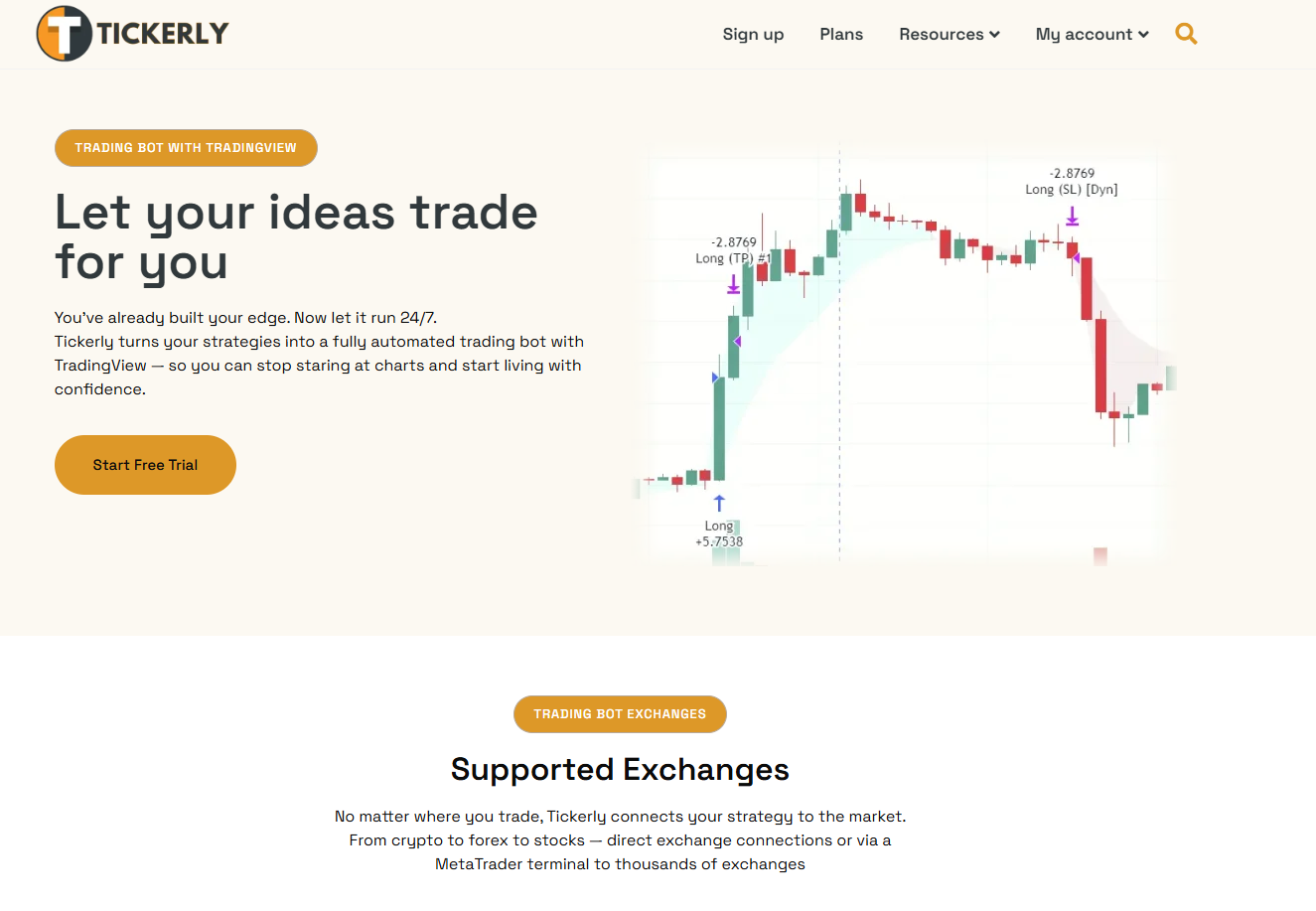
Tickerly is built specifically for TradingView traders who want to move from manual or semi-manual execution to fully automated, bot-driven trading without rebuilding their workflow from scratch. Whether you’re testing a regime-adaptive system or running a classic momentum approach, Tickerly handles the automation layer so your focus stays on strategy quality. Explore why automated bots boost efficiency for your specific setup, browse top TradingView strategies that are already performing in live markets, or learn more about algotrading on TradingView to understand how to build and deploy with confidence in 2026.
Frequently asked questions
What is the fastest-growing area in algorithmic trading for 2026?
Hybrid AI and rule-based strategies on TradingView are rapidly gaining traction, with combinations of SMC structure and adaptive filtering consistently outperforming either pure approach on its own.
Which strategy had the highest risk-adjusted performance in 2026?
The equal-weight strategy achieved the best risk-adjusted result with a Sharpe ratio of 1.04, outperforming both the MVO-Momentum and Transformer AI approaches studied.
Why aren’t more traders using generative AI in 2026?
54% of quants are not integrating generative AI primarily because of unresolved concerns around data quality and governance, which create unpredictable behavior in live trading environments.
How can I automate new strategies on TradingView?
You write your strategy logic in Pine Script, then route TradingView alerts via webhooks to platforms like MT5 or cTrader for live execution, with Tickerly handling the automation layer between them.
What pitfall most often derails algorithmic strategies in 2026?
Execution friction and order flow blind spots are the leading causes of underperformance, as live trading conditions expose gaps that standard backtesting environments cannot replicate.