

What is trade monitoring and why does it matter?
Trade monitoring is the continuous process of overseeing and analyzing trading activity to detect market abuse, policy violations, and compliance breaches before they escalate. For financial firms, it covers orders, executions, employee securities transactions, alert generation, and formal investigations. Regulators treat it as a core supervisory function, not an optional layer.
The scope is broad by design. A well-built trade monitoring program tracks:
- Orders and executions across all asset classes and trading venues
- Employee securities transactions for conflicts of interest and misuse of material nonpublic information (MNPI)
- Automated alerts triggered by rule-based or AI-driven detection models
- Investigative workflows that document findings and justify disposition decisions
- Data retention to satisfy regulatory examination requests
How trade surveillance differs from employee trade monitoring
These two functions share a name but serve distinct purposes. Confusing them creates regulatory gaps that examiners will find.

Trade surveillance focuses on firm-level and market-wide order and execution data. Its goal is detecting external market abuse: manipulation, front-running, and coordinated trading schemes that distort prices or harm other market participants.

Employee trade monitoring is internally focused. It tracks staff securities transactions to prevent conflicts of interest and MNPI misuse, and it operates under specific SEC and FINRA requirements. Firms that track trades across multiple brokerages must maintain supervisory proof or face fines and reputational damage.
Key distinctions at a glance:
- Scope: Surveillance covers markets; employee monitoring covers individuals
- Data sources: Surveillance uses order books and execution feeds; employee monitoring uses personal account statements and pre-clearance logs
- Compliance goals: Surveillance targets market integrity; employee monitoring targets insider trading prevention and Code of Ethics adherence
- Regulatory hooks: Both fall under SEC oversight, but employee monitoring also triggers FINRA Rule 3110 supervisory obligations
Common red flags and suspicious patterns you need to recognize
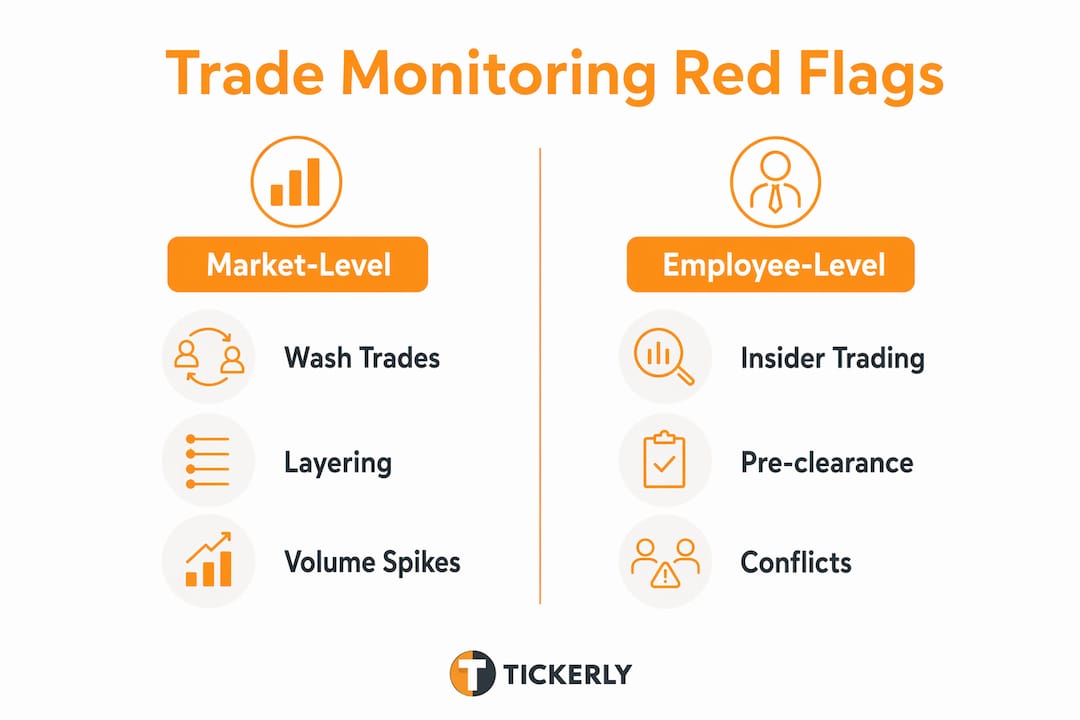
Automated systems flag anomalies, but compliance staff must understand what those flags mean. Common red flags include wash trading, layering or spoofing, and trading patterns that deviate sharply from historical or peer group norms. Automated systems assign risk scores to prioritize investigations and reduce manual review workload.
Patterns that consistently draw regulatory attention:
- Wash trades: Simultaneous buy and sell orders that create artificial volume without real economic exposure
- Layering/spoofing: Placing large orders with no intent to execute, then canceling after moving the price
- Pre-announcement trading: Unusual position buildup immediately before material corporate events
- Abnormal volume spikes: Trades that dwarf a security’s average daily volume without a clear market catalyst
- Cross-asset correlation: Equity positions that mirror derivatives activity in a way that suggests coordinated manipulation
Real-time automated detection is not optional given the volume of data modern markets generate. Manual review alone cannot keep pace.
US regulatory requirements shaping trade monitoring programs
The SEC and FINRA both mandate that firms do more than run software. Regulators require scenario-based alerts, investigative workflows, and documentation that demonstrates supervisory proof at every step.
Core compliance requirements include:
- Scenario-based alert libraries covering manipulation, insider trading, and best execution failures
- Documented investigation records showing who reviewed each alert, what evidence was gathered, and how the case was closed
- Cross-asset monitoring as an emerging best practice, replacing siloed single-asset systems
- Code of Ethics policies under SEC Rule 17j-1 for registered investment companies, requiring pre-clearance and reporting of personal securities transactions
- Supervisory review logs that satisfy FINRA Rule 3110 examination requests
Regulatory reality: Examiners increasingly scrutinize not just whether a system exists, but whether alerts were investigated, documented, and acted upon. A surveillance platform with no investigative paper trail satisfies no one.
Implementation challenges and best practices for effective systems
Alert fatigue is the most common operational failure in trade monitoring. High false positive rates overwhelm compliance teams, causing genuine risks to be buried under noise. Machine learning models help normalize data and prioritize alerts, but calibration requires ongoing investment.
Other persistent challenges:
- Siloed systems that monitor equities separately from fixed income or derivatives, missing cross-asset manipulation schemes
- Data quality gaps from fragmented broker feeds, delayed reporting, or inconsistent formatting
- Sensitivity vs. efficiency trade-offs where tightening thresholds generates more alerts but not necessarily more actionable ones
Best practices that address these directly:
- Risk-based alert prioritization: Score alerts by severity and route high-risk cases to senior reviewers immediately
- Integrated surveillance across asset classes to catch cross-market manipulation that single-asset tools miss
- Machine learning for normalization: Train models on firm-specific and peer-group baselines rather than generic industry thresholds
- Compliance culture investment: Ongoing training, clear policies, and audit-ready documentation signal proactive oversight to regulators
Pro Tip: Set a monthly alert disposition review. Track the ratio of alerts closed as false positives versus escalated cases. If a high percentage of alerts are false positives, your thresholds need recalibration before the next exam cycle.
How financial firms actually run trade monitoring processes
A large broker-dealer typically runs trade monitoring through a three-tier workflow. The first tier is automated: a trade monitoring system using AI, data analytics, and automated workflows continuously scans execution data and generates alerts when activity crosses predefined thresholds. The second tier is human review: a compliance analyst assesses each alert, pulls supporting data, and either closes it with documentation or escalates it. The third tier is formal investigation, where a senior compliance officer or legal team conducts a deeper review, contacts the trader if needed, and decides whether to file a Suspicious Activity Report or refer the matter to regulators.
Asset managers run a parallel process for employee trade monitoring. Pre-clearance requests flow through a compliance portal, personal account statements are aggregated from multiple brokerages, and any trade that conflicts with firm holdings or pending orders triggers an automatic hold for review.
How trade monitoring strengthens compliance and risk management
A well-run trade monitoring program does more than satisfy regulators. It creates a documented record of supervisory diligence that protects the firm in enforcement proceedings. When the SEC or FINRA opens an inquiry, firms with complete alert investigation logs and disposition records can demonstrate good-faith oversight. Firms without that paper trail face a much harder conversation.
Risk management benefits extend beyond enforcement defense. Monitoring data reveals behavioral patterns across trading desks, identifying traders who consistently push policy boundaries before a violation occurs. That early-warning function is where trade monitoring outcomes translate directly into reduced regulatory and reputational exposure.
International regulatory considerations and how they compare to US standards
US firms operating globally must align with frameworks beyond SEC and FINRA. The European Union’s Market Abuse Regulation (MAR) sets requirements for market abuse detection and reporting that parallel US rules but differ in scope and enforcement mechanics. The UK’s Financial Conduct Authority maintains its own market abuse regime post-Brexit, with similar scenario-based surveillance expectations.
The practical challenge for multinational compliance teams is that each jurisdiction defines “suspicious” differently. A trading pattern that triggers a FINRA alert may fall below MAR thresholds, or vice versa. Firms with cross-border operations typically maintain jurisdiction-specific alert libraries within a unified surveillance platform, then route alerts to the appropriate regional compliance team for disposition.
Case studies of trade monitoring catching misconduct early
The SEC’s enforcement record offers concrete examples of what effective monitoring prevents. In multiple insider trading cases, surveillance systems at broker-dealers flagged unusual options activity in the days before merger announcements. Those alerts, when properly investigated and reported, gave regulators the data trail needed to build enforcement cases. The firms that flagged and documented the activity faced no liability. The traders who executed the suspicious positions faced civil and criminal charges.
Employee trade monitoring has similarly prevented misconduct at the firm level. Pre-clearance systems that automatically cross-reference pending employee trades against the firm’s restricted securities list catch potential violations before execution, not after. That pre-trade gate is far more effective than post-trade review because it stops the violation rather than documenting it.
Key Takeaways
Trade monitoring is the continuous oversight of trading activity and employee transactions that regulators require financial firms to document, investigate, and act upon.
| Point | Details |
|---|---|
| Two distinct functions | Trade surveillance covers market-level activity; employee trade monitoring covers internal staff transactions. |
| Red flags require automation | Wash trades, layering, and abnormal volume spikes demand real-time AI-driven detection to keep pace with data volume. |
| Documentation is the proof | Regulators examine alert investigation records, not just system presence, to verify supervisory compliance. |
| Alert fatigue is the top pitfall | Machine learning risk scoring and monthly threshold reviews keep false positive rates from overwhelming compliance teams. |
| International rules vary | MAR in the EU and FCA rules in the UK parallel US requirements but differ in scope, requiring jurisdiction-specific alert libraries. |
FAQ
What are the red flags for trade surveillance?
The most common red flags are wash trading, layering or spoofing, abnormal volume spikes, and trading that precedes material corporate announcements. Automated systems assign risk scores to each anomaly to prioritize which cases compliance staff review first.
What is an example of trade surveillance in practice?
A broker-dealer’s surveillance system flags unusual options activity in a stock two days before a merger announcement. A compliance analyst reviews the alert, documents the findings, and escalates the case to the firm’s legal team, which then reports to the SEC.
How does employee trade monitoring differ from trade surveillance?
Employee trade monitoring tracks internal staff securities transactions to prevent conflicts of interest and MNPI misuse, while trade surveillance monitors market-wide order and execution data for external manipulation. Both fall under SEC oversight, but they use different data sources and serve different compliance goals.
What does trade monitoring involve on a daily basis?
Daily trade monitoring involves automated alert generation, human review and disposition of flagged activity, pre-clearance processing for employee trades, and documentation of all investigative steps for regulatory examination readiness. You can see how real-time alert logs function in automated trading contexts as a parallel to compliance alert workflows.
Why do US regulators require documented investigative workflows?
The SEC and FINRA require documented workflows because a surveillance system with no investigation record provides no supervisory proof. Regulators need to see that alerts were reviewed, evidence was gathered, and decisions were justified, not just that software was running.