

TL;DR:
- The risk-reward ratio helps traders determine if a trade is worthwhile before entering, balancing potential profit against possible loss. Consistently managing this ratio and pairing it with proper position sizing improves the chances of long-term profitability and helps avoid emotional trading decisions.
The risk-reward ratio is the single metric that tells you whether a trade is mathematically worth taking before you ever click buy or sell. Risk is the dollar amount you stand to lose if the trade moves against you; reward is the potential profit if it hits your target. A 1:3 ratio means you risk $100 to make $300. That relationship, simple as it sounds, drives every sound trading decision.
Here is why this matters immediately: you can be wrong on the majority of your trades and still grow your account, provided your winners are large enough relative to your losers. The ratio is not just a planning tool. It is the foundation of sustainable risk management in trading, the filter that separates disciplined traders from those who blow up chasing setups that never justified the risk.
- Risk = the dollar amount lost if the trade hits your stop-loss
- Reward = the dollar amount gained if the trade reaches your profit target
- Risk-reward ratio (R/R) = reward divided by risk, expressed as 1:X
- A ratio above 1.0 means potential profit exceeds potential loss, which is the favorable side
- Managing this ratio consistently is what keeps you in the game long enough to compound an edge
How to calculate the risk-reward ratio step by step
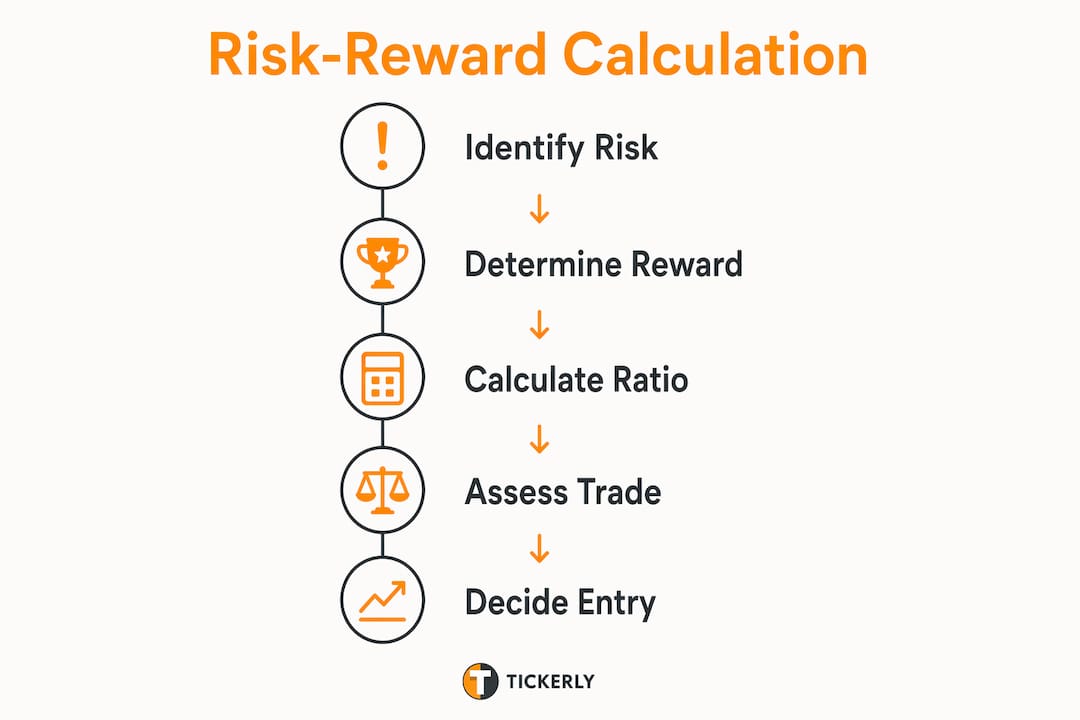
Getting the math right before you enter a trade is non-negotiable. Here is the exact process:
- Identify your entry price. This is the price at which you open the position.
- Set your stop-loss price. Place it at the level where the trade is clearly wrong, based on market structure, not emotion.
- Set your profit target. Anchor it to a realistic level, such as a resistance zone or a measured move, not an arbitrary number.
- Calculate your risk. Subtract the stop-loss price from the entry price (for a long trade). Example: entry at $50.00, stop-loss at $48.50 means $1.50 of risk per share.
- Calculate your reward. Subtract the entry price from the profit target. Example: target at $53.00 means $3.00 of reward per share.
- Form the ratio. Divide reward by risk: $3.00 / $1.50 = 2.0, giving you a 1:2 ratio.
- Think in dollars, not percentages. A 2% stop on a $5,000 position and a 2% stop on a $50,000 position carry very different dollar exposure. Dollar-based risk ties your decision directly to account equity and keeps position sizing consistent.
Pro Tip: Always calculate the ratio before entering, not after. If the math does not work at the planning stage, the trade does not happen.
Why the risk-reward ratio matters in trading decisions and strategy
A favorable ratio reduces the win rate you need to stay profitable. At a 1:2 risk-to-reward ratio, the breakeven win rate is about one-third, and it is lower at a 1:3 ratio. Professional traders often run moderate win rates because their average winner is large enough relative to their average loser to produce net gains.
Consider two traders over 100 trades. Trader A wins many trades but risks large amounts with low reward-to-risk, leading to large drawdowns that require big gains to recover. Trader B wins fewer trades but risks less per trade with higher reward-to-risk, enabling easier recovery from losses. Trader B compounds at a higher rate and survives long enough to express a real edge.
The ratio also delivers psychological benefits that are easy to underestimate:
- It forces you to define your exit before you enter, removing in-trade emotional decisions
- It filters out low-quality setups before capital is committed
- It creates a consistent framework that reduces impulsive trading
- It connects naturally to win rate and expectancy, the two other metrics that determine whether a strategy is viable
- It gives you an objective standard to review trades against, separate from whether they won or lost
Expectancy ties all of this together. With a 40% win rate and a 1:3 ratio, your expectancy per trade is (0.40 × 3R) minus (0.60 × 1R) = 0.60R. That positive number means the strategy makes money over a large sample, even though you lose more trades than you win.
Common mistakes traders make with risk-reward ratio
Most traders who struggle with risk management are not ignoring the ratio entirely. They are applying it incorrectly.
- No minimum threshold. Entering trades with a 1:1 or worse ratio because the setup “looks good” is how breakeven traders stay breakeven. Disciplined traders only take trades offering at least 1:2.
- Ignoring probability. A 1:10 ratio is useless if the trade has a near-zero chance of reaching the target. Ratio math must be paired with a realistic assessment of whether the setup actually works.
- Confusing position size with risk amount. Buying 1,000 shares is not a risk amount. Risk is the dollar distance between entry and stop-loss multiplied by position size. Conflating the two leads to wildly inconsistent exposure.
- Using percentages instead of dollars. Percentage-based thinking obscures how much real capital is at stake, especially when position sizes vary across trades.
- Skipping trades that fail the filter. Many traders calculate the ratio, see it is below their minimum, and enter anyway. Skipping bad setups is as important as executing good ones.
- Overreliance without market context. A 1:3 ratio in a choppy, low-volatility range is not the same as a 1:3 ratio in a trending market with clear momentum. Context shapes whether the target is realistic.
Effective application of risk-reward ratio in trade evaluation and risk management
Setting a minimum standard and enforcing it consistently is where most traders separate from the pack. A minimum 1:2 ratio on every trade is the professional baseline. Target 1:3 as your standard. Only accept 1:1 in exceptional circumstances with very high-probability setups backed by historical data.

Pro Tip: Combine your R/R filter with a daily loss limit. If you hit 3% account drawdown in a session, stop trading for the day. This layered approach, described in risk management best practices, prevents a bad morning from becoming a blown account.
Practical application looks like this:
- Position sizing from dollar risk. Decide the maximum dollar amount you will lose on the trade, then calculate the share or contract size from that number and your stop distance.
- Pre-trade checklist. Before entry, confirm entry price, stop-loss level, profit target, dollar risk, and the resulting ratio. If any item is missing, the trade waits.
- Skip trades that miss the threshold. Discipline in skipping low R/R setups is as valuable as executing good ones. Every bad trade you avoid is capital preserved for the next quality setup.
- Adjust targets to market conditions. In high-volatility environments, wider stops may be necessary. Widen the target proportionally so the ratio holds. In tight-range markets, tighten both.
- Track R-Multiples. R-Multiples standardize your results by expressing each trade outcome as a multiple of initial risk, making it easy to compare performance across assets and time periods.
- Use automation to enforce rules. Manual execution under pressure invites rule-breaking. Automated systems apply your stop-loss and take-profit levels without hesitation.
How automated trading tools support risk-reward discipline
Manual execution is where risk-reward discipline breaks down most often. You plan a 1:3 trade, the position moves in your favor, and you close early at 1:1 because you fear a reversal. Or the trade hits your stop-loss level and you move it wider, hoping for a recovery. Both behaviors destroy the math that made the setup worth taking.
Automated trading bots enforce stop-loss and take-profit levels consistently, at execution speed no human can match. The bot does not feel fear at a drawdown or greed near a target. It executes the plan exactly as defined. Automated platforms like Tickerly convert TradingView strategies into live bots that apply your risk-reward rules across every trade, every session, without deviation.
Traders using automated execution report measurable gains in consistency and profitability. When stop-loss and take-profit levels are enforced by code rather than discretion, the realized risk-reward ratio across a sample of trades actually matches the planned ratio, which is rarely true in manual trading.
Benefits of automation for risk-reward management:
- Emotion elimination. Bots execute the plan; they do not second-guess it mid-trade.
- Execution speed. Alerts trigger entries and exits in milliseconds, capturing the price levels you planned rather than a worse fill caused by hesitation.
- Consistency across strategies. Tickerly can run multiple strategies simultaneously, each with its own risk-reward parameters, without the cognitive load that causes manual traders to cut corners.
- Diversification without added complexity. Spreading risk across uncorrelated setups reduces drawdown without requiring you to monitor every position manually.
- Audit trail. Every trade is logged with its planned and realized R/R, feeding directly into performance review.
For traders building on TradingView, automating your strategy with Tickerly means your Pine Script signals trigger real orders with predefined stop-loss and take-profit levels, enforcing your risk-reward rules at the moment of execution.
How risk-reward ratio applies across different trading strategies
The ratio does not work the same way in every style of trading. Scalpers operating on one-minute charts typically target 1:0.8 to 1:1.5 ratios, compensating with win rates of 60%–75% and high trade frequency. The math still works because the high win rate offsets the compressed ratio.
Swing traders, who hold positions for days or weeks, typically target 1:2 to 1:4. Wider stops are necessary to survive normal price fluctuation, so the target must be proportionally further away. A swing trade with a $2.00 stop needs at least a $4.00 target to meet the minimum standard. Position sizing from a fixed dollar risk keeps exposure consistent regardless of the stop distance.
Day traders sit between these two extremes. A practical risk-reward guide for day trading typically recommends targeting at least 2:1 reward-to-risk, with setups anchored to intraday support and resistance levels rather than arbitrary price projections. The key in all three styles is that the target must be realistic given the asset’s typical volatility range, not just mathematically convenient.
Long-term investors use the same risk-reward evaluation framework at different price scales and time horizons.
What the risk-reward ratio cannot tell you on its own
The ratio is a necessary input, not a complete trading system. Relying on it exclusively produces a specific failure mode: traders take setups with attractive ratios that have no realistic probability of reaching the target, then wonder why the math is not working.
A 1:10 ratio with a 5% win rate has a theoretical expectancy of negative territory in practice. Most traders cannot psychologically sustain an 85%–95% loss rate. The discipline breakdown leads to early profit-taking, stop-loss widening, and revenge trading, all of which collapse the realized ratio far below the planned one. A 1:1.5 ratio with a 60% win rate typically outperforms in real trading because the strategy is psychologically sustainable.
Other limitations worth knowing:
- The ratio does not account for commissions, slippage, or spread, all of which erode the realized reward on every trade.
- It does not capture how often the market actually reaches your target before reversing, which depends on market structure and volatility, not just the ratio itself.
- It says nothing about position sizing or drawdown management, both of which are required for account survival.
- A static minimum ratio applied without adjustment to changing market conditions will produce inconsistent results across different volatility regimes.
The solution is to treat the ratio as one layer in a broader risk management framework that includes win rate tracking, expectancy calculation, position sizing rules, and daily loss limits.
How psychology shapes your risk-reward decisions
The ratio is objective. The trader applying it is not. Two psychological traps consistently undermine even well-planned risk-reward frameworks.
The first is premature profit-taking. A trade moves 60% of the way to the target, and the fear of giving back gains triggers an early exit. The result is a realized ratio of 1:1.2 on a trade planned at 1:3. Do this consistently and the math that made the strategy viable disappears entirely.
The second is stop-loss avoidance. When a trade approaches the stop level, the brain reframes the loss as temporary and the stop gets moved wider. This converts a planned 1:3 trade into a 1:1.5 trade at best, or a full account-damaging loss at worst. Automation addresses both traps directly, since the system executes the plan regardless of what the trader feels in the moment. Building disciplined trading habits around pre-defined rules, rather than in-trade judgment, is the practical solution for traders who are not yet using automation.
Key Takeaways
A minimum 1:2 risk-reward ratio, combined with consistent position sizing and win rate tracking, is the mathematical foundation of profitable trading over any meaningful sample of trades.
| Point | Details |
|---|---|
| Minimum ratio standard | Never take a trade with less than 1:2 risk-to-reward; target 1:3 as your standard. |
| Dollar-based risk | Measure risk in dollars, not percentages, to keep position sizing consistent with account equity. |
| Expectancy over ratio alone | A 40% win rate with 1:3 R/R produces 0.60R expectancy per trade; ratio without win rate tells you nothing. |
| Automation enforces discipline | Automated bots execute stop-loss and take-profit levels without emotional interference, preserving the planned ratio. |
| Ratio has limits | Probability, slippage, and drawdown management are required alongside the ratio for a complete risk framework. |
FAQ
What is the risk-reward ratio and why does it matter?
The risk-reward ratio compares the dollar amount you stand to lose against the dollar amount you aim to gain on a trade. It matters because a favorable ratio lets you remain profitable even with a win rate below 50%, since larger winners offset more frequent smaller losses.
How does risk-reward affect trading profitability?
At a 1:2 ratio, the breakeven win rate is about one-third, and it is lower at a 1:3 ratio. This means disciplined risk-reward management can produce net profits even when you lose the majority of individual trades.
What is a good risk-reward ratio for most traders?
A minimum of 1:2 is the professional standard, with 1:3 as the preferred target for most trading strategies. Most consistently profitable traders operate between 1:2 and 1:3 with win rates of 40%.
Is it true that most day traders lose money?
Day trading carries a high failure rate, and retail traders as a group lose money more often than they profit, largely due to poor risk management rather than bad strategy. Applying consistent risk-reward rules and position sizing is the primary factor separating traders who survive from those who do not.
Can a high risk-reward ratio alone make a strategy profitable?
No. A 1:10 ratio is useless if the trade has a near-zero chance of reaching the target. Profitability depends on expectancy, which combines the ratio with win rate. A 1:1.5 ratio with a 60% win rate outperforms in real trading because it is psychologically sustainable and produces consistent positive expectancy.