

TL;DR:
- Paper trading uses virtual funds to simulate real market trades without risking money. It helps traders practice order entries and test strategies but often produces more favorable results than live trading due to lack of real slippage and emotional pressure.
Paper trading is defined as simulated trading using virtual funds, where you practice buying and selling securities in real market conditions without risking a single dollar. The industry term for this practice is “simulated trading” or “virtual trading,” and it has become the standard entry point for new traders in stocks, crypto, and forex. If you are exploring how to start paper trading, you are already making the right call. Mastering order entries, reading charts, and testing strategies in a zero-risk environment builds the mechanical foundation every serious trader needs before committing real capital.
What is paper trading and how does it work?
Paper trading is a simulated market environment where you execute trades using virtual money against real or delayed market data. No real clearing or settlement happens. Your orders are filled based on quoted prices, not actual market depth. The platform tracks your virtual portfolio, profit and loss, and trade history exactly as a live account would.

Most paper trading platforms provide a virtual account balance, real-time or slightly delayed price feeds, and access to common order types like market, limit, and stop orders. You can test entries and exits, practice position sizing, and track your results over time. The experience closely mirrors live trading in terms of interface and workflow.
The key mechanical limitation is that simulated fills are often generated from the top of the order book. They do not reflect real market depth or the price impact of large orders. This means your fills in simulation will almost always look cleaner than what you would get in a live account.
Here is what a standard paper trading environment includes and excludes:
Included in most simulators:
-
Real-time or delayed price data for stocks, crypto, or forex
-
Virtual account balance with full portfolio tracking
-
Common order types: market, limit, stop loss, and stop limit
-
Profit and loss reporting and trade history
Typically excluded:
-
Real order clearing and settlement
-
True slippage and liquidity constraints
-
Corporate actions such as stock splits, dividends, and borrowing fees
-
All advanced order types available on live platforms
Pro Tip: Always check whether your chosen simulator supports the specific order types your strategy requires. Many simulators do not support all order types, and discovering this after weeks of practice wastes your time.
How to start paper trading: essential setup steps
Setting up a paper trading account correctly from day one determines how much you actually learn. A poorly configured simulator produces misleading results and builds bad habits.
-
Choose a broker or platform that offers paper trading. Select the same broker you plan to use for live trading. Platform consistency is critical because order types, execution speed, and interface details vary significantly across systems. Switching platforms when you go live creates costly errors.
-
Register and configure your virtual balance. Set your virtual account balance to match the real capital you plan to deploy. Experts recommend matching your virtual balance to your actual intended capital, whether that is $1,000 or $25,000. Default simulator balances are often set at $100,000 or more, which trains you to take position sizes you could never afford in real life.
-
Configure commissions and fees. Enable commission simulation in your platform settings. Ignoring commissions and spreads in simulation produces false profitable results. Many strategies look viable on paper but fail in live trading once fees are factored in. Set your fee structure to match your broker’s actual rates.
-
Select one trading strategy and commit to it. Do not jump between strategies. Pick one approach, whether that is momentum trading, breakout trading, or a moving average crossover system, and test it consistently for at least 30 trading sessions. Consistency produces data you can actually analyze.
-
Build a structured trading schedule. Trade only during active market hours. Practicing during low-volume periods gives you unrealistic fill conditions. Treat your paper trading sessions like a job with fixed start and end times.
-
Open a trading journal on day one. Record every trade, including your reasoning, entry and exit prices, and how you felt during the trade. Emotional observations matter as much as financial outcomes.
Pro Tip: Pair your paper trading practice with strategy backtesting to validate your approach on historical data before committing to it in simulation. Backtesting and paper trading together give you a much stronger signal on whether a strategy has real edge.
What is paper trading vs live trading: key differences
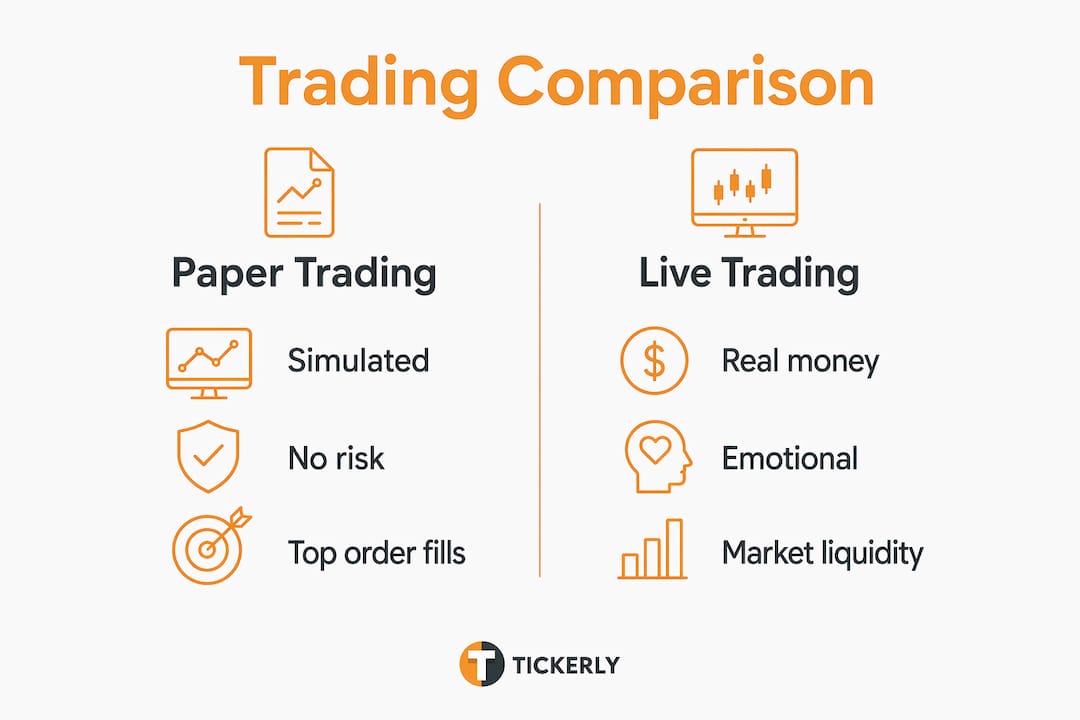
The gap between paper trading and live trading is wider than most beginners expect. Understanding these differences before you go live prevents expensive surprises.
Simulated performance runs 5–15% better than live trading results on the same strategy. That gap exists because simulators cannot replicate real slippage, liquidity constraints, or the emotional weight of watching real money move. Experts advise starting live trading with position sizes 50–90% smaller than those used in simulation to manage both risk and emotional impact.
| Factor | Paper trading | Live trading |
|---|---|---|
| Order fills | Simulated from quoted prices | Subject to real slippage and liquidity |
| Emotional pressure | Minimal, no real money at stake | High, real capital consequences |
| Corporate actions | Often excluded | Fully reflected in account |
| Performance accuracy | Typically 5–15% better than live | True market results |
| Position sizing discipline | Often unrealistic | Forces real risk management |
| Fee impact | Configurable, often ignored | Automatically deducted |
The most important difference is psychological. Paper trading cannot substitute for the emotional discipline that only real money can train. Fear and greed do not show up in simulation. You will exit trades too early or hold losers too long in live trading in ways you never did in simulation. That is normal. It is also why paper trading is a starting point, not a finishing line.
Understanding live trading mechanics before you make the switch gives you a clearer picture of what to expect from real execution environments.
Advantages and limitations of paper trading for traders
Paper trading delivers real value when used correctly. It also has hard limits that you need to understand before drawing conclusions from your simulation results.
Core advantages:
-
Zero financial risk. You can test aggressive strategies, make mistakes, and learn from them without losing money. This is the single biggest benefit for beginners.
-
Platform familiarization. You learn the interface, order entry workflow, and reporting tools of your broker before real money is involved.
-
Strategy experimentation. You can run multiple approaches back to back and compare results objectively.
-
Mechanics mastery. Paper trading is the best tool for learning order entries, charting, and reading price action. Technical skill development is where simulation genuinely excels.
Key limitations:
-
No emotional realism. The absence of real financial consequences means your decision-making in simulation does not fully reflect how you will behave with real money.
-
Skewed performance data. Corporate actions like stock splits and dividends are often excluded, which distorts strategy results.
-
Fee blindness. Traders who do not configure commissions in their simulator often believe their strategy is profitable when it is not.
-
Unrealistic balances. Starting with a $100,000 virtual account when you plan to trade $5,000 live trains the wrong position sizing instincts entirely.
Treat paper trading as a discipline tool and a technical training ground. Do not treat it as a perfect predictor of live trading performance. The value is in the practice, not the profit numbers.
One common beginner mistake worth flagging: treating simulation like a video game by ignoring risk management or trading outside market hours leads to unrealistic expectations and a rough transition to live trading.
Best practices to get the most from paper trading
The difference between traders who benefit from paper trading and those who waste months on it comes down to discipline and setup quality.
-
Match your virtual balance to your real capital. Set your portfolio balance to the exact amount you plan to trade live. This enforces correct position sizing from the start and builds habits that transfer directly to your live account.
-
Enable commissions and fees in your simulator settings. Configure fee estimates that match your broker’s actual rates. This prevents the false confidence that comes from seeing profitable simulation results that would be losers after fees.
-
Trade only during active market hours. Crypto markets run 24/7, but equities and forex have peak liquidity windows. Practice during those windows to get realistic fill conditions and price action.
-
Maintain a detailed trading journal. Record your entry rationale, exit reasoning, and emotional state for every trade. Disciplined record keeping improves the realism and value of your paper trading sessions far more than simply tracking profit and loss.
-
Use the exact platform you plan to trade live. Do not practice on one platform and trade live on another. Platform differences in order types and execution speed create costly errors when you switch.
-
Run your simulation for a statistically meaningful period. Thirty trading sessions is a minimum. Sixty or more gives you a data set large enough to identify whether your strategy has consistent edge or just got lucky in a trending market.
Pro Tip: Combine paper trading with a simulation role in your trading plan to track how your strategy performs across different market conditions, not just trending or volatile periods.
Understanding trading fees in depth also helps you configure your simulator more accurately and avoid the fee blindness trap that catches most beginners.
Key Takeaways
Paper trading builds mechanical trading skills and validates strategies in a zero-risk environment, but it cannot replicate the emotional pressure of live trading and requires realistic setup to produce useful results.
| Point | Details |
|---|---|
| Match your virtual balance | Set simulation capital equal to your real planned capital to train correct position sizing. |
| Configure fees from day one | Enable commission and spread settings to avoid false profitable results in simulation. |
| Use the same platform for both | Practice on the exact broker you plan to trade live to avoid costly interface errors. |
| Expect a performance gap | Simulated results run 5–15% better than live; start live trading with smaller position sizes. |
| Journal every trade | Record emotional observations alongside financial data to build real self-awareness as a trader. |
Why paper trading alone will not make you a profitable trader
Paper trading is genuinely useful. I have seen it accelerate skill development for traders who approach it with discipline. But I have also watched traders spend six months in simulation, post impressive virtual returns, and then blow up their first live account in two weeks. The reason is always the same: they confused technical competence with emotional readiness.
The mechanics of trading, reading charts, placing orders, managing position size, are learnable in simulation. The emotional side is not. Fear of loss, the urge to revenge trade after a bad session, the paralysis that hits when a position moves against you with real money on the line. None of that shows up in paper trading. You only encounter it when the stakes are real.
My honest advice is this: use paper trading to master the mechanics and validate your strategy. But do not stay in simulation longer than necessary. The goal is to build enough confidence in your system that you can go live with small size and start accumulating real emotional experience. Beginners who treat simulation as a safe harbor indefinitely never develop the psychological muscle that live trading demands.
One more thing worth saying: the traders who get the most from paper trading are the ones who treat it seriously. They trade at fixed hours, journal every session, and avoid beginner investing mistakes like ignoring risk management or sizing positions based on emotion. If you bring that discipline to simulation, you will carry it into live trading.— Jay
From paper trading to automated execution with Tickerly
Once you have validated a strategy through paper trading, the next challenge is executing it consistently in live markets without letting emotion or manual errors interfere.
Tickerly automates your TradingView strategies into fully functional trading bots that execute in real time, without hesitation and without the emotional interference that derails manual traders. You can connect Tickerly to your exchange, set your strategy parameters, and let the bot execute your tested approach with speed and consistency that manual trading cannot match. For traders ready to move beyond simulation, automated trading bots are the logical next step. Tickerly handles multiple strategies simultaneously, which means the diversification you practiced in paper trading becomes fully operational in live markets.
FAQ
What is paper trading in simple terms?
Paper trading is practicing buying and selling securities using virtual money in a real market environment, with no financial risk. It lets you test strategies and learn platform mechanics before committing real capital.
Is paper trading safe for beginners?
Paper trading carries zero financial risk because no real money is involved. It is the safest way for beginners to learn trading mechanics, though it cannot fully prepare you for the emotional pressure of live trading.
How long should you paper trade before going live?
Most experts recommend a minimum of 30 trading sessions before transitioning to live trading. Sixty or more sessions gives you enough data to determine whether your strategy has consistent edge across different market conditions.
Does paper trading accurately predict live trading results?
Simulated results typically run 5–15% better than live trading results on the same strategy. Slippage, real liquidity constraints, and emotional pressure all reduce live performance compared to simulation.
What is the biggest mistake beginners make in paper trading?
The most common mistake is using an unrealistically large virtual balance and ignoring commissions. Both habits produce misleading results and build position sizing instincts that fail immediately in live trading.