

Building a reliable trading strategy automation workflow that does not require custom coding or manual order entry creates avoidable risk and delays. Most trading bot platforms force you to code, limit broker choices, or delay order routing with slow execution. This comparison covers features, broker support, and execution speed so traders can choose a code free autotrading tool that works for their strategies.
Table of Contents
Tickerly
At a Glance
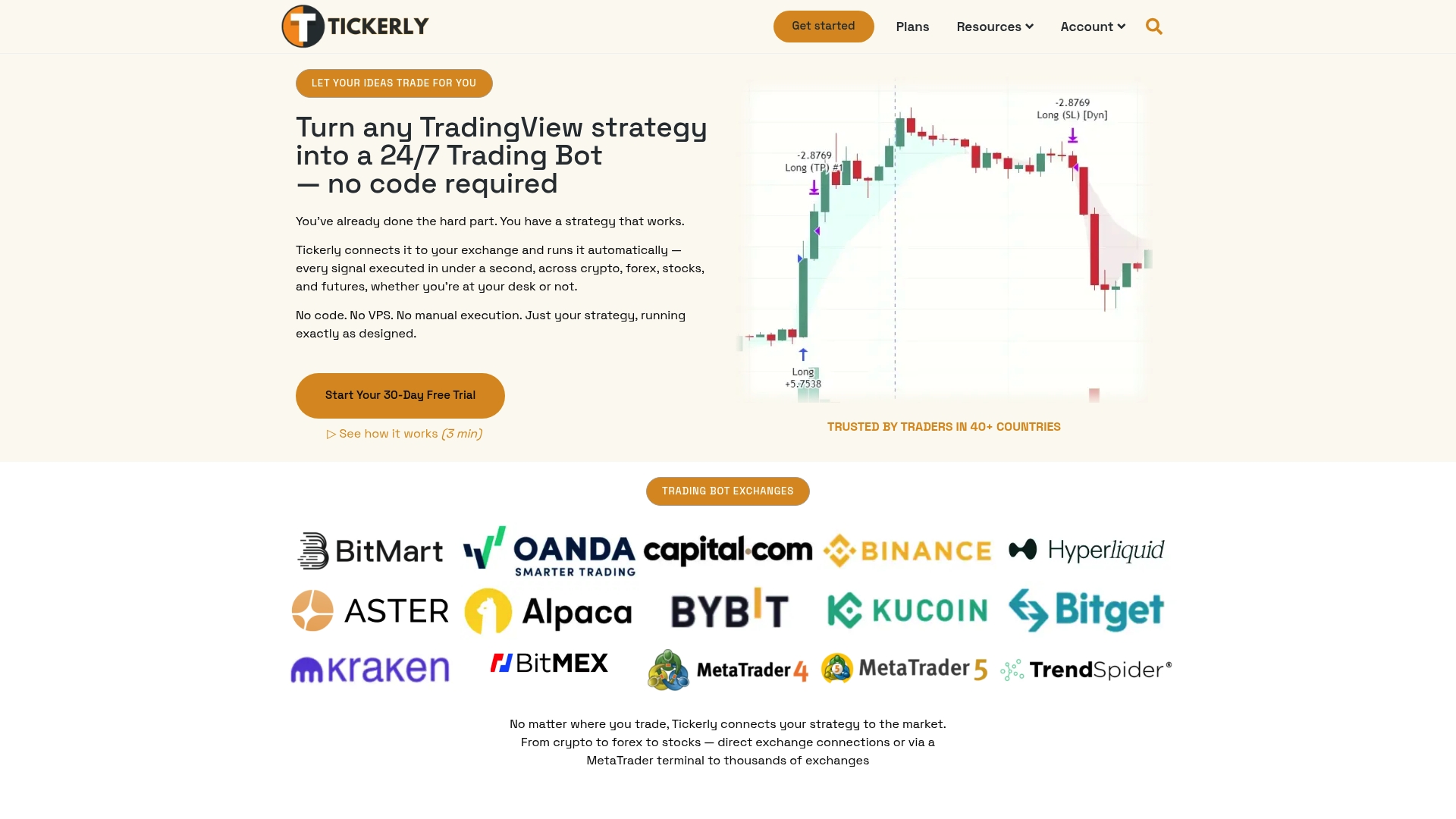
Converts TradingView strategies into 24/7 trading bots across crypto, forex, stocks, and futures. It routes real-time alerts to live execution and runs multiple strategies on the same asset. The platform connects chart signals directly to exchanges via API or MetaTrader.
Core Features
Tickerly converts TradingView alerts into automated orders and supports cryptocurrencies, stocks, forex, and futures. It routes real-time alerts to execution endpoints, lets you run multiple strategies on the same pair, and provides direct broker integration without coding. Dedicated servers near exchanges handle order routing to improve fill speed.
Key Differentiator
Tickerly’s marketing materials state industry-leading execution speed combined with seamless TradingView integration and multi-asset exchange support. That claim underlies the platform emphasis on low latency routing and direct API plus MetaTrader connectivity. Furthermore, it allows customers to focus on strategy development, as no strategy-specific setup is need to set up automation.
Pros
According to the company, users report significant improvements in efficiency and profitability after automating strategies. Fast execution comes from servers positioned close to exchange gateways and from direct API routes to brokers, which supports quicker fills. No coding is required to turn TradingView signals into live orders, and flexible settings let you run different take profit and stop loss rules across strategies.
Cons
- Limited detail on customization of individual strategies beyond connecting TradingView signals.
Notable Integrations
Supported exchanges include Binance, Capital.com, KuCoin, Bybit, and MetaTrader 4/5. The list covers major centralized exchanges plus MetaTrader for retail forex and futures access. Additional supported endpoints are documented by the vendor.
Who It’s For
Active traders and investors who build strategies in TradingView and want automated execution across multiple markets will get the most value. Day traders who need fast fills in crypto, forex, or stocks will benefit from low latency routing. Traders should feel comfortable managing API keys and maintaining exchange connections.
Unique Value Proposition
Direct broker integration via API or MetaTrader without coding moves strategies from chart to market with minimal friction. That connectivity reduces manual steps and keeps strategies running 24 hours a day while you monitor performance. For traders focused on execution speed and multi-asset deployment, this changes how alerts become orders.
Real World Use Case
A forex trader builds an algorithm in TradingView and connects Tickerly to an Oanda account. The bot executes signals live and continues running while the trader is away from the desk. That setup cuts manual entry errors and preserves strategy uptime.
Pricing
Plans start at $19/month with tiered options that expand active strategies and alerts. Higher tiers raise the number of simultaneous strategies and alerts and may include unlimited strategies per the vendor description. Exact tier limits and feature lists are available on the product site.
Website: https://tickerly.net
SignalStack
At a Glance
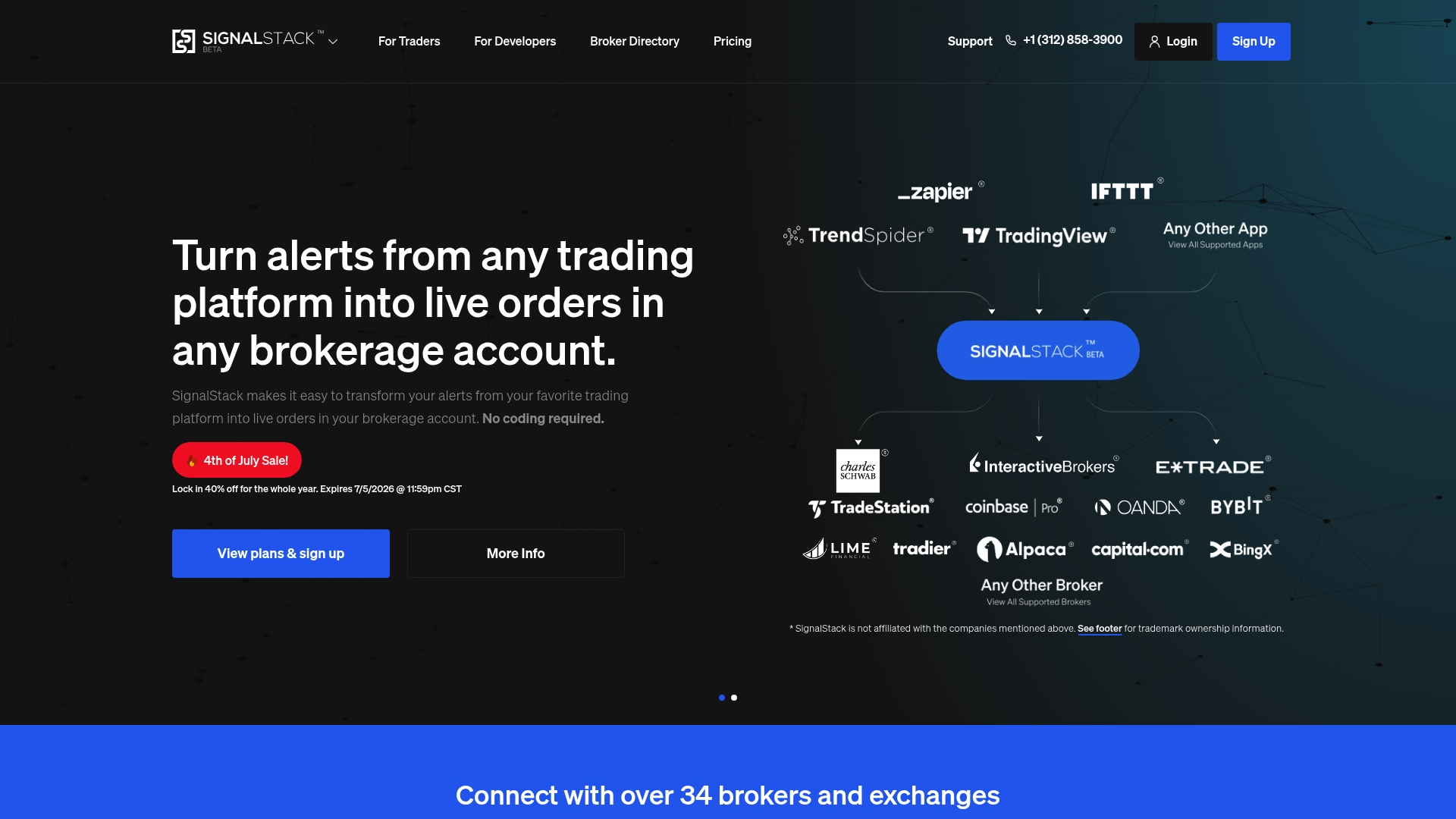
SignalStack reports order execution under 0.45 seconds, a specific latency figure traders care about for fast fills. The service connects to over 34 brokers, including Binance and Interactive Brokers, to route alerts to live accounts. It targets users who want a code free way to convert webhook alerts into live orders.
Core Features
SignalStack accepts any webhook alert from charting platforms and translates those alerts into executable orders across asset classes. It supports common order types, including Market, Limit, Stops, and Options, and covers crypto, stocks, futures, forex, and CFDs. Setup does not require programming knowledge and includes flexible order management options for manual and automated workflows.
Key Differentiator
The standout is broad compatibility with any webhook alert source plus deep broker connectivity for direct routing. That execution claim above combines with multi broker support to reduce manual steps between signal and execution. This focus fits traders who already run alerts in TradingView or TrendSpider and want reliable order placement.
Pros
SignalStack offers no coding required setup, which gets traders from alert to live order quickly without building middleware. The platform reports subsecond execution, and that figure matters when you trade small windows or scalping setups. Wide broker coverage lets you consolidate execution across accounts, and support for options and multiple asset classes expands strategy flexibility. The tool also handles both manual and automated strategies for portfolio managers and active traders.
Cons
-
Limited to traders who already have an alert source. It does not generate signals or replace a charting engine.
-
SignalStack’s marketing materials state 99.99% uptime; your reliability depends on their infrastructure and your webhook quality.
-
Documentation is light on handling complex scripting and multi leg strategies, which may frustrate advanced quant setups.
When It May Not Fit
You should skip SignalStack if you need an integrated alert generation and execution platform in one product. It is also a poor match for strategy developers who require native scripting or advanced multi leg orchestration within the same environment. Finally, if your alerts are unreliable or arrive intermittently, the service will only be as good as that webhook stream.
Notable Integrations
-
TradingView
-
TrendSpider
-
Zapier
-
IFTTT
Who It’s For
Traders and developers who want a code free bridge from webhook alerts to live broker orders will get the most value. Active traders who run alert driven strategies across multiple accounts will appreciate unified routing. It also fits retail traders moving into options and crypto without building execution middleware.
Real World Use Case
A trader sends alerts from TradingView to SignalStack, configures order parameters, and routes fills to an Interactive Brokers account. Orders execute automatically, reducing manual entry errors and time spent staring at screens. The workflow preserves the trader’s existing signal logic while automating execution.
Pricing
Plans start at $27/month for the basic tier and go up to $97/month for the premium tier, with discounts available for annual billing. The pricing model targets individual traders and small teams who need multi broker connectivity without custom development.
Website: https://signalstack.com
Capitalise.ai
At a Glance
According to the company, Capitalise.ai lets traders write trading rules in plain English to build and run complex strategies without coding. Among autoview.com alternatives, it stands out for targeting traders who lack programming skills. The product also supports multiple asset classes and broker connections, making it useful for retail traders who want automation without a development team.
Core Features
Capitalise.ai enables users to create, test, and automate strategies using plain English, and it offers tools to backtest and simulate trade performance. The platform provides real time market monitoring and alerts alongside a large strategy library for idea discovery. Advanced conditions such as macroeconomic news and technical indicators combine with buying power optimization and loop strategies for continuous execution.
Key Differentiator
The plain English workflow is the defining difference. That approach removes a coding barrier and reduces setup time for traders who cannot write scripts. Firms or developers who need programmatic rule creation will find this is aimed at a different audience.
Pros
Nontechnical traders can automate entries and exits without learning a scripting language, which lowers the barrier to using algorithmic tactics. The product lists broker and exchange links such as CFI Financial, FXCM, Fidelity, and InteractiveBrokers, which helps you move from idea to live execution. Backtesting, performance stats, and trade simulation tools let you validate concepts before risking capital. The platform also advertises a broad strategy library that accelerates strategy exploration and learning.
Cons
-
Pricing and plan details are not publicly listed, which makes cost comparisons difficult.
-
The vendor provides limited public detail about advanced features and institutional capabilities; evaluate fit for large portfolios.
-
The integrations list in public materials is not exhaustive, so confirm connectivity with your broker first.
When It May Not Fit
If you require low latency programmatic execution or direct API scripting, this platform may not meet that need. Institutional desks that need audit grade reporting or detailed compliance documentation should verify feature availability. Developers who prefer code based control will find the English driven flow limiting for complex automation.
Who It’s For
Retail traders without programming skills who want to convert logic into automated rules will get the most value. Traders who trade forex, stocks, crypto, indices, or commodities and want a visual approach to automation will find this product relevant. Educators and strategy researchers who teach nontechnical automation will also find the library helpful.
Real World Use Case
A forex trader sets conditions that combine moving average crossovers with scheduled macroeconomic releases and saves the rules in plain English. The system backtests the strategy and runs simulations against historical data. When live, the trader receives alerts and the platform executes trades through a connected broker based on the saved rules.
Pricing
Pricing is not publicly listed. The product data notes signup appears free with broker integrations, but detailed tiers and fees are not published. Contact the vendor or your broker for up to date pricing and any execution fees.
Website: https://capitalise.ai
Comparison of alternatives
When evaluating the most viable Autoview.com alternatives, considerations such as execution speed, ease of use, and integration capabilities emerge as factors.
Execution Workflow Analysis
Tickerly.net excels in trading execution speed through its dedicated server placement near exchange gateways and direct API routing. This architecture minimizes latency and maximizes fill precision, which supports high-frequency and scalping strategies. SignalStack offers comparable routing efficiency, substantiated by its claimed sub-0.45 second latency. While suitable for quick setups, its reliance on webhook source precision may introduce variability. Capitalise.ai, however, aligns less with latency-critical needs due to its focus on user-friendly strategy formulation over execution infrastructure.
Accessibility and Ease of Automation
Capitalise.ai stands out in enabling nontechnical users to implement complex trading strategies using a plain-English programming approach—a feature absent from Tickerly.net and SignalStack. This functionality empowers traders without coding expertise, facilitating broader accessibility. Yet, the lack of advanced scripting options might limit appeal for institutions and experienced strategy developers. SignalStack and Tickerly.net cater better to technically proficient users, with Tickerly.net providing direct integrations that enhance operational control.
Best fit
-
Traders prioritizing execution speed and multi-strategy support will benefit most from Tickerly.net’s specialized capabilities.
-
Brokers and users seeking extensive connectivity alongside latency optimization should consider SignalStack as an effective intermediary.
-
Retail traders aiming to automate without coding knowledge will find Capitalise.ai an approachable solution.
-
Trading educators needing accessible automation tools for teaching purposes would benefit strongly from Capitalise.ai’s strategy library.
-
Institutions requiring rigorous compliance documentation might find limitations in all products discussed.
Our pick
Among the reviewed alternatives, Tickerly.net is our recommended choice for active traders focusing on execution speed and multi-strategy deployment. Its unique direct broker integration and server placement offer performance for time-sensitive trading setups. In cases where simplicity and nontechnical usability take precedence, Capitalise.ai may suit those requirements better, showcasing the importance of aligning solution choice with particular user objectives.
For traders seeking automation platforms to streamline strategy execution with advanced integration options, the following comparison highlights key features and distinctions:
| Product | Core Feature | Key Differentiator | Pricing | Notable Limitation |
|---|---|---|---|---|
| Tickerly | Converts TradingView alerts into orders | High-speed direct API and MetaTrader routes | Starting at $19/month | Must bring your own trading logic |
| SignalStack | Routes webhook alerts to broker orders | Broad broker and alert source compatibility | $27–$97/month | Relies on external alert sources and webhook quality |
| Capitalise.ai | Rules created in plain English for automation | Plain English rule generation and strategy library | Price not published | Limited public detail on pricing; advanced scripting support gaps |
Addressing Execution Speed and Automation Challenges in Autoview.com Alternatives
If you build TradingView strategies and seek autoview.com alternatives that remove manual order entry, Tickerly turns TradingView alerts directly into live trades across crypto, stocks, forex, and futures. Traders who want fast execution combined with the ability to run multiple strategies on the same asset will see clear advantages in Tickerly’s low latency order routing and real-time alert handling.
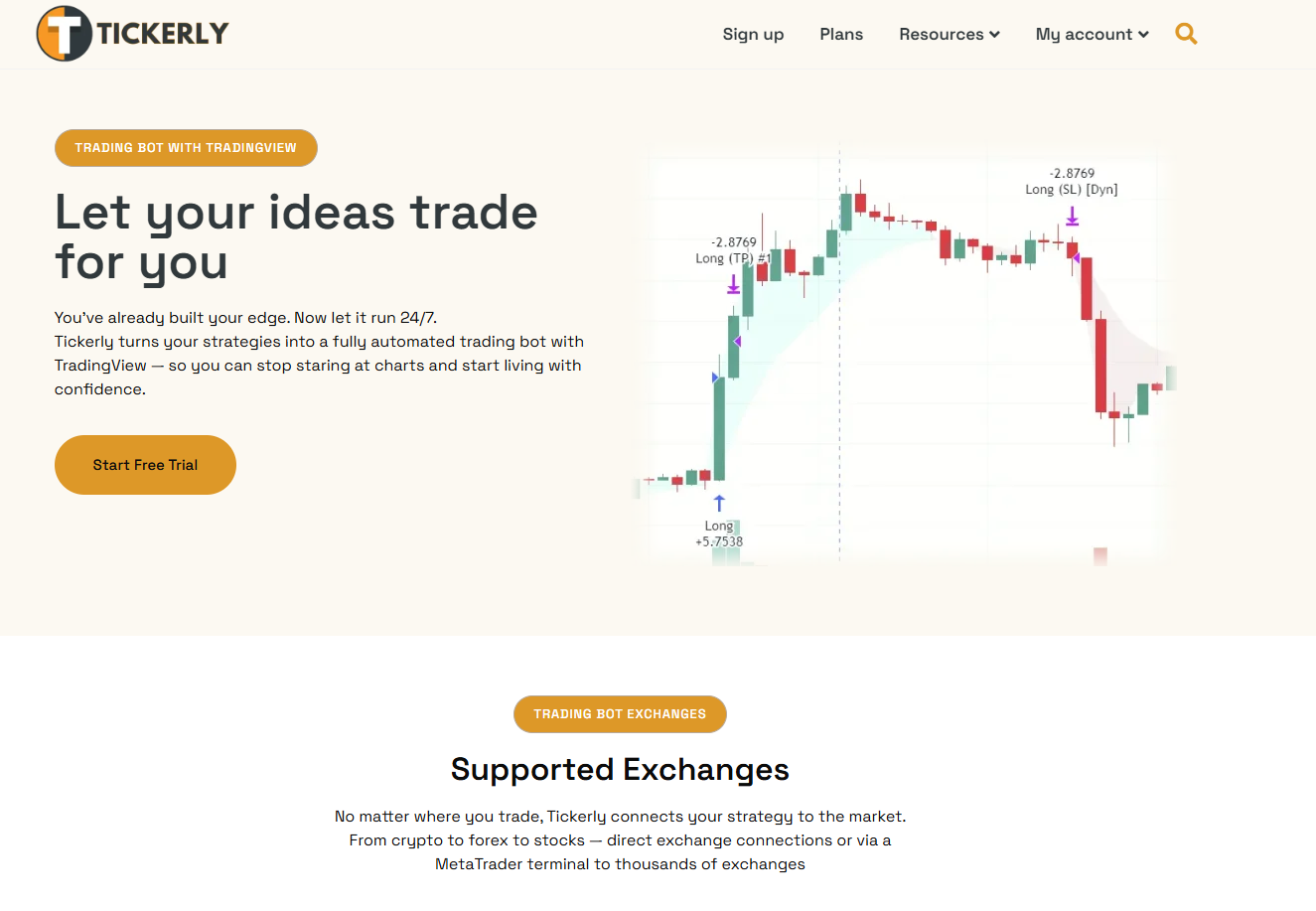
Active traders and investors who want to boost execution speed without coding can visit Guides Archives – Tickerly for detailed strategy automation resources. Begin your trading automation by connecting your TradingView account at Tickerly and increase your efficiency by automating entry and exit signals with precision.
FAQ
What features make Tickerly a strong choice for trading strategy automation?
Tickerly excels in converting TradingView alerts into automated trades across multiple asset classes. This capability allows users to efficiently route real-time alerts to execution endpoints, maintaining a focus on speed and accuracy.
How does Tickerly compare to SignalStack in terms of order execution speed?
SignalStack boasts an impressive order execution speed of under 0.45 seconds, making it ideal for traders focused on fast fills. Tickerly, on the other hand, provides low latency routing through dedicated servers, optimizing execution for multiple strategies without requiring coding.
What pricing tiers does Tickerly offer for its services?
Plans for Tickerly start at $14 per month, providing access to multiple active strategies and alerts. This tiered pricing allows traders to select a plan that fits their needs as they expand their automated trading strategies.
Can Tickerly support various asset classes beyond cryptocurrencies?
Yes, Tickerly supports automation for cryptocurrencies, stocks, forex, and futures, making it versatile for different trading preferences. Traders seeking a broad approach to automate their strategies will find this feature particularly beneficial.
How does Tickerly handle order routing to brokers?
Tickerly connects directly to brokers via API, allowing for quick execution of trading strategies without the need for coding. This integration enhances efficiency by simplifying the transition from alert to market execution.