

TL;DR:
- High-frequency trading uses algorithms and ultra-low latency systems to execute thousands of trades in microseconds. It accounts for most U.S. equity volume and relies on speed, infrastructure, and risk controls rather than prediction models. Understanding HFT principles helps traders improve execution quality and develop more effective automated strategies.
High-frequency trading (HFT) is defined as a method of automated trading that uses algorithms and ultra-low latency systems to execute thousands of trades within microseconds, capturing small price inefficiencies for profit. This guide to high-frequency trading covers everything active traders need: core strategies, required infrastructure, step-by-step setup, and the most common mistakes that cost real money. HFT accounts for approximately 50–70% of U.S. equity volume, making it the dominant force in modern market structure. Understanding how it works gives you a sharper view of price behavior, execution quality, and the mechanics behind every trade you place.
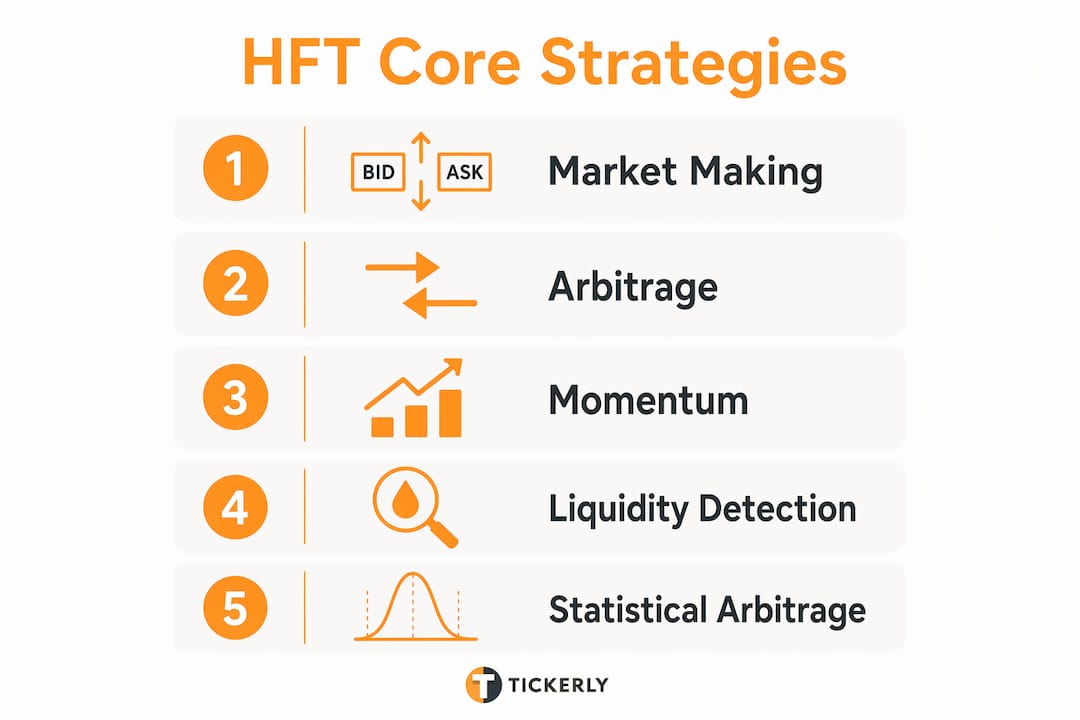
What are the core high-frequency trading strategies?
HFT is not one single approach. It is a family of distinct strategies that all share one requirement: speed measured in microseconds rather than seconds.
The four main strategies are:
-
Market making. The algorithm continuously posts both a buy and a sell order on either side of the current price. It earns the bid-ask spread on each completed round trip. Profitability depends on high volume and tight spreads, not directional prediction.
-
Latency arbitrage. The system detects a price difference for the same asset across two or more trading venues and buys on the cheaper venue while selling on the more expensive one. The window to act is typically a few microseconds.
-
Statistical arbitrage. Algorithms identify temporary price divergences between correlated instruments, such as an ETF and its underlying basket, and trade the spread back toward its historical mean.
-
Order flow prediction. The system analyzes real-time order book data to anticipate where large institutional orders will push prices and positions ahead of that move.
Key HFT strategies hold positions from microseconds to seconds, which is far shorter than any human trader can manage manually. That holding period is the defining feature separating HFT from standard algorithmic trading.
A common misconception is that HFT strategies are impenetrable black boxes driven by artificial intelligence. Most are grounded in straightforward market microstructure logic. The edge comes from execution speed, not from exotic prediction models.
Pro Tip: If you are studying HFT strategies for the first time, start with market making. It has the clearest profit logic and the most published academic research behind it.
What technology and infrastructure does HFT require?
HFT success depends on latency reduction across the tick-to-trade pipeline rather than on predictive power. That single fact shapes every infrastructure decision an HFT operation makes.
The core components are:
| Component | Purpose | Latency Impact |
|---|---|---|
| Co-located servers | Placed physically inside exchange data centers | Eliminates network travel time |
| Direct Market Access (DMA) | Connects directly to exchange matching engines | Removes broker intermediary delays |
| FPGA hardware | Executes trading logic in silicon, not software | Achieves sub-microsecond processing |
| Microwave and fiber networks | Carries data between venues at near-light speed | Reduces inter-venue latency by microseconds |
Top HFT firms implement trading logic into FPGAs rather than relying on CPU-based software, achieving tick-to-trade pipeline times below one microsecond. That is roughly 1,000 times faster than a standard software trading system running on a general-purpose server.
Direct Market Access bypasses brokers, saving critical microseconds in trade execution. Every intermediary in the order chain adds latency, and in HFT, each microsecond of delay is a competitive disadvantage.
HFT firms invest heavily in microwave and fiber networks because even a few microseconds of latency advantage can translate to millions of dollars in annual profit. The famous Chicago-to-New York microwave link, built specifically to shave milliseconds off the route between CME and NYSE, is the clearest example of this logic in practice.
For retail traders, replicating full institutional HFT infrastructure is not realistic. The capital and engineering requirements are significant. However, understanding this infrastructure helps you recognize why your own execution quality matters and where latency enters your trading workflow.
Pro Tip: You do not need FPGA hardware to benefit from low-latency execution principles. Choosing a broker with DMA and co-located order routing already puts you ahead of most retail participants.
How to start implementing a high-frequency trading system
Setting up an HFT system requires a structured approach. Skipping steps, especially in testing, is the fastest way to lose capital.
-
Assess your prerequisites. Confirm you have sufficient capital, programming skills in C++ or Python, and a clear understanding of the regulatory environment in your target market. HFT is subject to oversight from bodies like the SEC in the United States and ESMA in Europe.
-
Select and define your strategy. Choose one of the four core strategy types. Document its entry logic, exit logic, and expected holding period before writing a single line of code.
-
Build and test in simulation. Run your algorithm against historical tick data in a simulated environment. Use realistic assumptions about execution prices.
-
Set up your infrastructure. Provision co-located servers or the closest available equivalent. Establish DMA connections to your target exchanges. Configure your data feeds for real-time tick data.
-
Integrate exchange access and data feeds. Connect your algorithm to live market data via a low-latency API. Test order routing end-to-end before committing capital.
-
Deploy with strict risk controls. Set hard position limits, maximum drawdown thresholds, and automatic kill switches. A runaway algorithm without these controls can generate catastrophic losses within seconds.
-
Monitor and adjust continuously. Track execution quality, slippage, and fill rates daily. Markets change, and a strategy that worked last month may degrade without warning.
| Setup Phase | Key Action | Common Mistake |
|---|---|---|
| Strategy selection | Define logic before coding | Starting with code, not logic |
| Backtesting | Use tick-level data | Using daily OHLC data |
| Infrastructure | DMA and co-location | Routing through a standard retail broker |
| Risk controls | Set kill switches before going live | Deploying without position limits |
| Monitoring | Track slippage and fill rates daily | Checking performance only weekly |
For traders exploring automated strategy execution, the principles above apply directly. Speed, precision, and continuous monitoring are the foundation of any automated trading system, whether you are running microsecond HFT or a multi-minute algorithmic strategy.
What are the most common HFT mistakes and how do you avoid them?
Most HFT failures trace back to a small set of repeatable errors. Recognizing them early saves significant capital.
-
Assuming mid-price execution in backtests. Most naive backtests fail by assuming mid-price execution. In live markets, aggressive market orders cross the spread and immediately start at a loss. Successful HFT strategies use passive limit orders to avoid this cost.
-
Ignoring adverse selection. When your limit order gets filled, ask why. If you are consistently filled only when the market is about to move against you, your strategy is being picked off by faster participants.
-
Underestimating execution slippage. Slippage compounds across thousands of trades. A strategy that looks profitable in simulation can lose money live if slippage assumptions are even slightly off.
-
Failing to account for regulatory changes. HFT is heavily regulated. Rule changes from bodies like the SEC or MiFID II in Europe can alter the profitability of entire strategy categories overnight.
-
No kill switch. Every live HFT system needs an automatic shutdown mechanism triggered by drawdown thresholds or anomalous order rates. Without one, a software bug can empty an account in minutes.
The perceived risks of HFT, such as market crashes, are outweighed by its role in enhancing liquidity and reducing trading costs for many participants.” Interactive Brokers
That perspective matters when evaluating HFT’s reputation. The strategy class is controversial, but the data on market liquidity benefits is consistent. When HFT fees were tested in one market analysis, bid-ask spreads rose 13% market-wide and 9% for retail traders. That result shows how much of everyday trading cost HFT activity absorbs.
Maintaining continuous surveillance is non-negotiable. Build dashboards that flag anomalies in fill rates, order rejection rates, and net position in real time. React to alerts within seconds, not minutes.
Key Takeaways
High-frequency trading gives you a structural edge only when latency, strategy logic, and risk controls work together as a complete system.
| Point | Details |
|---|---|
| HFT dominates equity markets | HFT accounts for 50–70% of U.S. equity volume, shaping price behavior for all traders. |
| Speed beats prediction | Latency reduction across the tick-to-trade pipeline is the primary competitive advantage, not alpha models. |
| Passive orders protect profit | Using limit orders instead of market orders prevents spread costs from eroding strategy returns. |
| Infrastructure determines results | Co-location, DMA, and FPGA hardware are the three pillars of competitive HFT execution. |
| Risk controls are mandatory | Kill switches and drawdown limits must be in place before any live deployment. |
Tickerly and the case for automated execution
Execution speed separates profitable traders from those who consistently leave money on the table. Tickerly automates your TradingView strategies into fully functional trading bots, connecting directly to exchange platforms for real-time order execution without manual intervention.
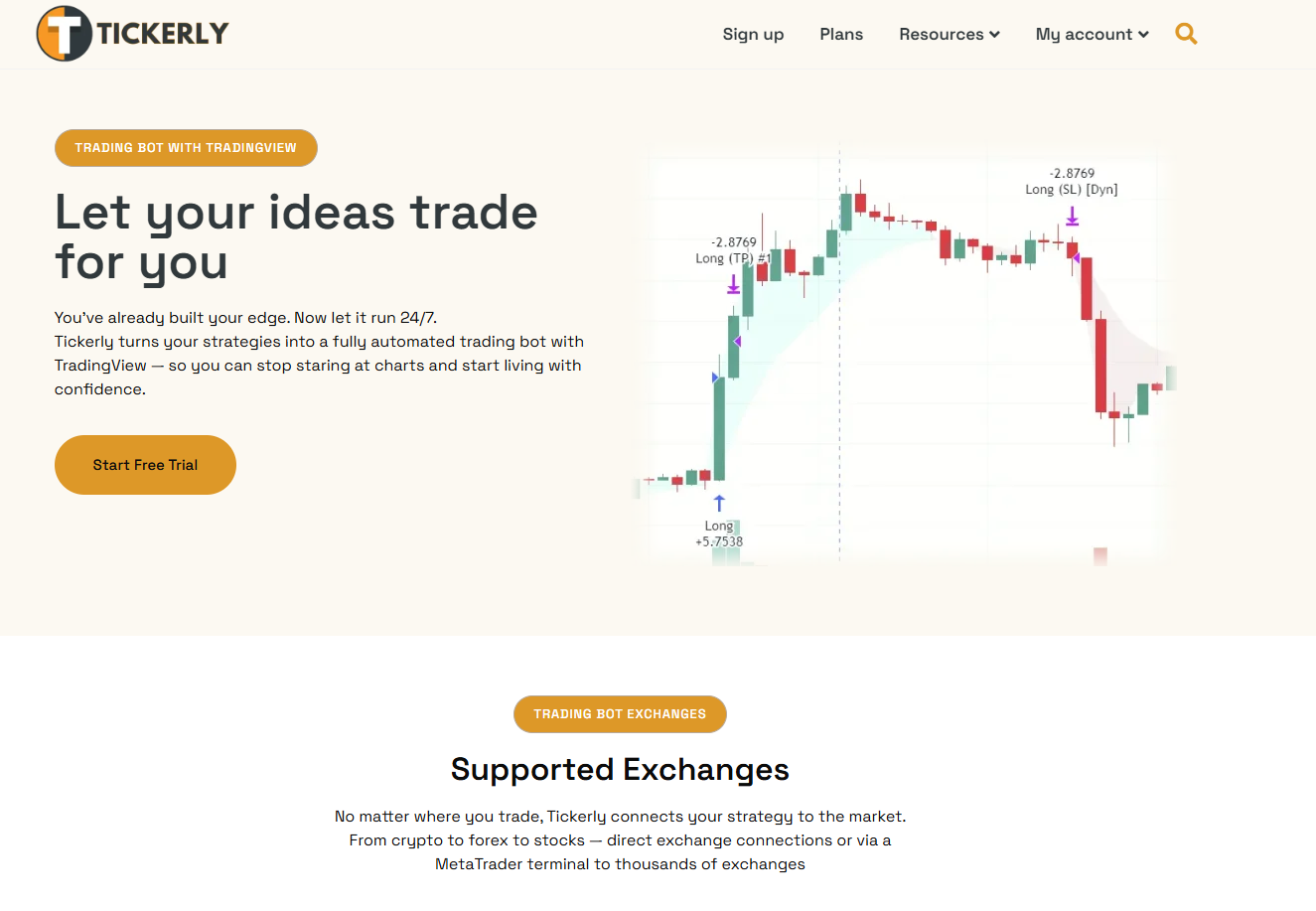
Tickerly’s automated trading bots handle multiple strategies simultaneously, so you capture opportunities across crypto, forex, and stocks without watching screens around the clock. Real-time alerts trigger execution the moment your strategy conditions are met, applying the same speed-first logic that makes HFT effective at the institutional level. If you are ready to put your strategy on autopilot, Tickerly gives you the infrastructure to do it. Explore the full range of trading strategies on Tickerly and find the setup that fits your trading style.
FAQ
What is high-frequency trading in simple terms?
High-frequency trading is automated trading that uses algorithms to execute thousands of orders within microseconds, profiting from tiny price differences across markets. It accounts for approximately 50–70% of U.S. equity trading volume.
Do retail traders benefit from HFT activity?
Yes. HFT narrows bid-ask spreads and improves market liquidity, which directly reduces transaction costs for retail traders. When HFT activity is reduced through fees, spreads rise for retail traders by measurable amounts.
What is the most important factor in HFT success?
Latency reduction is the primary driver of HFT profitability. Faster tick-to-trade pipelines, achieved through co-location, DMA, and FPGA hardware, generate the edge rather than predictive models.
Can beginners learn high-frequency trading strategies?
Beginners can study HFT strategies and apply their principles, especially passive order placement and execution speed awareness, to improve performance at any trading time frame. Full institutional HFT requires significant capital and engineering resources. A good starting point is reviewing common HFT questions to build foundational knowledge.
Why do most HFT backtests fail?
Most backtests fail because they assume execution at the mid-price. In live markets, aggressive orders cross the spread and start at an immediate loss. Successful HFT strategies use passive limit orders to avoid this cost.